

✨ TL;DR
Bookmark this page. It covers 100+ call center abbreviations and contact center solution terms across metrics, software, compliance, and customer experience, all in one easy to scan list.
The call center software market is projected to hit $39.25 billion by 2034, and more agents, managers, and CX leaders are joining the industry every day.
With that growth comes a lot of new terminology to learn.
Call center acronyms can be confusing, especially when you’re seeing them for the first time. This guide was put together for exactly that reason.
Whether you’re looking up a specific term, getting familiar with call center operations, or exploring contact center solutions, you’ll find everything you need.
Cheat Sheet: Ultimate list of call center abbreviations
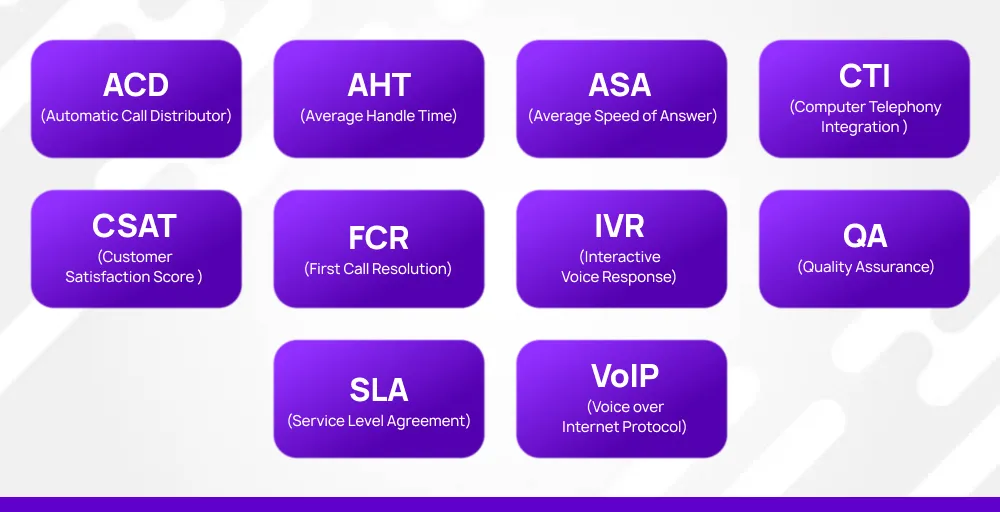
The list of famous call center abbreviations is listed in alphabetical order below:
A – Call center acronyms and terms starting with A
1. Abandonment rate
Abandonment rate is a call center metric that measures the percentage of calls disconnected by the customers before getting answers from the agent (especially in IVR or phone call menu).
When the abandonment rate is higher, it indicates long wait times for customers due to insufficient call center agents.
2. After call work (ACW)
Also referred to as Wrap-up work, ACW is the updates taken by call center agents after the hang-up of a call. Here, agents add logging call details to CRM systems and input key discussion points of the conversation.
These activities are performed during the gap between one customer call and another.
3. Application program interface (API)
An API is a set of protocols that enables two applications to communicate with each other and share data. Using APIs, it’s possible to integrate multiple communication features, such as text, voice, and video, into existing business applications.
4. Automatic call distributor (ACD)
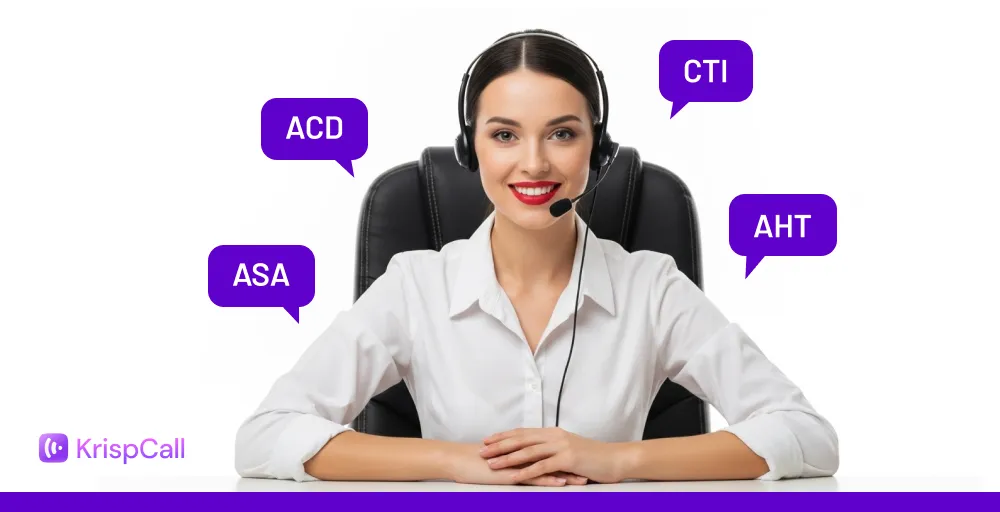
Automatic call distributor (ACD) is a telephony feature that routes the inbound calls to appropriate departments based on predefined rules. A call center already defines criteria based on agent availability, skills, and workload.
This routing system aims to enhance the efficiency of call handling and customer satisfaction.
5. Application service provider (ASP)
An ASP, also called Software as a Service (SaaS), is an organization that offers software applications for customers through the Internet. It is used in contact center solutions to access tools like CRM or workforce management solutions without the need for on-site installations.
6. Artificial intelligence (AI)
Artificial intelligence in a contact center is used to mimic human intelligence and improve performance for performing tasks like decision-making, speech recognition, and predictive analysis.
7. Automatic number identification (ANI)
ANI is a telephony feature that shows the caller’s phone number to the call center before the call is answered. In simple words, it lets the receiver of a call see the number that originated the call.
8. Average hold time
Average hold time is a metric to measure how much time a customer needs to spend beforing getting to speak with an agent. It is a key feature that shows if the customer is frustrated and reduces the risk of call abandonment.
9. Automatic speech recognition (ASR)
Automatic speech recognition (ASR) is a tool for converting spoken words into text. From this, human beings can speak with a computer interface or system like interactive voice response (IVR) and resolve issues.
10. Average handle time (AHT)
Average handle time (AHT) is the average time that an agent spends handling a customer call. It is one of the key performance indicators KPI to identify rooms for improvement and analyse the Agent’s performance.
11. Average speed of answer (ASA)
The average speed of answer refers to the time taken by an agent to answer incoming calls from the moment a caller is placed in a call queue. It is calculated by dividing the total wait time for answered calls by / total number of answered calls.
12. Average talk time (ATT)
Average talk time is the average time duration that an agent spends while actively speaking with a customer. It is a crucial key call center metric to understand how effectively and in a timely manner agents are capable of resolving issues.
13. Average time of abandonment (ATA)
Average time of abandonment (ATA) is the measurement of the average time a customer waits before hanging up the call. The higher this metric, the more likely customers are to be dissatisfied with the customer service.
14. Average wait time (AVT)
AVT is the central metric for measuring how long a customer should wait in the queue to speak with an agent. Shorter response times indicate improved customer satisfaction for the company.
15. Agent idle time (AIT)
Agent idle time is the time period when an agent is not actively engaged in any tasks. In a call center, it shows that the number of agents is more than required for customer handling.
16. Agent effort score
Agent Effort Score is a call center metric that indicates how much effort an agent is required to put in to solve a customer’s issue. It helps managers to understand the difficulty for the agents of handling interactions and improve processes if needed.
B – Call center acronyms and terms starting with B
1. Back-office management
The back-office management handles all the behind-the-scenes tasks, such as processing orders, managing data, and record-keeping.
In a call center context, back-office management often works closely with the human resources (HR) department regarding staffing requirements, training, and overall call center operations.
2. Best-in-class (BIC)
Best-in-class (BIC) is the term used by management to refer to the high standard or preferred solution in a particular area. It denotes the top-performing systems, strategies, and teams.
3. Business continuity/disaster recovery (BC/DR)
Business continuity and disaster recovery (BC/DR) are the plans to continue the contact center operations even after some technical failures or adverse events. It is like a backup plan for recovering the protocols and minimizing call center downtime.
4. Business continuity planning (BCP)
BCP is the process by which the cloud contact center creates a BC/DR plan. This plan includes the continuity of business even in the face of potential threats, assessed vulnerabilities, and other unexpected issues.
5. Business intelligence (BI)
Business intelligence (BI) is the use of features like analytics, data mining, data tools, and data visualization to gain insights into call center performance and make necessary improvements.
6. Business process outsourcing (BPO)
Business process outsourcing (BPO) is the practice of outsourcing some part of the business operations to a third-party service provider. It helps companies reduce costs by avoiding high expenses on hiring and training in-house teams.
C – Call center acronyms and terms starting with C
1. Call abandonment rate
The call abandonment rate is the same as the abandonment rate. It is the percentage of inbound call percentage that customers abandon before speaking to an agent. To measure it, you need to divide the abandoned calls by the total number of inbound calls.
2. Callback
Callback is a feature that allows customers to request a call schedule instead of waiting on hold. This feature is enabled when the call center experiences high call volume and long wait times.
3. Call center management
Call center management is the process of how businesses manage their daily operations, proper staffing, monitoring, and implementing strategies for improvement.
4. Call detail record (CDR)
A call detail record (CDR) is a data record that stores all key information about each call made and received. Details include the caller’s name, phone number, duration of time, and sometimes even the call recordings.
5. Caller entered digits (CED)
Every digit entered by the caller using telephone keypads refers to the caller-entered digits (CED). It is often used to respond to prompts from automated systems such as Interactive Voice Response (IVR).
6. Calling line identity (CLI)
Calling line identity (CLI) is the caller ID of the caller. In the inbound calls, it allows agents to identify the caller’s number and name.
7. Call management system (CMS)
A call management system (CMS) is software that can handle call routing, reporting, and monitoring with reports in a call center. It helps to receive a large volume of telephone calls.
8. Contact Center as a Service (CCaaS)
Contact Center as a Service (CCaaS) is a cloud-based solution that offers the technologies for contact center infrastructure management via the Internet. With this, companies avoid the cost of getting expensive hardware.
9. Computer telephony integration (CTI)
Computer telephony integration (CTI) links the call centers with the computer systems to handle a large number of incoming calls. This integration allows agents to access customer details on their screens.
10. Customer-controlled routing (CCR)
The primary objective of customer-controlled routing (CCR) is to improve the customer experience by allowing customers to select specific agents via an IVR system.
11. Customer experience (CX)
Customer experience (CX) is the image and perspective a customer has of a brand. It is based on their prior experiences with the company’s products, services, and agents.
12. Customer experience management (CEM)
CEM is the practice of improving customer interactions by responding in ways that meet their expectations. Proper customer experience management leads to higher customer satisfaction.
13. Customer information system (CIS)
Everything related to a customer’s details, let’s say a database of all customer data, is stored in the customer information system (CIS). It contains customers’ addresses, billing details, and account history, etc.
14. Customer relationship management (CRM)
Customer relationship management (CRM) is a tool to help call centers in managing customer data, tracking interaction histories, and identifying preferences. CRM is vital for personalizing the call center experience and smoothing the workflow.
15. Customer satisfaction (CSAT)
Customer satisfaction (CSAT) is a score that indicates how satisfied customers are with the company’s products or services. It is usually done by collecting CSAT scores from various surveys and forms.
The higher this metric, the better the company’s image towards its customers.
16. Customer sentiment
Customer sentiment is the customers’ emotions for the brand based on their overall interactions with the company. It is calculated through a customer sentiment analysis process.
Often, when a customer engages and leaves a review on an online platform such as social media, it is considered that the customer has positive sentiment toward the company.
17. Customer service agent (CSA)
Customer service agents (CSAs) are the regular call center representatives who help customers solve problems and provide information on behalf of the company.
18. Customer Service Representative (CSR).
A customer service representative (CSR) is another term for an agent who interacts with customers. They handle the tasks in the call center, such as processing orders and giving information about the company’s products and services.
19. Customer Retention Rate (CRR)
Customer retention rate (CRR) is the percentage of customers a company retains over a given period. It is calculated by dividing the number of new customers at the end of the period by the number of customers at the beginning.
20. Conversion Rate Optimization (CRO)
Conversion Rate Optimization (CRO) is the process of improving your business campaigns for getting more people to take actions such as signing up, making a purchase, and booking a demo. I help turn more leads into actual customers.
21. Click Through Rate
Click-Through Rate (CTR) is the percentage of people who click on a link, ad, or button after seeing it. It helps measure how effective a message or campaign is at getting people to take action.
D – Call center acronyms and terms starting with D
1. Dashboard
A call center dashboard is a visual user interface that displays all the important KPIs like agent performance, call volume, and customer satisfaction in real time. It contains charts, graphs, and gauges to make the data easier to grasp.
2. Deep learning (DL)
Deep learning is a subset of machine learning that uses neural networks for data analysis and prediction. It powers advanced tools such as Speech recognition and sentiment analysis.
3. Deep learning techniques (DLT)
Deep learning techniques (DLT) refer to advanced methods within machine learning that use neural networks with multiple layers to analyze and process complex data. Examples include LSTM and RNNs, which help AI understand voice, text, and behaviour patterns.
4. Dialled number identification service (DNIS)
Dialled number identification service (DNIS) identifies the number that the customer dialled to reach the call centre. It helps you to route the call to the appropriate department or services.
5. Dialer
A dialer software for a call center is a system or an application that automates the outgoing calling for numbers and delivers them to the agents. There are different types of dialers: predictive, preview, and power dialers.
6. Direct inward dialing (DID)
Customers can directly reach out to a specific department by dialing a dedicated phone number. DIDs reduce wait times in the IVR menu, enabling customers to be routed to specialists more quickly and leading to better customer service.
7. Digital subscriber line (DSL)
A digital subscriber line (DSL) is a high-speed internet connection that uses existing telephone lines to support reliable communications such as video, audio, and multimedia.
8. Document management system (DMS)
A document management system (DMS) manages, stores, organizes, and retrieves documents electronically. It reduces paper usage and enhances the convenience of the company’s access to records.
9. Dollars per call (DPC)
Dollars per call (DPC) is a metric that can measure the average revenue generated from each inbound and outbound call.
E – Call center acronyms and terms starting with E
1. Email response management system (ERMS)
An email response management system (ERMS) is a contact center software that can handle email messages automatically based on user-defined rules.
2. Employee engagement
Employee engagement refers to when employees are actively engaging in their work, and it directly relates to employees’ motivation, performance, retention, and customer experience.
3. Employee satisfaction (ESAT)
Similar to customer satisfaction, Employee satisfaction (ESAT) is a metric to measure how happy employees are in their work environment, or the job overall. High employee satisfaction is linked with increased productivity and positive work culture.
4. Enterprise application integration (EAI)
EAI is the use of different contact center software and computer systems to share data and smooth the exchange of interactions between tools like CRM and telephony systems.
5. Enterprise resource planning (ERP)
Enterprise resource planning (ERP) is a unified management system that integrates business processes like finance, HR, and customer management.
6. Expected wait time (EWT)
Expected wait time is the estimated time for a caller to wait before speaking to an agent. EWT is shared with the callers after they place calls to inform them regarding call handling delays.
7. End of life (EOL)
End of Life (EOL) means a product or software that is no longer supported or updated by the company. In call centers, using EOL tools can lead to security risks, system issues, and a lack of new features, so it’s important to upgrade in time.
F – Call center acronyms and terms starting with F
1. First call resolution (FCR)
First call resolution (FCR) is the ability to resolve the customer’s problem on the first call without the need for follow-ups. Improving the FCR rate reduces operational costs and increases customer satisfaction with the brand.
2. First call resolution rate (FCRR)
The measurement of first-call resolution is known as the first-call resolution rate (FCRR). It is a popular metric that’s calculated by dividing the number of resolved problems at first calls by the total number of calls.
3. Forecasting
Forecasting in the call center predicts the possible future call volumes (calls or any other contacts) and how many staff are required to handle them by analyzing historical data.
4. Full-time equivalent (FTE)
Full-time equivalent (FTE) is the number of full-time employees, or a combination of part-time employees, required to handle the workload in the call center. With this, it helps call centers manage the staff requirements.
5. First response time (FRT)
First response time is the period of time that it takes for a customer to get the initial reply after reaching out for assistance. With the first response time, the call center provides better customer service.
G – Call center acronyms and terms starting with G
1. Generative pre-trained transformer (GPT)
GPT is an artificial intelligence model that generates human-like text for handling tasks like text generation, translations, and solving queries using machine learning.
2. Grade of service (GOS)
A metric that measures the percentage of customer interactions or calls answered in a given time duration is the grade of service (GOS). It finds the required staff for better performance management with exceptional customer service.
I – Call center acronyms and terms starting with I
1. Inbound call
An inbound call, also known as an incoming call, is a call initiated by customers or prospects to your business to seek information, customer service, complaints, support, billing problems, or order assistance.
2. Intelligent network service (INS)
Intelligent network service (INS) is a telecommunication feature that routes calls to different destinations within the network based on pre-defined rules.
3. Integrated Services Digital Network (ISDN)
Integrated Services Digital Network (ISDN) is a telephone network system that transmits voice, video, and other network services over the existing telephone network.
4. Interactive voice response (IVR)
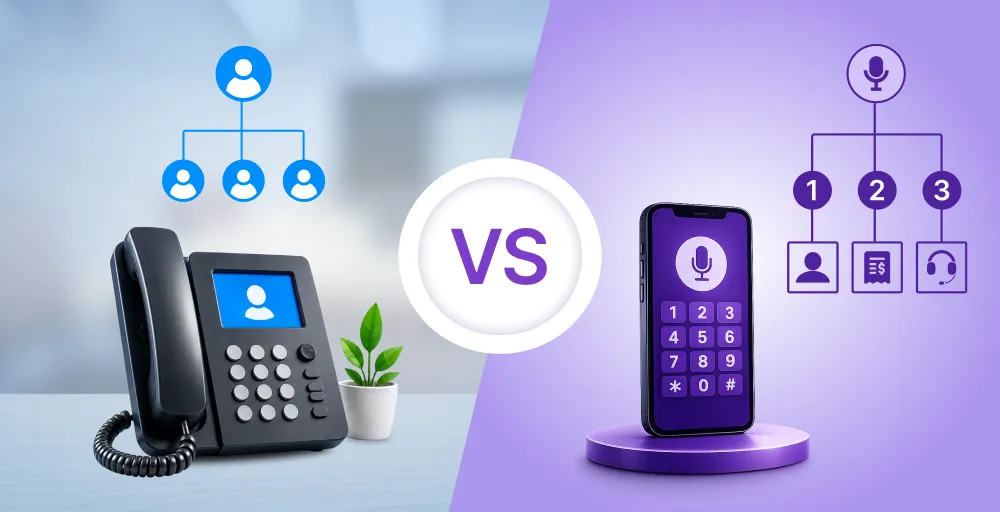
Interactive voice response (IVR) is an automated telephony menu that assists callers with voice prompts and keypad inputs and helps to route calls to the appropriate department/agent.
5. Interexchange carrier (IXC)
An interexchange carrier (IXC) is a telecommunications company that provides long-distance services between different local exchange areas. It handles call routing across different regions, states, and countries. Examples are AT&T and Verizon.
6. Internet service provider (ISP)
An internet service provider (ISP) is the term used in the industry to refer to a service provider that offers you access to the internet.
K – Call center acronyms and terms starting with K
1. Key performance indicator (KPI)
A key performance indicator (KPI) is the measurable value that shows how effectively a call center is achieving success in multiple factors. Some common KPIs include average handle time, customer satisfaction score, and first call resolution.
2. Knowledge base
It’s a collection of documentation with all the commonly asked questions & answers. Typically, how-to guides and helpdesk content are published to help customer troubleshoot their issues by themselves.
3. Knowledge management
Knowledge management is the process by which the contact center creates, shares, uses, and manages the organization’s information and knowledge.
L – Call center acronyms and terms starting with L
1. Large language models (LLM)
Large language models (LLMs) are artificial intelligence models that have the ability to understand human language and provide outputs. They perform tasks such as generating text, answering queries, conducting sentiment analysis, and summarization, among others.
2. Least occupied agent (LOA)
In the contact center, the term “least occupied agent (LOA)” means the agent with the lowest or fewest calls at a particular time. This metric shows which agent is available at the moment for additional calls or new tasks.
3. Lifetime customer value (LCV)
Lifetime customer value (LCV) is the value provided by an individual customer over the lifetime as a client of the company or brand.
4. Local area network (LAN)
A local area network (LAN) is a computer network associated with specific areas. It interconnects the customers to its area, such as schools, university campuses, laboratories, or any other buildings.
M – Call center acronyms and terms starting with M
1. Machine Learning (ML)
Machine learning is a form of artificial intelligence that uses algorithms for the analysis of data, learns from it, predicts outcomes, and makes decisions based on the learning.
2. Most idle agent (MIA)
When a customer makes the call, the most available and free agents to take calls are the most idle agents.
3. Multichannel contact center
The multichannel contact center is a solution that integrates different social media, channels, or touchpoints, with voice, text, and other features.
4. Multimedia routing (MMR)
Multimedia routing (MMR) is a method that manages and directs customer interactions from channels like email, SMS, video, and chat with a unified routing strategy.
N – Call center acronyms and terms starting with N
1. Natural language processing (NLP)
Natural language processing (NLP) is a form of artificial intelligence that lets humans understand, interpret, and interact with computers using conversational speech.
2. Natural language speech recognition (NLSR)
NLSR stands for Natural Language Speech Recognition (NLSR). With this ability, call centers can transcribe conversations, recognize and interpret words, and improve service efficiency.
3. Natural language understanding (NLU)
Natural language understanding (NLU) is the part of NLP that focuses on understanding the meaning of words and phrases. It helps call center tools understand customer intent and reply correctly through their chatbots.
4. Net promoter score (NPS)
The NPS (Net Promoter Score) measures customer loyalty by asking how likely they are to recommend a company to their friends or colleagues. It provides an overview of customer satisfaction levels and identifies areas for improvement.
5. Network service provider (NS)
A network service provider ( NSP) is an internet or telecommunication service provider that sells bandwidth or network access to ISPs.
O – Call center acronyms and terms starting with
1. Off-phone activity (OPA)
Off-phone activity (OPA) is any of the tasks (training, meetings, or administration) that a call center completes without the use of a phone. For example, writing emails, attending training, and updating records.
2. On-the-job training (OJT)
On-the-job training (OJT) is a training method to increase the skills of business-paid employees. In call centers, it helps agents gain the necessary skills for improving productivity at work.
3. Omnichannel contact center
An omnichannel contact center helps customers connect with businesses through multiple channels, including calls, emails, and social media. For this, it makes a consistent experience across all touchpoints.
4. Open system interconnector (OSI)
The Open Systems Interconnection (OSI) is a networking model that allows communication between computers. It makes understanding and managing the communication of different systems easier.
5. Operations, administration, and maintenance (OAM)
Operations, administration, and maintenance (OAM) are the processes and tools used to monitor, manage, and maintain a call center system.
P – Call center acronyms and terms starting with P

1. Post-call processing (PCP)
Post-call processing (PCP) is the time period spent between two successive calls. In simple words, it is what agents do after a call. It might be updating information, logging details, and scheduling follow-ups.
2. Predictive dialer
A predictive dialer is an automated dialing system that dials a large number of phone numbers at once based on predefined call lists and connects to available agents.
3. Private automatic branch exchange (PABX)
A private automatic branch exchange (PABX) is a private telephone system for managing inbound and outbound calls. With this, agents route calls automatically without the need for a manual operator.
4. Private branch exchange (PBX)
PBX stands for private branch exchange, a telephone system that connects office extensions to outside lines. It offers features like call transferring, conferencing, and voicemail to help businesses manage communication efficiently.
5. Public switched telephone network (PSTN)
A public switched telephone network (PSTN) is a global network that regional, national, and local telephony operators operate. It uses telephone lines, cellular networks, and communication satellites, and understands telephone cables, which allows most telephones to communicate with each other.
Q – Call center acronyms and terms starting with Q
1. Quality assurance (QA)
Quality assurance (QA) is the measurement of all the agents’ performance to determine if the service level meets the expectations of the customer. All the customer data is gathered and used for improvements to processes and a positive customer experience.
2. Quality monitoring (QM)
Quality monitoring (QM) is a technology that a call center uses to evaluate and analyze agent-customer interactions.
3. Quality of service (QoS)
Quality of service (QoS) refers to the overall quality of customer service provided by a call center. It measures the network’s performance, clarity of calls, and the stability of connections.
High quality of service indicates that interactions with customers are well-managed and professional.
4. Queue
A queue is the virtual line of customer calls or messages waiting to be answered by agents. Effective queue management minimizes customer waiting time and improves their experience.
R – Call center acronyms and terms starting with R
1. Real-time adherence (RTA)
RTA is a cloud-based software that monitors agent activity in real time and ensures agents are following their schedules. It enables call centers to maintain high productivity and meet service-level agreements.
2. Reinforcement learning from human feedback (RLHF)
RLHF is a machine-learning technique that refines its performance through constant human feedback and guidance. It’s used to improve AI responses in real-world tasks such as customer support or chatbots.
3. Request for information (RFI)
A request for information (RFI) is a document sent to vendors to gather information about their products or services. Call centers use it to explore potential solutions before making a decision.
4. Request for proposal (RFP)
RFP is a formal document that outlines any product or service requirement. Vendors often submit proposals based on an RFP to help the call center choose the appropriate one.
5. Ring no answer (RNA)
RNA refers to calls that ring without being answered by an agent. Monitoring RNA helps call centers identify inefficiencies and improve response times.
6. Return on investment (ROI)
Return on investment (ROI) is the major metric to calculate the financial gain or loss after an investment. The ROI indicates whether the call center is profitable with the given investment.
S – Call center acronyms and terms starting with S
1. Salesforce automation (SFA)
Salesforce automation is a contact center software that helps you automate your sales tasks like managing leads, tracking interactions, and generating reports to boost overall efficiency.
2. Schedule adherence
Schedule adherence shows how closely agents can follow and complete their assigned work schedules. It helps call centers understand the number of staff available to meet the target or goals.
3. Self-service rate
The self-service rate indicates how many customer issues are solved within self-service channels, such as FAQs, IVR systems, or chatbots.
4. Sentiment analysis
Sentiment analysis uses AI to analyze the emotional tone of customer interactions, providing insights for call centers to gauge customer sentiment.
5. Service level (SL)
Service level is a metric that reflects the percentage of calls answered in a specific time frame, indicating call center performance.
6. Service level agreement (SLA)
SLA is the contract that defines the specific service quality expectations between the call center and customers. It includes metrics such as ASA, FCRR, and even imposes consequences for not meeting these expectations.
7. Session initiation protocol (SIP)
Session Initiation Protocol (SIP) is a communication protocol that is used to start, manage, and end conversations (voice, video) over the Internet. It’s an important part of VoIP systems in call centers.
8. Shrinkage
Shrinkage is the time agents spend on things not directly related to calls, like breaks, training, or meetings.
9. Skill-based routing (SBR)
Distributing incoming calls to agents with the most appropriate skills to handle the unique needs of certain customers, which is what skill-based routing does.
10. Software as a service (SaaS)
SaaS Software as a service, a cloud-based software delivery model that allows organizations to use applications over the internet without having to install them locally.
11. Speech analytics (SA)
Speech analytics is the analysis of recorded or live calls to customers, including insights about customer needs, agent performance, emerging trends, etc.
T – Call center acronyms and terms starting with T
1. Telephony applications programming interface (TAPI)
Telephone Application Programming Interface (TAPI) is a tool that provides computer telephony integration and connects telephony devices with computers to handle calls.
2. Text to speech (TTS)
Text-to-speech (TTS) is a technology that allows you to convert written text into a spoken version for better communication between multiple people.
3. Total cost of ownership (TCO)
Total cost of ownership (TCO) is a term that describes the overall costs associated with owning and running a system. It includes the purchase of any system, hardware, software, asset, or operating costs till the asset’s lifespan.
U – Call center acronyms and terms starting with U
1. Unified Communications (UC)
Unified communications (UC) is a combination of communications such as instant messaging, voice, web, audio & video conferencing with other non-real-time services ( integrated voicemail, email, and SMS).
2. Uniform Call Distributor (UCD)
A uniform call distributor (UCD) is a system responsible for routing incoming calls to available agents through the rotation of lines instead of starting with the first agent or line in the team.
3. Unsupervised learning
Unsupervised learning is a type of machine learning that trains AI models on unlabeled data to discover structures and patterns.
4. Unified Interface.
An unified interface is a single dashboard which is visible and accessible by all the agents. This includes all customer details, conversations and tools required for the daily operations.
V – Call center acronyms and terms starting with V
1. Virtual agent
A Virtual Agent is an AI-oriented customer assistant that guides customers through troubleshooting issues and answers questions through a conversational experience.
2. Virtual Assistant
A Virtual Assistant is a software-based system that is powered by machine learning and artificial intelligence for human-type interactions. Both text-based and voice-based virtual assistants provide support to customers by answering queries.
3. Virtual private network (VPN)
A virtual private network (VPN) is a secure internet connection that provides a private network across a public network. It encrypts data and masks the user’s IP address to protect online activities. This helps users better understand how does a VPN work in maintaining online privacy.
4. Voice biometrics authentication
Voice Biometrics Authentication is a security technique that grants authorization to people based on their unique voice tone.
5. Voicebot
A voicebot is software powered by AI that helps a caller navigate an IVR system with their voice. With this, callers avoid listening to menus and pressing numbers; instead, they directly speak to the IVR.
6. Voice of the customer (VOC)
Voice of the customer (VOC) is a process for collecting customer feedback, analyzing, capturing, and understanding customer expectations and preferences in order to enhance service and meet expectations.
7. Voice over Internet Protocol (VoIP)
Voice over Internet Protocol (VoIP) is a technology that can establish communication services through the Internet Protocol (IP) networks.
8. Voice response unit (VRU)
A voice response unit (VRU) is an automated system that consists of software and hardware that allows the caller to navigate through the pre-recorded messages and use the menu via voice recognition or buttons.
W – Call center acronyms and terms starting with W
1. Wide area network (WAN)
A wide area network (WAN) is a telecommunication network that connects devices from a huge geographic area to connect computers and establish networks.
2. Workforce management (WFM)
Workforce management (WFM) is the whole process that aims to maximize performance levels and competency for the organization. It involves activities for the productive workforce, such as hr management, training, data collection, accounting, recruiting, forecasting, and analytics.
3. Workforce optimization (WFO)
Workforce optimization (WFO) is a strategy used by call centers to improve workforce management. It is oriented toward the performance of the employee and the effectiveness of the entire operation and involves data visibility, automating processes, and solving the staffing problem of the business.
Track everything with KrispCall contact center solution
The various call center abbreviations, starting from A to W, show the complexity and innovation of the industry. All these terms are meaningful and define specific workflows, metrics, and technologies to deliver great customer service.


If you want a call center solution that includes most of these features in a unified place, KrispCall is a good choice. We help your teams work better, stay organized, and effectively interact with your customers, providing 24/7 human support when they need it.
Explore KrispCall features with a quick demo and see how it can improve your business interactions.