


Have you lost a strong lead just because you could not handle the channels smoothly?
Multiple phone calls, emails, chats, and social media in a single channel create chaos and often lead to missed messages, stressed agents, and frustrated customers.
That’s where a multichannel contact center platform can be a perfect attendee. It provides individual channels for each customer interaction, so you can handle everything smoothly.
Let’s discuss what a multichannel contact center is, its benefits to the business, how to set it up, and which provider is reliable for handling all the pain points at once.
✨ Key Takeaways
- A multichannel contact center is a contact center software solution that supports multiple communication channels like voice calls, emails, chat, social media, and SMS.
- Using a multichannel contact center, you get personalized interactions, a unified view of customer interaction, can target market sales, and increase customer loyalty.
- To set up a multichannel contact center, identify business goals and customer preferences, choose the right platform, train agents, and set up a standard workflow.
What is a multichannel contact center?
A multichannel contact center is a type of customer service hub that uses multiple communication channels, such as phone support, email, social media, sms, website chats, and video conferencing, to interact with customers.
A multichannel call center offers channel-specific metrics for customer experiences, so that they can choose the one that best suits their needs.
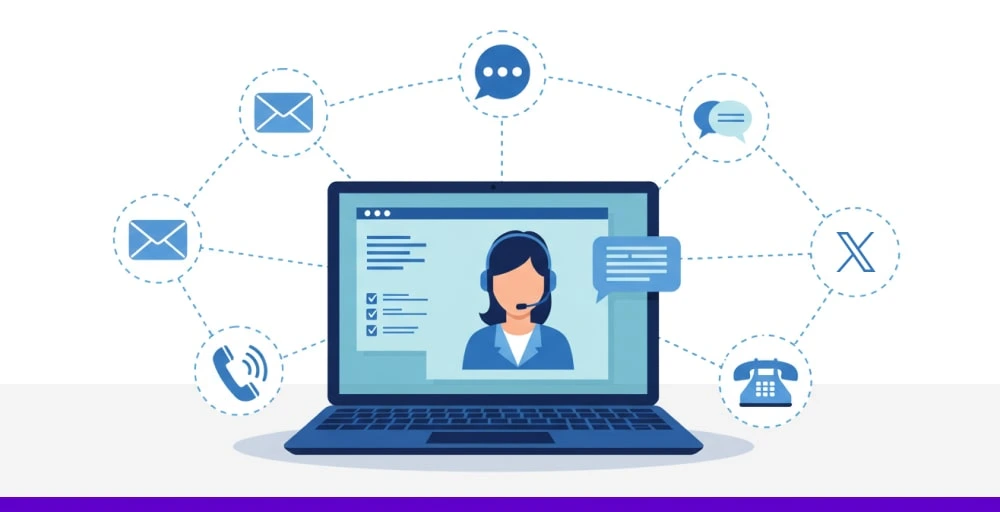
Unlike traditional lines, multichannel offers advanced features to handle each channel individually while maintaining the quality and responsiveness to that platform. This means each inbound and outbound interaction is managed efficiently without mixing up conversations or losing important details.
In short, a multichannel contact center solution transforms fragmented communication into a seamless experience to boost loyalty, responsiveness, and brand trust.
Channels & features of multichannel contact center
You should consider these must-have features while selecting a multichannel contact center metric for your business needs:
1. Voice: The voice call is the core feature of multichannel. It comes with features like automatic call distribution and IVR( Interactive Voice Response) as self-service tools.
2. Email: Email management handles customer inquiries and tracks comprehensive customer data.
3. Web chat: It allows real-time communication with customers via web applications or messaging platforms.
4. Social media: Social media messaging apps like Facebook, WhatsApp, and Instagram are used in a multichannel approach to enhance flexibility and offer a more personalized experience to customers.
5. SMS/MMS: It is a traditional means of communication, yet effective for quick communication during crises or when the internet is unavailable due to server waiting time..
6. Video meetings: Video meetings are effective during personalized and complex interactions.
7. Agent multi-channel dashboard: It is a unified interface for agents to handle multiple channels simultaneously with a complete view of customer behavior.
8. AI and automation: AI-powered bots and virtual assistants can handle the routine tasks, whereas automation helps to keep the tasks up-to-date.
9. Integration with third-party apps: Integration with CRM and helpdesk platforms for agents to view customer history and context in real estate. It can eliminate the back-and-forth so that agents can resolve issues faster and with a personal touch.
Benefits of multichannel contact center
Multichannel benefits the VoIP phone system in many ways using the Internet protocol. Let’s discuss some of the key benefits of a multichannel communication platform to best suit the customer’s needs:
1. Choice of preferred method
With a multichannel contact center software solution, customers can choose the preferred channel, which can improve overall productivity.
This choice can lead to improved customer satisfaction with positive feedback.
2. Personalized interaction
Customers feel valued and receive personalized care while interacting through the preferred channel, which can positively impact the business’s sales.
3. Unified view of customer interaction
Multichannel provides comprehensive insights into customer interaction across multiple channels.
Although it does not allow the channel switch, it overcomes the issues of a single channel by providing multiple channel options.
4. Targeted marketing sales
When the target audience is captured by multiple touchpoints, businesses can easily notice the pattern of increased customer engagement much like analyzing customer journeys in a web development process, and create targeted ads for the essential channels that are likely to have more personalization opportunities
5. Increased customer loyalty
When the customer can enjoy the flexibility of a multichannel call center security, they are likely to engage more and stay loyal to one brand.
This increases the brand value of the business.
How to set up a multichannel contact center?
To set up the multichannel contact centers channels becomes easier when you have clear guidance and preferred use of the internet protocol.
Here is a step-by-step process that you can follow to set it up.
1. Understand customer preferences and business goals
Before initiating the setup, you must understand the clear specifications and business requirements of your business. You can start by identifying which communication channel matters the most and which one has the highest engagement. You can do this with a online survey or based on the interaction history.
Now, assess the capacity of your team and business goals to ensure the channels you offer align with both customer expectations and your service objectives.
2. Choose the right multichannel platform
Choose a cloud contact center that supports all the channels your customers use. Look for a system that offers a unified agent interface, CRM integration, real-time analytics, and automation tools.
The platform should be easy to use and allow switching between channels to maintain context across interactions and scale as your business grows.
3. Train agents across all supported channels
Your agents must be interactive and responsive across all the channels you offer. If not, you can provide customer training to help them manage interactions effectively in the right department.
This training includes using the platform’s features, understanding the tone and expectations unique to each channel (e.g., faster replies on chat and detailed responses via email), and navigation of integrated tools such as knowledge bases or customer records.
4. Set up workflows and standard guidelines
Develop clear standard operating procedures (SOPs) for handling customer interactions across channels. Define escalation paths, resolution timeframes, and protocols for customer data privacy.
Additionally, make sure that your system tracks key performance metrics, such as response time, channel usage, and customer satisfaction, so you can continuously improve service delivery.
Single channel vs Multi-channel vs Omni-channel contact centers
Here’s a quick comparison between single-channel, multichannel, and omnichannel contact centers.
| Single Channel Contact Center | Multichannel Contact Center | Omnichannel Contact Center |
| Uses only one customer communication channel (like email or phone support) | Supports various channels (video calls, email, chat, social media platforms), but they’re separate | All omnichannel solutions are integrated for a smooth experience |
| The customer has only one option to reach you | Customers can choose how they want to connect | Customers can switch channels without repeating the same information |
| Contact center agents use one tool, focused on one type of interaction | Agents juggle between tools, with no shared context | Human agents work from a unified dashboard with full conversation history |
| Simple to manage, but lacks flexibility | Offers flexibility but can get messy without coordination | Streamlined, efficient, and highly personalized partner portal |
| Best for very small teams with minimal customer queries | Good for growing businesses needing a multi-platform presence | Ideal for customer-centric businesses aiming for consistent communication |
| Offers a pay-as-you-go model. | Cost ranges from $100 to $500 per month, depending on the features and implementation needs. | Typically more expensive, starting around $500/month, but it offers higher ROI through an improved customer journey. |
Streamline customer conversations with KrispCall’s multichannel contact center!
Managing multiple customer conversations via multiple dashboards can be a little frustrating, but with KrispCall’s multichannel contact center, you can access features like phone, SMS, MMS, power dialer, live chat, and voicemail in a single, unified platform.
With it, you get to take a competitive advantage of powerful options like Interactive Voice Response (IVR), real-time call monitoring, call recording, and call analytics. Furthermore, KrispCall provides virtual numbers from over 100 countries, CRM integrations, and AI-powered tools for auto-suggestions and call transcriptions. It empowers your business to deliver faster, more personalized service, regardless of your team’s location.
Step up to a smarter and more efficient call center solution that drives faster results in the digital revolution.
Contact us today and book a free demo to see how KrispCall can enhance your contact center strategy.