Call Center ROI Calculator
ROI Calculator
Contact Center ROI Calculator – Measure Savings & Performance
Discover how much your team could save with KrispCall - calculate ROI in seconds.
Krispcall AI could give you a total cost savings of:
per month
Details:
|
Monthly Labor Cost Savings |
$5,280 |
|
|
Monthly System Savings |
$37,820 |
|
|
Additional Calls Handled Per Month |
29,333 |
|
What is a contact center ROI calculator?
A contact center ROI calculator is a tool that helps you measure the financial and operational impact of your contact center. It estimates return by comparing benefits like cost savings, efficiency improvements, increased customer satisfaction against your total investment in staff, technology, and processes.
These contact center ROI calculators help businesses forecast potential cost saving and revenue gains, providing a data-driven business case to justify the investment to stakeholders.
How to Calculate Contact Center ROI?
In the world of contact center, return of investment (ROI) isn’t just about boosting revenue. It may also cover operational gains like fewer repeat calls, reducing churn, faster ticket handling and many more.
The formula to calculate contact center roi is simple:
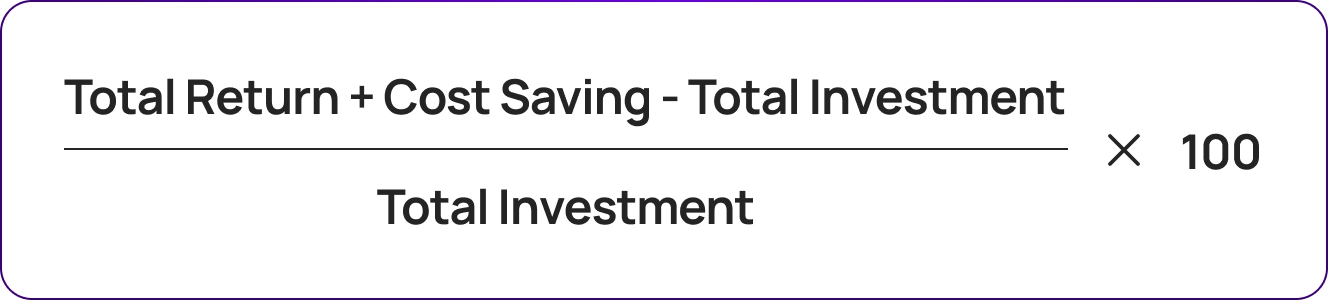
Using this formula, you can determine the full value of your investment – whether introducing a new dialer system, training staff, implementing CRM/helpdesk software, or implementing new automation.
An example to measure contact center ROI::
A mid-sized SaaS company invested $40,000 in KrispCall to streamline their support operation. Over the year, they earned $20,000 as an extra revenue and saved $35,000 in operational cost through improved call routing and automation follow ups.
That’s a $15,000 net profit and about $1.38 return for every $1 spent, resulting in a 38% ROI.
How KrispCall Contact Center Drive ROI?

Automate Repeated Work
Help Agents Work Faster
Lower Costs
Keep Customer Happy
Use Data to Improve
Grow Easily
Maximize ROI using Erlang based Contact Center Calculator
What is contact center ROI?
Contact center ROI (Return on Investment) measures the financial return a company receives from its investment in a contact center. It quantifies whether the financial gains from the contact center like increased revenue & saving, to the cost of running it, such as technology, salaries, and operations.
In a simple terms, it tells you that:
“For every dollar I save in my bank account, how much will I get back?”
This shows how ROI acts as a performance guide, helping you see whether your investment in the contact center is delivering measurable value or just going in a circle.
What does an Erlang calculator mean?
An Erlang calculator is a tool that helps call centers determine the ideal number of agents and telephone lines needed to manage incoming calls efficiently. It ensures you are staffed just right—enough to handle peak call volumes without long wait times, but not so many that agents are left idle during slow hours.
It considers key factors such as average handling time, call volume, and desired service levels (for example, answering 85% of calls within 20 seconds). Using Erlang’s queuing theory, it indicates whether your team is overburdened, underutilized, or optimally staffed, helping you plan your workforce and volume.
What is the average ROI for various industries?
Industries
Average ROI (%)
Retail & E-commerce
10-25%
Healthcare
10-20%
Telecommunication
3-5%
Technology
15-30%
Finance
10-25%
Tips to Boost Contact Center ROI

Focus on Critical Metrics

Leverage AI for Repetitive Tasks

Train Your Team Effectively

Utilize Real-Time Analytics

Proactive with Customer Support

Enhance the Customer Experience
Checkout more free tools


Frequently Asked Questions
Not finding the answer you’re looking for? Reach out to our team or visit our help center.
A good contact center ROI is considered to be over 50-100%, meaning you are making back your investment returns plus an additional 50-100%.
The good ROI varies across the industry and cost structure, while top performing contact centers see 100-200% or even greater ROI by merging cost savings (automation and lower repeated calls) with revenue gains from enhanced retention and upsell opportunities.
Calculating ROI requires monitoring financial and operational metrics as well as intangible benefits like customer and employee satisfaction.
You should track contact center ROI quarterly. Reviewing it every quarter allows you to measure the impact of new tools, process changes, or training programs while keeping data relevant and actionable.
Track key metrics like Cost Per Contact (CPC), First Call Resolution (FCR), and Average Handle Time (AHT) to allow for immediate operational adjustments.
The essential KPIs for contact center ROI are:
- First Call Resolution (FCR): Are most issues solved in their first contact?
- Average Handle Time (AHT): Are calls handled efficiently in optimal time?
- Customer Satisfaction (CSAT): Are customers satisfied with their experience?
- Cost per Contact: Are resources being used cost effectively?
- Agent Productivity: Are agents handling interactions efficiently?
To calculate ROI on customer experience, use the formula: CX ROI = [ (Gain from CX – Cost of CX) / Cost of CX ] x 100.
For Example:
If your business spent $10,000 on enhancing customer support and saw a $25,000 raise in customer retention and sales, then:
CX ROI= (25000-10000) / 10000 x 100 = 150% ROI
This concludes that your CX investment returned 1.5 times its cost in value.
Yes, the Erlang calculator is necessary for small teams. It helps to optimize agent allocation, lower wait times, maintain service quality, and ensure your team is neither overstaffed nor understaffed—especially when call volume fluctuates.
In a call center, ROI measures the value gained from investments compared to their cost, including revenue, cost saving, and efficiency improvements.
The factors that you should consider while determining the ROI for a contact center are:
- Consider Technology Lifespan: Select tools that won’t be replaced soon, and plan ahead for upgrades.
- Include Tangible & intangible advantages: Don’t just track saving—also value happier customers and employees.
- Calculate TCO (Total Cost of Ownership): Look beyond purchase price and include setup, training and maintenance costs.
- Account for Implementation time: Recognize that some investments take time to deliver results and plan accordingly.
- Check for Scalability: Make sure your system handles more customers and agents in the near future.
- Choose the Right Metrics: Track only those KPIs that truly reflect performance and ROI.
Get Started
Boost Your CRM Efficiency with KrispCall Telephony Solutions
Enhance KrispCall’s potential by seamlessly integrating advanced telephony features with your CRM platforms.

CRM platforms integrated

