


Customers expect their calls to be answered quickly and their issues resolved with minimal waiting time. In a contact center, this means having enough agents at the right time to handle incoming calls effectively.
Even though you schedule the correct number of agents, there’ll always be a gap between those who are on the schedule and those who are actually available for handling calls.
This gap is called the call center shrinkage. Call center shrinkage is the time agents are paid but are not actively working as they should. It’s an essential factor that shows if your call center meets customer demand.
So, it’s a must for every call center to understand the call center shrinkage meaning, along with the process to calculate it and reduce it.
✨ Key Takeaways
- Call center shrinkage is a measurement metric to find out the percentage of time when agents are unavailable to perform their work.
- The call center shrinkage formula is (Total External Shrinkage Hours + Total Internal Shrinkage Hours) ÷ Total Hours Available multiplied by 100.
- To reduce the call center shrinkage rate, improve the workforce, set realistic breaks, monitor, and regularly audit shrinkage.
What is call center shrinkage?
Call center shrinkage is the percentage of time that agents are scheduled to work but are unavailable to take calls or support customers. It’s the exact opposite term for agent utilization, which measures the proportion of time agents spend productively serving customers.
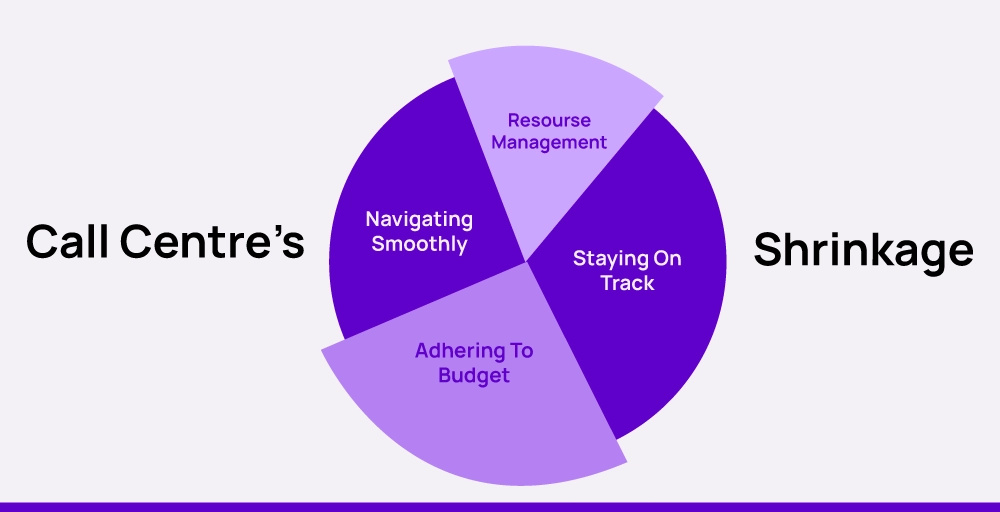
The importance of tracking the shrinkage metric is important as it shows the number of agents that are required to maintain service levels.
Unplanned and planned leaves, emergency, or meetings can influence this workforce management metric. For example, if a call center scheduled 50 agents to handle the calls efficiently, but 10 of them are not available due to sickness and emergency leave.
Now, the remaining call center agents are required to handle all the work and cover the absent agents. So, if not managed correctly, it results in reduced customer satisfaction.
Here, call center shrinkage is 50/10 = 5%. So, the call center needs to increase its workforce by 5% or add 10 employees to make up for the gap of shrinkage.
Types of shrinkage in BPO
In a BPO or call center, shrinkage is when agents are paid but are unavailable to handle customer interactions. For reducing shrinkage in BPO, businesses need to understand the types of shrinkage: Internal and external shrinkage.
1. Internal shrinkage
Internal shrinkage happens when agents are present on-site but are not actively engaged in calls or chat activity. These are usually planned shrinkages with routine activities, and the call center management team has some control over them.
Internal factors of shrinkage in BPO include:
- Team meetings
- One-to-one coaching sessions
- Training and development sessions
- Planned break and lunch breaks
- After-call work (ACW)
- Post call tasks
- Working on internal projects
- System downtime or tool failure
Although these activities result in high shrinkage, they are still essential for smooth business operations in contact centers. Although businesses can not avoid them, they can still calculate the shrinkage formula in BPO to find the staffing needs more accurately.
2. External Shrinkage
Opposite to internal shrinkage, external shrinkage is caused by factors that go beyond the organization’s control. These unplanned shrinkages negatively affect agent availability, which can disrupt call handling without proper planning and management.
Examples of external shrinkage in call centers are:
- Paid time off (PTO) and vacations
- Sick leaves
- Public holidays
- Showing up late or leaving early
- Unexpected events
- Power outages or poor internet (especially for remote agents)
- Natural disasters or emergencies
External shrinkages are harder to predict and affect customer service. However, by applying the shrinkage calculation formula to calculate the impact, call center managers can adjust staff levels as needed and improve customer experience.
How to calculate call center shrinkage?
Shriikange calculation in BPO and contact center is simple. Just divide the total shrinkage hours (addition of both internal and external shrinkage) by the number of hours available. Then, multiply the number by 100 to get the call center shrinkage percentage.

So, the formula of shrinkage in BPO follows this calculation:
Shrinkage (%) = (Total External Shrinkage Hours + Total Internal Shrinkage Hours)
× 100
Total Hours Available
Here’s the implementation of the call center shrinkage calculation formula with an example:
Imagine a call center where external shrinkage is 10 hours and internal shrinkage is 5 hours per week. And, the total available time was 80 hours for them. The shrinkage calculation would be:
Shrinkage = (10 + 5) ÷ 80 × 100 = 18.75%
This means 18.75% of paid time is unavailable for handling customer calls in a week.
Shrinkage percentage example
To better understand the shrinkage formula, let’s walk through a real-life example of calculating shrinkage in a call center.
We’ll use the following assumptions:
Working days per year: 260
Working hours per week: 40
| Category | Hours/Week | Days/Year | Shrinkage Days | Percentage |
| External Shrinkage | ||||
| Annual Leave | — | 22 | 22.0 | 8.5% |
| Public Holidays | — | 10 | 10.0 | 3.8% |
| Sickness | — | 6 | 6.0 | 2.3% |
| Absenteeism / Lateness | 1 | — | 1.3 | 0.5% |
| Internal Shrinkage | ||||
| Training | — | 4 | 4.0 | 1.5% |
| Coaching | 4 | — | 5.2 | 2.0% |
| Quality Sessions | 2 | — | 2.6 | 1.0% |
| Team Meetings | 3 | — | 3.9 | 1.5% |
| One-to-Ones | 1 | — | 1.3 | 0.5% |
| Paid Breaks | 5 | — | 6.5 | 2.5% |
| Toilet Breaks | 2.5 | — | 3.3 | 1.3% |
| System Problems | 1 | — | 1.3 | 0.5% |
| Other Activities | 6 | — | 7.8 | 3.0% |
| Total Shrinkage: | 75.2 days/year | 28.9% shrinkage rate |
Formula: Shrinkage (%) = (Total External Shrinkage Hours + Total Internal Shrinkage Hours) / Total Hours Available × 100
In this case, 28.9% of total paid hours and time lost to shrinkage, meaning that almost 3 out of every 10 hours spent are not available for taking customer calls.
Agent requirement formula
Now that you know how to identify shrinkage hours, you can determine how many call center agents you need to cover that gap. Here’s the formula for calculating agent requirements considering shrinkage:
Required Agents: Number of On-Call Agents Needed ÷ (1 – Shrinkage Rate).
If you need 60 agents live and your shrinkage is 15% then 60 ÷ (1-0.15) = 70.59.
Hence, you’ll need to schedule at least 71 agents to make sure that 60 are live during operating hours, considering a 15% shrinkage rate.
📝Note: Convert the percentage to a decimal by dividing by 100.
What is a good shrinkage rate?
Good shrinkage rate varies by industry. In the contact center industry, professionals estimate that the average shrinkage rate of 30 to 35% is considered acceptable. And, these shrinkages are calculated on a yearly basis (12 months).
So, your call center doesn’t need to worry if its shrinkage rate is lower than 30%. Apparently, it becomes a problem, and you need to constantly monitor shrinkage if the shrinkage exceeds the average figure of 35%.
For that, you need to start analyzing the reasons behind the agent unavailability, whether it be burnout, emergencies, or agent dissatisfaction, to increase your call center efficiency.


How to use shrinkage to plan your staffing?
So, how can you use the shrinkage data to plan your staffing needs? Here is the breakdown:
Step 1: Determine how many agents are required for calls.
Start by finding the needed staff to handle your workflow efficiently. This number should be the total number of agents required to be available to handle customer calls at any time.
For example, if your call forecast says you need 70 live agents, it’s your base number. How do you find it? It’s based on the call volume prediction based on historical patterns and marketing campaigns.
Step 2: Find out your shrinkage percentage
Now that you know how many agents are required. It’s time to calculate your call center shrinkage percentage. Having a shrinkage of 30% would mean that 30% of agents are unavailable due to planned or unplanned reasons.
While calculating this, convert it into a decimal. The 30% would be 0.30 in decimal.
Step 3: Use the shrinkage formula
Now, you’ll need to use a shrinkage formula that gives you the required staff to achieve service level targets. It’s the same formula we used before:
Total Required Staff = Needed Staff ÷ (1 – Shrinkage as a decimal)
We estimated the needed staff to be 70 with a shrinkage of 30% which is 0.30 in decimal, so,
Total staff = 70 ÷ (1 – 0.30) = 100 agents.
Meaning, you’ll need 100 agents to provide the service level operational efficiency even with the 30% shrinkage.
How to reduce call center shrinkage?
Call center supervisors and managers can implement tested strategies in order to minimise shrinkage and maximise agent productivity. This is how you can minimise contact center shrinkage:
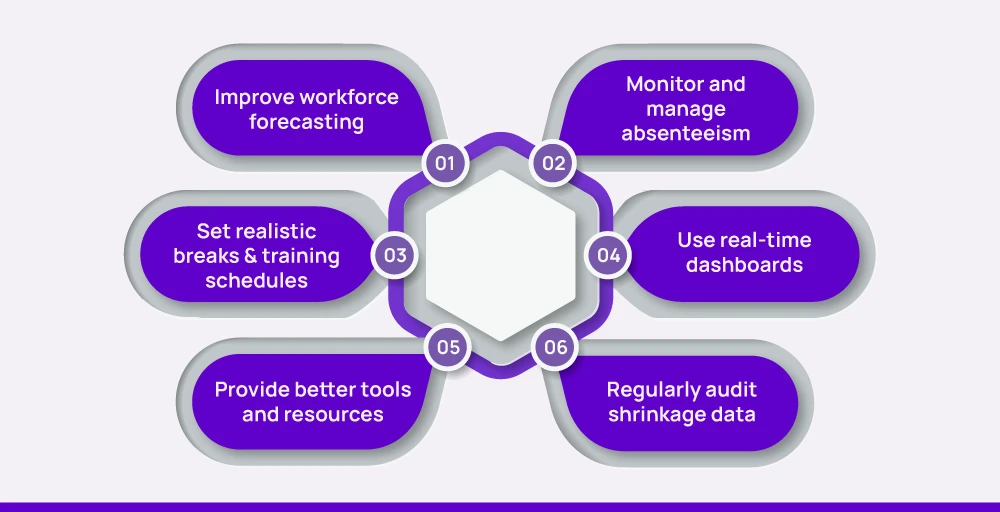
1. Improve workforce forecasting
Good management of workforce shrinkage starts with correct staffing forecasting. By analyzing historical call volumes and customer trends, you can more accurately project staffing needs.
By using Workforce Management (WFM) software, you can automate the process of aligning agent availability with the projected call volumes. This eliminates the problem of understaffing during peak periods and overstaffing when there are low call volumes. It results in optimal staffing levels with accurate forecasting, which helps in meeting service level agreements.
2. Set realistic breaks & training schedules
Scheduling training sessions, coaching, team meetings, and strategic breaks during low call volume prevents customer service from being affected by shrinkage to the least extent.
It’s necessary not to reduce training hours to save on shrinkage. Poor agent development also eventually negatively impacts customer satisfaction and leads to higher average handle time.
Having a good balance is crucial for achieving agents’ training without missing out during high call volume times.
3. Monitor and manage absenteeism
Absenteeism, even more unplanned absenteeism, negatively impacts the shrinkage with the reduction of available agent time. At this point, call center managers should provide assistance and ask if the agents are suffering from any problems while working in a call center. Also, call center agents should be encouraged to give prior notice before taking leave.
The most common reasons include:
- Burnout
- Demotivation
- Poor support from management
- Less respect in the workplace.
Managers must find underlying reasons and implement supportive measures, such as improving work conditions, recognising agent performance, and fostering engagement, to reduce absenteeism and call avoidance behaviour.
4. Use real-time dashboards
Real-time monitoring solutions enable managers to have a constant eye on key metrics, such as agent availability, call queues, and other internal and external factors of shrinkage. With these key performance indicators, they can quickly detect unexpected call volume spikes or unexpected breaks, which helps them make immediate staffing adjustments.
Dashboards also enable tracking of important KPIs like schedule adherence, average handle time, and service level performance. Getting this live data lets managers react to issues and maintain consistent customer service.
5. Provide better tools and resources
Providing agents with effective contact center technologies significantly reduces shrinkage. Self service options like IVR menus and chatbots address common questions without the help of live agents, which reduces the incoming calls.
In addition, knowledge bases and better call handling software reduce handle time and idle agent time, keeping productivity ongoing.
6. Regularly audit shrinkage data
Shrinkage management is an ongoing process to increase customer satisfaction. Regular audits and analysis of shrinkage data help distinguish between productive shrinkage (training, coaching) and unproductive shrinkage (unscheduled breaks, absenteeism).
This detailed insight enables targeted improvements and ensures staffing plans can align with all the possible factors, such as rare leave types and part-time schedules. In addition, tons of Erland calculators are available online to calculate your call shrinkage rate, which helps you avoid tracking shrinkage manually.
Reduce Call Center Shrinkage with KrispCall
Are you struggling with high shrinkage, which is affecting your team’s productivity?
KrispCall helps you take control shrinkage with advanced contact center software. It offers real-time dashboards, reporting, and advanced VoIP features that let you identify how your time is being lost and help you make instant adjustments.
Stay ahead of staffing challenges, maintain agent availability, and turn every customer interaction into a lead.
Book a KrispCall demo to analyze how KrispCall can turn every paid hour into your team’s peak performance.