


Outbound call centers remain one of the most effective growth channels in B2B sales in 2026. According to the global call center market value in 2026, the industry is now worth 386.93 billion dollars, reflecting sustained investment in sales and customer outreach infrastructure. At the same time, B2B cold calling response statistics show that 69 percent of buyers still answer cold calls, proving the channel is far from obsolete.
However, performance tells a different story. The average cold call success rate is just 2.3 percent, highlighting a major gap between companies that rely on high-volume dialing and those that use data-driven targeting, advanced technology, and structured sales processes.
The difference between a high-performing outbound call center and an expensive failure comes down to strategy, systems, training, metrics, and compliance.
📌 TL;DR
- Outbound call centers proactively contact customers for sales, lead generation, surveys, and customer retention.
- Unlike inbound centers, agents initiate every call with a defined goal.
- The right technology, compliance practices, and agent training determine success.
- Key features include predictive dialers, CRM integration, call recording, and speech analytics.
- TCPA and Do Not Call Registry compliance is legally required for all outbound operations.
What is an outbound call center?
Outbound call centers are contact centers where agents proactively make phone calls to customers or prospects rather than handling incoming inquiries. These calls are commonly used for sales outreach, lead generation, customer follow-ups, surveys, appointment reminders, and retention campaigns.
In inbound contact centers, customers initiate contact, while outbound call centers rely on predefined call lists, scripts, and dialing systems to proactively reach specific audiences. Calls can be made manually or via automated dialers, such as predictive, progressive, or power dialers, based on campaign goals.
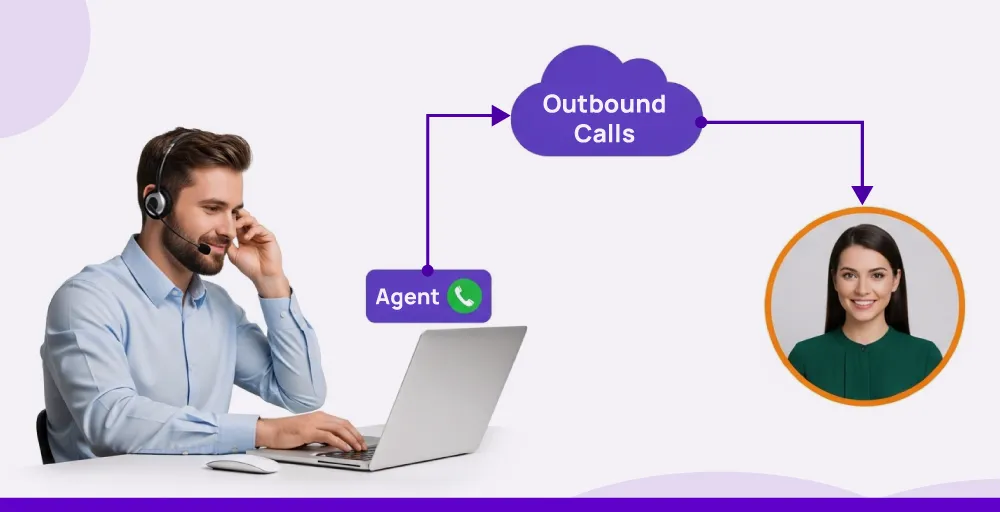
Outbound call center agents make outbound calls using multiple software and dialing systems. Additionally, these call centers integrate with CRM tools, performance-tracking systems, and predictive dialers to enable efficient calling.
How does an outbound call center work?
Before we explore the details, it’s essential to understand how an outbound call center operates within structured systems. To achieve specific business objectives, an outbound call center follows a planned process.
1. Planning and strategy development
At the beginning of the process, most outbound sales start with a structured or predetermined plan. This plan contains outbound lead generation, sales, follow-ups, and customer surveys.
Businesses determine their target customers to customize their communication strategy and approach effectively. They compile customer call lists from various sources, including business process outsourcing (BPO) call center services, market research, and internal databases.
These contact center agents are trained in customer service expertise and excel at efficiently managing customer interactions.
2. Software and dialing systems
Technology is what drives outbound call centers. The most advanced virtual call center software, including CRM, predictive dialers, and real-time analytics, helps manage agent calls efficiently, track interactions, and access customer information.
With integrated CRM systems, agents gain real-time access to customer details, allowing them to make more personalized calls. At the same time, call center analytics dashboards track performance and call outcomes, helping managers make data-driven decisions.
These tools help reduce idle time, instantly connect agents with live contacts, and automate the calling process, increasing agent productivity.
3. Outreach and engagement
Agents initiate calls by following their scripts while customizing their approach to suit each conversation.
With the help of contact center technologies, agents start making calls and interacting in conversations. For example, they introduce the company’s service or product or answer customer inquiries to accomplish the campaign’s objectives.
During each interaction, agents can gather information such as customer preferences and suggestions, and provide solutions by actively engaging with the customer.
4. Follow-up actions and performance evaluation
The information is stored in the CRM system after each call. Then, this data is analyzed to track the campaign performance, gain valuable customer insights, and identify trends.
After the call ends, agents can decide their next moves. Additionally, agents can follow up on customer calls, send additional e-mails, or transfer qualified leads to the sales team for further engagement.
5. Optimizing through technology
Outbound call centers rely on technology to make their campaigns efficient and improve results. Productivity tools inside the contact center software automate routine tasks, offer real-time analytics, and facilitate communication among teams.
Data analysis offers an opportunity to identify key call center metrics, areas for improvement, and successful strategies. This makes the marketing campaign more effective.
Examples of outbound call centers
Outbound call centers are crucial across industries such as financial services, telemarketing, healthcare, staffing agencies, and higher education for efficient call center operations.
An outbound call solution bridges the gap between businesses and their audiences, delivering timely information and boosting sales performance.
- Telemarketing: Outbound calls promote products or services to potential customers. This involves cold calls to customers who haven’t shown interest and follow-ups (those who have shown interest beforehand) through different channels.
- Lead generation and qualification: Agents make contact with potential customers, ask them relevant questions, and refer high-quality leads to a sales team. With this, the sales team eliminates wasting time chasin g dead-end leads and increases conversion rates.
- Telesales: Call center agents initiate sales and marketing phone calls to help businesses improve operations and grow revenue.
- Follow-ups or callbacks: Scheduling follow-up calls to avoid unnecessary customer frustration from being on hold. Eliminate long wait times for customer calls and improve the proactive customer service experience.
- Appointment setting: Agents qualify potential leads and book appointments for sales representatives or professionals to streamline the process.
- Customer retention: Agents reach out to customers at risk of leaving due to poor experiences, working to rebuild trust and retain their business.
- Product inquiries: Proactive agents help customers by answering questions related to features and benefits, eventually improving customer satisfaction. Product adoption platforms guide users, boosting engagement and reducing support requests.
- Technical support: Existing customers receive assistance with product or service issues through outbound calls, ensuring continued usability.
- Correcting billing issues: Agents notify customers about upcoming subscription renewals or billing errors to resolve financial concerns. Also, send payment reminder messages when payment goes overdue.
- Fundraising: Outbound calls help non-profits and charities secure donations from potential and existing contributors.
What are the types of outbound call centers?
Different types of outbound call centers vary based on their primary functions. Here are some of the main types:
- Lead generation centers: Agents focus on identifying and qualifying potential customers by collecting relevant details, evaluating their interests, and nurturing them for future sales conversions.
- Sales-focused: Agents make outbound sales calls to boost revenue by persuading customers to purchase products or services. They use upselling and cross-selling strategies to maximize sales opportunities and close deals effectively.
- Customer service and support call centers: Businesses proactively reach out to customers to address concerns, provide assistance, and resolve issues, strengthening customer satisfaction and loyalty.
- Collections and debt recovery centers: Agents contact existing customers with overdue payments, negotiate repayment terms, and work toward resolving outstanding debts while maintaining professionalism and customer trust.
- Market research and survey call centers: Outbound calls help businesses gather customer insights and valuable data. The information collected guides decision-making and allows companies to adapt to market trends.
Key features of outbound call center software
It is essential to select outbound calling software that can improve efficiency and communication with customers.
For that, look for an outbound call center service with these features:
1. Dialer tools
Dialer tools differ from outbound call center software, but their importance remains the same. These tools are one of the most essential tools for outbound call center agents to improve their efficiency and call volumes.
These tools basically simplify the calling process for agents, which will increase their efficiency in conducting more outbound calls. However, one thing you have to worry about is which dialer tool to use that can fit effortlessly with your business workflow.
Here are some of the popular dialer types:
- Predictive dialing: These automatically dial multiple numbers and connect agents to answered calls. They reduce idle time and ensure maximum call volume.
- Power dialing: Unlike predictive dialers, power dialers call one number at a time. This ensures agents have enough time to personalize their approach.
- Business phone calls: Cloud-based VoIP phone service enables call agents to make outbound calls from anywhere using an internet connection. It allows agents to work remotely and eliminates the need for traditional phone lines.
- SMS reminders: Send quick text reminders to potential customers from your outbound contact center and ensure meetings or follow-ups are not missed. This feature enhances customer engagement and retention.
2. Custom caller ID
Customers are more likely to pick up a call that has a local caller ID. That is why a custom caller ID is necessary for outbound interactions.
An outbound call center solution with a customizable caller ID feature enables agents to display more familiar and recognizable numbers. It will increase the likelihood of calls being answered. On top of that, it will build trust among the local community.
3. Click-to-call capability
In the outbound contact center, you can call someone with just one click. The phone system’s click-to-call feature helps you connect your phone calls via VoIP.
This feature speeds up your outbound interactions by eliminating the need for manual dialing. With one click, you can connect to your potential customer.
4. Call recording
One of the crucial features an outbound contact center offers is call recording. This feature records phone conversations and allows agents, supervisors, and managers to review agent-customer interactions.
Then, insights from these recorded conversations will help to track agent performance. This will help businesses to find any improvement areas and refine their strategy.
5. Speech analytics
You can use speech analytics tools to analyze conversations and detect patterns. It helps to refine call center strategies and improve training for agents. This information allows companies to offer quality call assurance, minimize legal risks, and increase accountability.
Importance of outbound call centers
Outbound call centers have been essential to modern business operations. Here’s why:
1. Customer interaction personalization
With an outbound contact center, you fill the gap between your company and your audience. This allows direct conversations that build customer loyalty and trust. Unlike email and websites, outgoing calls help to understand customer needs and offer the best solutions.
Based on The Radicati Group report, executives might receive around 115 emails daily, where outbound calls can make a significant difference in a successful sale.
Additionally, the right technologies allow agents to provide better customer service. Advanced features such as a power dialer, IVR, call routing, call recording, and call forwarding help manage outbound communication seamlessly. Other performance monitoring, real-time analytics, and performance monitoring help constantly improve customer interactions.
2. Improve revenue growth
Outbound campaigns are a proven way to generate leads, market research, and thriving sales. When pipelines need a boost, businesses often use industry email lists to quickly reach new prospects alongside outbound calling.
By making outgoing calls to potential customers, you avoid the wait for the customer to reach out to you. Meaning, you’re creating sales opportunities by taking charge of your sales pipeline.
Customers might want the solution; the only challenge is not knowing where to find it. You can reach these customers more quickly with outbound contact centers. Even more, the automated outbound calling process helps call center managers thrive in productivity and increase conversion rates.
3. Increase agent productivity
One of the prominent advantages of the contact center is its advanced software and integrations. The sales team can streamline the workflow and utilize most of the time on phone calls with the target audience.
Call center agents can handle outbound calls efficiently with features like predictive dialers and automated call distribution. Along with the call recording feature, you can track agent performance and find areas for further improvement.
4. Support business initiatives
Outbound call centers do more than just make calls. They support businesses to qualify leads, collect customer feedback, and offer proactive customer support & services. Businesses keep themselves ahead of market trends with outbound calls.
You can access and understand valuable customer data and buying habits to improve marketing strategies. Businesses can align product development based on the information received by conducting outbound calls.
Take it like this: An outbound solution is not just an expense. It’s an investment for stronger customer relationships and better business decisions.
Common outbound call center issues & solutions
Outbound call center solutions are required to make specific outgoing calls to achieve multiple business goals. It’s not only about initiating calls from a device, but various components are needed to make it successful.
These solutions have their issues, too. However, with an understanding of solutions and best practices, you can improve your call center operations and enhance the contact center experience.
1. Higher call rejection rates and customer pushback
Unwanted calls feel intrusive, which might lead to higher rejection rates and customer frustration because customers are more likely to engage only when the calls are relevant or valuable to them.
As a solution, contact centers can adopt a more personalized approach to target only the potential or existing customers to whom the call seems relevant. Additionally, sales reps should maintain a humble voice tone, which might help for 93% of potential success.
2. Keeping up with technology and customer expectations
Customers’ expectations are evolving alongside the digital landscape. Still, sticking to outdated calling methods is a straight red flag. Instead, integrate the AI-powered tools as well as omnichannel communication, which streamlines the whole outbound operations.
Embracing these latest technologies improves the customer experience and improves call outcomes.
3. Protecting customer data and privacy
It’s essential to have robust security measures for handling customer data and preventing data breaches. Outbound calls deal with this sensitive data, making compliance with data protection essential.
Compliance with data protection regulations is a must to win customer trust. A contact center should have security features such as end-to-end encryption, the Telephone Consumer Protection Act, data privacy, and HIPAA Compliance.
4. Agent burnout and high turnover
Agents can never turn any prospects into customers by themselves — it’s the customer who has decision authority. Therefore, the frequent rejections might cause stress that leads to high turnover among agents.
Stats: A QATC (Quality Assurance & Training Connection ) study benchmarks the average of 30% to 45% of agent turnover rate.
How do you deal with it? Invest in providing training, competitive salaries, compensation, and other welfare benefits that establish a positive work environment.
KrispCall: The proven solution for outbound call centers
After understanding how outbound call centers operate, choosing the right solution can significantly improve efficiency and results. KrispCall offers a cloud-based, AI-powered system designed for both inbound and outbound call operations.
Key features include:
- Seamless integrations: Connects with 100+ CRMs and business tools, reducing platform juggling.
- Advanced calling tools: Power dialer, voicemail, call forwarding, and call recording streamline workflows.
- Actionable analytics: Provides insights to optimize call strategies and maximize productivity.
- User-friendly interface: Simplifies navigation for agents, saving time and improving customer engagement.
- Cost-effective setup: No expensive on-premise infrastructure is required, suitable for small to large businesses.