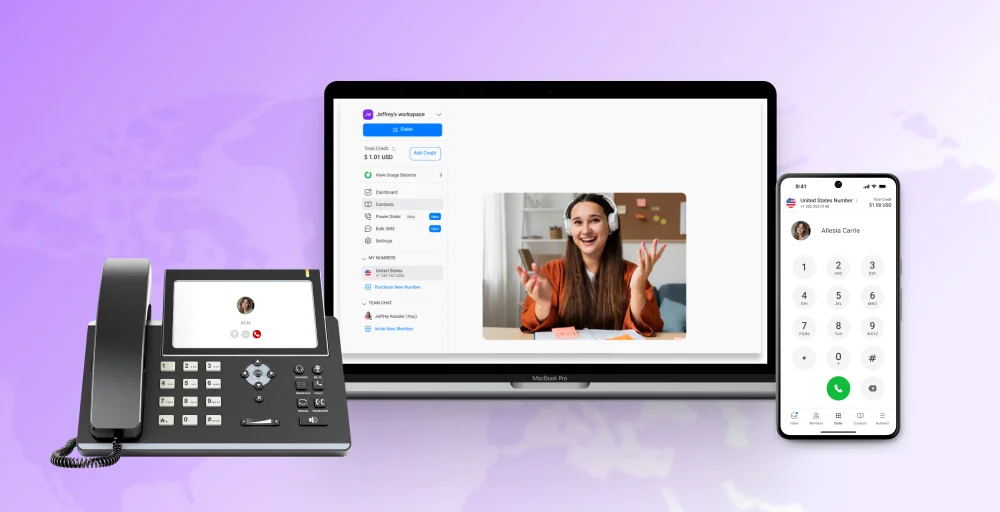



Tired of tangled wires, bulky hardware, high phone bills, and heavy desk phones?
Welcome to the world of VoIP phones, a modern and internet-based solution for communication. VoIP phones are a flexible, scalable, feature-rich, and cost-effective alternative to a traditional phone system.
But what exactly is a VoIP phone? How does it work to deliver crystal-clear calls over your internet connection?
In this blog, we’ll learn about VoIP phones, how they work, their types, and the best VoIP phones and conference phones available on the market.
✨ Key Takeaways
- A Voice over IP phone operates over the Internet instead of a traditional phone line.
- VoIP phones offer cost savings, high call quality, flexibility, scalability, advanced features, and access across multiple devices.
- You should choose an IP phone with a strong brand reputation, right line capacity, headset support, PoE capability, and auto-updates to meet your business needs.
What is a VoIP phone?
A VoIP phone is a device or application that enables users to make and receive calls over the Internet instead of traditional telephone lines. It converts voice into digital signals transmitted over an internet connection.
VoIP phones can be physical desk phones or software-based “softphones” on computers and smartphones. Unlike traditional landlines, they offer greater mobility, letting users stay connected from anywhere with internet access.
In addition to voice calls, VoIP phones often include features like call forwarding, CRM integration, IVR, voicemail-to-email, and video calls. These capabilities make them ideal for businesses and remote teams seeking flexibility, scalability, and cost savings.
How does a VoIP phone work?
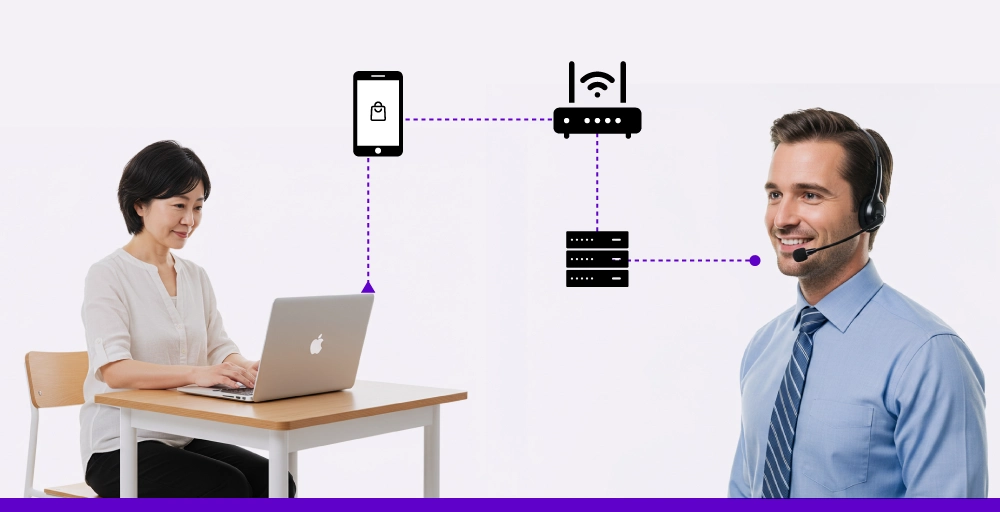
VoIP phones work by converting voice signals into digital data and transmitting them over the internet and cloud technology.
Here’s how a VoIP phone works:
- The VoIP phone is registered through a VoIP phone service provider, which handles the setup and call routing (both inbound and outbound).
- When a call is made, the provider transmits it over the public switched telephone network (PSTN) if needed.
- While a caller speaks on a VoIP phone, the handset converts the sound into digital data packets and sends them to the provider in real-time.
- Based on the recipient’s phone system, the provider either sends the data packets as they are or converts them back into sound.
For example, when a person makes a call using a VoIP app. The VoIP provider transmits the call as digital data and converts it back into sound before reaching the receiver. The receiver at the end hears like a regular phone call.
Check out our video and learn how you can set up VoIP for your business:
What makes VoIP phones different from traditional phones?
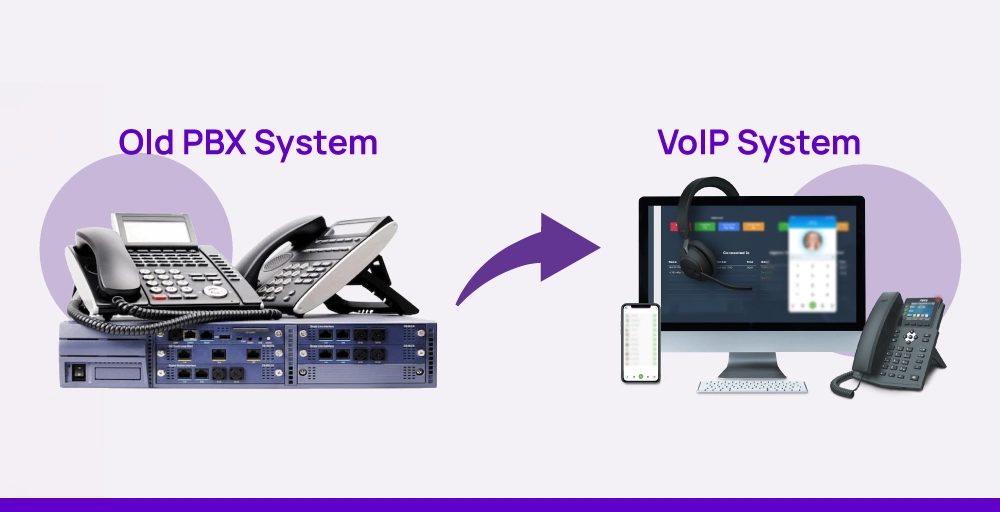
The main difference between a VoIP phone and a traditional system is how they connect with other devices.
A landline phone provider needs to install a landline phone in a fixed physical location. In contrast, VoIP phones can make and receive calls through the internet without being tied to any specific location. You can use these phone numbers from anywhere with internet access.
Here’s a table outlining the key differences between VoIP and traditional phones:
| Category | VoIP Phones | Traditional Phones |
| Basic calling | Supports standard PSTN calls over IP networks | Traditional PSTN calls via wired telephone networks |
| Long-distance & nationwide | Free or bundled in most plans | May incur extra charges depending on the distance |
| Internal user calling | Yes, direct VoIP-to-VoIP calling | Yes, but requires a private PBX system |
| Caller ID | Included | Included |
| Call waiting | Included | Included |
| Call forwarding | Included | Included |
| Voicemail | Included | Included |
| Call recording | Included | Not available |
| Call routing | Included | Requires PBX setup |
| Auto attendant | Built-in virtual receptionist features | Requires PBX setup |
| Conference calling | Multi-party audio/video conferencing tools included | Limited to basic 3-way calling |
| Calling cost | Lower costs, especially for long-distance | Higher, especially for international calls |
| Internet requirement | Needs a stable broadband connection (min. 100 Kbps per line) | No internet needed |
| Wireless capabilities | Connects to Wi-Fi, DECT, and Bluetooth headsets | Limited to DECT/Bluetooth on select devices |
| Underlying technologies | Uses SIP, TLS, and SRTP protocols for secure IP calling | Analog copper wire |
| Call quality | Delivers high-definition audio clarity, but depends on internet speed | Standard call quality varies with distance |
| Scalability | Highly scalable: can add lines virtually | Limited by physical infrastructure |
| Changing numbers | Free and easily managed via the dashboard | Typically incurs a fee (~$27) |
| Call security | Encrypted via TLS/SRTP protocols | No encryption, more vulnerable |
| Third-party integrations | Supports CRM, team messaging, surveys, and analytics | No support for business app integrations |
Why use VoIP phones?
VoIP phones are used in place of regular phones for several reasons, including cost efficiency, advanced features, flexibility, improved call quality, scalability, and enhanced security.
Here is a more detailed explanation of the reasons for using VoIP phones:
1. They lead to more cost savings
VoIP phones are less expensive than a PBX system. With affordable pricing plans per month, it reduces the calling cost, especially for international or long-distance calls. Moreover, it also eliminates the cost required for hardware and dedicated phone lines.
2. They provide better call quality
VoIP provides a reliable and better voice quality with a stable internet connection. It reduces background noise and delivers clearer audio compared to a traditional phone system. Additionally, there is very little chance of dropped calls or choppy audio.
3. They give you flexibility
Unlike a traditional phone systems that rely on a specific location to operate, VoIP is not tied to one location or device. It enables you to make and receive calls from anywhere, from a computer or mobile device with an internet connection. This ensures smooth communication regardless of your location.
4. They enable scalability
Scaling an IP phone system is quick and effortless. Whether you need to add users to your account or expand to multiple locations, you can manage it through the provider’s online portal. This makes it ideal for businesses with fluctuating or growing communication needs.
5. They come with more advanced features
VoIP phone isn’t limited to just calls, SMS, and voicemails. It comes with built-in advanced features like video calls, call analytics, call forwarding, voicemail transcription, receptionists, click-to-call, live call monitoring, voicemail to email, third-party integration, and many more.
6. They can be accessed from various devices
VoIP systems are accessible from a wide range of devices. You can make phone calls from computers, cell phones, desktops, tablets, laptops, desk phones, and handsets. With this, you can stay connected whether you are in the office, at home, or on the go.
What are the types of VoIP phones?
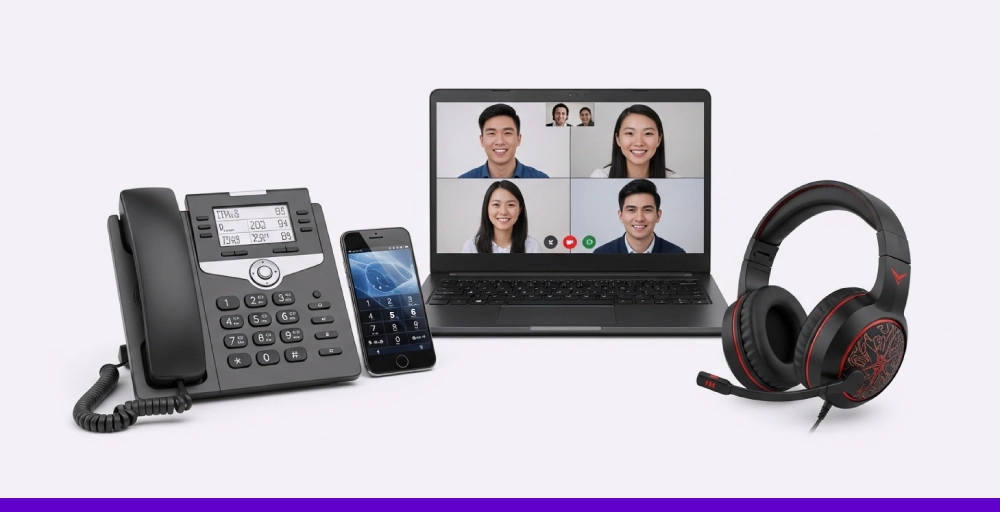
VoIP phones are categorized into two main types: Hard phones and softphones.
1. Hard phone
A hard phone is a physical desk phone that resembles traditional landline phones but connects via the internet and Ethernet cable. It includes desk IP phones, cordless IP phones, conference phones, and video phones.
The common features in VoIP hard phones are HD audio, USB/Bluetooth headset support, multi-line handling, and video on high-end models. Yealink, Snom, Fanvil, and Cisco are the top brands for hard phones based on customer reviews.
Here are some subtypes of VoIP hard phones:
- Desk IP phones: Standard business phones used at desks with Ethernet connections.
- Wireless IP phones: Equipped with Wi-Fi or DECT for mobility within an office or hotspot areas.
- USB phones: Connect directly to a computer via USB and are often used with softphone applications.
- Conference phones: Designed for group calls with enhanced speaker and microphone setups.
- Video phones: Combine both voice and video calling with built-in cameras and displays for video conferencing.
2. Softphone
A softphone is an app or software that is installed on your desktops, laptops, or mobile phones. It enables you to make and receive calls like a regular phone, without dedicated hardware. It supports unified communication with voice, video, text messaging, and collaboration tools in one interface.
The key features of softphones include call transfer, call forwarding, caller ID, instant messaging, conferencing, voicemail, call on hold, video calling, and integration with contact lists. It is ideal for remote workers and small business teams who need to use their phone service on multiple devices.
Top features every business VoIP phone system should have
When selecting a business VoIP phone system, focus on features along with VoIP basics that enhance communication, boost productivity, and drive long-term growth.
Here are the top features every business VoIP phone system should include:
1. Advanced call management and collaboration tools
A business VoIP provider must offer call management features such as call forwarding, number porting, shared phone number, call transfer, voicemail-to-email, call recording, auto attendant, team messaging, group calls, multi-level IVR, and call routing. These tools ensure your teams can stay connected and productive, regardless of location.
2. Scalability and global connectivity
The best VoIP system should grow with the business and support global connectivity with ease. It should allow you to add users and business phone numbers without complicated setups and high charges. It should also offer international business phone numbers, toll-free lines, and global call routing.
3. More integration capabilities
A VoIP system should integrate with existing business tools, such as CRM, helpdesk, productivity tools (e.g., Microsoft Teams), email, and marketing platforms. These integrations unify workflows, centralize data, and improve efficiency.
4. Mobile and remote accessibility
A modern VoIP system should be able to make and receive business calls from any internet-connected device, including tablets, laptops, computers, and smartphones. This ensures a smooth connection between remote teams in a hybrid work environment.
5. High-quality voice and video calling
VoIP provides superior audio and video quality compared to traditional phone systems. However, not all the providers are the same. Select a phone system that offers consistent HD voice and video quality with minimal lag or distortion.
Best business VoIP phones available in the market
Here is a list of the most popular VoIP phones:
1. Poly VVX 250: An entry-level VoIP phone designed for knowledge workers and cubicle workers. It has a 2.8-inch color LCD screen display with 4 line keys, 4 softkeys, and in-call keys for call transfer and hold. It integrates with more than 60 industry-leading call control platforms.
Pricing: $63.95 (Amazon)
2. Yealink T57W: A premium-level phone with 29 touch keys and 16 SIP accounts. It is designed for executives and busy managers with a heavy call load. It has a 7” 800×480-pixel color touch and a full-adjustable display. It offers HD Voice with Yealink Acoustic Shield technology.
Pricing: $213.50 (Amazon)
3. Poly CCX 700: A modern IP phone designed for professionals who require advanced communication features. It has color touchscreen operation with a 7-inch multi-touch LCD display. It offers superior audio quality with Poly HD Voice and Acoustic Clarity technologies.
Pricing: $432.14 (Amazon)
4. Mitel 6940w: A top-of-the-line executive phone with a large, high-resolution touch display. It provides 12 programmable self-labeling keys and six intuitive state-sensitive softkeys. It comes with function keys including transfer, hold, voicemail, conference, volume up/down, and many more.
Pricing: $109.99 (Amazon)
5. Unify CP700: A corded VoIP desk phone designed for professionals who require advanced communication features. It offers a 5-inch color graphical display with 800 x 480 pixel resolution. It is equipped with six permanent, free-programmable keys and six context-sensitive soft keys.
Pricing: Contact provider
Best VoIP conference phones available in the market
Here is a list of the best VoIP conference phones:
1. Poly Trio C60: A smart conference phone designed for any meeting space. It is well known for its audio quality and integration capabilities. It features a 5-inch color touch display and supports PoE/PoE+, WiFi (2.4/5GHz).
Pricing: $325(Amazon)
2. Yealink CP965: It is a flagship HD IP conference phone designed for medium to large conference rooms. It is based on the 9.0 operating system and is connected via Bluetooth, PoE, and built-in Wi-Fi (2.4 GHz and 5 GHz).
Pricing: $475(Amazon)
3. Mitel 6970: A high-quality conference phone designed to make meetings easier and more efficient. It has a high-resolution 7” (800×480 pixels) color touch display for a rich visual experience. It offers 6 context-sensitive soft keys and 7 dedicated touch feature keys for easy navigation.
Pricing: $445(Amazon)
4. Snom C520: A modern conference phone with 3 sophisticated microphones. Its key features include a full-duplex speaker, built-in batteries, Bluetooth connectivity, 2 detachable wireless microphones, and DECT technology.
Pricing: Contact provider.
5. Poly Trio 8800: A premium conference phone with two extra rechargeable wireless microphones. It features a 5-inch color touchscreen display with easy-to-use icons and user controls at your fingertips.
Pricing: $198(Amazon)
How to choose the best VoIP phone for your business?
To find out what types of VoIP phones your business needs, you must consider the following things:
1. Always evaluate brand reputation
A reputable brand typically signals better support, long-term reliability, and continuous innovation. Always choose a brand you know and trust. Some of the reputable brands are:
- Cisco is a leading name in business networking and internet infrastructure, making it a key player in the VoIP hardware market.
- Poly is a leading provider of business communication solutions and a key consideration for any VoIP system.
- Panasonic is recognized for its extensive experience in electronics, providing dependable and feature-rich VoIP systems.
- VTech is the world’s largest manufacturer of cordless phones and is widely recognized for its expertise in electronic learning products.
2. Check the line capacity
Check how many lines each phone needs to support in your office because some teams may require multi-line functionality.
In addition, check how many line appearances the screen can display. This feature makes it easy to know who’s on a call and who’s available.
3. Headset compatibility
Next, check what types of headsets the phone supports. Some use older RJ-9 connectors, while most modern ones use USB or Bluetooth. If you need Bluetooth, make sure the phone supports a Bluetooth adapter for connectivity.
4. Support Power Over Ethernet (PoE)
Many VoIP phones support Power over Ethernet (PoE), which enables a single cable to provide both power and internet connectivity.
However, if most employees are working from home and don’t have PoE equipment, ensure that the phone comes with a standard power adapter.
5. Must check reliability
Another important consideration is the reliability of VoIP phones. Choose a VoIP phone that receives automatic security and firmware updates. This makes the phone more secure and stable than models that require manual updates or don’t receive updates at all.
Wrapping Up!
Businesses should use reliable VoIP phone systems that scale with their business growth and communication needs.
With so many VoIP phone service provider options, choose the reputable provider that offers reliable call quality, advanced features, and is compatible with your existing tools and platforms
If you’re looking for an affordable and reliable VoIP phone service provider, KrispCall is here for you. Just sign up and start making calls within a few minutes.
Frequently Asked Questions
Are VoIP phones reliable?
Yes, VoIP phones are generally reliable when properly set up and have sufficient internet bandwidth. However, their reliability depends on several key factors, such as internet quality, the VoIP provider, and the stability of your network infrastructure.