

Whether you’re a small business owner tired of an expensive monthly bill from your landline service or a growing team that needs more than just basic phone calls, digital phone service is reshaping how people communicate. The way businesses make and receive calls has changed dramatically.
Traditional landline phones are slowly being retired, and more organizations, from solo freelancers to enterprise contact centers, are switching to internet-based solutions that cost a fraction of what legacy systems charge.
In this guide, we break down exactly what digital phone service is, how it works, what it costs, and how it compares to a traditional phone line, so you can make a confident, informed decision.
✨ Key Takeaways
- A digital phone service routes voice over internet protocol (VoIP) instead of copper telephone lines, letting you make and receive calls from any internet-connected device.
- It’s more affordable than a traditional landline, with plans starting at $12/user per month.
- Key features include call forwarding, call recording, IVR, voicemail-to-email, caller ID, call waiting, call blocking, and CRM integrations.
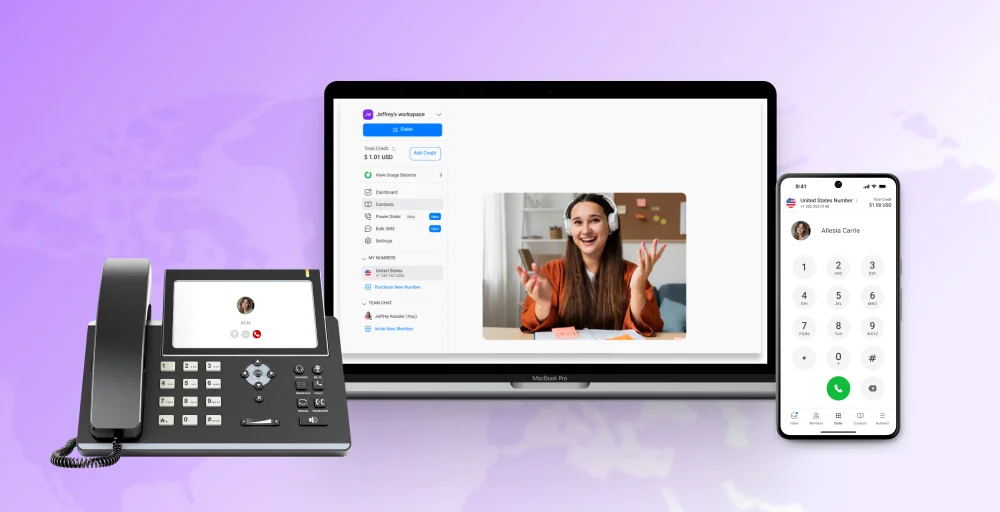
- It works on desk phones, mobile phones, personal computers, and mobile apps, with no special hardware required.
What Is a Digital Phone Service?
A digital phone service is a phone system that uses an internet connection to make and receive calls, rather than traditional copper wires or cellular networks. This technology converts analog voice signals into digital data packets. These packets travel securely across the internet to reach their destination, where they are converted back into clear audio.
This core solution is known by many names across the industry, meaning that voice over internet protocol (VoIP), cloud phone system, hosted PBX, internet phone service, and IP telephony all refer to the exact same product packaged under different terminology.
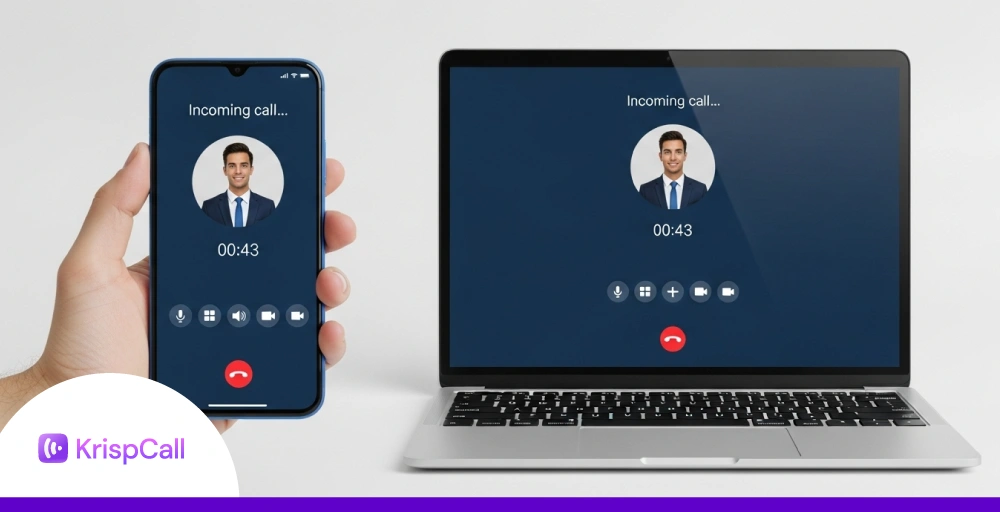
Instead of being tied to a fixed location like physical mail, a VoIP phone service operates more like instant messaging, accessible from anywhere, completely hardware-free, and built on modern cloud telephony and SIP infrastructure. You can forward calls to a cell phone, take incoming calls on a laptop, or manage everything through a web interface from any location in the world.
What is the Difference Between Digital Phone Service and Traditional Landline?
When choosing a communication setup for your business, the core decision is how your voice traffic is routed. Traditional landline phones rely on the Public Switched Telephone Network (PSTN), where physical copper wires connect calls through local and regional central switching centers.
Traditional phone lines require dedicated on-premises physical infrastructure, making it rigid and bound to a specific location.
In contrast, a digital phone service is hosted entirely in the cloud. It bypasses legacy digital phone lines by converting voice signals into data packets that travel across the internet.
This modern framework eliminates the need for specialized telecom hardware, allowing users to make and receive incoming calls from any internet-enabled device.
| Feature | Digital phone service | Traditional landline |
| Core technology | Cloud-based VoIP/ Internet Protocol | PSTN (Public Switched Telephone Network), Copper wires |
| Cost | Starts at $12 per user/month | Too expensive, plus it includes setup and hardware costs |
| Mobility | Works anywhere with internet; on any device | Tied to one physical address/building |
| Set-up time | Instantly, within a few minutes | Days to Weeks |
| Power dependency | Stops during power/internet outages | Works during power outages (no internet needed) |
| International calls | Very low cost or included | Expensive per-minute long-distance calling rates |
| Included features | Multi-level IVR, unified callbox, AI call summaries, SMS, call recording | Voicemail, caller ID, and call waiting; advanced features cost extra |
| Scalability | Add lines instantly | Requires hardware & technician |
| Reliability | Highly reliable with 99.999% uptime guarantee | Vulnerable to local issues like downed power lines or storms |
Key Features of a Digital Phone Service
One of the biggest reasons businesses are switching to digital phone services is the sheer depth of functionality they offer compared to traditional systems. Here are the most popular calling features you can expect from digital phone services:
1. Auto-attendant
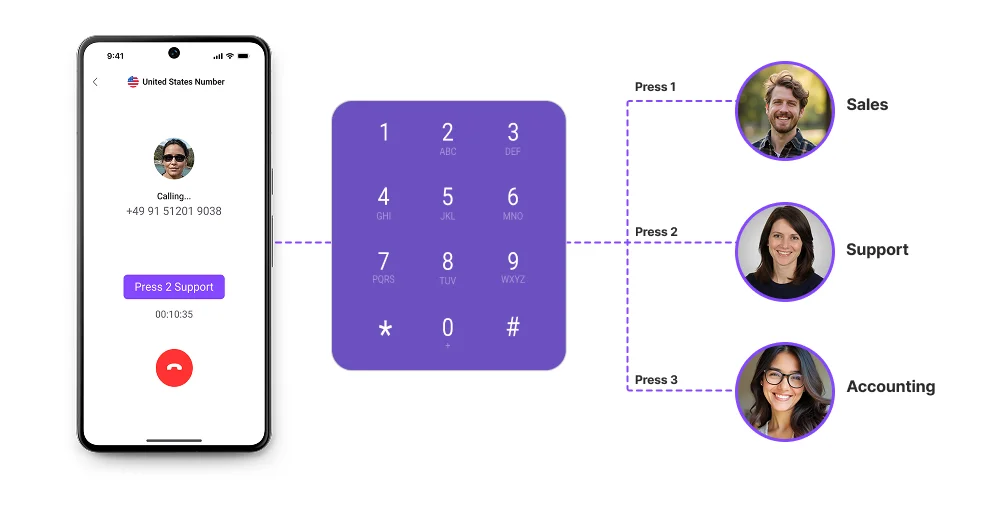
An auto-attendant greets callers with a professional recorded message and routes them to the right department or extension, without a human operator. Think ‘Press 1 for Sales, Press 2 for Support’. This feature ensures no call goes unanswered, even outside business hours.
2. Interactive Voice Response (IVR)
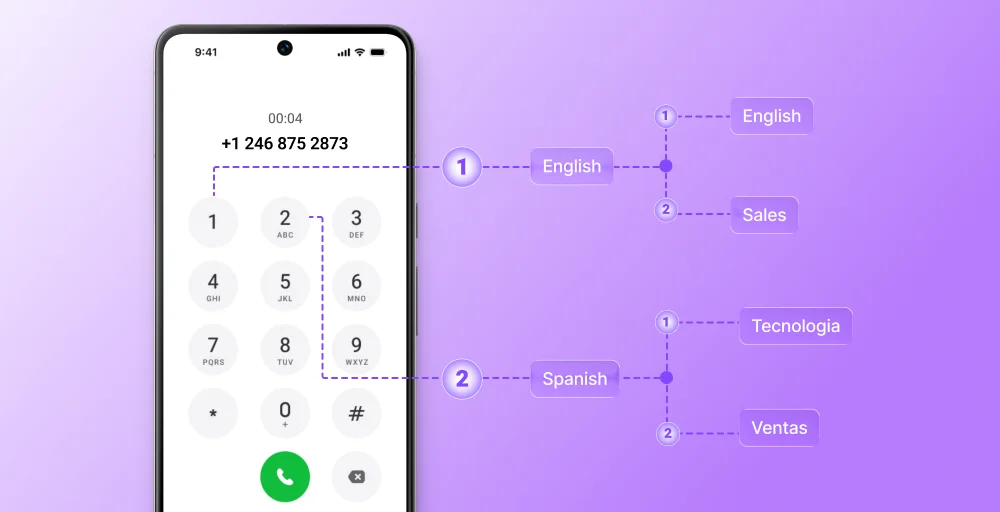
IVR goes a step beyond auto-attendant by allowing callers to interact with a menu system using their voice or keypad. It can handle common queries automatically, like order tracking, account balances, or business hours, without connecting callers to a live agent.
3. Call recording
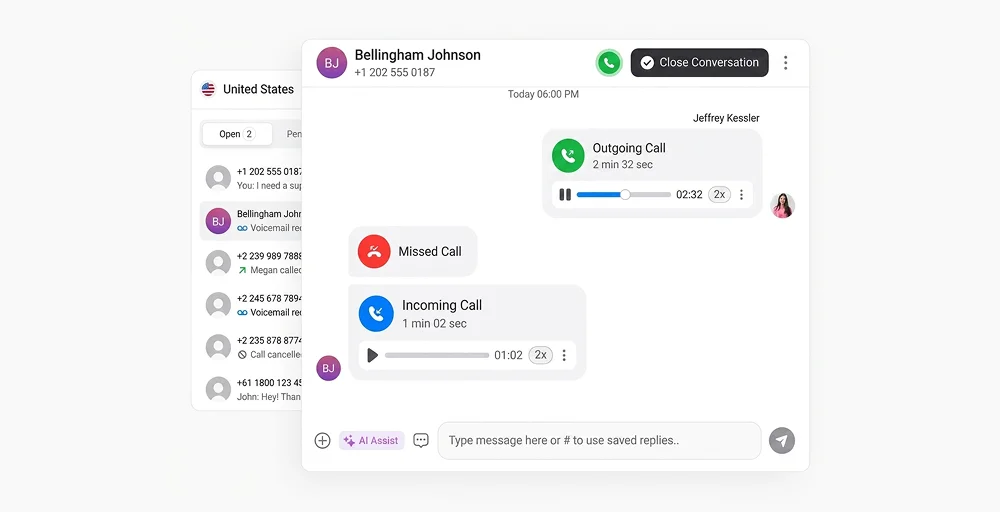
Digital phone services let you record inbound and outbound calls automatically or on demand. Call recordings are stored in the cloud and are accessible via your dashboard, making it easy to review conversations for quality assurance, training, or compliance purposes.
4. Call analytics & reporting
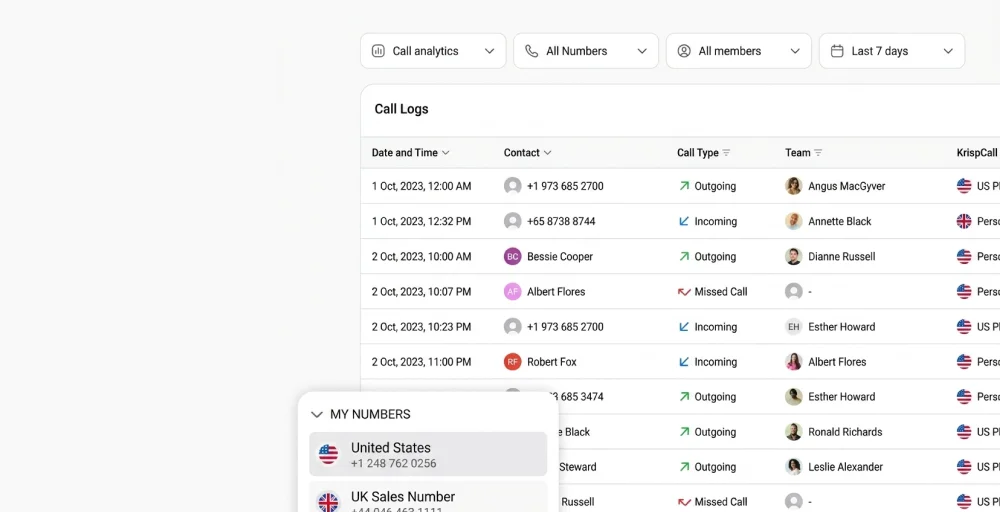
Get real-time visibility into your call traffic volume, duration, missed calls, wait times, agent performance, and more. Most digital phone services offer a customizable dashboard so you can track KPIs that matter most to your business.
5. Number portability
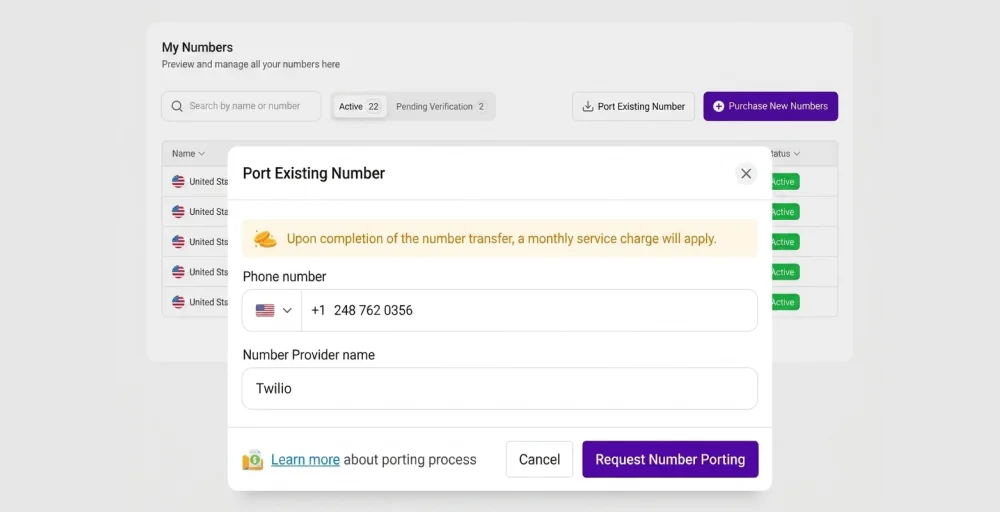
Number portability (or Phone Number Porting) is the feature that allows you to keep your existing phone number when switching from one telecom or digital phone service provider to another. It gives you the freedom to change carriers without losing contacts or updating your business collateral.
6. Toll-free & vanity numbers
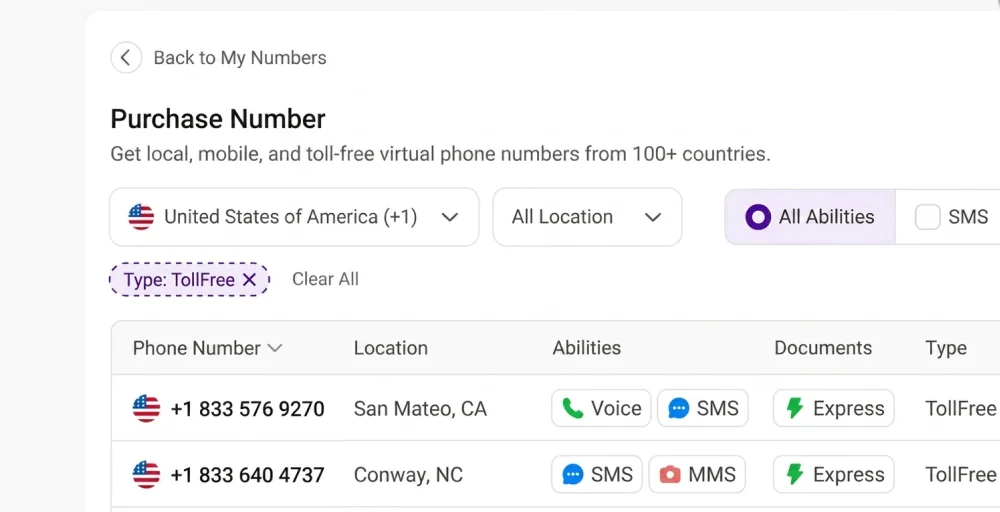
Instantly provision toll-free numbers (800, 888, 877, etc.) or memorable vanity numbers that reinforce your brand. These can be setup in minutes through your online dashboard.
7. CRM integrations
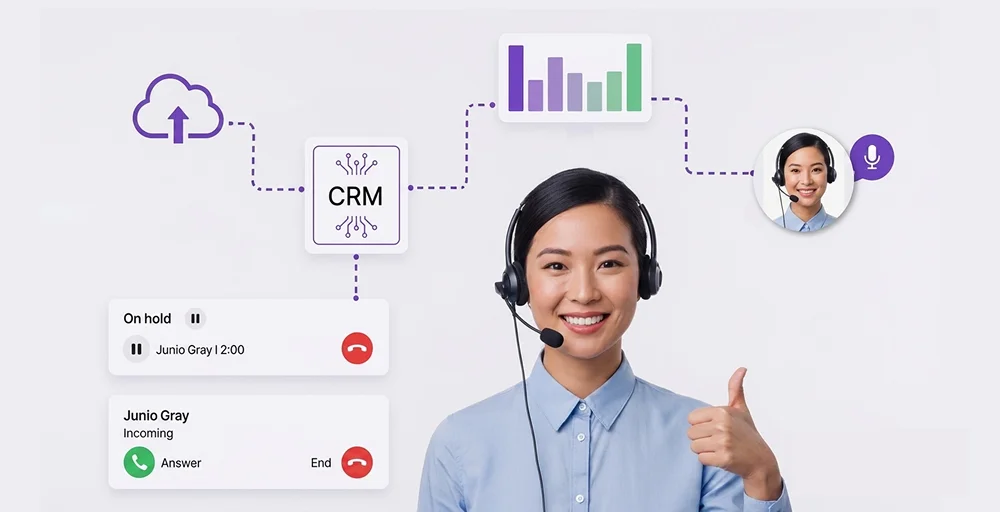
Digital phone systems integrate with the tools your team already relies on, such as HubSpot, Salesforce, Zoho, Slack, Microsoft Teams, and hundreds more. Calls can be automatically logged, contacts synced, and follow-up tasks created without manual data entry.
8. Voicemail-to-email
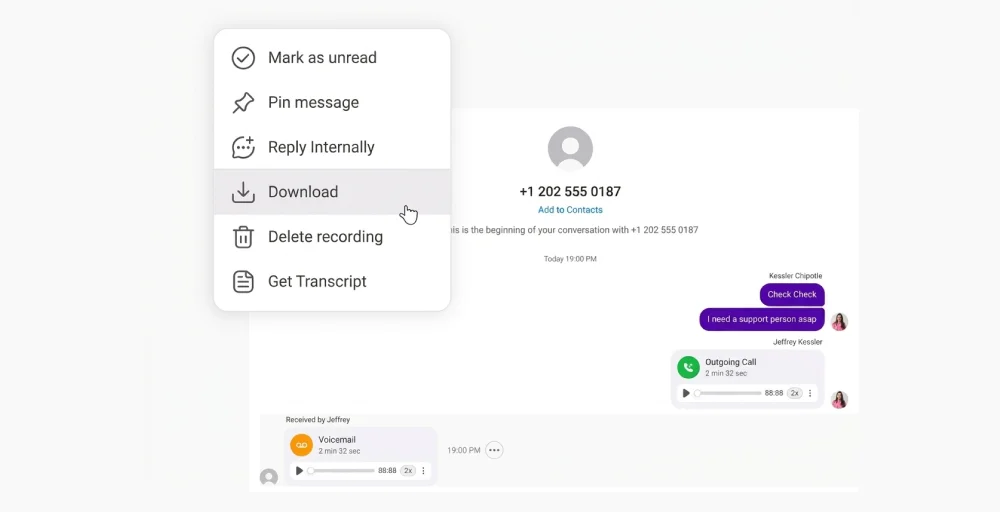
When a caller leaves a voicemail, it’s automatically transcribed and sent to your email or SMS inbox, so you never miss a text message, even when you’re on the road or in a meeting.
9. Multi-device support (Softphone)
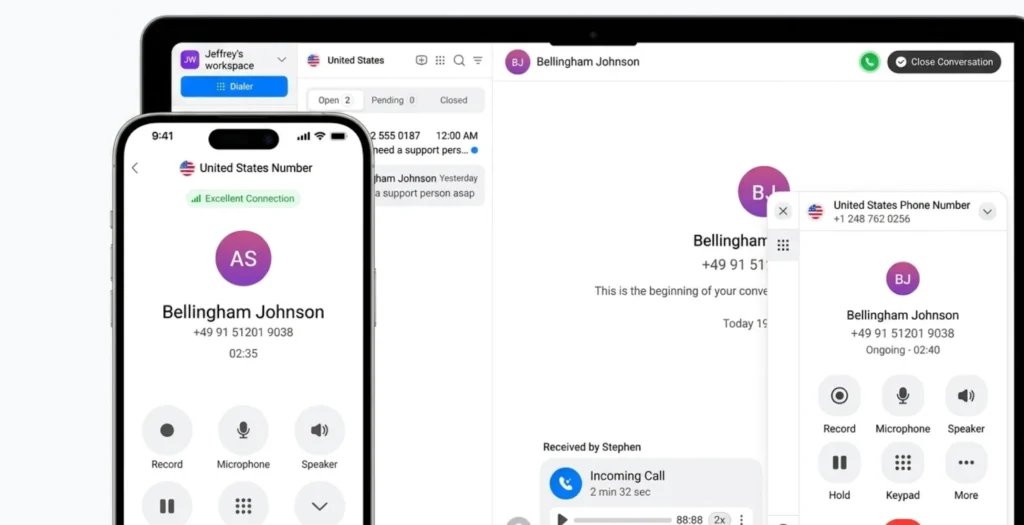
A digital phone service isn’t tied to a single desk phone. You can make and take calls from your computer, smartphone, tablet, or a traditional IP desk phone, all on a unified system with a single business number.
10. International & local virtual numbers
If you need a local presence in New York, London, or Sydney without opening a physical office. Digital phone services let you purchase local virtual numbers in hundreds of countries, so customers always see a familiar local number when you call.
How Much Does a Digital Phone Service Cost?
Digital phone service (VoIP) typically costs between $15 and $40 per user/month for standard business plans. Residential VoIP or basic home phone service plans can cost as little as $7 to $15 monthly. The total cost depends on the provider, feature tiers, and whether you need to buy physical IP desk phones.
| Service Category | Average Cost Range |
| Free Tier | $0 / month |
| Residential VoIP | $7 – $15 / month |
| Basic Business | $14 – $20 / user/mo |
| Advanced Business | $25 – $40 / user/mo |
| Enterprise / CX | $45 – $75+ / user/mo |
Most residential VoIP services and VoIP home phone service providers include unlimited calling within the US and Canada, with low-cost international calling rates available as an add-on. Business plans frequently bundle nationwide calling, unlimited calling to Canada, and advanced features like analytics and integrations into a single flat rate.
How to Choose the Right Digital Phone Service Provider?
Choosing the right digital phone service (VoIP) provider involves aligning key capabilities, such as connection reliability, essential features, pricing transparency, and third-party integrations, with your specific daily communication needs.
Key points to consider:
- Assess your business needs: Determine your team size, call volume, and needed features, basic calling or advanced options like video conferencing. So, tailor provider capabilities to your specific use case.
- Evaluate call quality & reliability: Look for HD voice quality, a 99.9%+ uptime guarantee, and SLAs with clear commitments. Ensure wi fi network redundancy to prevent dropped VoIP calls during peak usage.
- Check essential features: Core features include call recording, IVR, mobile/desktop apps, and voicemail transcriptions. Important extras are CRM integration, business SMS, and analytics.
- Review integration options: Choose providers that work seamlessly with your CRM and productivity tools. Test integrations during trials for data compatibility and API access.
- Price structure: Compare per-user/month pricing and watch for hidden fees. Calculate the total 12-month cost, accounting for add-ons and advanced feature access.
- Test support quality: Assess response times, support availability (phone, chat, email), and self-service resources. Ensure options for human assistance are available.
- Prioritize security & compliance: Demand end-to-end encryption, MFA, and compliance with relevant certifications. Look for additional security measures, such as monitoring and threat detection.
Top Digital Phone Service Providers to Compare in 2026
Comparing digital phone service providers involves choosing between all-in-one communication platforms and services tailored to specific business needs. Whether your priority is AI-powered coaching, CRM integration, or simple budget setups, the right cloud-based Voice over Internet Protocol (VoIP) system will seamlessly connect your desktop, smartphone, and tablet across any network.
The top digital phone service providers cater to different operational needs:
KrispCall — Best Digital Phone Service Provider
KrispCall is a cloud-based business phone system built for modern teams. It offers a unified phone system that works across desktop, mobile, and browser, with no hardware required. It’s designed for businesses that need professional calling capabilities without the complexity or cost of legacy phone systems.

Features
- Local, toll-free, and international virtual numbers in 100+ countries
- Auto-attendant and multi-level IVR
- Call recording with cloud storage and transcription
- Unified call inbox with team collaboration tools
- Advanced call analytics and real-time monitoring
- SMS and MMS messaging from your business number
Pricing
The KrispCall pricing offers three pricing plans:
- Essential: $12 per user per month
- Standard: $32 per user per month
- Enterprise: Custom
Integrations
- HubSpot CRM
- Salesforce
- Zoho CRM
- Slack
- Microsoft Teams
- Zapier
- Pipedrive
- Freshdesk
- Intercom
Zoom
Zoom is an AI-powered cloud business phone system that provides VoIP calling, SMS/MMS, and PBX capabilities. It’s the best choice for businesses already embedded in the Zoom ecosystem, offering a seamless transition between video meetings and voice calls.
Features
- Inbound and outbound VoIP calling, IVR, call queues, voicemail with transcription, and call recording
- AI Companion with real-time call summaries, call forwarding, call logs, and voicemail task extraction
- Team SMS/MMS, E911 emergency calling support, and number porting
- Real-time dashboard and historical reporting of usage, users, and devices
- Native integration with Zoom Meetings, Team Chat, and Zoom Contact Center
- Bring-your-own-carrier (BYOC) support for enterprises
Pricing
The Zoom pricing:
- Basic: Free
- Pro: $14.16 per user per month (annual billing)
- Business: $15.58 per user per month (annual billing)
- Enterprise: Contact sales per user per month
Integrations
- Google Calendar
- Eloqua
- Marketo
- Gmail
- Ontraport
- HipChat
- LTI Moodle
- InfusionSofy
- Panopto
Nextiva
Nextiva is a well-established business communications platform that combines VoIP, video, messaging, and CRM tools into one suite. It’s particularly strong for mid-market and enterprise customers who want a comprehensive UCaaS solution.
Features
- VoIP calling across the US, Canada, and Puerto Rico with HD call quality and a 99.999% uptime SLA
- Auto attendant, call flip between devices, and AI voicemail transcription on all plans
- Fios Digital Voice is compatible for enterprise deployments
- Unlimited video and audio meetings with conference bridge
- Drag-and-drop call flow builder with multisite automatic call routing
- Built-in HIPAA and PCI compliance automation
Pricing
The Nextiva plans include business phone and team messaging.
- Core: $15 per user per month (annual billing)
- Engage: $25 per user per month (annual billing)
- Power Suite: $75 per user per month (annual billing)
Integrations
- Microsoft Dynamics
- eClinicalWorks
- Square
- Jack Henry
- GoHighLevel
- Bullhorn
- Workbooks
- ConnectWise
- Shopify
Dialpad
Dialpad is known for its AI-powered calling features, including real-time transcription and sentiment analysis. It’s a great fit for sales teams and organizations that rely heavily on call coaching. Its AI capabilities are genuinely impressive, though some advanced features are gated.

Features
- AI call and voicemail transcription available on all plans
- A company dictionary that accepts custom terminology and competitor names to improve transcription accuracy, unique among VoIP providers
- Real-time call insights and a unified analytics dashboard across agent and customer interactions
- Team messaging with one-on-one and group chats, with the ability to launch calls or video meetings directly from the chat window
- Video meetings for up to 150 participants with screen sharing, and AI-generated recaps
- Unlimited domestic calling within the US and Canada, call recording, and number porting
Pricing
The Dialpad pricing offers three plans:
- Standard: $15 per user per month (annual billing)
- Pro: $25 per user per month (annual billing)
- Enterprise: Custom (100-user minimum)
Integrations
- Google Workspace
- RedSky
- Abstrakt
- Rippling
- LawGro
- Prodoscore
- SMS-Magic
- Fiserv
- Miro
CloudTalk
CloudTalk is a cloud call center solution, primarily for support and sales teams. It excels at call queue management, power dialing, and CRM integrations. It’s less suited for companies looking for a simple business phone system and more appropriate for teams running structured inbound or outbound call operations.

Features
- Local phone numbers in 160+ countries, enabling sales teams to display a local caller ID
- Inbound and outbound calling, and IVR across 80+ advanced calling features
- AI Conversational Intelligence with call transcription, sentiment analysis
- AI dialer that contacts up to 10 leads simultaneously while filtering out answering machines
- Skill-based routing, queue callbacks, and a visual call flow designer
- AI Voice Agent for end-to-end handling of routine support, sales, and billing inquiries
Pricing
The CloudTalk pricing offers five plans:
- Lite: $19 per user per month (annual billing)
- Essential: $29 per user per month (annual billing)
- Expert: $49 per user per month (annual billing)
Integrations
- Delighted
- Lever
- Capsule
- Modjo
- Stripe
- Odoo
- Plecto
- Adobe Commerce
- Kustomer
How to Switch from a Landline to a Digital Phone Service
Switching to a digital phone service (VoIP) is straightforward: choose a VoIP provider, select a plan, and plug your existing telephone into your internet router using an adapter. You can usually keep your current phone number by requesting a number port during setup.
Here is how to make the transition in a few clear steps:
1. Review your existing phone system
Begin by documenting all phone numbers, extensions, call-routing setups, and fax lines. Next, inspect your premises and identify any devices connected to the current phone system, such as alarm systems, elevator phones, wireless phones, or point-of-sale terminals. Spending time on this step upfront can prevent significant issues later.
2. Evaluate your internet connection
A typical VoIP line requires approximately 100 Kbps of bandwidth. This means a 10 Mbps internet service connection can generally support up to 100 simultaneous lines, which is more than sufficient for most small businesses. Before moving forward, perform a VoIP quality test to ensure your connection has acceptable latency and jitter levels.
3. Choose the right provider and plan
Focus on features that align with your business needs rather than on marketing claims alone. For many small businesses, the KrispCall Essential plan, priced at $12 per user per month with monthly billing, provides all the essential functionality required.
4. Port your phone numbers
Most VoIP providers offer number porting services. The key is to keep your existing phone service active until the transfer is complete to ensure uninterrupted call handling. While setting up local and toll-free numbers can often be completed quickly, understanding the provisioning process can help you better manage expectations.
5. Configure the new system
Cloud-based phone systems can typically be activated within minutes. Users simply download the application, log in, and begin making calls. If desk phones are in use, they are usually ready within a few minutes of being connected to the network.
6. Prepare your team
Modern VoIP applications are user-friendly, so a brief training session is often all that is needed. Designating a knowledgeable employee as the primary point of contact during the first week can help street address any questions and ensure a smooth transition.
7. Disconnect the old service
Only cancel your existing phone service after confirming that all numbers have been successfully transferred and the new system is operating correctly. Ending the old service too early is one of the most common causes of avoidable disruptions.
In most cases, the entire migration process takes only a few weeks. Number porting is usually the most time-consuming part, not the technology itself. When handled in the proper sequence, the transition is seamless, and customers are unlikely to notice any difference.
When a Traditional Landline Might Still Make Sense
While digital phone systems offer significant advantages, there are still a few situations where maintaining a traditional copper landline may be the better option.
These scenarios include:
- Small businesses with only one or two phone lines that benefit from competitive landline pricing and have no need for mobile access, video conferencing, or advanced collaboration tools.
- Locations with limited or unreliable broadband access, where internet-based calling could suffer from poor quality or frequent interruptions.
- Businesses that depend on legacy analog equipment, such as certain alarm systems, elevator emergency phones, or older fax machines that require a traditional POTS (Plain Old Telephone Service) or analog telephone adapter connection.
- Buildings or jurisdictions where local regulations mandate the use of copper phone lines for critical life-safety systems.
Even in these cases, the long-term outlook for copper-based phone service is clear. Telecommunications providers are steadily phasing out legacy infrastructure, and the transition is already underway.
In a December 2024 investor disclosure, AT&T’s Susan Johnson, Executive Vice President of Wireline Transformation, stated that the company expects to discontinue copper-based services across most of its service area by the end of 2029. AT&T reinforced this direction on October 15, 2025, by issuing a broad grandfathering notice affecting wire centers in 18 states.
At the same time, the Federal Communications Commission (FCC) has taken steps to speed up the industry’s shift away from copper networks. The agency now permits carriers to package replacement voice services in regions where traditional copper infrastructure has been retired.
As a result, businesses that still rely on landlines should begin planning their transition sooner rather than later. The opportunity for a gradual, stress-free migration is narrowing, and many customers are already experiencing rising costs to maintain legacy phone services.
Why Businesses Are Choosing to Switch to KrispCall?
Across industries, businesses are moving away from expensive landline phones and toward KrispCall’s cloud-based VoIP service, and the reasons are consistent.
- KrispCall’s Essential plan starts at $12 per user per month, offering unlimited calling and eliminating most hidden charges associated with traditional phone lines.
- This operates on desk phones, personal computers, and mobile apps, eliminating the need for special hardware or complex installations.
- Enjoy call forwarding, call routing, call recording, call screening, three-way calling, and more features that legacy providers usually charge extra for.
- Adding new phone lines or expanding international destinations is quick and hassle-free with your current phone service, thanks to the user-friendly interface.
- Teams can manage calls and messages in one shared inbox, making it ideal for high call volumes of incoming and outgoing calls.
- It seamlessly connects with HubSpot, Salesforce, Zoho, Slack, and more, ensuring your team stays informed on conversations.
For businesses ready to move beyond traditional landline phones and enjoy the flexibility of modern VoIP technology, KrispCall offers one of the most comprehensive and cost-effective solutions available.