


SIP trunking prices typically range from $15 to $30 per channel per month, while unlimited calling plans often cost $20 to $50 per user per month, depending on the provider and features. Businesses choose SIP trunking to replace expensive traditional copper lines with a flexible, internet-based solution that can reduce telecommunications costs by up to 50%.
This shift is driving rapid market growth: the SIP trunking market is expected to grow from USD 73.14 billion in 2025 to USD 181 billion by 2030, expanding at a 16.64% CAGR.
The total cost depends on factors like concurrent call volume, local and international calling needs, phone number availability, and advanced features such as call recording, analytics, and disaster recovery. Understanding SIP trunking pricing helps businesses budget accurately and select a provider that delivers the right balance of cost, scalability, and call quality.
✨ Key Takeaways
- SIP trunking costs $15–$30 per channel/month or $0.005–$0.03 per minute on metered plans.
- Hidden costs such as E911, DID numbers, regulatory fees, and toll-free usage can increase the final bill by 15–40%, so always request an all-inclusive quote.
- The different types of SIP trunking models are per-channel pricing, unlimited SIP trunk pricing, metered pricing, bundled pricing, and wholesale pricing.
How Much Does SIP Trunking Cost in 2026?
In 2026, SIP trunking costs between $15–$25 per channel per month for unlimited domestic calling plans, or $0.005–$0.02 per minute for metered (pay-as-you-go) usage.
| Cost Component | Range | Notes |
| Unlimited Channel Plan | $15–$30/channel/mo | Most common for steady call volumes |
| Metered (Pay-per-minute) | $0.005–$0.03/min | Best for low or seasonal usage |
| DID (Phone Numbers) | $1–$5/number/mo | Each inbound number is billed separately |
| Toll-Free Numbers | $2–$5/number/mo + usage | Plus $0.015–$0.025/min inbound |
| E911 Service | $1.50–$3/number/mo | Sometimes included, often extra |
| Setup / Activation | $0–$500 | One-time; varies widely by provider |
| Number Porting | $10–$25/number | Volume discounts often available |
| Regulatory Fees (USF, etc.) | 15–25% surcharge | Added on top of base rates |
| SMB Monthly Total (10 users) | $200–$300/mo | ~3–5 channels + DIDs + fees |
| Enterprise Monthly Total (100 users) | $2,000–$3,000/mo | Scales with channels and numbers |
| Legacy PRI Comparison | $300–$1,200/mo | Fixed 23-channel bundles |
| Savings vs. PRI | 25–65% | Often achieved within year one |
Channels
A single SIP trunk channel costs $15–$25 per month on unlimited domestic plans, or $0.005–$0.02 per minute on metered plans. The number of SIP channels you need follows a simple rule of thumb: one channel for every three to four employees, though call-intensive businesses may need more.
Business size
Monthly costs scale predictably. A small business with 10 users might pay approximately $200 to $300 per month for SIP trunking services, while larger enterprises with 100 users could be looking at costs ranging from $2,000 to $3,000 per month. Enterprises with a large number of users can expect costs as low as $10 per user per month, though additional implementation fees apply for complex setups and integrations.
DID numbers & Toll-free
Every inbound phone number is a separate line item. Local numbers typically cost $1.00 per month plus a $1.00 setup fee, while enhanced direct inward dialing numbers with E911 capabilities cost $2.50 per month plus a $2.00 setup fee. Toll-free numbers cost $2.95 per month plus $0.02 per minute of usage, and inbound calls to toll-free lines are always billed separately, even on unlimited plans.
E911 service
E911 service runs $1.50–$ 3 per number per month. Some providers bundle this in; others charge separately. Always confirm before signing up.
Setup & porting fees
Setup/activation fees range from $0–$150, with some providers charging one-time setup fees, particularly for dedicated channel configurations or porting existing phone lines. Number porting fees typically cost $10 per number, though volume discounts are available for organizations transferring multiple numbers.
Hidden & regulatory fees
This is where many businesses get surprised. Hidden fees, including DID numbers, E911, regulatory surcharges, and bursting, can add 15–40% to a headline quote. Specifically, USF (Universal Service Fund), RCIP fees, and state/local telecom taxes can add 15–25% to the base price. A provider quoting $15/channel may actually cost $22 per channel once regulatory fees, E911 charges, and add-ons are included.
Implementation costs
Implementation costs for SIP trunking can vary depending on setup complexity and organization size. Small businesses may spend $500 to $1,000 on implementation, while larger enterprises may spend $5,000 to $10,000 or more.
What Are the Different SIP Trunk Pricing Models?
SIP trunking doesn’t follow a one-size-fits-all billing structure. Providers offer several distinct pricing models, and the right one depends entirely on your call volume, team size, and need for predictable billing. Here’s what each model actually means and who it works best for:
Per-Channel Pricing (Flat Rate)
Per-channel pricing is a common model where businesses pay a fixed monthly fee for each SIP channel, allowing only one active call per channel. For instance, at $20 per channel, 10 channels would cost $200 per month, excluding DIDs, taxes, and add-ons.
This model simplifies budgeting and is suitable for medium-sized offices and teams with stable calling patterns. A key consideration is the number of simultaneous calls; for example, a 20-person office with only five active callers may only need five to eight channels.
Metered / Pay-As-You-Go Pricing
Metered plans flip the model entirely; instead of paying for upfront costs for capacity, you pay only for the minutes you actually use. Per-minute rates typically fall between $0.005 and $0.02, depending on the call destination’s carrier tier, and whether the call is inbound or outbound.
The main advantage of metered pricing is that you only pay for what you use, eliminating unused capacity costs and making it ideal for small businesses and seasonal operations with fluctuating call volumes. However, this can lead to unpredictable bills, especially in high-volume months.
Unlimited SIP Trunk Pricing
Unlimited plans charge a fixed monthly fee per channel with no cap on domestic call minutes, typically covering US and Canada calling. Its pricing ranges from $15 to $25 per channel per month.
This model is well-suited to high-volume environments, sales teams, inbound support centers, and contact centers where agents spend the majority of their time on voice calls. One thing that “unlimited” plans almost always carry is a fair use policy, and toll-free numbers, international calls, and premium-rate destinations are typically billed separately, even on these plans.
Bundled / Enterprise Pricing
Bundled or custom account pricing is common for larger businesses and contact centers with complex needs. Instead of a simple per-channel rate, quotes combine channels, call volume, DIDs, failover routing, support, implementation, and discounts into a single negotiated package.
Some providers offer a fixed number of included minutes split by destination, like 2,000 US and 500 Canada minutes, with per-minute overage charges for additional usage. This approach provides predictability but relies on accurate assessment of call patterns to maximize savings.
Wholesale SIP Trunk Pricing
Wholesale SIP trunking targets telecom resellers, MSPs, ITSPs, and large enterprises managing their own telecom infrastructure. It offers termination rates as low as $0.001- $0.008 per minute and per-channel pricing below $10 at high volumes, enabling resellers to achieve 50-75% margins compared to the 15-25% typical in agent commission models.
However, these plans require higher minimum volume commitments, a capable internal IT team, and more intensive telecom management, making them unsuitable for standard businesses. For most, standard business phone system plans with support and easier setup are preferable.
What Factors Affect SIP Trunk Pricing?
SIP trunk pricing is primarily determined by call volume, the number of concurrent channels, geographic destinations, and additional features. Here are the factors that matter most:
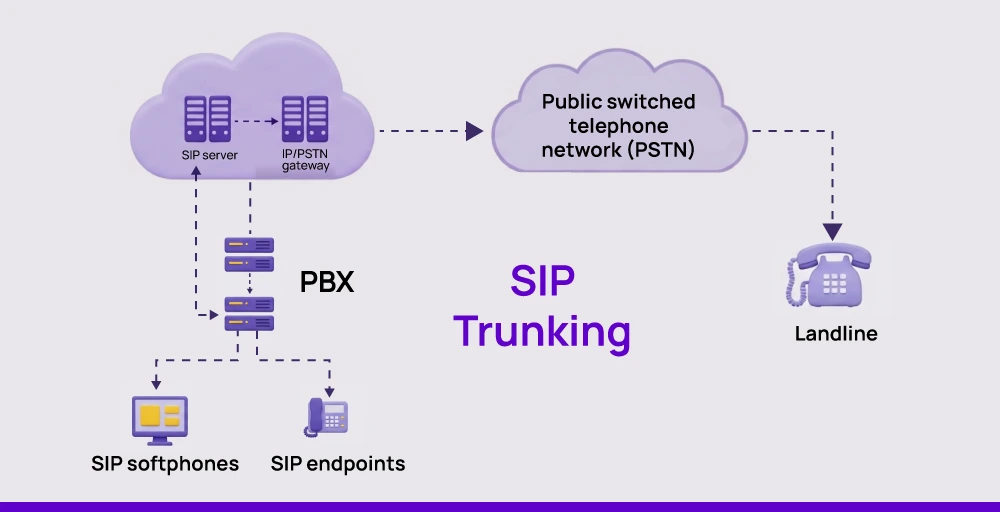
- Number of concurrent calls: Each channel supports one active call at a time, and the standard planning rule is one channel per three to four employees. Call-intensive teams, such as sales floors or support centers, will need more.
- Monthly call volumes: On metered plans, every minute consumed adds directly to the bill; a busy month can push the monthly price significantly higher than expected. Even on unlimited plans, low call activity can mean you’re overpaying for idle channel capacity.
- Call destinations: Domestic landline calls are cheapest and usually included in unlimited plans. Mobile calls cost more, and international calls are priced per country, with international calling rates varying widely; a call to Western Europe costs far less than a call to parts of Africa or South Asia.
- Codec quality: A VoIP codec encodes and compresses voice data for transmission. G.711 delivers HD-quality audio using more bandwidth; G.729 compresses aggressively, cutting infrastructure costs for the provider but degrading call clarity for your customers. Budget providers often default to G.729 without disclosing it.
- DID/phone numbers needed: Each DID number on your account is a separate monthly line item, priced at $1–$5 per number. A single main line is negligible, but a multi-location business with dozens of regional or department numbers will feel this cost. Number porting fees of $10–$25 per number also apply when migrating from a previous provider.
- Toll-free usage: Toll-free numbers carry two separate costs: a monthly number fee of $2–$5, plus inbound usage billed at $0.015–$0.025 per minute. Toll-free messaging and Inbound toll-free minutes are charged separately, even on “unlimited” plans.
- Contract length: Month-to-month plans offer flexibility but come at a price premium. Annual contracts typically include volume-pricing discounts of 10–20% oe per-channel or per-minute rates. For businesses confident in their call volume, the annual commitment usually pays for itself quickly.
- E911 registration: E911 is a legal requirement in the United States, not an optional add-on. It is charged per DID at $1.50–$3.00 per month, so costs scale directly with your number count. A business with 20 DIDs could pay $30–$60 per month in E911 fees alone.
What Hidden Fees Should You Watch for in SIP Trunk Pricing?
The advertised per-channel rate is rarely what you actually pay. These are the charges that routinely surface on the first invoice, each with specific dollar ranges so you know exactly what to look for before signing:
- Setup/activation fees: Some providers charge a one-time provisioning fee ($0-$150) to configure your account, set up trunks, or onboard your team. This fee is often waived on annual plans, so it is worth asking upfront rather than discovering it on the first invoice.
- Number porting fees: Porting your existing phone numbers from a previous provider is rarely free, despite what some providers imply. Factor in both the per-number cost and the porting timeline, which can take anywhere from 24 hours to 10 business days, depending on the carrier involved.
- E911: E911 is billed per DID, not as a single flat-fee account charge, so costs scale with every phone number on your account. A business with 20 active numbers could be paying $30–$60 per month in E911 fees alone, entirely separate from the base channel rate.
- CNAM/caller ID lookup: CNAM is the service that displays your business name on outbound calls. The per-lookup cost is small, often $0.003–$0.007, but at high outbound call volumes, it adds up to a noticeable monthly line item.
- Regulatory surcharges: Federal Universal Service Fund (USF) charges, state telecom taxes, and local regulatory fees are applied as a percentage on top of your base monthly rate. This is the most commonly missed charge on a first invoice; a $200 base bill can become $240–$250 once surcharges are applied.
- Fair-use overages on “unlimited” plans: Most unlimited SIP trunk plans carry a fair-use policy that caps usage at roughly 2,500–3,000 minutes per channel per month. Exceeding that threshold can trigger per-minute overage billing, turning a predictable flat-rate plan into a variable-cost surprise at the end of the month.
- International calls: International calls are never included in domestic unlimited plans and are always billed at per-minute rates that vary significantly by destination country. Businesses with regular overseas calling should request a full destination rate table before committing, as long-distance calls and international charges can quickly outpace the base channel cost.
- Burst channel fees: When a business receives more simultaneous calls than its provisioned channels allow, calls may either be dropped or routed at a premium burst rate. Both scenarios can increase trunking costs, with dropped calls risking lost business and burst rates potentially being two to three times the standard rate.
- Fraud protection/call authentication: Some providers charge separately for STIR/SHAKEN call authentication and fraud monitoring, which are essential as robocall regulations tighten. Without these protections, your numbers are at risk of spoofing and toll fraud, which can lead to costs in the hundreds before detection.
SIP Trunk Pricing vs. Traditional Phone Lines — Is It Worth Switching?
Switching to SIP trunking is well worth it for modern businesses, as it reduces costs by eliminating expensive traditional TDM circuits and PRI lines with a software-based solution that eliminates physical line maintenance overhead.
| Feature | SIP Trunking | PRI / Traditional |
| Monthly cost (23-channel equiv) | ~$200–$400/mo | $400–$800/mo |
| Cost per channel | $15-$25/channel | $17-$35/channel (fixed bundle) |
| Scalability | Add or remove channels instantly | Fixed 23-channel blocks only |
| International calling | Per-minute rates, easy to enable | Expensive, requires additional circuits |
| Number porting | Fast, often free | Slow, carrier-dependent |
| Setup time | Minutes via web portal | Days to weeks with technician visit |
| Remote/Hybrid support | Native support for remote and hybrid teams | Limited flexibility for remote work |
| Call quality control | Codec selection, HD audio available | Fixed quality, no configuration |
| Regulatory compliance (E911) | Per-DID, easily configured | Built into the physical line |
| Multi-location support | Single trunk servers in all locations | Separate PRI per location |
| Hardware dependency | None, software-based | T1/PRI circuits required |
SIP Trunk Pricing vs. Hosted VoIP – Which Is Cheaper Overall?
SIP trunking and hosted VoIP are often compared as if they are interchangeable, but they serve different infrastructure models. SIP trunking connects to your existing phone system, giving you control over call routing and configuration. Hosted VoIP is a fully managed cloud phone system where the provider handles everything. The right choice depends on what infrastructure you already have and how much control you want to maintain.
| Factor | SIP Trunking | Hosted VoIP |
| Pricing model | Per-channel (concurrent call) | Per-user, per-month |
| Average monthly cost | $15-$25 per channel | $15-$35 per user |
| Upfront hardware | High (requires IP-PBX server) | Uses existing PCs/phones |
| IT/Maintenance cost | High (requires internal IT staff) | Included in the monthly fee |
| Call minutes | Often metered (per-minute fees) | Usually bundled/unlimited |
| Number portability | Full control | Provider-dependent |
| Best for | Businesses with existing PBX | Businesses starting from scratch |
Related 👉: SIP Trunking vs VoIP
How Do You Estimate Your Monthly SIP Trunk Bill?
Estimating your actual monthly cost before committing to a SIP trunk provider is straightforward if you work through each cost component in order. Here is how to build a reliable number.
Step 1: Count your peak concurrent calls: Monitor your busiest hour of the day and count how many simultaneous calls your team handles. Add 20% headroom for unexpected spikes. That figure is your channel requirement. Use the rule of one channel per three to four employees as a starting baseline.
Step 2: Choose your pricing model: If your average daily call duration per channel exceeds three to four hours, an unlimited flat-rate plan will almost always cost less than a metered plan. If your call volume is light, irregular, or seasonal, a metered plan keeps costs proportional to actual usage.
Step 3: Count your DID numbers: List every inbound phone number your business needs, main lines, department lines, direct extensions, and local numbers for each location. Multiply by the per-DID monthly fee ($1–$5) to get your DID cost.
Step 4: Factor in toll-free numbers and usage: If you publish a toll-free number, add the monthly number fee ($2–$5) plus an estimate of your monthly inbound toll-free call minutes multiplied by the per-minute rate ($0.015–$0.025).
Step 5: Add E911 fees: Multiply your total DID count by the E911 per-number charge ($1.50–$3.00) to get your monthly E911 cost. This applies to every number on the account, not just the main line.
Step 6: Apply regulatory surcharges: Add 15–25% to your subtotal to cover USF charges, state telecom taxes, and local regulatory fees. This is the step most businesses skip, and the one that produces the most invoice surprises.
Step 7: Request an all-in quote and compare: Take your internal estimate to at least three providers and ask for a fully itemized quote that includes all fees, taxes, and surcharges. Compare the all-in monthly total, not the per-channel headline rate, to get a true apples-to-apples comparison.
How Do SIP Trunk Providers Compare on Pricing?
When evaluating a SIP provider or trunk provider, businesses should compare more than just SIP pricing. Consider factors such as call quality, automatic failover, volume discounts, free setup options, web portal functionality, web portal change controls, and customer support responsiveness. Here is how some of the major SIP providers compare at a high level.
| Provider | Per channel price | Per-minute rate | Contract required | Key features |
| Nextiva | $14.95 (Metered) $24.95 (Unmetered) | $0.008 | Yes | US points presence, free account setup, 100 minutes |
| PBX.IM | $5 | $0.0203 | No | Plug and play, auto-attendant, call queues |
| Telynx | Pay as you go | $0.005 | Yes | Secure trunking, call concurrency, T.38 fax support |
| Twilio | Contact sales | $0.0034 | No | Secure Trunking, Call Recording Storage |
| SIP.US | $19.99 | $1.00 | No | Nomadic e911, Business texting |
What Questions Should You Ask Before Choosing a SIP Trunk Provider?
Choosing a SIP trunk provider based on price is a common and costly mistake. The headline rate rarely reflects the total monthly cost, and differences among providers in quality, reliability, and support can directly impact your business operations. Here are the questions that matter most:
Pricing & fees:
- What is the all-in monthly cost for my specific configuration, including E911? DID numbers, regulatory fees, and any add-ons?
- Are there minimum monthly spend requirements?
- What triggers overage charges on unlimited plans, and at what usage threshold?
- How are international calls billed, and can I see a full destination rate table?
- Are there setup or activation fees, and are they waived on annual plans?
Quality & reliability:
- What codec does the platform use by default, G. 711 or G.729?
- Is geo-redundant routing available, and is it included or an add-on?
- What is the SLA uptime guarantee, and what compensation is offered if it is not met?
- Can I run a quality test before committing to a paid plan?
- What carrier tier does the provider operate on, Tier 1,2,3, and how does that affect call quality?
Scalability & contracts:
- Are there volume discounts for higher channel counts, and at what thresholds do they apply?
- Can I add or remove channels in real time, or does scaling require a support ticket?
- What is the number porting process, and how long does it typically take?
- Is month-to-month billing available, or is an annual contract required?
Support:
- Is a dedicated account manager included, or only available on higher-tier plans?
- How are outages communicated, and what is the typical response time for critical issues?
- What support channels are available: phone, email, live chat, and during what hours?
- What does the onboarding process look like, and is there a migration support team?
Is SIP Trunking Right for Your Business?
SIP trunking is the right choice for most businesses that already have a PBX system, handle consistent call volumes, and want to reduce their monthly telecom spend without giving up control over call routing and configuration.
The savings are real and well-documented, 25–65% in year one for businesses switching from PRI lines, and the flexibility to scale SIP channels up or down instantly makes it far more operationally agile than legacy infrastructure.
It is particularly well-suited to businesses with multiple locations, remote or hybrid teams, high outbound call volumes, or those facing an imminent deadline to migrate away from Public Switched Telephone Network (PSTN) infrastructure. For businesses in the UK, the Openreach PSTN switch-off deadline of January 31, 2027, makes the timing of this decision especially urgent.
SIP trunking is less ideal for very small businesses without an existing PBX that would need to invest in hardware upfront; in those cases, a hosted phone system with its zero-hardware model may offer a faster and simpler path to modern cloud telephony. Similarly, organizations with minimal or highly irregular call volumes may find that a hosted VoIP plan with a per-user fee is more cost-effective than maintaining SIP channels that sit mostly idle.
The key question is not whether to choose SIP trunking for savings; it consistently and measurably delivers. The question is whether your current infrastructure, calling patterns, and growth trajectory make it the right model for your business.