


Today’s customers expect quick, personalized, and reliable service, and it’s the call center manager who ensures that happens. To keep up with rising expectations, businesses are now turning to modern call center technology that makes customer support faster and smarter.
From AI-powered chatbots to cloud-based systems, these advanced call center technologies help agents handle calls more efficiently and deliver better service across every channel, phone, chat, email, and social media. With the right contact center solutions, your team can stay organized, improve response times, and keep customers happy no matter where they are.
This article explores 12 call center technologies, their benefits, current trends, and key factors to consider when choosing the best call center tools for your business.
✨ Key Takeaways
- Contact center technology is a suite of tools and platforms that manage customer interactions across multiple channels.
- Technologies like VoIP, IVR Systems, automatic call distribution, computer telephony integration, CRM integration, AI, and machine learning power modern contact centers.
- Top contact center technology trends include AI and automation, omnichannel communication, remote and hybrid teams, and analytics to enhance customer service.
What is call center technology?
Call center technology refers to the advanced tools and software used to manage and enhance customer interactions across multiple channels.
Unlike traditional call centers, which primarily handle voice calls, modern contact centers support voice, chat, email, SMS, and social media through a unified platform.
These technologies enable businesses to enhance efficiency, improve customer expectations and experience (CX), and boost agent productivity through automation, call analytics, call recording, and seamless integration with CRM systems that store customer data.
Core technologies powering modern contact centers
Here is a list of core technologies required for today’s contact centers:
1. VoIP
VoIP (Voice over Internet Protocol) lets businesses make high-quality calls over the internet. It combines calls, voicemails, texts, and faxes into one system to improve customer communication.
VoIP works through secure internet connections, so teams can use it on computers, smartphones, or regular phones from anywhere.
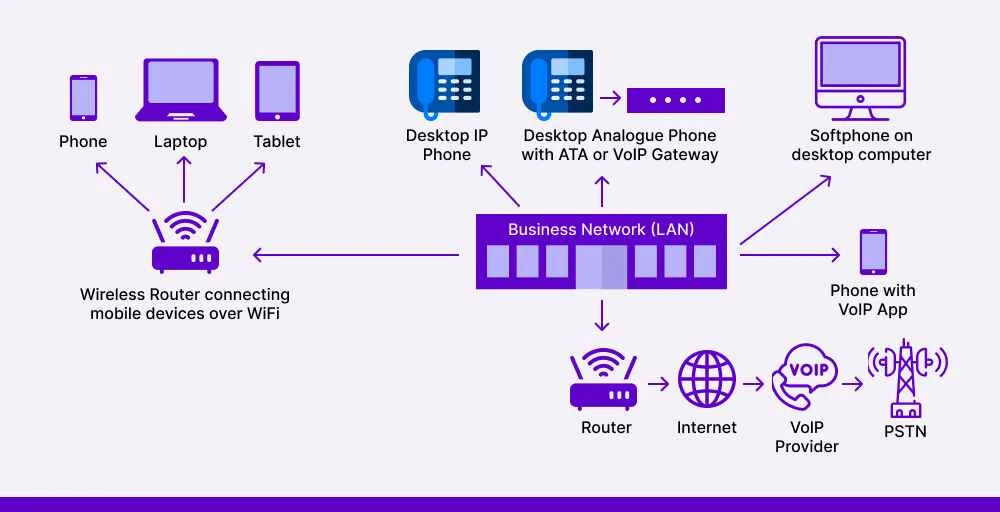
Cloud-based VoIP systems offer useful tools like auto attendants, integrations, call recording, smart call routing, and analytics. They also connect with CRMs to help agents access customer details quickly and provide better service. Some of the features of VoIP include:
- Call forwarding and routing
- Voicemail-to-email
- Virtual numbers for local presence
- Auto-attendants and call recording
- Real-time analytics and monitoring
2. Interactive voice response (IVR) systems
A well-designed IVR system creates a strong first impression by greeting callers and guiding them efficiently using voice prompts and menu options.
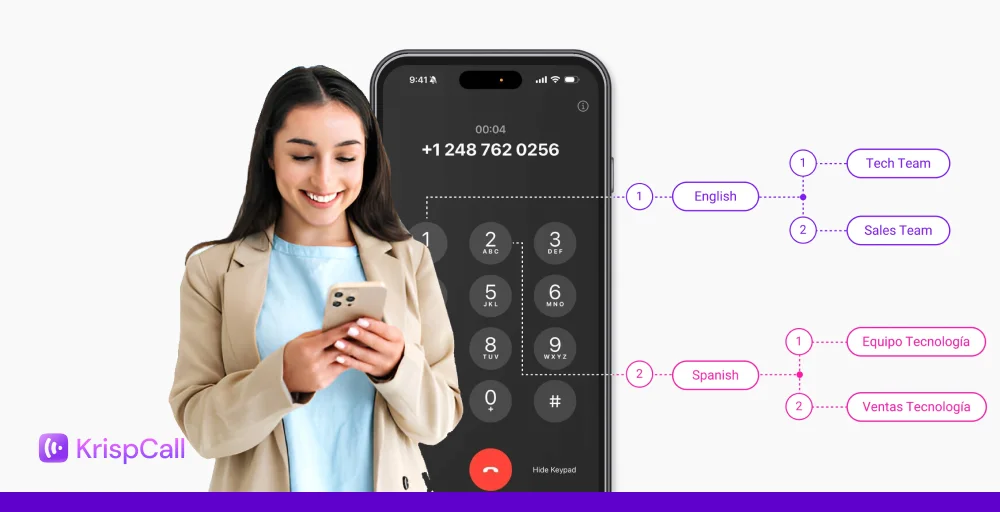
When callers make a call, IVR plays automated voice prompts or presents menu options like “Press 1 for Sales” or “Press 2 for Refunds” to guide callers to the right department. This ensures efficient call routing based on predefined rules, improving customer satisfaction by minimizing wait times and misdirected queries.
Modern IVR systems support both single-level and multi-level menus, offering advanced call routing and even self-service options for simple tasks, such as checking account status or tracking orders.
3. Automatic call distribution (ACD)
Automatic Call Distribution (ACD) is a core contact center feature that works right after the IVR captures the caller’s input. While IVR collects information and guides the caller, ACD takes over to intelligently route inbound calls to optimize call center operations by directing them to the right support agents or departments.
Using predefined logic, ACD assigns customer calls based on methods like skill-based routing, round-robin, least-idle agent, or priority-based distribution. This ensures a productive call center by connecting customers to the right person faster, improving service quality, and reducing wait times.
4. Computer telephony integration (CTI)
Computer telephony integration (CTI) is a call center software that connects your phone system with computer applications such as helpdesk platforms or Customer Relationship Management (CRM) platforms. The CTI fills the gaps between the voice communication and the customer data, allowing call center agents to access real-time caller information as soon as a call connects.
For instance, let’s say you call the customer service agents of KrispCall to enquire about your issue. When the call is connected, the agent’s screen automatically displays the caller’s information, including your name, address, and previous interaction.
The integration between the phone system and the CRM is possible through the use of CTI.
5. Voicemail to email
Voicemail-to-email offers a convenient way to deliver the message in the contact centers. This technology automatically converts voicemails into audio files and sends them as email attachments, reducing the tasks of agents manually dialing into a voicemail box to retrieve them.
This messaging feature streamlines the process, allowing agents to retrieve and respond to messages more effectively from their email inbox during remote work. It also provides valuable insights into customer sentiment and customer feedback, ensuring that no customer message is overlooked, resulting in consistent and reliable customer service.
6. Customer relationship management (CRM) integration
The CRM serves as the central hub for all customer-related data. This centralized system provides all the customer’s insights, including their personal details, activity such as purchase or ticketing history, and individual preferences.
The CRM integration also eliminates the need for agents to switch between distinct systems, providing instant access to a unified customer profile and thereby enhancing overall agent productivity. This ensures high-quality engagement across all communication channels, providing satisfied customer service.
7. Workforce optimization (WFO) & analytics
Workforce Optimization (WFO) is a critical set of integrated tools that helps to enhance contact center performance and efficiency. These comprehensive solutions make it easy to dynamically predict call volume and schedule agents effectively, based on agent skill set and service-level objectives.
Some centers even adopt simple digital check-in methods, such as using QR Codes for Attendance, to streamline shift tracking and ensure accurate workforce visibility across remote and on-site teams.
Combined call center analytics, WFO provides deep insights into agent productivity, customer behavior, and operational trends. Call center managers can then make data-driven decisions that continuously improve service quality, optimize workforce management, and customer satisfaction.
8. Cloud-based contact centers
This shift from legacy, on-premise hardware to cloud contact center platforms, including ai call center solutions is accelerating as more businesses adopt this cost-effective and user-friendly solution. With operations fully hosted in the cloud, companies gain unmatched scalability, allowing them to quickly scale up or down based on demand.
Cloud solutions also facilitate flexible work models, enabling remote and hybrid teams to work together from anywhere, at any time. Their distributed nature ensures strong business continuity and disaster recovery, so even during unexpected events, customer service remains uninterrupted and opportunities aren’t missed.
9. AI and machine learning in CX
Artificial Intelligence (AI) and Machine Learning (ML) are transforming the customer experience (CX). This transformative technology revolution is epitomized by conversational AI and natural language embedded within advanced chatbots and intelligent virtual assistants, enabling instantaneous, automated self-service for simple queries without human intervention.
Leveraging both historical data and real-time analytics, AI enables organizations to be proactive in providing targeted solutions and personalized support, often addressing issues before customers even realize there’s a problem.
10. Omnichannel communication tools (chat, email, social, etc.)
The unification of contact center platforms is transforming customer engagement by consolidating all communication channels, including voice, email, live chat, social media, and SMS, into a single, integrated system.
This centralized approach creates a complete customer profile, enabling agents to deliver more personalized and informed support. Furthermore, agents can access a full interaction history and provide seamless, personalized service across platforms, helping reduce call queues and improve first call resolution.
11. Security and compliance technologies
As data privacy regulations, such as GDPR, CCPA, and HIPAA, continue to evolve, contact centers must implement robust security and compliance solutions. These technologies are designed to protect customer data through strict, regulation-aligned protocols that minimize risk, ensure quality assurance, and meet compliance requirements.
Beyond meeting legal requirements, investing in strong data protection builds customer loyalty throughout their customer journey. When customer feel their personal information is secure, it strengthens their confidence in your brand, boosting both reputation and loyalty.
12. Knowledge management & agent assist tools
Knowledge management systems are foundational to efficient contact center operation, providing agents with quick access to a wealth of comprehensive, up-to-date information . This immediate access to accurate data significantly contributes to reducing resolution times for customer inquiries.
Alongside this, AI-powered agent-assist tools, utilizing Natural Language Processing (NLP), provide real-time guidance to agents during live interactions with suggestions, answers, and next-best actions to handle queries more effectively.
Benefits of using advanced call center technologies
The technology of advanced call centers offers a multitude of benefits, with a primary focus on enhancing the customer service experience. Let’s explore the benefits that businesses can gain by implementing contact center technologies.
Increased customer satisfaction
The modern contact center adopts numerous key advanced call center technologies and functionalities, especially crafted for the excellence of customer service. The features, such as Multi-level IVR, provide a smooth navigation experience to the customer as it offer various input options to choose from.
Another call handling feature, like Automatic Call Distribution, skill-based routing handled all the incoming calls and routed them to the agents who had expertise on those issues.
Likewise, the CRM integration ability empowers the agent to manage all the customer details on a single dashboard. These abilities are handy, especially when a user makes a call to resolve their issue. With those capabilities, staff can directly jump into the problem, instead of asking for personal details, leading to a positive customer experience.
Enhanced agent productivity
Modern call center automation tools are designed to handle routine tasks, reducing manual effort and boosting productivity. Solutions like intelligent callbacks, auto data entry, and intelligent shift scheduling help free up agents to focus on more complex issues where personalized support and human problem-solving truly make a difference.
Reduced operational costs
Reduced operational costs are a major benefit of cloud-based call center technology. Businesses can easily scale features up or down without investing in expensive hardware or infrastructure upgrades.
Cloud-based VoIP allows organizations to adapt quickly to changing market conditions, stay agile, and optimize resources, ensuring cost-efficiency without compromising performance.
Make data-driven and informed decisions
The analytics tools of the contact center provide profound insights into customer interactions, operational efficiency, and agent performance. Analyzing these tools enables managers to leverage real-time data, discern emerging trends, identify specific training requirements, and make data-driven strategic decisions.
By understanding the key metrics and patterns of customer interaction, staff can proactively address potential issues, enhance the workflow, and foster an effective support environment for both agents and customers.
Top contact center technology trends to follow
Organizations should be aware of emerging trends and implement the necessary measures to adapt to the growing industry. Here is the list of call center trends that need to be considered:
The rise of AI and automation across all touchpoints
Businesses are implementing automation across all communication channels, including voice, chat, and email. Some examples include intelligent virtual assistants and call center chatbots that are used to handle routine tasks and repetitive customer inquiries.
The caller’s data or even the past interaction can be analyzed through the contact center automation tools powered by AI. This will empower businesses to direct incoming calls to the most effective staff member at the center based on their previous interactions.
Omnichannel communication is now the norm in customer service
Modern contact centers are moving beyond phone support to meet customers wherever they are, email, live chat, social media, or self-service portals. To optimize omnichannel call center performance, businesses are now integrating all these touchpoints into a single, unified system.
This setup lets staff view previous interactions, no matter the channel, ensuring smoother and more personalized support. For example, a representative on a call can instantly access a customer’s past chat or email history, improving service quality and response time.
Remote and hybrid teams on the horizon
A cloud-based contact center enables service agents and staff to connect and work from anywhere, eliminating the need for a physical office. With all operations managed through cloud contact center software, teams can deliver support remotely while maintaining strong call center metrics such as response time, resolution rate, and customer satisfaction. This approach boosts flexibility, productivity, and business continuity.
Using analytics to enhance customer service
Customer interaction data holds valuable insights that businesses can turn into action. By analyzing patterns in both speech and text, companies can uncover customer pain points and highlight areas needing improvement.
When combined with operational analytics, this data helps identify inefficiencies and performance gaps. Supervisors can then use these insights to monitor performance more effectively and offer targeted coaching to boost service quality.
How to choose the right call center technology?
Selecting the right call center technology definitely requires a strategic approach and considerations. Take a closer look at this guide before choosing the technology for your business.
- Analyze your current needs and future goals: Evaluate your existing infrastructure, business objectives, and identify the pain points before choosing the technology. Ensure that you consider factors like expected call volumes, level of automation, and desired communication channels you need to achieve your goals.
- Prioritize customer-centricity and omnichannel capabilities: As the demands of customers are emerging, a seamless experience across all touchpoints is crucial. Make sure that the technologies offer robust omnichannel communication features.
- Evaluate the integration capabilities: Look for a system that can easily integrate with the software, such as CRM, ERP, or other help desk tools. The integrations will empower customer service representatives to unlock the unified data, automate workflows, and enhance the overall agent efficiency.
- Consider cloud-based solutions for flexibility and scalability: Choose cloud-based solutions for greater flexibility and scalability. They offer quick setup, minimal upfront costs, and can easily scale as your business grows.
- Focus on Analytics, AI, and Agent Enablement: Analyze whether the technologies include real-time analytics and reporting functionalities to gain actionable insights into performance. Look for the AI and automation tools, such as agent assistants and chatbots, to execute routine tasks and enhance agent productivity.