

You may have implemented a chatbot in your call center, but not received the intended result. The issue may not be the technology itself but rather how it was executed. Getting a high level of outcome from a chatbot requires effective implementation.
When deployed correctly, chatbots become more than just a communication tool that helps you transform customer service from reactive tasks into a proactive experience.
In this guide, we will explain what a call center chatbot is, its benefits, best tips, and some challenges when implementing.
What is a call center chatbot?
A call center chatbot is an AI-powered virtual assistant that utilizes natural language processing (NLP) and machine learning to understand customer queries and provide instant support across various platforms.
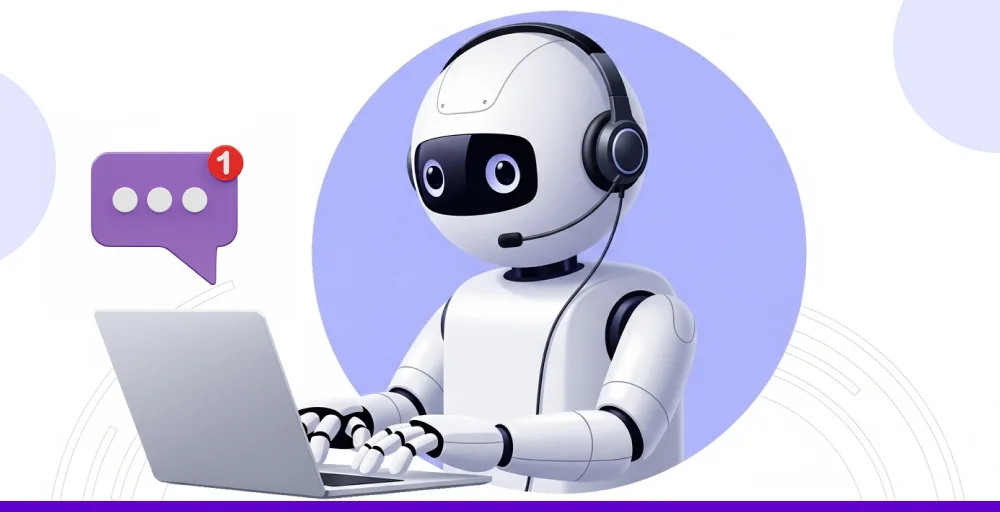
Chatbots in a call center can:
- Answer FAQs: Provide quick responses to common customer queries.
- Order and booking management: Assist with placing, tracking, or modifying orders and appointments.
- Customer account support: Helps users access account information, reset passwords, or update details.
- Lead qualification and routing: Collect basic information and direct potential customers to the right agent or department.
Whether it’s through social media platforms like WhatsApp and Facebook Messenger or other channels, a well-implemented chatbot enables you to meet customer needs efficiently.
Conversely, a poor execution can overwhelm agents with unproductive tasks, disrupt contact center workflows, and negatively impact the overall customer experience.
Call center chatbots vs. traditional customer support
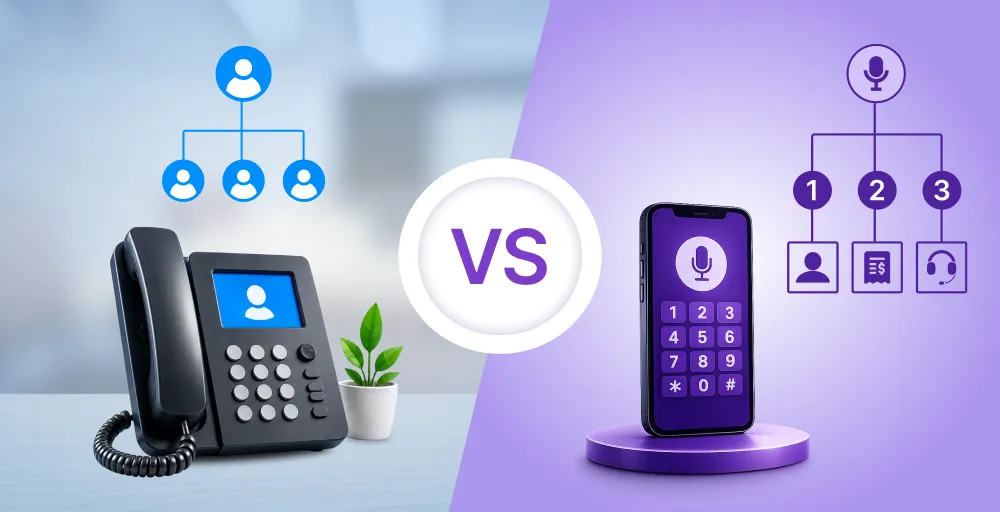
Traditional customer support involves providing customer support through phone calls, where human agents are often required, even for basic inquiries. But with chatbots, customer can resolve their basic issues instantly through automated interactions.
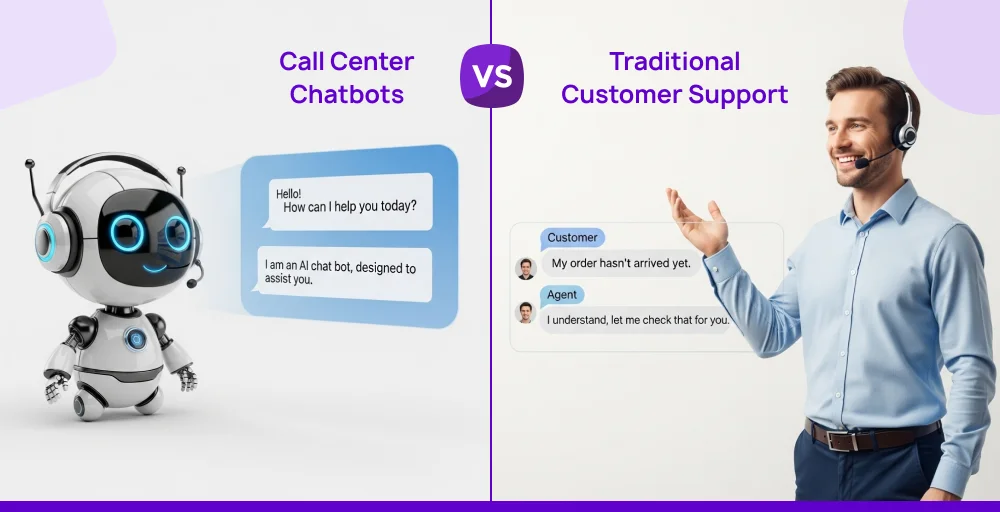
Here is a comparison table between contact center chatbots and traditional customer support for better understanding.
| Feature | Call Center Chatbots | Traditional Customer Support |
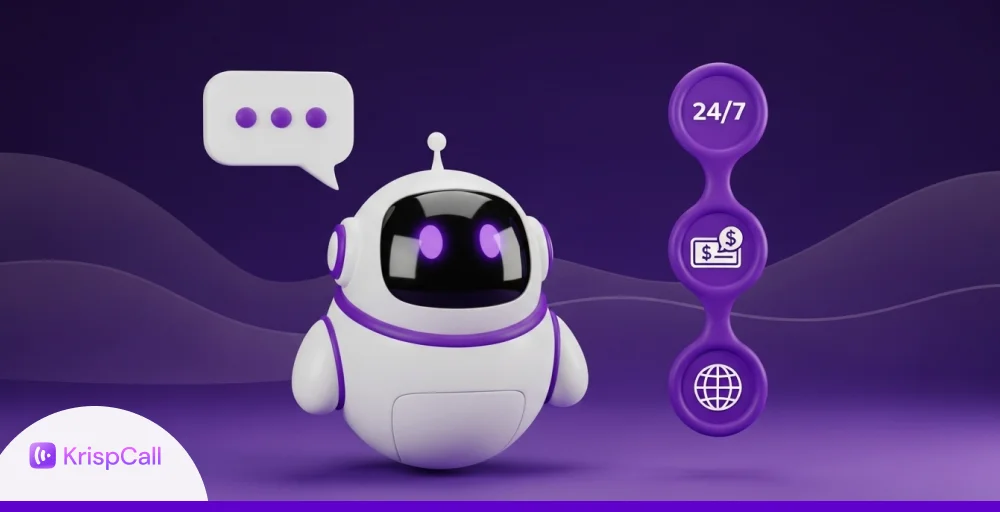
| Availability | 24/7 automated support | Limited to business hours |
| Response Time | Instant answers for routine queries | Longer wait times depend on agent availability |
| Handling Routine Tasks | Fully automated | Handled by human agents, slower |
| Escalation of Complex Issues | Seamless handoff to live agents | Managed directly by agents from the start |
| Cost Efficiency | Reduces operational costs by handling repetitive tasks | Higher costs due to full reliance on human agents |
| Scalability | Easily scales to handle high volumes of inquiries | Scaling requires hiring more staff |
| Customer Experience | Fast, consistent, and personalized when integrated properly | Personalized, but may have delays and inconsistencies |
Benefits of using chatbots for call center operations
Integrating a chatbot into your call center operations can:
1. Shorten response time
Customers feel frustrated waiting a long time to resolve their issues. Implementing a chatbot can provide instant support to customers, reducing wait times. A chatbot can efficiently handle routine inquiries like checking order statuses, answering billing questions, and providing product or service information.
An AI chatbot can generate support tickets and intelligently route more complex issues to the most appropriate human agents. Providing a quick response helps improve customer satisfaction.
2. Lower support expenses
As per Zendesk, AI and automated systems manage 85% of customer interactions without requiring human involvement. This demonstrates that businesses need to hire fewer human agents, significantly reducing staff and training costs.
3. Gather client data
A chatbot can gather valuable customer data from each interaction, allowing you to track user behavior, identify recurring questions, and capture customer preferences or feedback in real time. This information helps businesses recognize trends, uncover customer pain points, and improve service delivery.
4. Expand flexibility and growth capacity
A chatbot can easily manage the increased customer questions without compromising service quality. Unlike human agents, chatbots don’t have limits on how many interactions they can handle at once. It makes them highly scalable during peak hours or seasonal surges.
This flexibility allows businesses to expand their customer base without a proportional increase in staffing costs.
5. Increase operational efficiency
Chatbots not only handle common customer inquiries. It also manages repetitive call center tasks like appointment scheduling and order processing, enabling agents to focus on more complex issues that require human attention.
For instance, a chatbot can collect user details such as date, time, and service, check availability through calendar integration, and automatically send booking confirmations.
Best tips for implementing chatbots for a call center
Simply implementing a chatbot isn’t enough to boost a call center’s efficiency. Following best practices when integrating a chatbot solution into your call center operations is crucial for improving performance, streamlining operations, and enhancing the customer experience.
Here are the essential tips to follow for proper implementation:
1. Start small for a smooth chatbot implementation
Starting small allows you to test, learn, and refine the chatbot before rolling it out across your entire call center, ensuring a smooth experience for both customers and agents.
Define the bot’s purpose clearly and set expectations for what it can and cannot handle. Make sure there’s a seamless handoff to human agents for complex issues. Leverage customer data to personalize interactions, keep messages short and conversational, and continuously train the AI with feedback and new information.
2. Develop a strong and reliable knowledge base
You can create a knowledge base using customer service chatbot tools like Help Scout or note-taking apps such as Slite or Notion. A well-structured knowledge base provides the accurate and relevant responses the bot needs. Without it, chatbots may deliver incorrect answers or take longer to resolve customer issues.
Regularly review, update, and manage the content to ensure that your chatbot always has the most reliable data to support your customers effectively.
3. Make sure to use AI capabilities
Leverage artificial intelligence to help your chatbot learn and get better over time. Advanced AI techniques like natural language processing (NLP) also help the chatbot understand language variations.
Features such as entity recognition and information extraction enable the bot to pull relevant data from user interactions, company updates, or even external sources, making its responses more accurate and contextually relevant.
4. Ensure human support is available
Even the most advanced chatbot can’t handle every situation on its own. A human-in-the-loop approach lets chatbots work alongside call center agents. The bot manages routine queries autonomously, while agents step in for complex issues, quality checks, or training purposes.
There are multiple ways to implement this. For instance, a human can review and approve AI-generated responses before they reach the customer, ensuring accuracy for critical or high-risk inquiries.
The chatbot can also be programmed to flag challenging conversations and request human assistance whenever necessary.
5. Track and evaluate performance.
Once your chatbot is live, consistently track its performance. The key metrics include:
- Containment rate: Measures the percentage of inquiries fully resolved by the chatbot without needing human intervention.
- First call resolution (FCR): Tracks how often the chatbot resolves customer issues on the first interaction without follow-ups.
- Average handle time (AHT): Calculates the average time the chatbot spends managing a customer inquiry, indicating efficiency.
- Customer satisfaction (CSAT): Reflects customer feedback on how satisfied they were with the chatbot interaction.
- Escalation rate: Shows how often conversations are transferred to a human agent, highlighting the chatbot’s limitations.
6. Stay updated with emerging technologies
To build a productive, future-ready contact center workflow, keep up with AI chatbots for customer service, where innovations are crucial. Here are some key chatbot developments shaping the industry:
- Personalized interactions: AI can now deliver highly tailored conversations by analyzing customer history, preferences, and real-time context. This goes beyond basic responses, creating interactions that are relevant, nuanced, and specific to each individual.
- Streamlined voice authentication: Voice biometrics are increasingly used for secure, seamless verification. Customers can be authenticated during calls or chats without relying on lengthy security questions.
- Proactive AI solutions: AI-powered chatbots leverage predictive analytics to anticipate customer needs. By analyzing past interactions, they can provide proactive solutions, often resolving issues before the customer even reaches out.
- Empowering human agents: The rise of “super agents” demonstrates how AI equips support reps with real-time insights, recommended actions, and relevant customer context. This enables agents to resolve issues quickly while maintaining high-quality service.
Challenges of implementing chatbots in a call centers
Implementing chatbots in a call center is not an easy process. While integrating a chatbot solution, you face several challenges that hinder the growth and long-term plans of your call center. Some of them are:
1. Misinterpretation of customer intent
As chatbots are not human, it may be challenging for them to understand and respond to customer queries. As human emotions, sentiments, and language are dynamic, so too are your train chatbots; they will never be able to understand them.
Many chatbots depend on predefined rules and keyword matching to interpret user input, which can often result in significant misunderstandings. In 2025, 49% of CX leaders believe chatbot conversations should escalate to human agents only after checking intent, highlighting the issue of misinterpretation.
Chatbots also struggle to pick up tone or emotion, which makes it easy to misread sarcasm, frustration, or strong feelings. These gaps not only hurt the customer experience but also risk pushing users away when they want genuine understanding and support.
Ways to resolve it:
- To handle complex queries, try to use advanced natural language processing (NLP) models.
- Add a feedback section so that customers can review or correct the chatbot response for better understanding.
- Redirect to a human agent if the chatbots are unable to respond confidently to the customers’ queries.
2. User resistance
Though the usage of chatbots in call centers is increasing day by day. But customers still prefer to wait in a long queue for human agents rather than contacting chatbots to resolve their issues. Because most of the users believe that human agents understand their emotions, offer live chat support, can resolve their complex issues, and, most importantly, can protect their sensitive information.
But, if your customers still prefer to use human agents rather than chatbots, it will directly affect the growth of your business, as it deters the adoption of technology, increases operational costs, and consumes resources.
Ways to resolve it:
- Let your customers know what your chatbot can and cannot do, and explain their clear purpose of usage, like reviews, issue solving, providing customer service, FAQs, etc.
- Make it easy for customers to switch to a human agent from chatbots when it’s necessary. This builds trust while still showing the chatbot’s value.
- Provide helpful guides like short videos or demos to let them know how to use chatbots.
3. Technical integration issues.
Integration of chatbots is a simple process, but making such integration workable after completing such operations for your call center is another matter. As you know, call centers are not only just about chatbots; they depend on various other applications such as customer data platforms, VoIP phone systems, CRM, and business communication tools.
So, if your chatbot cannot work effectively with your existing tools, then it creates a significant challenge in the workflow of your call center.
Ways to resolve it:
- Try to choose a platform that can easily be deployed and integrated with your existing system, like KrispCall.
- Verify that the chatbot platform is compatible with your integration system, whether it’s a website, app, CRM, or other software.
- Before buying it, test the platform to verify whether it can integrate with the integration and customer interaction process to work effectively.
4. Ethical considerations and data privacy
As chatbots become more prevalent, prioritizing ethical practices and data security is essential. To maintain customer trust, safeguard your brand, and comply with regulations, focus on key areas like data security and transparency.
Add the encryption of sensitive information and restrict access to safeguard customer data. Ensure compliance with regulations such as HIPAA in healthcare, along with GDPR, CCPA, and other applicable laws for your call center. Before interacting with customers, inform them that they are interacting with a chatbot and provide easy access to connect with a human agent.
Ways to resolve it:
- Let chatbots do simple, repeated tasks.
- Keep tough or sensitive talks for human agents.
- Don’t replace your call center staff, just support them.
Transform customer support with intelligent chatbots with KrispCall
KrispCall helps businesses transform customer support with intelligent, AI-powered chatbots capable of human-like, dynamic conversations at scale. These self-learning bots can be integrated seamlessly across multiple channels, providing timely, omnichannel support wherever your customers are.
This ensures consistent and fast assistance while freeing human agents to focus on complex or sensitive issues, boosting both productivity and agent satisfaction.
Boost efficiency, enhance customer experiences, and empower your agents with KrispCall’s AI-powered chatbots.
Get started today and transform the way your business connects with customers.