


Over the past few years, the contact center environment and operations have undergone significant transformations. As the customer demands increase, the contact center industry finds a way to keep up with the trends.
This includes adopting smarter technologies and delivering faster and personalized service across multiple channels to enhance customer engagement.
And yet, many businesses struggle to meet these expectations due to the increased demands for 24/7 customer support, tighter security regulations, and pressure to reduce costs.
So, what is the solution?
We must figure out the latest call center trends that are reshaping how service teams operate and engage as of now.
In this blog, we will be discussing all of it, the current and the future of contact center trends, along with the top 8 trends you wish you had known earlier.
Let’s get started!
✨ Key Takeaways
- Artificial intelligence is revolutionizing contact centers by automating repetitive tasks, assisting agents in real time, and predicting customer needs.
- Customers prefer self-service options like IVR, chatbots, and web support, enabling businesses to provide 24/7 assistance while reducing costs and agent workload.
- AI-driven analytics now provide real-time insights, predicting customer behavior and enabling hyper-personalized experiences that boost satisfaction, loyalty, and retention.
- Businesses are increasingly adopting cloud-based contact center solutions for scalability, remote work flexibility, and enhanced data security compliance.
8 contact center trends in 2026
Contact Center has constantly evolved over the past few years, and sets up a new trend each time. Currently, the businesses that are behind the call center industry trends may face significant losses. So, keeping up with the future of the call center is the new normal.
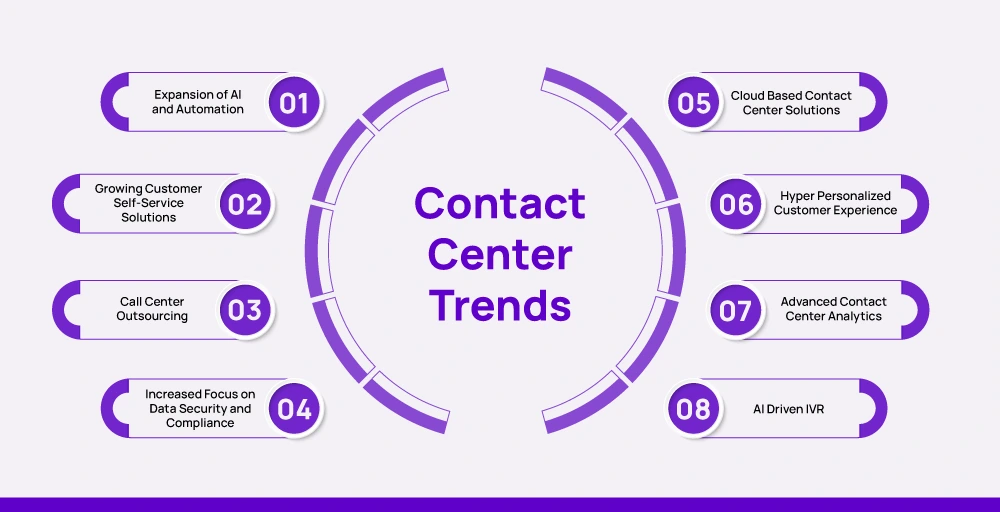
Let us discuss the top 8 contact center trends in 2026 that no business should miss.
1. Expansion of AI and automation
AI today is more powerful than ever. It can handle most repetitive tasks with a better result in no time. With the introduction of AI chatbots and responses, business tasks have become easier than ever.
With advanced AI features, bots will handle minor and repetitive tasks, allowing agents to concentrate on tasks that require empathy and critical thinking. Not only that, many businesses also adopt automation tools like an AI Video Maker to quickly produce customer-focused content

As Forbes predicted, “AI will power 95% of customer interactions by 2025, and 19 out of every 20 customer interactions will be AI-assisted by 2025”. This is now a reality, with AI driving the majority of customer support interactions across industries.
The use of artificial intelligence amplifies the performance of agents with real-time insights, customer history, and flags on potential issues.
For example, imagine AI identifies a customer query and automatically routes the call to the designated agent, or it predicts the most common pattern in the customer query and provides the necessary insights. This can prepare the agent with relevant context prior to addressing the problem. This level of robotic process automation can be a valuable asset for the business.
But AI alone is not capable, as it depends on human strategy. Contact center managers should thoughtfully combine agent-assist tools, predictive analytics, and generative AI to improve agent performance and meet customer needs in real time.
2. Growing customer self-service solutions
Aberdeen research shows that 85% of contact centers already use self-service capabilities (e.g., web self-service, IVR, chatbots, online communities) to enable customers to help themselves.
Customer self-service is becoming more popular for contact centers in 2026 as they prefer to solve problems on their own. With self-service options, businesses can help customers find answers and resolve service requests without needing to wait for a live agent to handle customer interactions.
Self-service tool is a reliable trend in 2026 because,
- For customers, it provides 24/7 access to support, faster answers, and greater convenience.
- For businesses, it reduces support volume, lowers agent workload, and cuts operating costs while still delivering high-quality service.
You can successfully implement or upgrade self-service in your contact center with 4 easy steps.
Step 1: Identify the most common queries of the customer and provide clear answers.
Step 2: Use analytics to monitor what customers are searching for and where they mostly get stuck.
Step 3: Train your AI models to learn and improve responses continuously.
Step 4: Finally, make it easy for customers to route to a live agent if their issue isn’t solved.
3. Call center outsourcing
Most of the businesses are shifting to call center outsourcing due to the continuously rising customer expectations and fluctuating labor costs.
Modern outsourcing involves specialized service providers (who bring domain knowledge), advanced call center technology trends, and multilingual support. Some of the popular outsourcing models that meets the emerging call center industry trends are: Offshore, Nearshore, Onshore/Domestic, and Hybrid.
Businesses can focus on core growth while the BPO (Business Process Outsourcing) manages many call center operations with the help of outsourcing. It also improves KPI metrics like FCR, CSAT, and AHT to make sure performance benchmarks are met while improving agent efficiency.
Here are a few reasons why outsourcing is driving the trend:
- 24/7 global coverage: Outsourced centers operate across continents to maintain continuous support.
- Access to specialized skills: It empowers agents for a specific niche.
- Cost optimization: Outsourcing reduces contact center costs for in-house staffing and infrastructure costs.
- Speed to scale: Companies can instantly expand teams during seasonal spikes or product launches without the long hiring process.
How to outsource in the right way?
- Define clear Objectives
- Choose the right Partner
- Start with a specific campaign or support function before outsourcing everything.
- Maintain Oversight (Use shared dashboards, regular check-ins, and SLAs)
4. Increased focus on data security and compliance
In 2026, contact centers are facing increasingly strict regulations and evolving cyber threats. With personal data flowing through every call, chat, and ticket, security and compliance are more important than ever, especially with the use of virtual private networks and vpn multi-factor authentication.
With AI expanding in contact center automation, data is more valuable and vulnerable than ever. Customers trust you with their most personal moments. Make sure your systems honor that trust, or risk losing them permanently. With rising cyber threats and a new wave of data privacy laws, security is a front-line concern for the customer experience.
What’s new in 2026?
Emerging trends in contact centers have better tools than ever to stay protected and compliant:
- End-to-end encryption for voice, chat, and email
- Zero Trust Architecture (ZTA) for agent access control
- Automated audit trails to track every interaction for compliance
- Real-time Data Loss Prevention (DLP) solutions that detect and flag sensitive information leaks.
- Multi-Factor Authentication (MFA) and Role-based access control (RBAC) for human agents and supervisors.
If you are not sure about the compliance of your business, you can start with this quick audit:
| Audit checklist for security and compliance in 2026 |
| Businesses should pass this audit to stay up to date with contact center future trends: ✔ Are your agents using secure, company-managed devices? ✔ Do you log and monitor all customer interactions? ✔ Are you storing customer data only as long as necessary? ✔ Can customers easily access, correct, or delete their data? ✔ Are your vendors and partners fully compliant with your standards? ✔ Is multi-factor authentication enabled across your tech stack? ✔ Are regular tests and security training in place? |
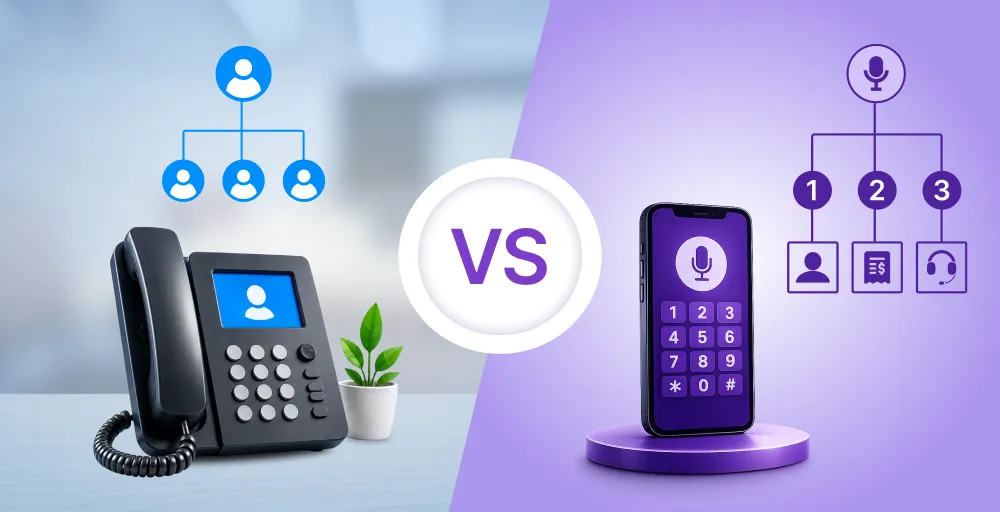
5. AI-driven IVR
Interactive Voice Response (IVR) has long been the frontline of customer service, but in 2026, it can actually understand what customers are saying, not just what buttons they press.
With AI-driven IVR, customers can speak in their own words and be understood accurately using Natural Language Processing (NLP). These systems learn from every interaction. Over time, they become better at predicting needs, recognizing returning customers, and offering relevant solutions before the customer even finishes their request.
AI-driven IVR is becoming a strategic asset for enhancing customer satisfaction and reducing operational load. And as voice technologies continue to advance, expect IVR to play an even more central role in delivering intuitive, 24/7 support.
AI-driven IVRs can:
- Instantly identify the intent of a call
- Route customers to the right agent without bouncing them around
- Deflect routine queries with intelligent self-service
- Even authenticate users with voice biometrics for added security
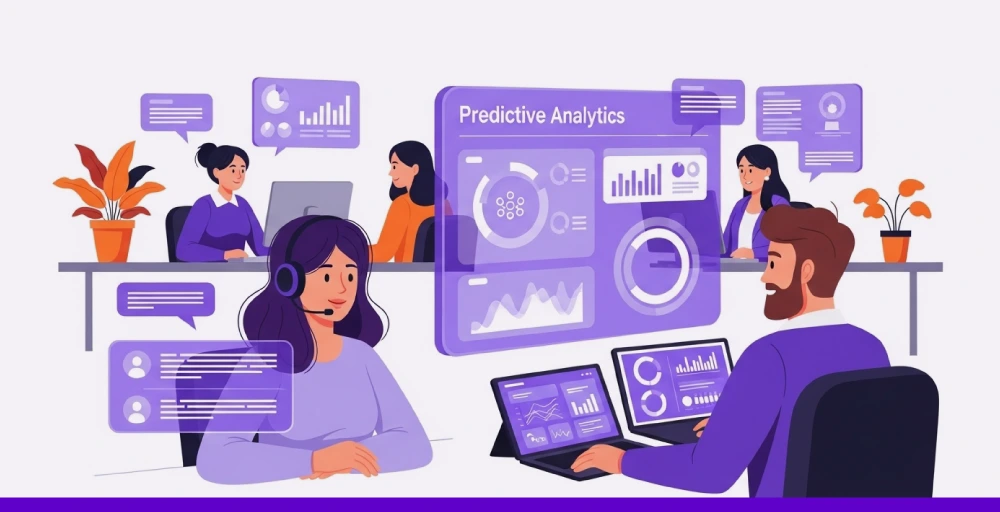
6. Advanced contact center analytics
The days when contact center analytics consisted of a collection of dashboards that showed yesterday’s performance are now gone. In 2026, analytics will be used to guide what should happen next.
Modern contact center industry trends are relying on AI-powered solutions, advanced speech analytics, and real-time dashboard insights that extend far beyond traditional metrics. It’s not just about how many calls were answered or how long they lasted. Today’s tools are spotting patterns, analyzing tone, and even predicting which customers are likely to churn or escalate.
You’re no longer just asking, “How many phone calls did we take?” Instead, you’re uncovering insights like:
- Why are customers contacting us?
- Which agents drive the most satisfaction?
- What phrases signal a churn risk?
- Which channels convert best for upselling?
With AI, machine learning, and cloud-based systems in play, future contact center technology now has access to real-time, multichannel insights. Advanced call center analytics help forecast call center operations, pinpoint training needs, and ensure the right virtual agents are available at the right time.
In short, analytics have evolved from being a mirror of performance to a compass for smarter decision-making. As the future contact center trends continue to advance, the most effective data will turn into real-time action.
7. Hyper-personalized customer experience
Customers have digested the personalized experience by now. Now they seek something extra, something that feels more personal and relevant to them. They want you to remember their preferences and pain points from past interactions. They expect the hyper-personalized customer experience, and if your business fails to meet that, you may lose a potential lead or a loyal customer.
It’s not just about the number of sales you make, but also about how many leads you can effectively manage, how many loyal customers you have, and how much your brand prioritizes converting new leads. With technologies like AI, machine learning, CRM integrations, omnichannel data syncing, and customer data platforms (CDPs), that level of precision is achievable.
These tools work together to ensure every business interaction feels like a personalized conversation.
Hyper-personalization is directly tied to core business outcomes as it helps to:
- Increase customer satisfaction (CSAT): People feel valued when service is tailored to them.
- Boost loyalty & retention: Personalized experiences build trust and emotional connection.
- Drive revenue: Happy, loyal customers are more likely to spend and recommend your brand to others.
- Reduce churn: Customers are less likely to leave when their experience consistently meets or exceeds expectations.
According to McKinsey, 71% of consumers expect personalized interactions, and 76% get frustrated when they don’t receive them.
This simply means that even small steps can make your brand feel more personal and less robotic.
8. Cloud-based contact center solutions
Contact center operations can no longer keep up with the emerging trends without switching to private cloud systems for greater data security. Cloud contact center solutions are more reliable and easily scalable than traditional ones. In a world where agility matters the most, cloud gives you the freedom to adapt, grow, and respond in real time. It is easy to use and does not rely on the physical location.
If you wonder why contact center technology trends are moving to the cloud, well, traditional on-premise contact centers simply can’t keep up with today’s fast-changing demands. It simply offers:
- Remote work capabilities: Allows customer service agents to work from anywhere with just an internet connection.
- Faster innovation: Get instant access to new features, updates, and AI tools without costly upgrades.
Tips for a smooth migration to the cloud for operational efficiency and lead generation
You need the right strategy before transforming/ moving your business to a cloud platform.
- Start with a needs assessment: Understand your goals: Is it remote enablement, cost savings, or omnichannel expansion?
- Choose a scalable vendor: Pick a provider that grows with your business and offers top-tier support.
- Plan a phased rollout: Migrate in stages to reduce disruption, test functionality along the way, and monitor post-migration KPIs
A cloud migration is a transformation of how your business connects with its customers.
In 2026, cloud-based contact centers offer the freedom to operate globally, scale instantly, and innovate continuously. For businesses that want to stay competitive and customer-focused, the cloud is the only way forward.
Related 👉: Modern Contact Center Requirements: Key Hardware & Software
Stay ahead of call center trends with KrispCall!
As you have noticed so far, businesses are struggling a lot to keep up with the trends. Join KrispCall today to stay ahead of the trends and keep up with the constantly changing business workflow based on customers’ interactions.
At KrispCall, we provide actionable insights into key contact center trends that will help you handle support capacity and keep you ahead of the curve, improving agent productivity.
Book a free demo to understand how KrispCall turns your business interaction into actionable leads. With KrispCall’s contact center features like AI Reply, Unified Callbox to handle all interactions, call recording and transcription, interactive voice response (IVR), call monitoring and analytics, CRM and workflow integrations, and global virtual numbers, you can always stay one step ahead of your competitors.