


If you’re considering Vonage Business Communications (VBC) as your cloud-based phone system, getting a clear picture of its pricing is crucial.
Though Vonage has long been a pioneer in VoIP and unified communications, offering reliable call quality, mobile apps, and integrations that appeal to businesses of all sizes, its pricing model has grown increasingly complex.
Whether you’re a small startup or a growing enterprise, getting a clear understanding of all the costs, including add-ons, regulatory fees, and service-specific charges, is essential.
This clarity ensures you can choose a plan that truly fits your communication needs without unexpected expenses.
This comprehensive guide breaks down everything you need to know about Vonage pricing, from their three main plan tiers and feature sets to hidden costs, missing capabilities, and how it compares against modern alternatives.
✨ Key Takeaways
- Vonage offers three pricing plans: Mobile ($13.99/user/month), Premium ($20.99/user/month), and Advanced ($27.99/user/month) plans with annual billing, providing significant savings over monthly commitments.
- Beyond advertised base rates, businesses face add-on fees ranging from $4.99 to $49.99 per month for essential features like automatic call recording, Salesforce integration, call queues, and toll-free numbers, plus 10-30% in regulatory surcharges.
- Modern VoIP providers like KrispCall offer transparent pricing starting at $12/user/month with included features that Vonage charges extra for, plus no long-term contracts, making them more cost-effective for small to mid-sized businesses.
Vonage plans and pricing overview
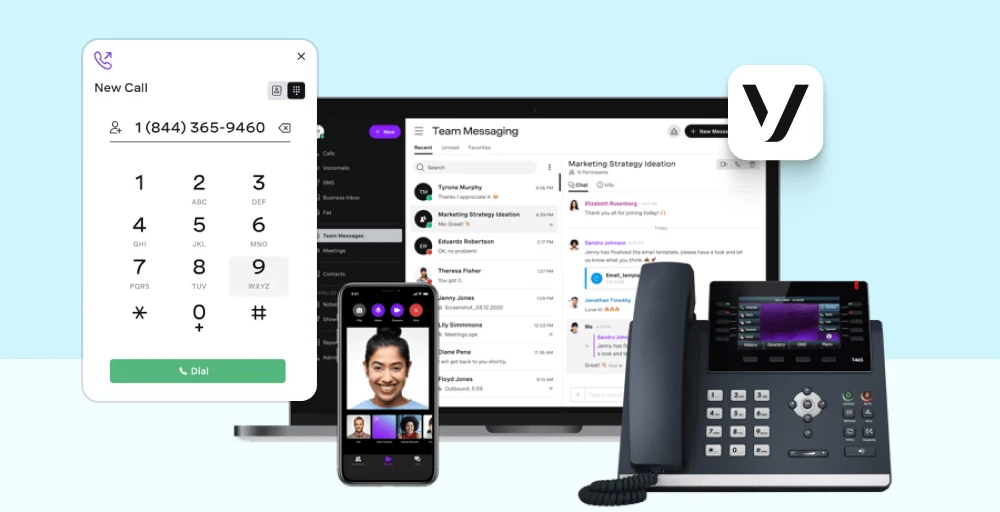
Vonage offers its business phone service, Vonage Business Communications (VBC), through three main tiered plans: Mobile, Premium, and Advanced. Pricing is based on the number of lines/users and whether you choose annual or monthly billing. These plans are often considered by companies building VoIP call center setups for sales and support teams.
Here is a breakdown of the plans and starting annual pricing for a small number of users (1–4 users):
| Feature | Mobile | Premium | Advanced |
| Pricing per month per line | Starts at $13.99 | Starts at $20.99 | Starts at $27.99 |
| SMS and MMS | Yes | Yes | Yes |
| VBC Desktop App | Yes | Yes | Yes |
| Team Messaging | No | Yes | Yes |
| Call Groups | No | No | Yes |
| Unlimited Domestic Calling | Yes | Yes | Yes |
| VBC Admin Portal | Yes | Yes | Yes |
| Visual Voicemail | No | No | Yes |
| VBC Mobile App | Yes | Yes | Yes |
| Call Groups | No | No | Yes |
| Vonage Meetings | No | Yes | Yes |
| Phone Number Porting | Yes | Yes | Yes |
| Virtual Receptionist | Yes | Yes | Yes |
| Single Sign-On | No | Yes | Yes |
| On-Demand Call Recording | No | No | Yes |
1. Mobile
The Vonage Mobile plan is the entry-level option, priced at $19.99 per line per month (billed monthly) or $13.99 per line per month with annual billing. The mobile plan offers just the basic features of VoIP, and they are:
- Support desktop and mobile apps
- Unlimited domestic calling
- SMS and MMS
- Voicemail
- VBC Admin Portal
The plan is ideal for small businesses or remote teams that need basic calling and messaging without advanced collaboration features.
However, it lacks team messaging, video conferencing, and advanced integrations, which limit its usefulness for larger or more collaborative organizations or any outbound call center focused on sales automation.
2. Premium
The Premium plan costs $29.99 per line per month (billed monthly) or $20.99 per line per month with annual billing. It includes all Mobile plan features, plus:
- Team messaging and file sharing
- Video meetings (up to 200 participants)
- VoIP desk phone support
- Single sign-on and advanced integrations
This plan is the top choice for mid-sized businesses that need simple VoIP features, video meetings, and some integrations.
But it has limitations in integration, like it lacks Pipedrive integration, or you need to pay extra for Salesforce integrations. Also, call handling features lack call recording, voicemail transcription, or call groups.
3. Advanced
The Advanced Vonage business plan is the top tier, priced at $39.99 per line per month (billed monthly) or $27.99 with annual billing.
With this plan, you will get these capabilities:
- Call groups
- On-demand call recording
- Visual voicemail with transcription
- Advanced analytics and reporting
This plan is best for larger businesses or enterprise teams that need strict compliance requirements or customization options along with advanced call management features.
Though this plan seems reliable, it still lacks basic features like automatic call recording or a shared phone number. An AI virtual assistant is only available if you pay an extra charge.
Other Vonage options and add-ons
Beyond the advanced plans, Vonage offers a range of add-ons to personalize your unified communications setup further. Though these features make your small business phone system more advanced, they also raise the total cost.
Here are some of the paid add-ons:
- AI transcript on-demand call recording
- AI virtual assistant
- Business call recording service
- Business inbox
- Call queue
- Conference bridge
- International phone number
- IP phone paging system
- Local business phone number
- Local paperless fax
- Secondary line appearance
- Virtual extension and mailbox
Extra costs and hidden fees in Vonage plans
While Vonage advertises competitive base pricing, several additional costs can significantly increase your monthly bill:
1. Number porting and setup costs
Businesses should be aware that there may be activation fees when porting phone numbers to the Vonage system.
If you choose professional setup or dedicated hardware, you may face activation fees and on-site installation charges. While self-installation can help you avoid these costs, many companies still end up paying them.
2. International calling
Even though unified communications are available, international calling requires a separate service with minute bundles, adding complexity to billing. Usually, international calling is not part of base plans and is billed separately.
As a result, rates for global calling can be high and inconsistent unless you buy specific packages. This can lead to unexpected costs for businesses when they call overseas clients.
3. Taxes and regulatory fees
Several extra fees, such as the Federal Program Fee, Regulatory Compliance Fee, and Intellectual Property Fee, along with state-specific charges, can increase advertised rates by 10-30%, affecting scalability for contact center solutions.
In some plans, you may also see fees for regulatory recovery, emergency services, and universal service added to the advertised rates. This can raise the actual monthly cost by several dollars per line.
4. Early termination fees
Vonage’s standard one-year contract imposes early termination fees that require businesses to pay the full remaining balance if they cancel. It’s essential to be aware of these penalties before committing to the service.
What’s missing in each Vonage plan?
Vonage’s Mobile plan is its basic option, but it lacks key features that modern business phone apps need. Most importantly, it lacks video conferencing, so you need other apps for video meetings. It also lacks team messaging, forcing employees to use third-party apps like Slack or Microsoft Teams, which disrupts clear communication.
The Premium plan offers video conferencing for up to 200 participants and basic integrations, but has notable limitations. Call recording is manual rather than automatic, posing compliance risks for regulated industries. Integrations are limited to about 20 third-party apps, excluding popular CRMs like Pipedrive, and incur no extra fees, which could hinder specialized software workflows.
Even at its highest tier, Vonage’s Advanced plan lacks key features compared to competitors at similar price points. While it offers automatic call recording, storage limitations, and no advanced transcription, businesses are left reliant on manual processes. Those who need detailed analysis or AI insights must turn to expensive third-party options. Although its analytics are more comprehensive than those of lower tiers, they still lack predictive capabilities.
Related 👉 Explore Ooma Pricing & Plans in Detail
Vonage plan & pricing compared to competitors
Vonage is a top choice for businesses that want flexibility and customization. Your decision will depend on whether you prefer a low starting price or a fully loaded package. It lets you build a phone system tailored to your budget and workflow. But it may not be suitable for virtual call center businesses due to its hidden fees for advanced features.
KrispCall has emerged as a compelling Vonage competitor, particularly for small to mid-sized businesses seeking transparent pricing without hidden fees. This cloud-based phone system provides comprehensive features, including local and international numbers from 100+ countries, a Unified Callbox for managing all conversations, CRM integrations, and AI-powered capabilities.
G2 Review: The support before and the live support have been brilliant! The ease of using an Australian number to call Australian businesses is a game-changer for me as I live in Spain…OZ Folks don’t pick up European numbers often. Thanks for this amazing set up. My pick-up call rates have jumped from 3.45% to 35% on cold outreach alone.
— Craig M., Co-Founder, Small Business (50 or fewer employees)
Unlike Vonage’s complex add-on structure, KrispCall bundles essential features into straightforward plans with predictable monthly costs. Here’s the general overview of KrispCall pricing plans:
Essential plan
The Essential Plan starts at $12 per user/month (billed annually) or $15 per user/month (billed monthly), making it significantly more affordable than Vonage’s entry-level option.
This plan includes up to 5 users, unified callbox, number porting, call analytics, and integrations with platforms like Slack.
Standard plan
The Standard Plan costs $32 per user/month (billed annually) or $40 per user/month (billed monthly), and is targeted at mid-sized businesses and call centers.
This tier removes user limitations and adds advanced features, including IVR (phone trees), call transfer, API and webhook access, unlimited call recording and storage, and integrations with popular CRMs like Pipedrive, HubSpot, and Salesforce.
Enterprise plan
The Enterprise Plan offers custom pricing tailored to large organizations with complex requirements. It includes everything in the Standard plan plus developer support, a dedicated account manager, and bundled calling/SMS rates for high-volume users.
Notably, KrispCall provides a 14-day money-back guarantee and a 20% discount on annual subscriptions, demonstrating confidence in their service quality.
Core features you’ll get with every plan
Every KrispCall subscription includes a robust suite of communication tools. Users can manage interactions through a unified callbox and access features like number porting, call monitoring, and advanced filtering for voicemails and messages. The platform simplifies outreach with bulk SMS and contact importing, while offering professional controls such as call barging, caller ID, and AI copilot.
Furthermore, most tiers allow for seamless CRM integrations to streamline your workflow and provide detailed analytics to monitor and improve team performance.
Best features of Vonage and KrispCall
Vonage and KrispCall are both reliable VoIP business phone systems, but they significantly target different customer needs.
Features of Vonage
- Advanced single sign-on (SSO): This allows you to access Vonage with a single login across multiple apps, improving security and saving time by reducing repeated logins.
- On-demand call recording: This feature lets users record calls whenever needed, rather than automatically recording every conversation. It is helpful for training, compliance, and reviewing essential customer interactions.
- Visual voicemail: With this, you can display voicemail messages in a list so users can easily choose which message to listen to first. It saves time by eliminating the need to listen to messages sequentially.
- Fax Service: Vonage provides both digital and traditional faxing capabilities directly through its platform. This helps your businesses send and receive faxes without needing separate fax machines.
- Virtual Receptionists: The virtual receptionist feature automatically answers incoming calls and routes them to the correct department or employee. It creates a professional caller experience and reduces missed calls.
KrispCall features
- Unified Callbox: Combines calls, messages, and voicemails into a single dashboard. It helps teams manage all communications efficiently from one place.
- Shared phone number: Allows multiple team members to use the same business phone number. This ensures faster response times and better call handling during high call volumes.
- Power dialer: The power dialer automatically dials numbers from a predefined list to increase calling efficiency. It is ideal for sales and support teams that make high volumes of outbound calls.
- Custom caller ID: You can control what number or name shows up on someone’s phone when you call. This lets businesses use main lines or local numbers to build trust while keeping personal numbers private.
- Do Not Disturb (DND): It temporarily blocks incoming calls and notifications. It helps users stay focused during meetings or non-working hours.
Related 👉 8×8 Pricing & Plans: Full Cost Breakdown
KrispCall vs. Vonage: Direct comparison
KrispCall and Vonage are both cloud-based communication platforms. Still, KrispCall is generally considered a more affordable, modern alternative with transparent pricing. At the same time, Nextiva is known for its ease of use and core features for small to medium-sized businesses.
Let’s look at the standard comparison between KrispCall and Vonage:
| Feature/Aspect | KrispCall | Vonage |
| Starting price (annual) | $12/user/month | $13.99 per line per month |
| Unified Callbox | Yes | No |
| Call Barging | Yes | Yes |
| Call recording limits | Unlimited | Limited (15 hours per month) |
| Virtual phone numbers | More than 100 countries | 20+ countries |
| Bulk SMS | Yes | No |
| Number porting | Add-ons | available |
| Voicemail filter | Yes | No |
| Free phone numbers | One local/mobile from the UK, USA, or Canada upon signup | No |
| Power dialer | Yes | No |
| Integrations | 100+ integrations | 80+ integrations |
Based on a comparison of Vonage and KrispCall, both providers differ in terms of pricing, features, and value to businesses.
- KrispCall’s Essential plan starts at $15 per user per month, while Vonage’s Mobile plan begins at $19.99 per extension, making KrispCall slightly more affordable for small businesses.
- KrispCall offers additional features, such as a unified callbox, DND mode, number sharing, call and SMS filters, and advanced integrations, that are not included in Vonage’s entry-level plan.
- Both platforms offer unlimited calls and SMS, but KrispCall’s pricing is more transparent and includes a 20% discount for annual billing, while Vonage does not offer this discount.
- KrispCall supports phone number porting from Vonage, making it easy to switch platforms without losing your business number.
- Vonage offers 99.999% reliability and is suitable for larger enterprises, but KrispCall is preferred by small and mid-size businesses for its flexibility, advanced features, and ease of use.
Should you still use Vonage?
Vonage is a good option for large enterprises with development resources that need API customization, but its pricing is complex. If you want a solution for small to mid-sized businesses that offers transparent pricing and comprehensive features, alternatives like KrispCall provide better value.
Vonage’s hidden costs, one-year contracts, and limited features in its lower-tier plans make it less competitive than newer, budget-friendly VoIP solutions.
Pros and cons of Vonage pricing plans
Vonage’s pricing plans offer transparent pricing and feature sets, but they also come with add-on fees and functionality issues.
Here are some of the pros and cons of Vonage pricing plans:
| Pros | Cons |
| Developer-friendly APIs for custom integrations and solutions. | Difficult to predict total monthly costs with numerous surcharges. |
| Comprehensive call handling and management features in all plans. | New accounts are locked into an annual commitment with termination fees. |
| Premium plans support large video meetings with advanced features. | Mobile plan lacks video conferencing and team messaging. |
| Connects with popular business call center tools (some are paid). | Salesforce and other key CRMs require additional cost, |
| 30% off up to 99 lines for larger teams. | Requires a different service with minute bundles. |
Final verdict: KrispCall offers better pricing
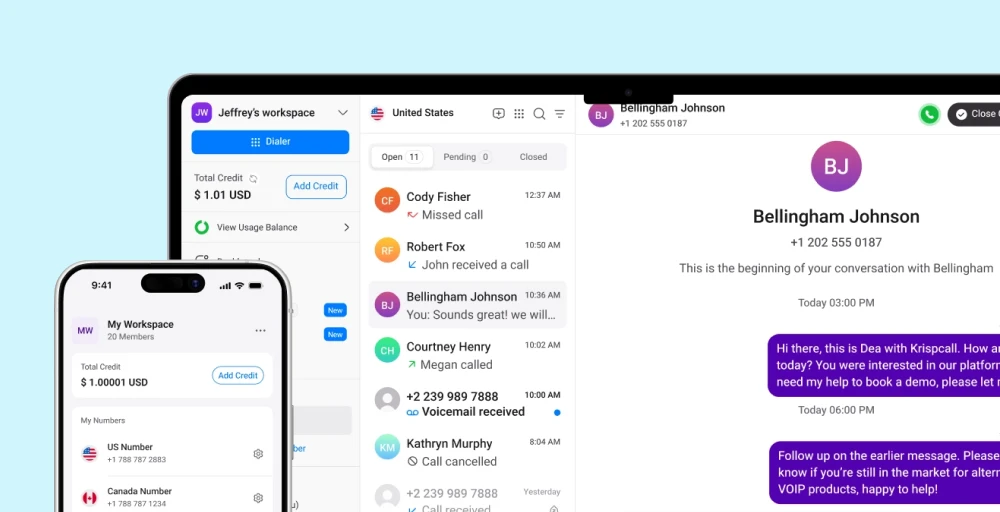
KrispCall offers a more compelling value proposition for most businesses, especially small- to mid-sized organizations that prioritize transparent pricing and comprehensive features without add-on complexity.
While Vonage serves large enterprises with complex API requirements and substantial development resources well, its opaque pricing, extensive add-on fees, and contract inflexibility make it a poor fit for cost-conscious small to mid-sized businesses.
KrispCall transparent pricing delivers superior value for businesses through comprehensive included features, contractual flexibility, and modern capabilities designed for how teams actually work.
Unless your organization specifically requires Vonage’s enterprise-grade API customization and can absorb unpredictable monthly costs, KrispCall represents the smarter investment for business communication.
Frequently Asked Questions
Vonage vs. KrispCall: Which is right for your business?
If you need a reliable and affordable VoIP service with basic features, Vonage is a good choice. If your business is growing globally and you want advanced AI tools, CRM integrations, and power dialers, choose KrispCall. KrispCall also offers better value with its many features at a low cost.