


Understanding 8×8’s pricing structure in 2026 can feel like navigating a maze without a map. Unlike many modern VoIP providers, which display clear public pricing tiers on their websites, 8×8 has shifted to a sales-led, quote-only model, making cost comparison challenging.
This opacity can lead to unexpected expenses and lengthy negotiations, especially for small- to medium-sized businesses trying to budget accurately.
Whether you’re a startup evaluating your first business phone system or an enterprise considering a platform switch, understanding the true cost of 8×8 is essential for making an informed decision.
In this comprehensive guide, we’ll pull back the curtain on 8×8’s pricing structure, breaking down their four main plan categories, uncovering hidden fees that can inflate your monthly bill, and examining all the features you actually get for your investment.
✨ Key Takeaways
- 8×8 operates on a quote-only model, requiring direct sales conversations to discover costs, which can lead to high-pressure negotiations and difficulty comparing price points.
- Beyond base plan pricing, expect regulatory recovery fees ($2.50-$3.49/user), E911 charges ($1.99/extension), toll-free minute overages, and early termination penalties that can significantly increase your monthly spend.
- With straightforward $12-$32/user pricing, no hidden fees, and a modern unified callbox interface, KrispCall provides comparable features without the complexity or sales pressure of 8×8’s enterprise model.
8×8 Plans and Pricing Overview
8×8 is a cloud-based business phone system that provides unified communication, voice and digital interactions, calls, and video conferencing, VoIP service, and AI contact center solutions in a single platform. The pricing for 8×8 is not publicly available; you need to contact their sales team to learn more.
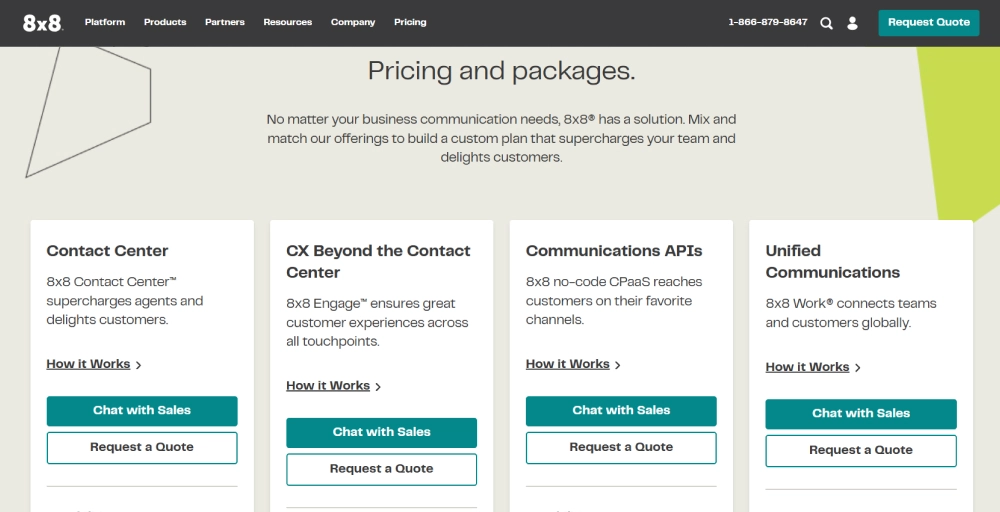
This 8×8 provides four pricing plans, and they are:
1. Contact center
The contact center solutions from 8×8 are tailored for specialized customer support and sales teams that require advanced call management. It is best for providing omnichannel engagement, voice-heavy support, and enterprise-level data and AI. It also supports traditional contact centers with robust tools for high-volume operations.
Key features available in Contact Center plans:
- Omnichannel routing
- AI-enabled self-service
- Agent workspace
- Workforce engagement management
- Supervisor analytics & workspace
- Analytics for contact center
- Secure payment processing
- High-volume messaging
The jump from X4 to X6 is nearly double, making it a “pricey” transition for growing businesses and larger teams. The X8 plan requires significant configuration time and often a dedicated admin to manage the speech analytics and quality management (QM) tools.
2. CX beyond the contact center
8×8 CX beyond the contact center is a newer plan designed for “customer-facing” roles that aren’t formal call center agents but still need better tools than a standard desk phone. This plan has a custom quote. It is best suited for roles such as account managers or sales reps who manage high-stakes customer relationships.
Available features in CX Beyond Contact Center:
- Global coverage
- Advanced queue management
- Meet
- Integrations
- Message
- Team lead analytics
- Calling limits
- Conversational intelligence
It is generally used by non-contact center staff who need omnichannel access and a history of interactions. It lacks the heavy-duty “Dialer” features found in contact centers, and, like other plans, AI sentiment analysis is often an extra cost.
3. Communications APIs
For businesses that want to build their own communication workflows, 8×8 offers a no-code API platform. These services typically follow a pay-per-use model (e.g., $0.0102 per SMS), making them more accessible for businesses with variable usage needs.
Communications APIs Features:
- Voice
- High-volume SMS
- Messaging
- Video calls
- Authentication and Fraud
It is best for developers and enterprises building custom customer journeys. This is a no-code/low-code platform; it does not come with a user-friendly “app” interface. You must build the front end yourself.
4. Unified communications
This core suite is designed for standard business needs, integrating unlimited voice calls, video meetings, and SMS messaging into a single application. It also offers greater business efficiency through features such as two-plan flexibility in some configurations and Wi-Fi calling support.
Features found in Unified Communication platforms are:
- Message
- High-volume Messaging
- Call
- Global coverage
- Message
- Integrations
- System analytics
- Receptionist console
The unified communication solution is best for remote/hybrid teams or for companies that need to replace their old phone system with an all-in-one cloud platform. It has inconsistent customer support, specific functional constraints regarding SMS, and an intelligent virtual assistant.
People Also Search 👉: CallHippo Pricing: Plans, Features & Hidden Fees to Watch For
Extra costs and hidden fees in 8×8 plans
8×8 plans frequently involve extra costs and hidden fees, as it has moved to a sales-led, quote-only model that removes public pricing, making these costs unexpected. So, beyond their pricing charges, it charges extra for mandatory regulatory surcharges, advanced-feature charges, and penalties for early contract termination.
- SMS/MMS Fees: Pricing is generally pay-as-you-go, subscription-based, or custom enterprise plans. For customizable SMS messaging pricing tailored for growing businesses with low or variable usage, a minimum monthly charge of $500 applies.
- Regulatory Recovery Fee (RRF): Generally costs around $2.50 to $3.49 per extension. While 8×8 uses this to cover compliance costs (FCC, state agencies, etc.) is a proprietary fee, not a government-mandated tax.
- Advanced features: Speech Analytics and Quality Management (QM) are typically restricted to the X8 tier or sold as add-ons for roughly $23 per month.
- E911 service fee: Usually roughly $1.99 per extension. This covers the cost of providing emergency services location data.
- Toll-Free Minutes: Inbound/outbound calls on toll-free numbers are not always included in “unlimited” plans, costing roughly $0.02 to $0.028 per minute, even in unlimited calling bundles.
- Number Porting/Setup Fees: Porting phone numbers is usually free, but “vanity” or premium numbers or specific toll-free setups may incur a one-time fee of $5+ per number.
- Early Termination Fees (ETF): If you cancel a 12–36 month contract early, you are often liable for the full remaining balance of the agreement or a flat fee of $60-$200 per user.
Things to keep in mind before choosing 8×8
If you are planning to use 8×8 for your business, critical factors beyond the initial quote that could impact your long-term satisfaction and operational costs.
While 8×8 is a long-standing player in the VoIP space, its shift toward a non-transparent pricing model and specific technical limitations mean you should evaluate the following areas before making a purchase.
Lack of transparent plan details
8×8’s move to a “quote-only” model makes it difficult to perform an apples-to-apples comparison with competitors. This lack of transparency often leads to high-pressure sales negotiations.
Small business owners, in particular, may find themselves spending excessive time in back-and-forth discussions just to uncover the actual cost of basic features.
Complex Call Recording Management
Unlike modern platforms, where recording rules are set at the “number” level, 8×8 requires you to adjust settings for every individual user. This “user-based” configuration becomes a significant administrative burden as your team grows.
Furthermore, standard recordings are only stored for 90 days; keeping them longer requires an additional “cold storage” fee that is not publicly priced.
Limitations on integration tools
8×8 advertises compatibility with major CRMs and productivity tools, but it rarely specifies which CRM integrations are included in each tier. In some cases, “out-of-the-box” integrations are listed as upgrades for higher-tier plans.
Without a detailed sales quote, it is difficult to know whether the software you currently use (such as Salesforce, Google Workspace, HubSpot, Microsoft Teams, or Slack) will connect without an additional fee.
Restricted SMS/MMS Functionality
For businesses that rely on text-based customer engagement or two way SMS, 8×8 lacks several native automated workflows. You will find a lack of auto-replies for missed calls or voicemails, and no built-in ability to schedule messages for later.
Most advanced SMS workflows require a third-party tool like Zapier, adding more complexity and cost.
Difficult Cancellation Process
Exiting an 8×8 contract is notoriously tricky. You must provide written notice at least 30 days before the contract ends, followed by a multi-step process involving support tickets and case confirmations.
Failing to follow this specific protocol or attempting to leave early can result in hefty Early Termination Fees (ETFs) or automatic contract renewal.
KrispCall vs 8×8: Direct Comparison
Choosing between KrispCall and 8×8 depends mainly on whether you value a modern, transparent self-service experience or an enterprise-grade, all-in-one suite.
While 8×8 is a long-standing giant that offers deep, advanced contact center capabilities, voice contact center, Krispcall has gained massive traction by focusing on a clean user experience and straightforward pricing.
| Features | KrispCall | 8×8 |
| Price per month | $12-$32 per user | Contact sales |
| Global Calling | 100+ countries | 100+ countries |
| Unified Callbox | Yes (one interface) | No |
| Call Recording Access | Unlimited | Limited |
| SMS Filtering | Yes | No |
| Click to call | Yes | Yes |
| Power dialer | Yes | No |
| Non-VoIP Number | US only | No |
| Free Phone Numbers | One local/mobile from the UK, USA, or Canada upon signup | No |
1. Pricing Transparency and Hidden Costs
KrispCall offers a transparent, self-service pricing model that lets you choose a plan ($12–$32) and get started in minutes, making it perfect for an agile virtual call center or voice contact center. There are no hidden fees, so what you see is what you pay.
In contrast, 8×8 has a sales-led approach with opaque pricing. You need to talk to a representative to get a starting price, and their bills can include mandatory fees, making 8×8 often more expensive for small teams than KrispCall.
2. User Interface and the Unified Callbox
KrispCall’s key feature is its Unified Callbox, which consolidates calls, text messages, and voicemails into one clean conversation thread, enables live call monitoring to reduce app-switching fatigue, and provides a comprehensive view of customer interactions.
While 8×8 struggles with a legacy UI that users find clunky. Switching between the admin console and the user workspace can feel like switching between different programs. Despite AI updates aimed at modernization, users often find these changes complicate simple tasks rather than streamline them.
3. Messaging and Automation Features
KrispCall offers essential SMS features, such as auto-replies for missed calls and message scheduling, making it ideal for small businesses that need responsiveness without being glued to their phones. Their system also supports shared numbers for team collaboration.
In contrast, 8×8 has limitations: most plans offer only a small number of messages per user and lack advanced automations. If your business relies on texting or team messaging for customer support or an outbound call center strategy for sales, 8×8’s rigid structure and pay-as-you-go fees can be challenging.
4. Global Reach vs. Unlimited Bundles
8×8 offers “Unlimited International Calling” to 14 or 48 countries, making it ideal for teams with high outbound call volumes to destinations such as the UK, France, or Australia. Their flat-rate calling is especially beneficial for international landlines.
On the other hand, KrispCall emphasizes local presence by providing local, mobile, and toll-free numbers in over 100 countries. While they may not have the same “unlimited” plans as 8×8, their competitive per-minute rates and ability to quickly set up local numbers make them a great option for global startups.
5. Customer Support and Reliability
Support is where KrispCall and 8×8 differ significantly. KrispCall offers highly rated 24/7 customer support, resolving most issues via live chat in real-time, which is crucial for non-technical users in startups and SMBs.
In contrast, 8×8 faces criticism for slow, “ticket-heavy” support, with users often waiting days or weeks for resolutions. While this may work for large enterprises with internal teams, small businesses can suffer significant disruptions due to these delays.
G2 Review: KrispCal has been a game-changer for our communication workflow. The dashboard is super intuitive, making it easy to manage multiple numbers, track calls, and collaborate with the team. The call quality is consistently clear, and I love that everything, from call logs to voicemail, is neatly organized in one place.
Srushtidhar L., AI Voice Agent & AI Automation Strategist, Small-Business (50 or fewer emp.)
Should you still use 8×8?
8×8 remains a viable option for large enterprises that need comprehensive call center features and have dedicated IT resources to manage complexity.
However, for small to medium-sized businesses seeking transparency, ease of use, a large unlimited calling area, and predictable costs, alternatives like KrispCall may provide better value without sacrificing essential communication capabilities.
Related 👉: Top 10 8×8 Alternatives and Competitors for Businesses in 2026
Pros and cons of 8×8 pricing plans
While 8×8 offers robust enterprise features, understanding both the advantages and limitations of their pricing structure is essential for making an informed decision.
Pros of 8×8 pricing plans
Comprehensive Enterprise Features
8×8 provides an all-in-one solution that includes advanced contact center capabilities, workforce management tools, speech analytics, and quality management systems. For large organizations that need these sophisticated features under one roof, 8×8 delivers genuine value despite the premium pricing.
Strong International Calling Options
The unlimited international calling to 14 or 48 countries (depending on your plan) is a significant advantage for businesses with high-volume international communication needs. This flat-rate approach eliminates the anxiety of per-minute charges when calling international landlines regularly.
Scalable Contact Center Infrastructure
8×8’s tiered contact center plans (X4, X6, X8) allow businesses to scale their customer support operations as they grow. The platform handles everything from basic skill-based routing to AI-powered self-service and omnichannel engagement, making it suitable for companies planning significant expansion.
API Flexibility for Custom Solutions
The Communications APIs allow technical teams to build custom cloud communication workflows tailored to specific business processes. The pay-per-use model for these APIs can be cost-effective for businesses with variable or specialized business communication needs that don’t fit standard plans.
Cons of 8×8 pricing plans
Complete Lack of Price Transparency
The shift to a quote-only model creates frustration and inefficiency for buyers. You cannot quickly compare costs with competitors, and the sales process often becomes lengthy and high-pressure, wasting valuable time that small business owners don’t have.
Numerous Hidden Fees
The base quote rarely tells the full story. Regulatory recovery fees, E911 charges, toll-free minute overages, and SMS minimums can add $5-$10 per user per month or more. These “mandatory” fees feel deceptive when they weren’t clearly communicated upfront, making budgeting nearly impossible.
Restrictive Contracts with Harsh Penalties
8×8’s 12-36 month contracts lock you in, and early termination fees can be brutal, either the full remaining contract value or $60-$200 per user. The 30-day written cancellation notice requirement with multiple confirmation steps makes leaving the platform unnecessarily complex.
Administrative Complexity
Managing 8×8 requires significant ongoing effort. Call recording must be configured per user rather than per number, integrations aren’t always included in your tier, and the learning curve for the admin console is steep. Small businesses without dedicated IT staff often struggle with these operational burdens.
Final Verdict: KrispCall Edges Out on Price
When it comes to pricing and overall value, KrispCall emerges as the clear winner for most small to medium-sized businesses. While 8×8 offers powerful enterprise features, the lack of pricing transparency, hidden fees, and administrative complexity make it a challenging choice for organizations that value efficiency and predictability.
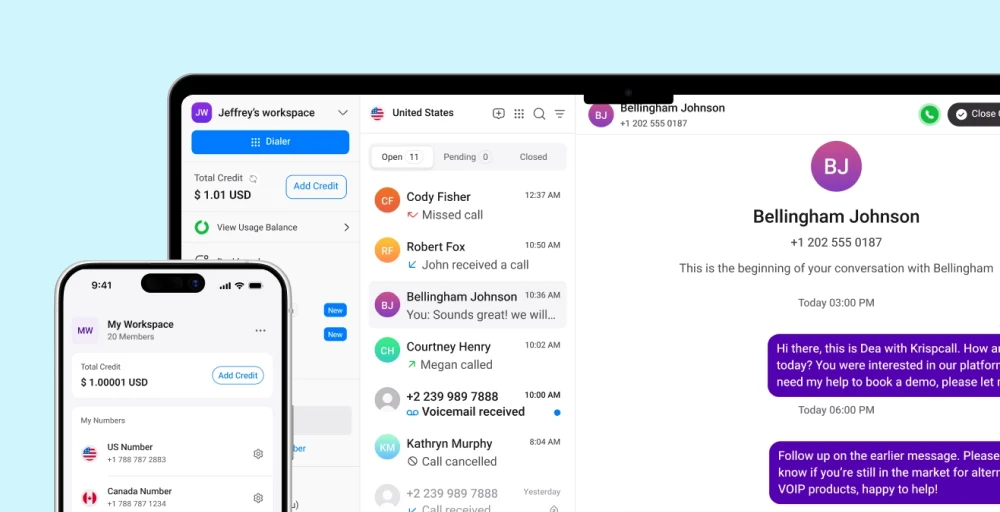
KrispCall’s straightforward $12- $32 per user pricing, with no hidden fees, means you can accurately budget from day one. The modern unified callbox interface requires minimal training, and features like auto-replies for missed calls and message scheduling come standard rather than as expensive add-ons.
That said, 8×8 may still be appropriate for large enterprises with dedicated IT teams and specific needs for advanced contact center features like workforce engagement management and speech analytics. However, for the vast majority of businesses, KrispCall offers a better balance of features, usability, and cost-effectiveness. The ability to start immediately with transparent pricing, combined with 24/7 responsive support, makes KrispCall the best choice.