


Everyone knows it’s hard to manage a call center efficiency. Call volume isn’t a single thing to handle; managers or supervisors also have to encourage and manage call center agents to stay motivated and work productively on customer calls.
On top of that, providing training for new agents is another level of stress.
Whether you’ve just stepped into a managerial role or you’re already running a busy contact center, this guide will help you navigate the challenges and lead your team more effectively.
✨ Key Takeaways
- Putting the customer needs first and building a work culture around their experience, you can deliver exceptional service and improve agent productivity.
- With the right call center software, omnichannel platform and automation tools, you streamline workflows and allow your agent to handle customer support more efficiently.
- Providing proper training programs, fostering a positive work environment, and fair incentives ensures your agents remain motivated and productive.
20 call center best practices
Here are all 20 call center best practices for improving agent productivity and performance:
1. Obsess over the customer experience
Agent productivity improves with a solid focus on the customer. When agents are aware that their priority is improving the overall customer experience, they shift their focus from task completion to resolving customer inquiries from customer data.
This mindset fosters empathy, enhances listening skills, and enables the delivery of exceptional customer experiences that secure long-term customer loyalty, improving customer retention. When you make customer satisfaction the core objective, call center agents become more productive and effective, providing exceptional service in every interaction.
Instead of thinking of customers’ incoming calls as tickets to be closed, they begin to view every call as an opportunity to build a long-lasting customer relationship. This mindset makes work more meaningful, which, in turn, boosts morale and performance.
2. Build a solid company culture
A positive and inclusive company culture provides the call center platform under which call center agents feel connected, appreciated, and motivated.
Company culture impacts everything from how agents collaborate to how they service customers. As a call center manager, if you can instill a sense of appreciation and purpose in the agents, it empowers them to perform well, take ownership of their work, and strive to excel.
Building a positive work culture includes implementing regular team engagement activities, effective reward structures, and maintaining open lines of communication. Once agents are part of a respectful, goal-driven culture, productivity will naturally increase.
3. Select stable solution partners
Selecting the right and modern call center software and technology partners has a direct impact on agent performance. Agents need reliable, fast, and easy-to-use systems to deliver rapid, effective call center operations.
If your software crashes frequently, loads slowly, or lacks critical features, agents might spend time, become frustrated, and fail to meet their quotas. That’s why we recommend switching to a reliable cloud-based application to provide your agents with the tools they need to manage calls with less hassle.
Additionally, integrations with Customer Relationship Management (CRMs) software, ticketing systems, and analytics platforms enable agents to access customer data in real-time, which fosters immediate service and eliminates unnecessary back-and-forth.
4. Boost real-time omnichannel support
Customers want to interact with your business across multiple communication channels, including phone, email, social media, live chat, and even messaging apps.
And, the way to do so is omnichannel customer support. By providing multiple customer service channels for customer interaction, you not only meet your customer expectations but also increase agent productivity.
How? When agents can switch between channels within a single interface, they can handle more customer queries with greater context, that increase response times and leaves only a few errors. Omnichannel software also helps your agents to prioritize and distribute workloads more efficiently. For instance, while one agent is attending to a chat, another agent can attend to emails or social messages, thereby preventing voice support from becoming overloaded.
5. Scale your customer service team with VoIP
Switching to VoIP (Voice over Internet Protocol) is the ideal way to grow your customer support business without incurring cost or complexity. VoIP enables agents to make and receive phone calls from any web-connected device, anywhere in the world.
That mobility allows you to recruit remote agents, build distributed teams, and offer 24/7 customer support without the need for costly office space or expensive hardware.
VoIP also offers productivity-boosting capabilities, including automated call distribution, call recording, and detailed analysis for effective call center management and call center processes. Agents can manage their time more effectively, identify mistakes, and raise concerns using these tools.
6. Reward your team with the right incentives
Incentivized agents perform. Creating a culture of recognition through effective incentive programs motivates agents to perform at their best. Bonuses, team recognition, gift cards, or a break acknowledge hard work and make agents appreciate and feel motivated
Incentives tied to key call center performance indicators, such as CSAT, AHT, and FCR, motivate agents to stay laser-focused on what matters most and contribute to business success.
But rewards need to be equitable and attainable. Extremely competitive environments can lead to burnout or falsification, hurting long-term performance. An adequately balanced reward system that combines monetary rewards with emotional gratitude, such as peer approval or career advancement opportunities, helps maintain high energy levels.
7. Empower your customer service agents
Granting agents decision-making authority boosts their confidence and reduces customer service delays. When Agents are not told to refer every problem to management in an inbound call center, they can handle more calls, which eventually reduces queue times and provides exceptional customer service.
For this, provide them with clear instructions on what they are allowed to do independently and what requires authorization. Back this up with proper training as well as ready access to real-time information through tools like CRMs and knowledge bases.
Agents in control become more engaged in their work, take ownership of their tasks, and are more proactive in resolving problems, making your entire support team more effective.
8. Establish a knowledge base
A well-organized knowledge base is a productivity powerhouse for increased call center efficiency. It allows agents to get the correct information immediately, which means they save time that would be wasted looking for answers or asking peers.
This speeds up resolution times, ensures communication consistency, and reduces escalations. A good knowledge base also facilitates self-service for customers, reducing incoming requests and freeing up agents’ workload.
To keep your knowledge base running smoothly, update it periodically and ensure it remains easy to browse and locate. Visualize content like videos or screenshots for in-depth subjects. The more polished your internal knowledge system is, the more efficient and confident your agents will be.
9. Track the metrics and KPIs that matter
Tracking the right call center KPIs is essential to identify trends in driving agent productivity and performance. Key call center metrics, like Average Handle Time (AHT), First Call Resolution (FCR), Customer Satisfaction Score (CSAT), and abandonment rate, provide valuable insights where your team excels and where it needs improvement.
Tracking these numbers regularly enables the identification of performance patterns, workflow issues, and coaching opportunities.
However, avoid overwhelming agents with too many metrics. Select those that align with your business goals and have the most direct impact on customer satisfaction. Share these metrics broadly with agents so they understand how their performance will be measured.
10. Implement rigorous call center quality assurance
Quality assurance (QA) procedures guarantee consistency and service excellence in all customer interactions. Through listening to recorded calls and rating agent performance against a checklist, managers can provide one-to-one feedback and coaching.
With this process, your call center is guaranteed to meet high-quality standards while improving each individual agent’s performance.
Ongoing QA also highlights recurring issues, skill shortages, or compliance issues before they escalate into significant problems. Use these results to garner success, reinforce best practices, and share learning across the team.


11. Create a bullet-proof redundancy plan
Unexpected events, such as internet outages, software failures, or medical emergencies, can immediately bring a call center to a standstill. Having a strong redundancy or business continuity plan ensures that your staff can continue operating and streamline operations even when things go wrong.
To include a business continuity plan across the call center process, implement cloud-based communications solutions, mobile VoIP applications, or call rerouting to secondary numbers.
Train your agents in situations like this so they can switch systems quickly without losing momentum. Test your continuity plan periodically to ensure everyone understands their role in an emergency.
12. Offer continuous training and upskilling
Constant agent training and development are a high priority in the fast-paced atmosphere of a call center.
Technology changes, customer behavior shifts, and new products or services emerge; your agents must stay prepared. Regular training sessions refine skills, update knowledge, and build confidence. It also prevents bad habits from infiltrating your processes and impacting service quality.
Offer a mix of live coaching, e-learning modules, and interactive training to meet different learning styles. Include realistic situational-based training and customer feedback in your training materials to enhance agent performance and deliver a better call center experience with personalized services.
Upskilled agents answer calls with increased competence, reduce escalations, and perform better under stress, directly enhancing call center productivity and customer satisfaction.
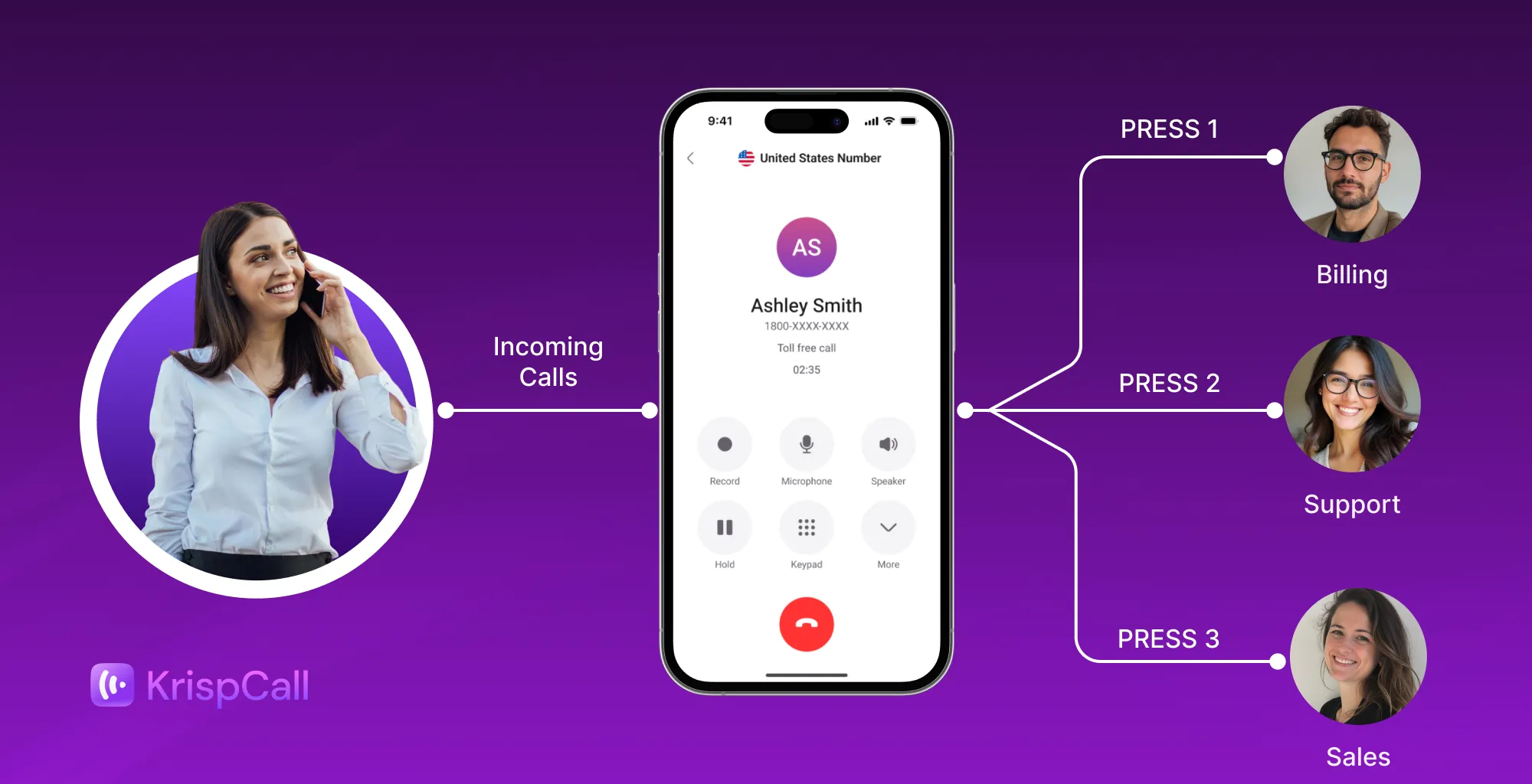
13. Implement intelligent call routing
Smart call routing automatically directs each incoming customer call to the optimal agent based on their skills, language, availability, and the type of problem. It prevents customers from being transferred between departments or held indefinitely.
Intelligent routing maximizes First Call Resolution (FCR) by enabling the right person to resolve the problem on the first attempt.
Additionally, call routing also adjusts workloads by distributing calls evenly over active agents, preventing burnout and keeping queue times low.
Agents perform better when they’re working on cases for which they’re trained and provisioned, feeling more in control and delivering superior service, which results in improved productivity and overall performance.
14. Streamline internal communication
Fast and effective internal communication enables agents to receive help instantly whenever they need clarification, policy information, or assistance with complex cases.
Real-time chat capabilities or collaboration tools, such as Slack, Microsoft Teams, or built-in CRM chat, allow agents to bypass downtime, continue working, and resolve customer issues more rapidly. Clear internal communication also builds transparency and cooperation.
By understanding and knowing team goals, campaigns, and launches, agents can clearly communicate with customers. It saves time, prevents repeated errors, and enables all team members to work from the same playbook, leading to more precise and high-quality customer service provision.
15. Encourage team collaboration
Promoting teamwork enables agents to learn from one another, share valuable resources, and enhance their problem-solving skills.
Having support from their peers gives agents a boost in spirit and adds flavor to work. Teamwork also reduces the workload of individual agents, especially during peak hours or when handling complex cases.
Managers can foster collaboration by conducting weekly huddles or knowledge-sharing sessions to promote open communication and shared understanding. When agents feel they are working as a team rather than as individuals, they are more likely to collaborate effectively and contribute to continuous improvement in service standards.
16. Automate repetitive tasks
Redundant processes, such as logging calls, sending follow-up emails, tagging tickets, or updating CRM fields, can consume a significant amount of an agent’s time.
Automation tools can help you eliminate these steps, allowing your staff to focus on engaging with customers. For example, auto-ticketing or pre-populated call summaries can save you minutes per call.
Accuracy improves with automation by eliminating human errors and offering consistency in customer details and processes. Automation also prevents mental fatigue, keeping agents refreshed and active throughout the day. When the agents are not occupied with repetitive tasks, they can expend more energy on solving customers’ issues creatively and cost-effectively.
17. Conduct regular performance reviews
Routine performance reviews inform agents of their current standing and how they can improve. It is not merely a time to criticize mistakes; it is an opportunity to reward good habits, set new goals, and link personal performance to corporate objectives.
Use real metrics, such as Average Handle Time (AHT), Customer Satisfaction Scores (CSAT), and call quality ratings, in these sessions. Be solution-focused and constructive in your tone. Provide two-way feedback so agents can also share their issues and suggestions.
Feedback on a regular basis creates a performance culture where agents understand what is expected of them and feel encouraged to provide it.
18. Put agent wellness and mental health first
Taking care of agents’ mental health and well-being in a high-volume call center is essential to sustained productivity. Agents who are stressed or burned out are more likely to make mistakes or call out with regularity.
Provide amenities like wellness breaks, counseling, mental health days, and flexible work hours where possible. Train managers to recognize signs of burnout and create a culture where agents feel comfortable reporting challenges. When agents feel important and cared for, they bring more energy, patience, and concentration to work, which directly enhances the customer experience and their own happiness.
19. Set clear escalation paths
The frontline agent can handle all customer issues. This is why there needs to be a clear escalation process so that complex or high-priority problems are routed to the right person in a timely manner without undue delays.
This improves response time, protects agent confidence, and maintains a smooth customer experience, even when matters exceed the agent’s capability.
Set clearly defined escalation levels, and train agents on when and how to escalate. Make sure escalation will not be seen as a failure but as a professional means of delivering quality service. Having a strong support system allows agents to focus on what they can solve with the promise that backup will always be available when needed.
20. Set realistic goals and expectations
Having too stringent targets can backfire by stressing out your agents and reducing performance. Set reasonable goals that are challenging yet achievable. Use past performance trends, agent feedback, and industry benchmarks to determine KPIs that motivate effort without overburdening your team.
Clear goals provide agents with a target to aim for and enable managers to measure progress objectively. Ensure that expectations are clear, concise, and regularly reviewed. Allow agents to check their own performance and achieve small successes.
When objectives are reality-based and linked to business outcomes, they are motivational tools rather than pressure points.
Improve agents’ call center productivity with KrispCall’s call center software.
Suppose you want to enhance the performance of your call center team. In that case, KrispCall’s call center software offers a modern, cloud-based solution that enables agents to be more productive and efficient, from enhanced call routing to real-time statistics.
KrispCall includes everything your team needs to provide high-quality support while staying focused and stress-free.
KrispCall aligns with all proven best practices, supporting omni-channel communication, scaling remote teams with VoIP services, and providing built-in tools for call monitoring, quality assurance, and performance tracking.