


Contact centers commonly report annual agent turnover of 30% and 45%. Most departures occur in an agent’s first year, while the agent is still learning the role, systems, and customer workflows.
If you look at where the timeline breaks down, onboarding is usually the fault line. Depending on the role’s complexity, a new agents may need several months to reach full proficiency. During that period, they must learn new systems, understand call flows, apply product knowledge, and handle real customers with increasing independence. Replacing that agent once they leave costs $10,000 to $20,000, and the center is right back at month zero with the next hire.
This guide breaks down what effective call center agent onboarding looks like and how to build sustainable call center retention strategies from day one.
✨ Key Takeaways
- Contact center turnover runs 30-45% annually, and most departures happen in an agent’s first year.
- Onboarding and training aren’t the same thing. Training is the curriculum; onboarding is the entire system around it, including access, mentorship, and KPI gates.
- A structured 4-phase framework (pre-boarding, orientation, shadowing and nesting, full ramp) reduces ramp time and catches struggling agents before they quit.
- Measuring onboarding success requires performance, documentation, and retention KPIs together, not performance metrics alone.
- Modern call center software (unified workspace, call whispering, live monitoring, AI summaries) can’t replace coaching, but it removes friction that slows down ramp time.
What is call center agent onboarding?

Call center agent onboarding is the structured process of preparing a new hire for a contact center’s customer service ecosystem. It covers system access, compliance training, call scripts, soft skills development, and product knowledge. It also includes supervised practice before an agent takes their first unsupervised call.
It’s different from a single “training day.” Onboarding typically spans the first 30 to 90 days of employment and includes pre-boarding paperwork, tool setup, shadowing, simulated calls, and ongoing coaching, not just a one-time orientation session.
Onboarding vs. Training: Why the distinction matters
Many industry guides mistake training and onboarding for synonyms. This confusion is a costly operational mistake. Failing to recognize the boundary between them is precisely why many contact centers experience high turnover despite investing heavily in instructional content.
The distinction between the two is operational, structural, and definitive:
- Training is the curriculum. It is a tactical input focused on knowledge transfer. Training covers learning the scripts, studying product specifications, and watching tutorials on how to navigate the telephony system. It is something an agent completes.
- Onboarding is the environment. It is the entire ecosystem wrapped around that curriculum. Onboarding dictates role-based access controls on day one, structures your mentor assignments, manages the nesting phase, enforces metric-based KPI gates before access to live channels, and drives cultural integration.
Training gives an agent the information, while onboarding gives them the infrastructure to execute it successfully.
The real cost of bad onboarding

Poor onboarding is often viewed as an abstract human resources problem, but its financial impact is concrete and measurable. When an onboarding framework fails, it drains capital through two primary operational leaks: early turnover and extended ramp time.
To understand the scope of this issue, let’s look at the financial data for a standard onboarding class of 20 new agents.
The early turnover cost
When a new hire leaves within their first 90 days, the organization loses its entire initial investment.
The formula to calculate this loss:
Cost per early departure = recruiting cost + training cost + manager time + lost productivity
If replacing one early-departing agent costs $10,000 and 5 out of 20 new hires leave before reaching full proficiency, the cost of early attrition scales rapidly:
$10,000 x 5 = $50,000
The ramp-time cost
When an onboarding process is disorganized, agents take longer to reach standard operational proficiency. During this extended ramp period, you pay full wages for partial output.
The formula to calculate this loss:
Ramp-time cost = productivity gap x loaded hourly rate x extra ramp hours
For example, suppose an agent in training operates at 60% efficiency, leaving a 40% productivity gap. If their loaded hourly wage is $25 and a poor onboarding process causes them to take an extra 4 weeks (160 working hours) to reach 100% proficiency, the cost per agent is:
40% x $25 x 160 hours = $1,600 per agent
For the remaining 15 agents, this hidden productivity drain adds up significantly:
$1,600 x 15 = $24,000
The combined impact: Financial drag & Performance fallout
When you combine these two factors for a single class of 20 agents, the financial loss is substantial:
- Early turnover cost: $50,000
- Extra ramp-time cost: $24,000
- Total onboarding drag: $74,000
The consequences of a slow, inefficient onboarding process also extend beyond the balance sheet. While under-prepared agents struggle to find their footing, your live operation suffers across several key call center metrics:
- First Call Resolution (FCR) drops because new hires lack the system fluency to resolve complex issues on the first attempt.
- Repeat contact rates spike, inflating overall queue volumes and straining the rest of the support team.
- CSAT and QA scores decline as customers experience longer holds, inconsistent answers, and extended handling times.
The common mistake
Viewing onboarding strictly as an HR line item is a huge error. A well-designed onboarding program is an active investment in employee retention, productivity, and the overall customer experience.
What good onboarding actually requires
Good onboarding isn’t about front-loading everything an agent needs to know. It’s about pacing each core area across the right stage of their ramp, so nothing gets rushed and nothing gets skipped.
An effective onboarding program integrates these seven essential areas:
- Company and team orientation: Organizational culture, core values, internal communication channels, and who to go to for what
- Product knowledge: What are the product lines, service tiers, and common troubleshooting issues
- Call handling process: Mapping out call scripts, ticket routing workflows, escalation paths, and call-closure protocols
- Phone system and tools: Providing necessary information about the telephony platform, dialer, and any software used on calls
- CRM and customer context: Training agents on navigating the CRM database, analyzing customer interaction histories, and maintaining clean data logging
- Compliance: Training agents to follow applicable privacy, recording-consent, and industry-specific requirements such as PCI-DSS and HIPAA
- Soft skills: Cultivating active listening, empathy, de-escalation tactics
Keep in mind that none of these areas work well in isolation. They need a structured or sequenced onboarding journey behind them, not a crash course crammed into the first few days.
The 4-phase call center onboarding framework
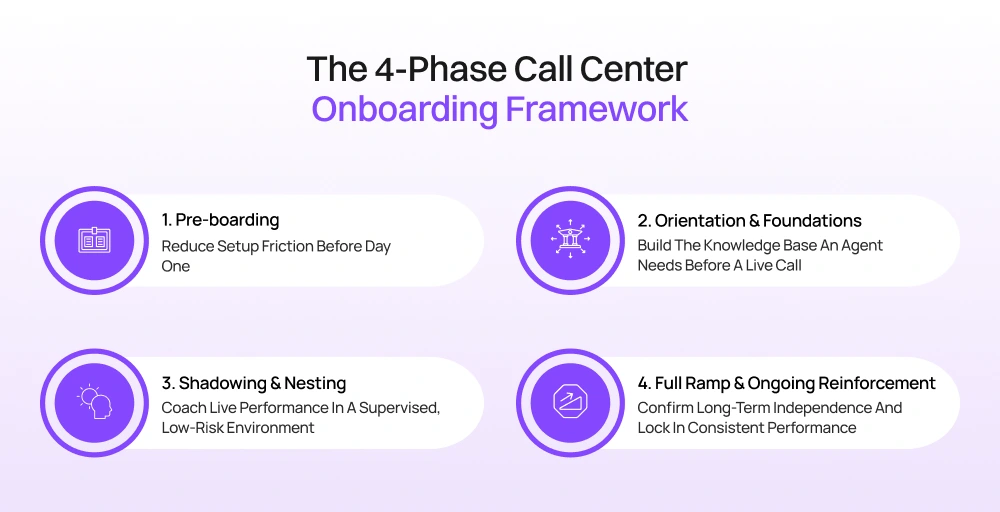
Effective onboarding doesn’t happen in a single week, and it doesn’t stop once an agent takes their first call. It runs the full stretch from offer acceptance through the agent’s first 90 days, broken into four distinct phases, each with its own objective.
- Pre-boarding: reduce setup friction before day one
- Orientation & Foundations: build the knowledge base an agent needs before a live call
- Shadowing & Nesting: coach live performance in a supervised, low-risk environment
- Full Ramp & Ongoing Reinforcement: confirm long-term independence and lock in consistent performance
Phase 1: Pre-boarding
Pre-boarding covers everything that happens between offer acceptance and day one. Done well, it eliminates the dead time new hires usually lose to paperwork, account setup, and waiting around on their first day.
What it includes
- Sending offer letters, contracts, and compliance documents within 24 hours of offer acceptance
- Provisioning system access: email, CRM, phone system, and any internal tools
- Assigning a mentor or buddy before the hire’s first day
- Sending a welcome kit or day-one agenda so the agent knows what to expect
- Setting up their desk, headset, or remote work equipment ahead of time
Common mistake
Letting the gap between offer acceptance and the start date go quiet. Silence during that window is often when candidates start second-guessing the offer, sometimes enough to back out before they ever begin.
Checkpoint
Before moving to phase 2, make sure every piece of paper is signed. Also, all system credentials are active and tested, and a mentor has been assigned and briefed on who they’re supporting.
Phase 2: Orientation & Foundations
This phase builds the knowledge base an agent needs before they touch a live call. It typically covers the first few days to the first week or two, depending on program length.
What it includes:
- Company mission, org structure, team introductions, and manager expectations
- Product and service walkthroughs
- Call handling process: scripts, escalation paths, call flow standards
- Hands-on training on the phone system, CRM, and any support tools
- Compliance training: data privacy, recording disclosures, industry regulations
The number of separate tools an agent has to learn directly affects how long this phase takes. When the phone system, CRM, and call logs live in one workspace instead of three or four disconnected platforms, agents spend that first week learning the actual job instead of hunting for where information lives.
Common mistake
Treating this phase as a single marathon training day rather than spacing it out. Cramming product knowledge, compliance, and tool training into one or two sessions overwhelms retention, and agents end up relying on guesswork once they’re on the floor.
Checkpoint
Before moving to Phase 3, ensure the agent can independently navigate the CRM and phone system. Agents should also pass a basic product knowledge check and should demonstrate understanding of compliance requirements.
Phase 3: Shadowing & Nesting
This is where theory meets live customers, but under supervision. The agent listens in on real calls to understand how to greet, what tone to use, what discovery questions to ask, how to handle objections, and how to document the interaction after the call.
What it includes:
- Structured shadowing: listening to experienced agents handle live calls
- Reverse shadowing: the new agent takes calls while a mentor listens and coaches in real time
- Nesting: the agent works independently but in a dedicated space with immediate support available
- Call scoring, QA feedback, and AI-generated call summaries for self-review
- Regular check-ins to address confidence gaps before they become habits
Call whispering and live monitoring can make supervised nesting easier to manage across larger or distributed teams.
Common mistake
Moving an agent to a full, unsupervised queue too early because they “seem ready.” Confidence on a handful of calls doesn’t mean consistency across call types, and rushing this phase is one of the biggest drivers of early attrition.
Checkpoint
Before moving to phase 4, make sure that the agent consistently meets baseline QA scores and handling-time targets across a range of call types without a mentor present.
Phase 4: Full Ramp & Ongoing Reinforcement
By this point, the agent is handling calls without a mentor listening in, but full independence should not be assumed on day one of the queue. It’s confirmed gradually, with volume and oversight tapering off in step with actual performance.
What it includes
- Starting the agent on a lighter call load
- Scaling volume up as QA scores and confidence hold steady
- Regular 1:1 coaching sessions tied to call scoring and KPI trends
- Refresher training as products, scripts, or compliance requirements change
- Milestone check-ins at 30, 60, and 90 days to track progress against ramp targets
- Peer learning: pairing agents to share call techniques and troubleshoot together
The 30/60/90-day ramp plan
A ramp plan turns those checkpoints into something concrete: what the agent should know and be able to do at each milestone, so gaps get caught early rather than surfacing as a performance problem three months in.
| Milestone | What to review | Expected progress |
| Day 30 | Tool confidence, QA basics, mentor feedback, simple call handling | Handles basic calls with support |
| Day 60 | Average handle time, first call resolution, documentation quality, and escalation judgment | Handles standard calls independently |
| Day 90 | QA score, CSAT, retention risk, productivity, independence | Meets core performance targets without supervisor support |
Common mistake
Treating day 30 as the finish line. Most onboarding programs are built around that first milestone and quietly wind down after it, but the 60- to 90-day window is when many agents are expected to be fully independent yet privately unsure. That gap is where a meaningful chunk of attrition actually happens.
Checkpoint
Before completing onboarding, the agents should independently meet the sustained KPI targets (QA score, FCR, handling time, and CSAT) without active supervisor support.
First-week onboarding checklist
To maximize efficiency during the foundational week, use this organized roadmap to guide your new agents from initial IT setup to software mastery.
| Day 1 | Days 2-3 | Days 4-5 |
| Welcome and team introductions | Product and service walkthrough | Structured shadowing session |
| Confirm system access: email, CRM, phone system | Voicemail, SMS, and call recording workflow walkthrough | Compliance training: data privacy, recording disclosures |
| Meet the assigned mentor | Call handling process: scripts, escalation paths, call flow standards | Call routing overview: how calls reach the right agent |
| Equipment check | Navigating the phone system and CRM | Contact-history review |
| Review first-week agenda | Mock-call preparation | Mock call and knowledge check |
Onboarding for remote and distributed agent teams
The four-phase framework doesn’t change for remote teams. What changes is how each phase gets delivered, since there’s no shared office to lean on for the informal parts of onboarding that happen naturally in person.
What stays the same
- The four phases and their checkpoints still apply in the same order
- Compliance, product knowledge, and call handling standards don’t get diluted for remote hires
- QA scoring and ramp targets stay identical to those of in-office agents, since customers can’t tell the difference
What changes
- Pre-boarding shifts from desk setup to shipping logistics. Equipment needs to arrive before day one, and IT support has to be remote-capable.
- Orientation and foundations rely more heavily on recorded walkthroughs and screen-share sessions.
- Shadowing and nesting depend on tools like call whispering and live monitoring that replicate in-person coaching remotely. A cloud phone system helps here too: calls, history, and recordings all live on one platform, so a remote agent has everything they need without being in an office.
- Full ramp and reinforcement need more deliberate scheduling. Weekly 1:1s and check-ins have to be calendared because remote managers don’t get the casual hallway moments that catch a struggling agent early in an office setting.
KPIs to track during onboarding
To accurately measure the health of your onboarding framework, you cannot rely solely on standard performance data. Evaluating an agent’s success requires a balanced scorecard that tracks three distinct categories of metrics: Performance KPIs, System & Documentation KPIs, and Retention KPIs.
This comprehensive data combination ensures you catch process gaps and engagement red flags before they lead to early-stage turnover.
| Category | KPI | What it tells you |
| Performance | Average handle time (AHT) | How efficiently the agent moves through a call |
| Performance | Time-to-proficiency | How long until the agent hits the expected output |
| Performance | First call resolution (FCR) | Whether issues get resolved without follow-up |
| Performance | QA score | How closely calls match quality standards |
| Performance | CSAT | Whether customers are satisfied with the interaction |
| Documentation | Call note completion rate | Whether the agent is logging calls consistently |
| Documentation | CRM data accuracy | Whether logged information is usable for the next interaction |
| Documentation | Compliance adherence | Whether disclosures and required scripts are being followed |
| Retention | 30/60/90-day attrition rate | How many new hires leave at each milestone |
| Retention | Engagement or pulse survey scores | Early signals of disengagement before it becomes a resignation |
| Retention | Mentor and manager check-in frequency | Whether support is actually happening, not just scheduled |
Performance numbers can look great and still hide a broken onboarding program because they say nothing about whether an agent sticks around. Documentation metrics help fill that gap by showing whether the workflow is actually being followed, not just whether calls are resolved. And finally, the retention metrics close it, since they’re the real test of whether the onboarding system holds up past the point at which most agents are at risk of leaving.
Common onboarding mistakes to avoid
Most onboarding failures stem from a handful of repeat offenders, and they show up across programs regardless of company size or industry, such as:
Rushed or compressed training
Cramming a multi-week curriculum into a few days creates cognitive overload and immediate operational errors. This rush backfires by lengthening real time-to-proficiency, as floor managers must spend weeks correcting mistakes that should have been mastered in a sandbox.
One-size-fits-all onboarding
Not every hire needs the same pace or the same depth. A rigid, identical timeline for every agent regardless of experience or role either bores experienced hires into disengagement or rushes newer ones past concepts they haven’t actually absorbed.
Coaching that stops too early
Many programs treat day 30, or the end of a training week, as the finish line. Without continuous, data-driven micro-coaching throughout the first 90 days, agents quickly lose confidence and slip into poor procedural habits.
No clear ownership
When onboarding is split among HR, team leads, and trainers, with no single person accountable for the outcome, gaps fall through the cracks. Nobody catches a missed checkpoint or a struggling agent early enough if no single owner is tracking the whole journey.
Disconnected tools that slow context-gathering
When the phone system, CRM, and call history live in separate platforms, agents spend early weeks hunting for information instead of learning to use it. That friction shows up directly in slower ramp times and lower confidence on live calls.
How call center software shortens onboarding
Many call center software platforms are available in the market that can shorten onboarding. It’s worth noting that while this advanced call center software cannot replace human coaching, it can significantly reduce your time-to-proficiency by removing operational friction in the learning curve.
Modern cloud telephony and CCaaS platforms streamline the onboarding pipeline through several core capabilities:
Unified workspace
Consolidating telephony, SMS, and digital channels into a single interface eliminates toggle between multiple apps. New hires will spend less time on “where do I find this?” during the first few weeks and more time actually practicing the job itself.
Centralized call history and CRM context
When customer history, past notes, and call outcomes live in one place, a new agent quickly gathers context. They no longer have to manually dig through external databases.
Call recording and live monitoring
Storing clear audio logs and screen recordings gives coaches the exact data they need for objective QA calibration. It also provides new hires with a library of high-quality, real-world interactions to model.
Call whispering during nesting
Real-time, private coaching during a live call means an agent gets corrected in the moment a mistake happens, not two days later when the context has faded.
AI-generated call summaries
Automated summaries give new agents a fast way to self-review their own calls without waiting on a manager’s time. This speeds up the feedback loop, especially in a high-volume onboarding group.
Conclusion
Good onboarding isn’t a checklist you complete once and file away. It’s a structured, phased process that runs from offer acceptance through the first 90 days, with clear checkpoints at each stage. The cost of skipping that structure is measurable: early turnover, slower ramp times, and dips in FCR, CSAT, and QA scores while agents are still finding their footing.
Get onboarding right, and the payoff shows up exactly where it should: agents who ramp faster, perform consistently, and stick around long enough to make the investment worth it.