



Call center meaning: A call center is a centralized team or department where agents handle customer communications — mainly phone calls, and often chat, email, and social messages. It provides support, answers questions, resolves issues, and can run sales or marketing campaigns.
When you reach out to a company for support, you’re often connected to a call center rather than the main office. But what exactly do call centers do today, and how do modern call centers operate?
Call centers are key components of a company’s customer support system. In this article, we’ll break down, what is a call center, functions of a call center, highlight the different types, and explain why your business might need one.
✨ Key Takeaways
- Call centers are centralized hubs where trained agents handle inbound and outbound customer interactions through voice and digital channels.
- There are various types of call centers, including inbound, outbound, blended, offshore, nearshore, virtual, and automated, each designed to serve specific business functions and industries.
- Tracking call center metrics such as CSAT, AHT, and FCR helps managers assess performance, improve call center operations, and maintain high-quality support.
How do call centers work?
Call centers operate by organizing teams of call center agents who manage outgoing and incoming calls and customer service interactions across different departments.
When a customer reaches out, whether through phone support or an automated system, the process typically follows a structured path supported by modern call center technology and trained contact center agents.
Here’s a step-by-step breakdown of how most of the modern call centers function:
1. The customer dials in: Customer initiates contact. Automated systems like Interactive Voice Response (IVR) greet callers and present self-service options.
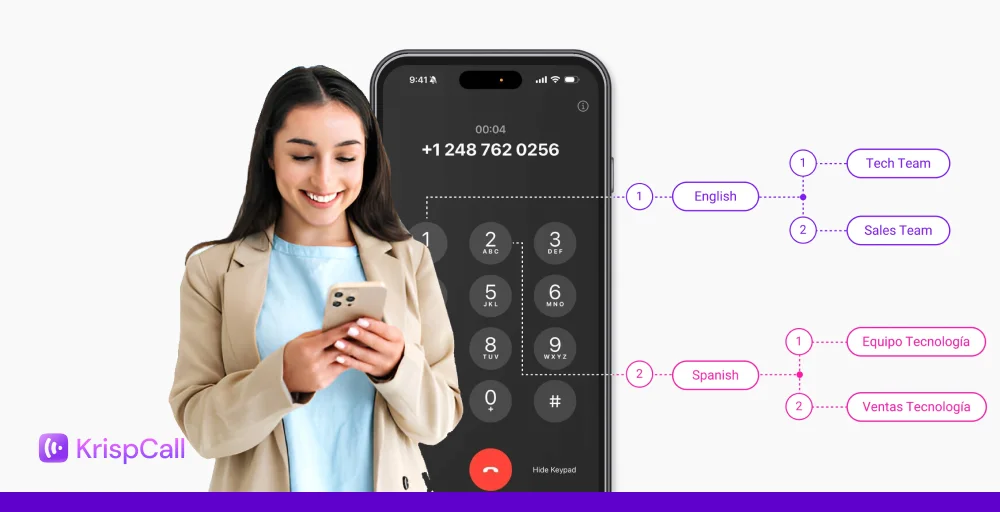
2. Routing the call: The IVR system uses customer input to guide the call. Call routing ensures that inbound calls are directed to the most suitable agent.
3. Agent engagement: Once the call reaches a live agent, the call center representative identifies the customer, verifies relevant customer data, and assesses the issues.
4. Issue resolution: The call center agents either resolve the customer service issue directly or transfer it to a specialized department. Either way, the focus remains on meeting customer expectations.
5. Documentation and follow-up: After handling calls, agents log the interaction, key points, call quality feedback, and next steps.
This structured call center workflow helps to focus on both efficiency and the overall customer experience. From traditional call centers to virtual call centers, these systems are built to scale with demand, support remote work tools, and ensure that even frustrated customers receive timely, helpful responses.
What does a call center do?
A call center is the front line between a business and its customers. Its main role is to handle communication, answer questions, solve problems, and sometimes drive sales. While phone calls are the core, many call centers now manage chats, emails, and even social media messages.
- Customer support: Agents help customers with product or service issues, troubleshooting, and account queries.
- Information requests: Providing details about services, pricing, policies, or processes.
- Technical help: Guiding customers through setup, installation, or problem resolution.
- Order management: Taking new orders, tracking shipments, processing returns, and handling billing.
- Outbound activities: Running follow-up calls, surveys, or sales campaigns to reach new and existing customers.
In short, a call center is designed to make customer interactions smoother and ensure people get quick answers, reliable support, and a positive brand experience.
What are the benefits of call centers?
Call centers help businesses manage high-stakes customer service issues by providing a structured space for agents to focus on resolving complex problems. Whether it’s a support call or follow-up, call center operations are designed to improve customer interactions.
With technology like AI customer service, including AI assistants and intelligent virtual agents, call centers can handle high volumes of customer phone calls without sacrificing quality.
This aligns with Zendesk’s 2025 findings, which show that most customers believe AI voice support significantly enhances the customer experience. Even as customers adopt self-service options, many still prefer phone support for urgent needs.
By enabling real-time conversations, call centers boost CSAT, increase customer loyalty, and allow contact center agents to deliver meaningful support when it matters most.
For businesses with global customers, call centers offer multilingual support and 24/7 availability, ensuring no query is left unanswered regardless of time zone. This not only builds trust but also gives companies a competitive edge in markets where quick, reliable communication is key.


Definition of call center vs contact center
A call center handles customer calls only, focusing on voice communication. A contact center manages calls, chat, email, and social media, providing a complete customer experience across multiple channels. Here’s a short comparison table for Call Center vs Contact Center:
| Feature | Call center | Contact center |
| Main channel | Voice (phone calls) | Multiple channels (voice, chat, email, social media) |
| Purpose | Handle customer calls | Manage all customer interactions across channels |
| Scope | Reactive support | Reactive and proactive support, marketing, and sales |
| Technology used | Phone systems, IVR | Omnichannel platforms, CRM integration |
| Customer experience | Limited to calls | Broader, more seamless experience across channels |
Types of call centers
Not all call centers operate the same way. Based on their function, setup, and purpose, different types of call centers serve specific business needs. Below are the most common models used today:
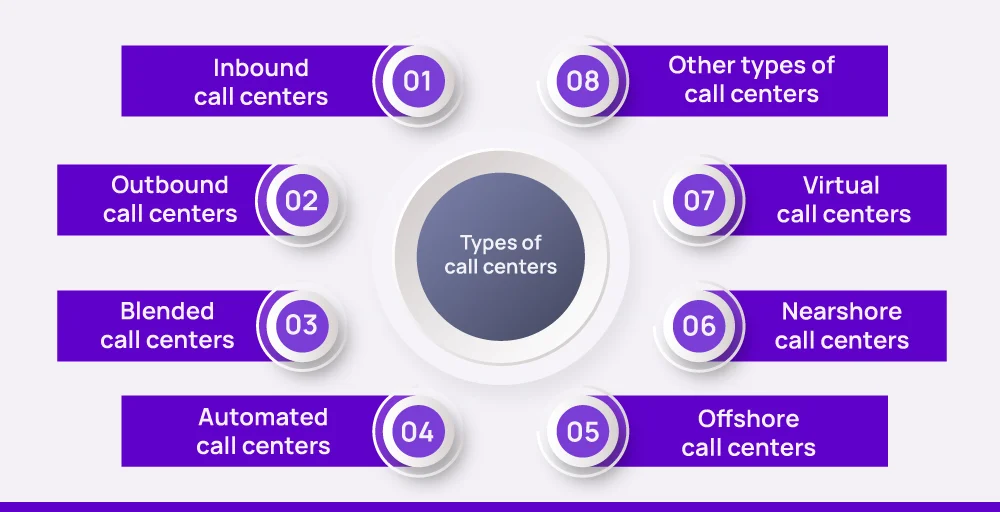
Inbound call centers
Inbound call centers focus entirely on receiving calls from customers. The work here revolves around assisting callers, whether it’s answering product-related questions, processing orders, or resolving issues. Agents often receive training tailored to the brand’s services so they can respond quickly and accurately to different situations.
Many companies use inbound centers to maintain high customer satisfaction levels by ensuring that a knowledgeable agent answers every call.
Best for: Businesses where customer service, technical support, or inquiry handling is a core priority.
Outbound call centers
In an outbound call center, agents are the ones initiating contact. Their calls might be part of sales efforts, market research surveys, lead nurturing, or appointment scheduling. Outbound teams often follow detailed scripts while also adapting to the flow of each conversation, which helps them maintain a professional yet persuasive approach.
The goal is to reach the right audience, convey the intended message, and achieve measurable results such as closing a sale or gathering valuable feedback.
Best for: Sales-driven organizations, telemarketing campaigns, and businesses aiming to expand their customer base.
Blended call centers
Blended call centers combine the functions of both inbound and outbound operations. This structure allows agents to switch between answering incoming queries and making outbound calls as needed, based on current call volumes or campaign requirements.
It offers flexibility in staffing and ensures that agents’ time is used productively throughout the day. In many cases, blended centers are supported by call routing systems that direct calls to the right people at the right time.
Best for: Companies that want to balance customer service with sales or outreach without running separate teams.
Automated call center
Automated call centers use systems like IVR and auto attendant scripts to manage simple tasks without human involvement. These tools handle repetitive or straightforward requests, such as checking account balances, booking appointments, or tracking orders, without requiring a live agent.
When the need is more complex, the system transfers the call to a human representative. This approach allows companies to manage large call volumes efficiently while reserving agent time for higher-value conversations.
Best for: Businesses that deal with high volumes of simple, repetitive inquiries.
Offshore call centers
Offshore call centers operate in countries far from the business’s main customer base, often chosen to reduce call center costs while maintaining large-scale service capabilities significantly. These centers handle a variety of tasks, including technical support, order processing, and telesales.
Success in offshore operations depends on careful recruitment, language training, and cultural alignment to ensure that the quality of telephony conversation remains consistent with brand standards.
Best for: Organizations aiming to expand capacity and manage call center costs more effectively.
Nearshore call centers
Nearshore call centers are located in neighboring or nearby countries, offering many of the same advantages as offshore operations but with closer cultural alignment and time zone compatibility. This type of call center outsourcing appeals to businesses that want cost efficiency without the added complexity of managing large time differences or significant language barriers.
The proximity makes it easier to coordinate real-time tasks, conduct training, and maintain consistent service quality. For many companies, nearshore outsourcing strikes a balance between operational savings and smooth day-to-day collaboration.
Best for: Businesses seeking the benefits of call center outsourcing with fewer logistical challenges.
Virtual call centers
Virtual call centers operate without a central physical location, with agents working from different places and connecting through cloud-based telephony systems. These setups rely heavily on reliable remote work tools to keep teams connected, manage call queues, and share customer information in real time.
The model allows companies to recruit from a broader talent pool, adjust staffing levels to match demand, and provide extended service hours without the limitations of a single office. By combining flexible staffing with technology-driven coordination, virtual call centers can deliver consistent customer experiences across multiple time zones.
Best for: Companies that want flexible staffing arrangements supported by efficient remote work tools.
Related 👉: What Is a Call Center PBX? Key Features, Benefits & Best Fit
Other types of call centers
Apart from the typical inbound and outbound models, businesses can also choose from several other types of call centers, each designed to meet different operational needs and customer service goals.
Here’s a look at these alternative customer service centers, along with their key pros and cons:
| Call center type | Call center description | Call center pros | Call center cons | Category |
| Multichannel call center | Handles customer interaction across multiple channels, like email, phone, and chat, but channels operate separately. | Offers flexibility for customers; easier to implement. | Channels are not integrated; this may cause disjointed experiences. | Based on communication |
| Omnichannel call center | Provides smooth, integrated customer interactions across all channels, with shared data and context. | Consistent experience across channels improves satisfaction. | Requires advanced technology and higher setup costs. | Based on communication/technology |
| In-house call center | Operated and managed internally by the businesses on its premises or remotely. | Full control over operation and quality; direct oversight. | Higher call center costs for staffing and infrastructure. | Based on location |
| Outsourced call center | An outsourced call center operated by third-party providers who specialize in CCaaS. | Reduces operational burden and expenses; easy to scale. | Less control over quality and customer experience. | Based on location |
The people behind every call centre
A call center runs smoothly thanks to the dedicated staff working in it every day. From traditional offices to virtual setups, each team member plays a key role in delivering efficient service and strong customer experiences.
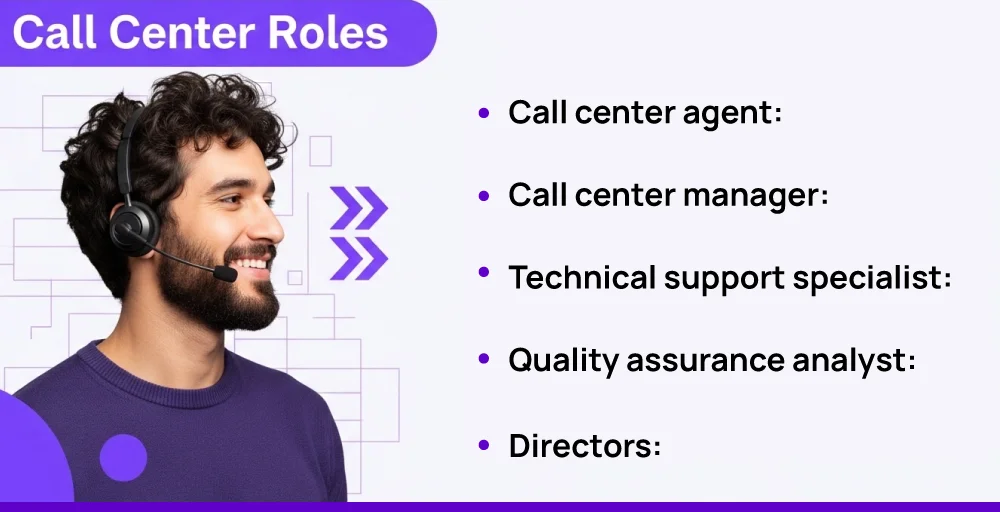
Call center agent: Call center agents are on the front lines, handling inbound and outbound calls and resolving customer issues. They’re trained to follow customer service strategies, manage high call volumes, and provide accurate support with each call.
Call center manager: The call center managers supervise the day-to-day call center operations. They monitor call center metrics and guide the team to improve outcomes, stay productive, and maintain call quality across all channels.
Technical support specialist: Technical support specialists assist with more complex problems that require product or system knowledge. They troubleshoot issues, manage escalations, and ensure smooth call handling by supporting both customers and agents using internal tools.
Quality assurance analyst: Quality assurance analysts evaluate calls, review recordings, and ensure agents follow best practices. They help maintain consistent service standards and often contribute to training programs that strengthen call center agent performance.
Directors: At the top level, call center directors oversee the entire operation. They focus on strategy, budget, hiring, and long-term planning to drive the success of the call center and align efforts across all teams, from customer service agents to supervisors and support staff.
6 reasons why you need a call center
Understanding how call centers work is only part of the picture. The bigger question is, does your business actually need one? If you’re seeing any of the signs below, it’s probably time to consider investing in a call center.

1. You want your customers to reach you anytime
If your customers expect immediate service, you need a team that can answer customer phone calls without delay. A virtual call center or automated call center helps extend your support hours, even 24/7, so your business is always accessible.
2. You’re getting more calls than you can handle
A growing volume of incoming calls is a good sign, but missing them can hurt your reputation. Effective call center management helps manage high demand, improve call routing, and make sure no call goes unanswered.
3. Your team is spending too much time on calls
When your in-house team spends most of the day on handling calls, they can’t focus on core tasks. Adding a dedicated customer service team helps offload routine inquiries and lets your staff concentrate on higher-impact work.
4. You’re missing out on potential sales
If you’re not following up leads quickly, you’re likely losing sales. Outbound call centers support a call center campaign that lets you proactively reach prospects and recover missed opportunities.
5. You want better insight into your customer experience
Without the right tools, it’s hard to track performance or measure satisfaction. Call centers give you access to call center metrics and tools that help analyze customer service interactions and pinpoint areas for improvement.
6. You’re ready to grow
As you scale, customer needs multiply. A structured call center, whether in-house or through outsourcing, offers the flexibility to handle more volume, support more channels, and maintain a consistent customer experience as your business expands.
How to measure call center success?
To truly understand whether your call centre operations are effective, you need to track measurable data tied to performance and satisfaction. Here are five key performance indicators to measure call centre success:

First call resolution (FCR): This metric shows how often customer service agents resolve customer issues during the first interaction. A high FCR means your agents are knowledgeable and efficient, which reduces the need for callbacks and boosts customer satisfaction.
Average handle time (AHT): AHT tracks how agents spend on each call, including talk time and follow-up. While faster isn’t always better, monitoring AHT helps evaluate the performance of agents and optimize call handling without rushing customers.
Call abandonment rate: This tells you how many incoming calls are dropped before reaching an agent. High abandonment can signal long wait times or ineffective self-service options. Keeping this number low is essential to reducing frustrated customers and improving customer service interactions.
Customer satisfaction score (CSAT): Customer satisfaction score (CSAT) directly reflects how happy customers are with their interaction. Often collected through post-call surveys, this metric is a strong indicator of customer service quality and overall customer experience.
Net promoter score (NPS): NPS gauges customer loyalty by asking how likely customers are to recommend your service. It’s a core customer service metric that helps measure long-term satisfaction and predict retention trends.
Examples of call centers across industries
Customer support centers serve a wide range of industries where direct customer interaction is essential. Whether it’s managing incoming calls, resolving issues, or offering support, the services of call centers can be tailored to the specific needs of each sector. Here are a few examples:
Travel & tourism
Airlines, hotels, and travel agencies utilize call centers to manage reservations, cancellations, itinerary changes, and emergency assistance. With travel plans often changing at the last minute, having flexible, responsive customer support is key to delivering a positive customer experience.
Financial services
Banks and credit unions use call centers to support customers with account inquiries, lost cards, fraud alerts, and loan applications. These teams require secure, compliant handling of calls and are critical for maintaining customer trust and loyalty.
For example, call center agents guiding a small business owner through applying for a secured business credit card must provide accurate information while protecting sensitive account details.
Retail & e-commerce
Retailers and online storefronts depend on call centers for order management, returns, product support, and customer feedback. Whether helping with product questions or resolving shipping issues, agents play a key role in improving customer retention and brand loyalty through timely, personalized support.
A well-structured contact center for retail industry ensures that businesses can handle high call volumes efficiently, deliver consistent customer experiences, and maintain trust across every stage of the buying journey.
Healthcare
Healthcare providers often use outsourced customer support centers to manage off-hour patient calls, appointment scheduling, and urgent case routing. With trained contact center agents, these services ensure that patients receive timely information, even when medical staff aren’t immediately available.
Telecommunications & utilities
Call centers are essential for telecom companies, internet providers, and utilities to manage technical support, billing issues, service outages, and plan upgrades. Agents help resolve technical disruptions and improve customer retention in highly competitive markets.
Enterprises
Large enterprises often deal with complex customer interactions across multiple regions and departments. A contact center for enterprise helps unify communication channels, streamline workflows, and ensure consistency in customer experience at scale. From handling employee helpdesk support to managing global client interactions, these contact centers are critical for efficiency and operational success.
Strengthen and scale your call center support without hesitation
Upgrade your call center operations with KrispCall’s cloud telephony system. From an AI copilot that rephrases replies and auto-responds to common questions, to a call transcription that turns recorded conversations into searchable records.
KrispCall gives your team the tools to handle more customer interactions with less effort. It also allows you to scale your business as you grow, along with features like call routing, multi-level IVR, analytics, and call recordings.