

The Public Switched Telephone Network (PSTN) is the traditional telephone system that has connected people across the globe for over a century. Known as the backbone of global voice communication, it encompasses everything from analog copper lines to digital switching centers that route voice signals between landlines and mobile devices.
Despite the rise of VoIP, IP telephony, and other digital communication technologies, PSTN still powers essential business operations in many industries.
From reliable call quality to emergency services compatibility, it plays a critical role, especially for companies operating in regulated environments or remote locations.
This article provides a clear and simplified breakdown of what PSTN is, how it works, and where it fits in the modern communication landscape.
Whether you’re an IT manager, a business decision-maker, or simply exploring migration strategies, you’ll learn about the core components of PSTN, how it compares with VoIP systems, and what options exist for future-proofing your organization’s communication setup.
✨ Key Takeaways
- PSTN (Public Switched Telephone Network) is the traditional circuit-switched system that enables real-time voice communication through copper wires, fiber optics, and telephone exchanges.
- A PSTN call goes through a complex chain of exchanges, trunk lines, and gateways, ensuring consistent call quality through dedicated physical circuits.
- Despite its stability and 99.999% uptime, PSTN’s aging infrastructure limits scalability, feature availability, and cost-efficiency for modern business communication.
What is PSTN (public switched telephone network)?
The Public Switched Telephone Network (PSTN) is the global system of circuit-switched telephony networks that enables traditional voice calls.
Often referred to as the traditional telephone network, plain old telephone service (POTS), landline phones, and analog or fixed lines. PSTN connects calls using a combination of copper wires, fiber optic cables, switching centers, and telephone exchanges.

When you make a landline phone call, your voice is converted into analog or digital signals, routed through the local exchange, and then passed through a network of switches to reach the recipient’s phone.
PSTN is regulated, standardized, and operates with high reliability, making it the foundation of global voice communication for over a century. Even though it’s increasingly being replaced by VoIP (Voice over Internet Protocol) and digital communication platforms, PSTN is still actively used in many countries and industries.
A Brief History of PSTN
The story of the PSTN begins in the late 19th century, shortly after Alexander Graham Bell patented the telephone in 1876. Initially, calls were connected through manual switching by operators using physical patchboards, a labor-intensive process limited to local communication.
The Early Days: Manual Switching & Analog Signals
In the earliest systems, a user would pick up their phone, which signaled a nearby operator at a central office. The operator manually connected the call by plugging in wires to establish a temporary voice path between two telephones. This system used analog voice signals transmitted over copper wires, forming the foundation of early telephone lines.
The Age of Automation & Digital Transition
By the mid-20th century, automatic switching systems replaced manual operations, enabling faster and more private communication. As the network grew, international trunk lines, telephone exchanges, and signaling protocols like SS7 were introduced to handle more complex call routing and global communication.
In the 1980s and 90s, digital technology began to transform PSTN with the introduction of Integrated Services Digital Network (ISDN) and digital switching centers, allowing voice and data transmission over the same line.
PSTN in the Modern Era
Today, while many countries are phasing out analog PSTN in favor of IP-based systems, the PSTN infrastructure still forms a core part of many telecommunications providers’ networks. It’s integrated with VoIP, mobile communication, and fiber-optic backbones, enabling hybrid communication models in both urban and remote areas.
Though newer systems like VoIP services offer more flexibility, the legacy of PSTN remains, not just in infrastructure, but in the standards and reliability it brought to global voice communication.
Why PSTN Still Matters?
Despite the rise of modern alternatives, PSTN remains critical for several reasons:
Proven Reliability: PSTN is known for its uptime and call clarity. Since it uses dedicated circuits for each call, it’s less affected by congestion or internet instability.
Emergency Communication Compliance: PSTN supports emergency services (e.g., 911, E911) more reliably than many VoIP systems. In emergencies, being able to connect without power or internet is a key advantage.
Universality & Reach: The global network of PSTN connects virtually every landline and many mobile networks. It’s still the default telephony infrastructure in remote or underdeveloped areas.
Regulatory Trust: Many governments and industries still require PSTN lines for compliance, especially in financial services, healthcare, or public institutions.
Integration with Legacy Systems: Older PBX systems, fax machines, and certain telecommunications devices rely on analog or TDM (Time Division Multiplexing) lines, which PSTN supports.
How Does PSTN Calling Work?
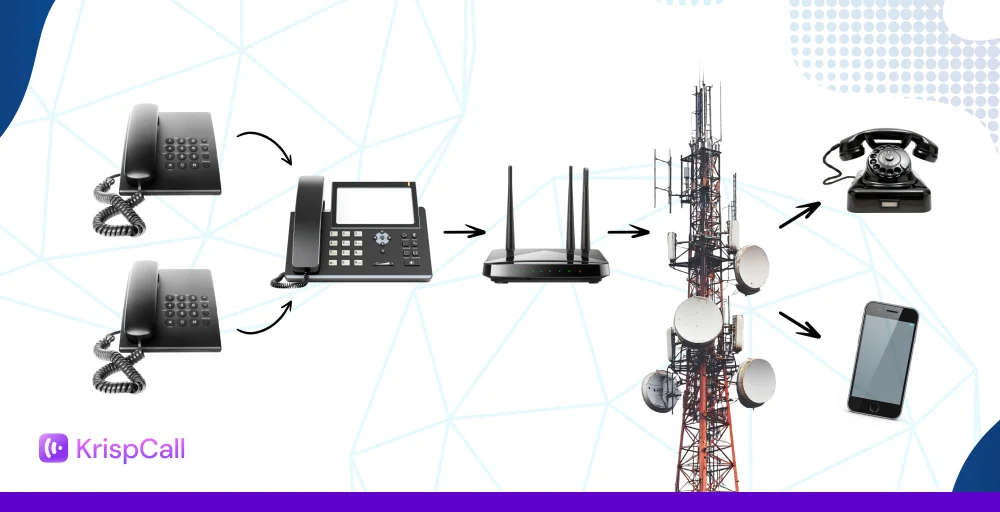
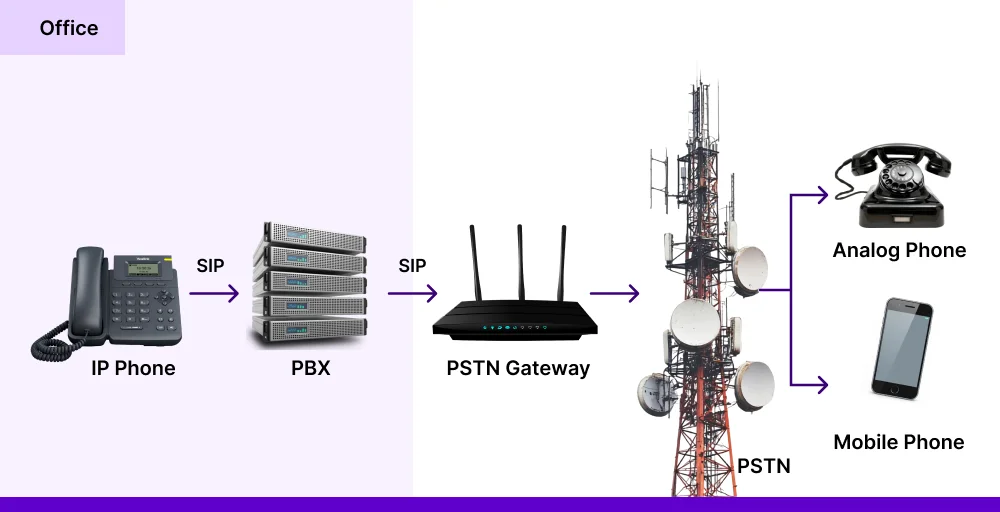
When you place a call through the Public Switched Telephone Network (PSTN), the system establishes a dedicated communication path between you and the recipient. Here’s a simplified breakdown of the entire process:
Step 1: Dialing the Number
When you dial a phone number on a PSTN line, your phone sends a signal to the local telephone exchange (also known as the central office). This signal may be analog (in traditional setups) or digitized (in modern PSTN systems).
Step 2: Local Exchange Processing
The local exchange determines whether the number you’re calling is:
- Within the same local area
- Routed through a long-distance trunk line
- Or directed to a mobile or international gateway
Based on this, the system decides how to route the call efficiently.
Step 3: Establishing the Circuit
Next, the PSTN begins to build a temporary circuit between the caller and the receiver. This includes:
- Local lines connecting the caller to the exchange
- Tandem switches or trunk lines for long-distance routing
- Recipient’s local exchange, which connects to the receiving line
These components work together to form an uninterrupted physical or virtual path across the switched telephone network.
Step 4: Signaling with SS7
While the voice circuit is being established, another layer of communication is happening through Signaling System 7 (SS7). This global protocol:
- Sends information like the caller ID
- Sets up and tears down calls
- Handles number translation, routing, and call forwarding logic
Step 5: Voice Transmission Begins
Once the circuit is active:
- Voice signals are converted into electrical signals (if analog) or digital streams (in modern PSTN)
- These signals travel end-to-end through the dedicated circuit, no interruptions, no packet loss
- Minimal latency is achieved due to the direct, continuous connection
What Is a POTS (Plain Old Telephone Service)?
Plain Old Telephone Service (POTS) is the traditional analog phone system, part of the Public Switched Telephone Network (PSTN). The main difference is that POTS uses copper wires for voice calls, while PSTN includes newer technologies like fiber optics for better functionality.
When you make a call with POTS, your voice is converted into electrical signals that travel through wires to a switching center, which then connects you to the recipient. Long-distance calls are more expensive because the circuit stays open longer as the signal travels farther.
Businesses often use a Private Branch Exchange (PBX) to route calls internally, allowing multiple extensions to share a single phone line.
PSTN architecture and components
The architecture of the traditional PSTN is a complex yet highly organized system designed to facilitate voice communication across local, national, and international boundaries. Traditional PSTN follows a circuit-switched model, establishing a dedicated pathway between two endpoints for the duration of a call.
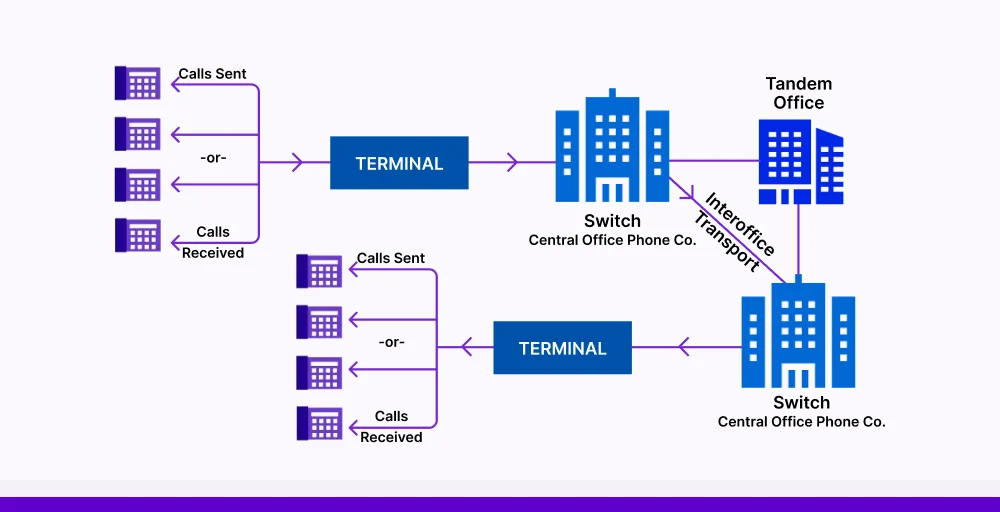
Local Loop (Subscriber Loop)
This is the physical connection between the end-user’s phone and the local exchange (central office). Traditionally built using copper wires, this segment is where analog voice signals begin their journey.
Central Office / Local Exchange
The central office houses switching equipment that connects subscriber calls within a local area. It’s the first point of contact where calls are routed, and decisions are made about where to send them next.
- Responsible for digitizing voice signals in modern systems
- Routes calls either locally or to tandem switches if the destination is outside the local area
Tandem Switches (Trunk Exchanges)
Tandem or transit switches connect multiple local exchanges. They form the backbone of regional and national PSTN routing, especially for long-distance calls.
- These do not connect directly to end-users but handle inter-office traffic
Trunk Lines
These are high-capacity circuits that connect central offices and tandem switches. They use digital channels and can carry multiple calls simultaneously.
- Modern trunks often run on fiber optic cables, replacing older copper infrastructure
- Support both voice and signaling data
Signaling System
PSTN relies on out-of-band signaling, primarily Signaling System No. 7 (SS7), to handle:
- Call setup and teardown
- Number translation (e.g., 800 numbers)
- Billing and routing instructions
SS7 operates independently of the voice path, ensuring faster and more secure signaling.
Switching Systems
Switches form the intelligent layer in PSTN architecture. They make real-time decisions on:
- Which path to send the call
- When to engage/disengage connections
- Providing features like call forwarding, voicemail, etc.
There are two types:
- Class 5 switches: local subscriber-level switching
- Class 4 switches: handle long-distance and tandem-level traffic
End Devices & Terminal Equipment
These include:
- Analog phones
- Fax machines
- PBX systems
- Modems
While newer technologies often bypass PSTN, many legacy systems still rely on these terminal devices.
Transmission Mediums
PSTN supports various physical channels:
- Underground copper wires
- Aerial cables
- Coaxial cables
- Fiber optics
- Microwave towers (in remote areas)
The shift from analog to digital technology has significantly improved signal quality, bandwidth, and scalability.
Key features of a PSTN phone system
PSTN is known as one of the most popular communication methods over the past decades, offering some of the best-fitted features such as:
1. Interoperability: Any PSTN user can call any phone number worldwide. All networks follow standard telephone protocols, making communication universal.
2. Circuit-switched: PSTN uses circuit switching, which means a dedicated path is created for each call. This ensures consistent and stable voice quality.
3. Voice quality: Because PSTN uses a fixed circuit, the voice quality stays clear without lag or jitter. This is why emergency services and government networks still trust PSTN lines.
4. 99.999 percent uptime: PSTN is known for “five-nines reliability”. Phone lines keep working even during internet outages or power failures (with backup power).
5. Global connectivity: PSTN connects millions of telephone exchanges and trunk networks across the world, allowing anyone to make local, national, or international calls.
Advantages of PSTN
Though VoIP phone services are mostly considered by businesses, PSTN still remains one of the popular options due to various reasons. Some of them are:
1. Well-developed network infrastructure
PSTN’s major benefit is its decades-old infrastructure, featuring a vast landline network of copper lines, switches, and exchanges that ensure reliable voice communication. Its extensive reach provides connectivity even in remote areas, making it a dependable, although old, system.
2. Proven reliability
The PSTN has been used for a very long time and has long-term technology that has been used all around the world. As it doesn’t need an internet connection to operate, you can still use it in case of power outages or network crashes, as you can easily make and answer business calls.
3. Stable voice transmission
PSTN (traditional phone lines) uses dedicated connections for each call. It means clear, reliable voice calls with minimal delays or problems. This consistent quality is crucial for businesses and vital communications where clarity and dependability are essential.
4. Universal accessibility
Public Switched Telephone networks are easy to use even for those who are unaware of new technologies. They provide basic features like call muting, forwarding, putting a call on hold, or leaving a voicemail, which are easy to operate and learn, making PSTN accessible.
5. Enhanced data protection
PSTN networks have a very low chance of hacking as they operate on a dedicated network via copper wires. Additionally, it adheres to strict regulations and employs standard encryption safeguards, thereby preventing unauthorized access to users’ privacy.
Disadvantages and limitations of PSTN
PSTN has several limitations that push businesses toward VoIP and cloud telephony.
1. Costly to operate
The PSTN is very costly to maintain as it depends on dedicated circuits, and it charges more for international or long-distance calls. Its pricing includes maintenance expenditures, time-to-time upgrade costs to support new technologies, and other physical facilities.
Additionally, if you have no phone line, the rental cost of a phone line is also high, which in turn increases the PSTN pricing. This traditional setup often delays the digital transformation in telecom as upgrading the infrastructure is expensive and complex.
2. Lack of advanced features
Not for every business, the basic features of PSTN are often insufficient, and it doesn’t offer the advanced features that modern VoIP alternatives provide. As communication is becoming modern-day-to-day, PSTN doesn’t support those features, which makes it less effective than others.
3 Call limits
In the Public Switched Telephone Network, there is a limit for making calls, and if you exceed the limit, you need to pay an extra charge for making calls. Also, calling abroad using PSTN is very costly.
4. Limited scalability
Another major limitation is that it is very much dependent on the physical infrastructure, such as circuit-switching and copper wires. This limits the scalability and flexibility of the PSTN network in comparison to other modern phone services and unified customer experience management that integrates communications smoothly.
5. Struggles with new tech
Nowadays, technology continues to advance day by day, but with PSTN, you may encounter challenges when integrating with other digital services. Additionally, real-time collaboration, such as video conferencing and virtual meetings, is not possible without upgrading your system or adding other technologies.
Alternatives of PSTN for businesses
As the Public Switched Telephone Network becomes outdated, businesses are turning to modern alternatives. VoIP is the most popular, offering more features at lower costs. Some of the other PSTN alternatives include ISDN, VoIP phone systems, Private Branch Exchange (PBX), and more.
PSTN vs. ISDN
Integrated Services Digital Network (ISDN) is developed for the transmission of digital voice and data through the telephone lines. In comparison to PSTN, ISDN provides better voice quality and faster calls with 128 Kbps.
The main features of ISDN are the integration of speech and data within the same line, which is not available in other telephone services.
However, the ISDN overcomes the limitation of PSTN, providing faster and more reliable connections, which have now become outdated. PSTN is still based on circuit-switched analog lines with limited bandwidth and adaptability. ISDN, while advanced, was quickly overtaken by a more scalable, internet-based solution.
PSTN vs. PBX
PBX is known as a private telephone network that is a good fit for businesses that make calls via their own central switchboard, either to make internal or external phone calls.
Traditional PBX systems rely on the PSTN to connect external calls, which means they’re still dependent on outdated analog infrastructure.
Many PBX systems use VoIP to route calls online, reducing costs and adding features like voicemail, call forwarding, and conference calling. Because of this, businesses are increasingly switching to IP-based PBX systems or cloud-based phone systems, accelerating digital transformation in telecom, and integrating smoothly with other digital tools.
PSTN vs VoIP: What’s the difference?
One of the popular alternatives to PSTN is Voice over Internet Protocol (VoIP). The major difference between Public Switched Telephone Network and VoIP is that VoIP converts voice into digital packets sent over the internet, while PSTN uses analog electrical signals over dedicated copper wires.
The general overview of the differences between VoIP and landline PSTN:
| Features | PSTN | VoIP |
| Connection type | Dedicated telephone lines | Digital via the Internet protocol |
| Switching | Uses circuit switching | Uses packet switching |
| Third-party integration | No third-party integrations | Supports third-party integrations |
| Device support | Limited to basic handsets | Softphones, SIP phones, |
| Scalability | Difficult and costly (requires new lines/hardware) | Easy and cost-effective (software-based upgrades) |
| Bandwidth | Supports 64 Kbps | Requires 100 Kbps |
| Security | Depends on the dedicated telephone lines | Depends on the security of the Internet connection |
For businesses, upgrading a VoIP phone system offers significant financial advantages. Setting up VoIP costs much less than a traditional phone system connected to the PSTN. Plus, international calls are up to 60% cheaper.
VoIP phone service digital setup is also more flexible, offering advanced features such as IVR, call analytics, CRM integration, SMS, and voicemail-to-email, which are often expensive extras with PSTN.
Growing a VoIP system requires only a software update, whereas expanding a PSTN involves costly new hardware and wiring.
However, the main trade-off is reliability. Traditional PSTN phone lines are highly stable and secure due to their dedicated physical connections. VoIP, in contrast, requires a stable internet connection and power to function properly.
Why VoIP is better than PSTN?
The VoIP (Voice over Internet Protocol) is one of the most popular alternatives to PSTN because it is better in several aspects, like:
1. Improves productivity
As VoIP offers advanced features such as instant messaging, video conferencing, and integration with other business tools, it facilitates easier collaboration and communication. Also, this eliminates the time spent managing calls and enhances productivity.
2. Higher scalability
While VoIP installation, you are free to add or remove lines based on your preferences without any cost or making any changes, which provides greater scalability to your business. This will enable businesses to use VoIP with greater flexibility, whereas PSTN requires additional costs and complex expansion for such accommodations.
3. Cost-effective
In comparison to PSTN, VoIP is most cost-effective, as it uses the internet for voice transmission. This will help to reduce the call charges of international or long-distance calls. Also, VoIP offers advanced features like call routing, recording, and others with no additional cost.
4. Enhance customer service
Connecting PSTN and IP calls lets businesses use advanced features like call forwarding, automated attendants, and CRM integration. These tools help manage customer calls better, making service more efficient and personal than basic PSTN.
5. Internet & power dependence
VoIP networks rely entirely on a strong internet connection and a consistent power supply. Unlike PSTN’s inherent stability through dedicated lines, businesses using VoIP networks need to plan for internet and power outages to maintain communication.
How much does PSTN access cost?
The cost of PSTN may vary based on several factors, such as the location, specific services, or the service provider. Here’s the general pricing overview:
1. Installation fee: If you have no phone line, you need to set up a new PSTN phone line that includes the installation fee. It ranges from $50 to $ 200, varying based on location and provider.
2. Monthly line rental: Next comes the monthly rental fee, which ranges between $20 to $50 per line to maintain PSTN. It covers the service and maintenance fee of the line.
3. Local and long-distance or international rates: Typically, local calls are included in a monthly plan or at a very low charge rate. However, if you need to make international or long-distance calls, additional costs apply. The pricing may range from a few cents per minute to higher prices based on distance.
4. Advanced features: PSTN offers basic features only. However, if you require advanced or additional features, such as call waiting, call forwarding, voicemail, and caller ID, you will incur an extra cost. It typically ranges from $5 to $15 per feature.
5. Business plans: Businesses might choose multi-line or bundled phone plans costing from $50 to hundreds of dollars monthly, depending on how many lines and extra services they need.
The future of PSTN phone line
The Public Switched Telephone Network (PSTN) remains operational in regions with limited access to modern infrastructure and continues to support emergency communications. However, its future is uncertain. With advancements in fiber-optic and mobile networks, the PSTN is steadily being phased out.
Due to its limited scalability, bandwidth constraints, and high operational costs, PSTN is increasingly unsuitable for today’s growing business demands. Organizations are rapidly transitioning to internet-based solutions like VoIP and unified communications, which offer superior flexibility, cost efficiency, and advanced features.
As the shift accelerates, the future of PSTN appears uncertain. To remain competitive and deliver modern customer communication experiences, companies must embrace newer, more capable technologies.
Should you switch from PSTN to VoIP?
PSTN (Public Switched Telephone Network) has served as the foundation for voice communication for decades. However, with the rise of internet-based communication, VoIP alternatives are becoming the go-to choice for businesses of all sizes.
VoIP offers more features, flexibility, and cost-efficiency compared to traditional landlines. While PSTN is stable and reliable, it lacks the advanced capabilities that modern businesses need to stay connected and competitive.
That’s where KrispCall plays a role. Built for small to medium-sized businesses, KrispCall provides a powerful VoIP-based business phone system that serves as an all-in-one unified business telephony solution.
With features like IVR, call analytics, call on hold, shared phone number, CRM integration, multimedia messaging, AI-powered call summaries, and more, KrispCall gives your team everything it needs.