


Managing a support team across multiple time zones creates a specific kind of problem: a customer calls expecting help, but your team’s schedule doesn’t line up with their clock. The result is a higher missed call rate, a rising abandonment rate, and CSAT scores that quietly drop.
Time zone chaos is one of the most underrated reasons global support teams fail to deliver consistent service.
This guide covers how to stop missing customers’ calls and ways to deliver real 24/7 customer support coverage without the usual scheduling mistakes.
TL;DR
- Missed calls across time zones usually trace back to a handful of avoidable gaps, like mismatched business hours, no backup routing, or fragmented regional systems.
- Every missed call carries real cost, from lost revenue and slower sales cycles to lower CSAT and reduced brand trust.
- Time-based routing and follow-the-sun coverage let you offer real 24/7 support without forcing any single team into overnight shifts.
- Shared numbers and intelligent call forwarding remove the single points of failure that cause most missed calls in the first place.
- Routing rules need regular review as teams grow, regions shift, and DST changes roll through.
What causes businesses to miss customer calls across different time zones?
Missed calls across time zones usually come down to a handful of avoidable setup gaps such as:
1. Different business hours
When your primary operations run on standard local time (e.g., EST), customers in other time zones (like GMT or JST) may end up calling outside your working hours without realizing it. A 9-to-5 in New York is already past midnight in Singapore, so calls naturally go unanswered.
2. Calls are routed to unavailable employees
Even with agents scattered across regions, a poorly configured call routing setup can route calls to an employee who’s off shift or logged out. The call rings, nobody picks up, and the customer hangs up.
3. No centralized business phone system
Relying on fragmented infrastructure prevents seamless global communication. Without a cohesive cloud phone system, your operation lacks an ACD (Automatic Call Distributor) to intelligently handle incoming calls and dynamically route them across your active workforce.
4. Lack of after-hours coverage
Many organizations fail to implement automated conditional logic for times when live agents are entirely offline. Without smart rules to forward calls to a secondary on-call team, an outsourced partner, or an interactive voicemail system, calls hit a dead end, directly increasing your missed call rate.
5. Separate regional phone numbers
Running different virtual phone numbers for each region without a unified system means calls stay siloed. An agent in one region can’t easily pick up a call intended for another region, even if they’re available.
Why do missed customer calls hurt business growth?
A missed call is a lost customer, not just a lost conversation. It compounds into five measurable costs: lost revenue, slower sales cycles, lower CSAT, fragmented customer experience, and eroded brand trust, each one chipping away at growth.
1. Lost Revenue
Small businesses lose an average of $126,000 per year to unanswered calls, according to Callsetter’s breakdown of the cost of missed calls (Invoca, 2022 Call Intelligence Report). For high-ticket B2B or service businesses, missing even one inbound discovery call can mean losing that customer’s entire lifetime value, not just a single sale.
2. Slower Sales Cycles
Leads contacted within 5 minutes are 21 times more likely to qualify than leads contacted after 30 minutes (MIT and InsideSales lead-response study), according to this roundup of missed call statistics for 2026. A missed call skips this window entirely, and buying urgency cools fast once a lead has to wait.
3. Lower Customer Satisfaction
Callers read an unanswered line as poor operational care, not bad timing. Businesses covering only one time zone risk frustrating international callers who waited specifically to reach them during business hours, a direct hit to CSAT.
4. Fragmented Customer Experience
Customers expect consistent access across every channel, not just phone. Inconsistent availability and long hold times push customers to abandon your unified communications experience altogether, often mid-conversation.
5. Reduced Brand Trust
Trust depends on reliability. Roughly 80% of callers who reach voicemail hang up without leaving a message (Hiya, 2023 State of the Call report), a pattern CallSaver explores in its piece on why customers don’t leave voicemails, and most call a competitor next instead of waiting for a callback.
How can you stop missing customer calls across time zones?
Fixing missed calls across time zones is more about building a proper system where every call has somewhere to go, no matter when it comes in, and less about hiring more agents.
Here are some strategies that will ensure your organization never misses any customer call, regardless of the time zone:
1. Use a cloud phone system
Traditional phone systems bind your operations to a physical office location. Cloud telephony solutions, however, completely detach your phone lines from physical constraints, making your communication infrastructure globally available. Because the system runs in the cloud, employees can access it from anywhere in the world. It also helps you manage your entire global operations from a single dashboard.
2. Set up time-based call routing
Time-based call routing acts as your system’s traffic controller. It systematically sorts every incoming signal by time of day or day of the week.
Business hours routing sends calls to your primary team during their active shift. After-hours routing kicks in once that shift ends, sending calls to voicemail, an on-call agent, or the next region’s team. Regional routing takes it further by directing calls to the office or team physically closest to the caller’s time zone, so a customer in Manila and one in Manchester each land with someone actually awake and working.
3. Create follow-the-sun customer support
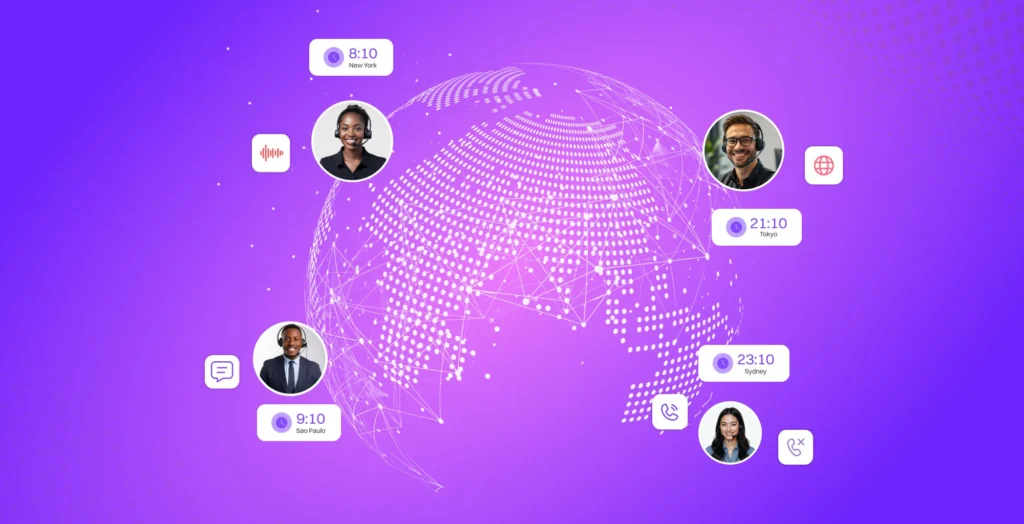
A follow-the-sun model is where customer support coverage is passed from team to team, following the natural progression of the sun’s daylight. Many global companies use this model as it delivers seamless 24/7 customer support coverage without forcing anyone into overnight shifts.
For example, as the East Asian team prepares to log off, their phone queues automatically shift over to the European office, and then to the next active team, creating a continuous loop of awake, alert representatives.
4. Enable intelligent call forwarding
Intelligent call forwarding settings act as an automated safety net, ensuring that even if an agent isn’t sitting right at their desk, the incoming call doesn’t ring out. If your primary representative is unavailable, backup agents receive the call immediately.
Agents can even receive live corporate calls directly in their mobile app via mobile forwarding when they’re away from their desk. And in the event of a power outage or severe weather, the entire office’s incoming volume can be rerouted to an alternative facility via office forwarding rules.
5. Use shared business phone numbers
When a number belongs to a single agent, calls are answered only if that person is around. Using a unified shared number removes that dependency and keeps the customer wait times down. Any available agent on the team can pick up the call, so coverage isn’t tied to one person’s schedule, time zone, or day off.
6. Add call queues
When call volume spikes, you can use an ACD (Automatic Call Distributor) to manage incoming call volume without dropping connections. It places each call in an organized queue with transparent hold music or wait-time updates, then distributes the call evenly among the active agents. This prevents individual burnout and reduces the abandonment rate.
7. Enable voicemail with instant notifications
Voicemail systems should function as a high-speed dispatch tool rather than an isolated digital storage archive. If a message just sits there until someone opens their inbox, it’s effectively a missed call with extra steps. Instant notifications will alert an agent the moment a message comes in, so a callback can happen while the customer’s still expecting to hear back.
8. Track missed call analytics
You cannot optimize what you do not measure. Utilizing structured call center analytics will show you exactly when calls are being missed. Evaluating your analytics reports helps you identify your peak hours and the exact times, dates, and regions where missed call are most frequent. With clean, visible data, you can make proactive decisions to map your infrastructure.
9. Connect your phone system with CRM software
Integrating your communication channels with your CRM platform ensures your voice operations are fully synced with your customer records. This gives agents instant access to a caller’s interaction history before the caller even says hello. CRM integration also automatically logs every call against the right record without manual entry. Together, these add up to faster callbacks, since agents spend less time searching and more time responding.
10. Review call routing regularly
A common pitfall is setting up intelligent call routing rules and letting them run on autopilot indefinitely. However, businesses are dynamic: team grows, new regional offices open, and customer demographics shift over time. Regularly auditing your routing parameters ensures your automated path continually evolve along side your team size and traffic volumes.
Which phone system features help global teams answer more calls?
The features that help global teams answer more calls are the one that removes the dependency on a single person, location, or time zone.
Business phone system features at a glance:
| Feature | Why it matters | Business benefit |
| Time-based routing | Directs calls to whoever’s actually on shift | Fewer calls will land outside working hours |
| Call forwarding | Redirects calls when the primary agent is unavailable | Prevents leads from hitting a dead end |
| Shared numbers | Allows entire teams to collaborate on a single incoming line | Speeds up response times with collective ownership |
| Call queues | Holds calls in a structured line during volume spikes | Lower abandonment rate |
| Analytics | Shows when and where calls are being missed | Data-driven staffing decisions |
| CRM integrations | Automatically syncs call history with customer records | Faster, more informed callbacks |
| Multi-device access | Agents can take calls from a phone, a desktop, or a laptop | Coverage isn’t tied to a physical desk |
| Voicemail | Captures calls that still go unanswered | Recoverable leads instead of silent losses |
| Global numbers | Provides local and toll-free numbers in target markets | Higher answer rates, lower caller hesitation |
1. Time-based routing
Time-based routing operates as an intelligent directory that analyzes incoming call timestamps against current localized working hours. It automatically directs incoming calls based on predefined schedules such as business hours, time zones, shifts, or holidays. This ensures continuous, seamless 24/7 customer support coverage without imposing demanding night shifts on any single local team.
Without it, every call follows the same path regardless of when it comes in, which means calls outside your home time zone’s business hours just ring into nothing.
2. Call forwarding
The CCaaS (Contact Center as a Service) model uses conditional logic to ensure a call doesn’t go cold just because one person is unreachable. If the primary agent is offline, on another call, or between shifts, call forwarding automatically reroutes it to a backup agent, a mobile number, or another office.
This continuous sequence ensures customers are never left stranded on an empty ringing line.
3. Shared numbers
Shared business phone numbers allow multiple team members to monitor, receive, and dial out from a single virtual phone number. Every active agent gains equal visibility into all incoming call, voicemails, and text messages.
When a number is tied to a single agent, the availability is only as good as that person’s schedule. Shared number, however, break that link, ensuring no client conversation stalls due to a single person’s full calendar.
4. Call queues
When incoming call volumes spike, call queues act as organized digital waiting rooms. Instead of hearing a busy signal or dropped connection, callers are placed in a structured holding queue with estimated wait times.
This systematic queuing ensures that high-volume periods do not lead to a spike in your missed call rate. It enables a global team to process incoming inquiries systematically, balance workloads, and maintain high customer satisfaction (CSAT) scores.
5. Analytics
Call center reporting and analytics turn missed calls from a vague problem into a specific, fixable one. Analytics tools track key metrics such as average handle times, peak call hours, and regional wait times across your entire communication network.
Reviewing these reports regularly helps make proactive staffing decisions and know precisely where to add coverage and when.
6. CRM integrations
Connecting your phone system to a CRM means every call is automatically tied to the right customer record. When an agent picks up a callback, they can see the full history instantly instead of starting from zero.
With CRM integration, the next agent can pick up exactly where the last one left off. Without it, that handoff loses context.
7. Multi-device access
Multi-device access forms the foundation of modern UCaaS (Unified Communications as a Service). By allowing agents to access their business phone via web browsers, desktop apps, or mobile apps, your workforce is no longer tied to a physical office desk.
This flexibility is essential for coordinating distributed teams. It ensures that your global support coverage remains active, agile, and resilient, regardless of individual agent locations.
8. Voicemail
Voicemail, when paired with instant notifications, turns an unanswered call into an immediate action item. An agent gets alerted the moment a message comes in and call back within minutes, while the customer’s still expecting a response.
This rapid-dispatch approach ensures that customers receive answers while their buying intent is still high, turning a missed connection into a successful resolution.
9. Global numbers
Providing local and toll-free numbers in your target international markets is one of the most effective ways to encourage customers to reach out. Many buyers hesitate to dial international numbers due to high costs and trust concerns.
Establishing a local presence with a virtual number breaks down these geographical barriers. Customers can dial a familiar, local phone number and get routed to any active global team, helping you build trust and scale your brand globally.
Common mistakes that cause businesses to miss calls
Even with good intentions, a few recurring setup mistakes quietly drain call volume before anyone notices the pattern.
1. Relying on personal mobile phones
When calls are routed to an agent’s personal number, coverage depends entirely on that one device being on, charged, and in range. There’s no backup, no shared visibility, and no way for anyone else to step in if that person is unavailable.
2. No backup routing
If a call has only one destination and that destination doesn’t answer, the call simply ends. Without a backup agent, queue, or forwarding rule behind it, every call has a single point of failure.
3. Ignoring after-hours calls
Ignoring after-hours calls overlooks the extent of demand outside standard hours, especially for global customers in other time zones. Without after-hours routing or voicemail with instant alerts, these calls just disappear.
4. Using different phone providers
Running separate systems per region or office makes it impossible to route calls between them or see a unified view of what’s being missed. Calls stay siloed exactly where they land, whether or not anyone’s there to answer.
5. Never reviewing call reports
Without a regular check-up of your call center reports, your operational bottlenecks or missed call patterns can remain invisible. Gaps in coverage, like a consistent dead zone at a certain hour or an overloaded queue during peak times, go unnoticed until a customer complains.
Best practices for managing customer calls across time zones
Here are some best practices that will help in managing customer calls across time zones:
1. Keep routing rules updated
Review and update the routing logic whenever your team structure changes, new offices open, or regional business hours shift. Outdated rules quietly send calls to agents who no longer cover that time slot, so a rule that isn’t kept current becomes a routing gap nobody notices until a customer complains.
2. Train backup agents
Cross-train your regional teams so that agents in one country can seamlessly handle basic inquiries from another region. This removes the single point of failure that comes from relying on a single person, so a call is still answered even when the primary agent is out or overloaded.
3. Use one centralized cloud phone system
Consolidate all your international offices, remote employees, and regional numbers onto a single, cohesive hosted phone system. A centralized system removes the communication silis and gives you one place to manage routing, numbers, and reporting.
4. Monitor call reports weekly
Set up a weekly schedule to audit your analytics, focusing closely on metrics like peak traffic hours, average wait times, and call abandonment trends. Weekly reviews help you spot and address operational issues before they impact your clients or your revenue.
5. Plan for public holidays in different countries
Build a comprehensive global holiday calendar into your system and program custom rules to handle traffic when a specific regional office closes for a local holiday. Accounting for regional holidays keeps your 24/7 support coverage running smoothly.
6. Test routing every month
Run monthly test calls through all your primary, after-hours, and holiday routing paths to confirm that your forwarding rules are executing exactly as intended. Regular testing helps you identify and fix configuration bugs, broken links, or inactive extensions before customers ever encounter them.
7. Set response-time goals for missed calls
Establish clear internal targets (such as a 15- or 30-minute window) for your team to follow up on any missed calls or voicemail notifications received after hours. Having a concrete goal keeps follow-ups from drifting into hours or days, which is exactly the delay that costs you the customer to a competitor who calls back first.
Why KrispCall helps global teams stay available
Trying to fix communication gaps by continuously hiring more agents or forcing teams onto exhausting night shifts often creates burnout without addressing the root cause: disjointed systems and manual, static scheduling that were never built to handle multiple time zones.
Moving your workflows onto a unified cloud telephony platform like KrispCall resolves these global operational challenges systematically:
- Automated time-based routing rules handle shift handoffs precisely, passing live phone traffic from one active regional hub to the next without manual intervention, closing the gaps left by DST changes and static schedules.
- Shared business numbers ensure that no client conversation stalls because an individual agent is away or occupied, removing the single-person dependency that causes most missed calls in the first place.
- Intelligent call forwarding and multi-device access remove single points of failure. If a primary location faces an unexpected outage or peak traffic burst, calls are instantly rerouted to active backup agents or mobile applications, keeping your global pipeline available.
- Unified CallBox consolidates text, voice, and voicemail channels into a centralized workspace, so handoffs between shifts preserve context rather than lose it.
- Deep CRM integrations keep every call tied to the right customer record, and weekly analytics audits surface exactly where gaps are still forming, so distributed teams can follow up on missed opportunities before they turn into missed customers.