

Quo (formerly OpenPhone) has become a popular choice for startups and small businesses looking for a modern VoIP phone system without the complexity of traditional call centers. With plans starting at $15 per user per month, Quo positions itself as an affordable business app.
But pricing is only part of the story. As teams grow, feature limits, add-ons, and scaling costs can quickly impact the total cost, and that’s why it’s important to look closely at Quo’s pricing plans, included features, and where each tier may fall short.
In this blog, we’ll break down Quo pricing, explain what each plan includes, highlight what’s missing at every level, and help you determine whether Quo is the right fit for your business in 2026.
✨ Key Takeaways
- Quo pricing starts at $15 per user per month, with multiple plans for individuals, small teams, and growing businesses. Each tier adds collaboration, automation, and administrative features, making it easier to scale without switching platforms.
- Quo stands out for its simplicity, with features like shared inboxes, unlimited calling and messaging in the US and Canada, AI-powered call summaries, and fast setup, making it ideal for teams that want a clean, easy-to-manage VoIP system.
- Quo’s higher-tier features come at a cost, and some advanced capabilities like advanced IVR, deep call analytics, and enterprise-grade controls are limited or locked behind upper plans, which may lead to quicker upgrades as teams grow.
Quo (formerly Openphone) plans and pricing overview
Quo, which recently rebranded from OpenPhone, offers three pricing tiers designed to scale with your business needs. Whether you’re a solo entrepreneur or managing growing contact center companies, Quo’s flexible plans provide essential business phone features without the complexity of traditional phone systems.
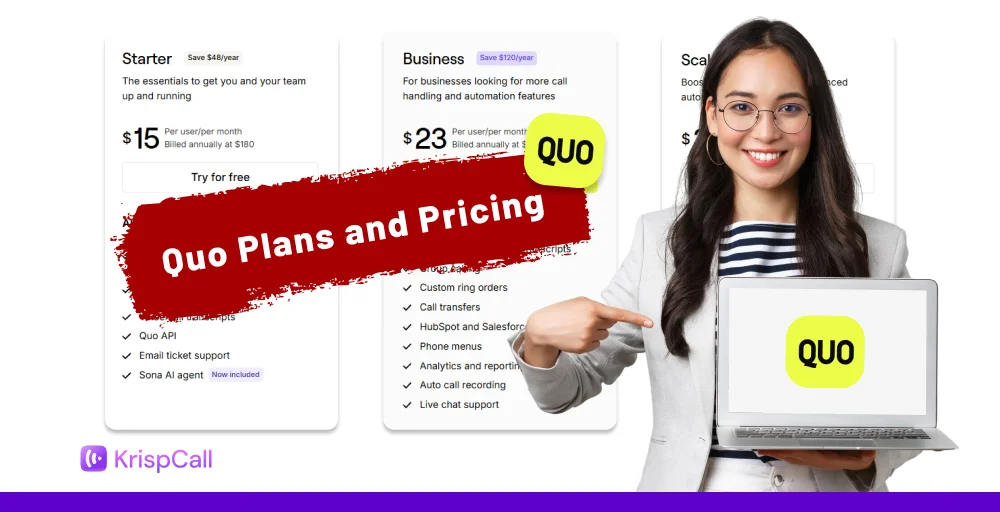
Side-by-side comparison of Quo (formerly OpenPhone) pricing plans 2026:
| Feature | Starter | Business | Scale |
| Monthly price | $19/user/month | $33/user/month | $47/user/month |
| Annual price | $15/user/month | $23/user/month | $35/user/month |
| Phone numbers included | 1 local or toll-free number per user | 1 local or toll-free number per user | 1 local or toll-free number per user |
| Calling coverage | Unlimited US & Canada* | Unlimited US & Canada* | Unlimited US & Canada* |
| SMS/MMS messaging | Unlimited US & Canada* | Unlimited US & Canada* | Unlimited US & Canada* |
| Shared phone number | Up to 10 users per number | Unlimited users per number | Unlimited US & Canada* |
| Call recording | On-demand (manual) | Automatic | Automatic |
| Call forwarding & transfer | Not available | Available | Available |
| Integrations | Email, Slack, Zapier | HubSpot, Salesforce, Gong + Standard | HubSpot, Salesforce, Gong + Standard |
| Support level | Standard email support | Email + Live chat support | Priority + Inbound phone support + Email and live chat |
| Admin & security | User roles and management | Analytics and reporting, HIPAA compliant | Analytics and reporting, HIPAA compliant |
| Phone menus & Group calling | Not included | Included | Included |
| Number porting | Included | Included | Included |
| Sona & AI message response | Available | Available | Available |
| Best for | Solopreneurs & micro teams | Small to mid-sized businesses | Growing enterprises |
Note: All prices listed are starting rates. Your final Quo (OpenPhone) cost may vary depending on the number of users, additional phone numbers, and any add-on features you choose. Alternatives like KrispCall also offer discounted annual billing, helping you reduce your overall VoIP costs by paying yearly.
Quo Starter plan
The Quo Starter plan is the most affordable entry point into the platform, priced at $15 per user per month (billed annually) or $19 per user per month (billed monthly). This plan is designed for solopreneurs, freelancers, and small teams who need professional business phone apps with unlimited calling and texting across the US and Canada, as well as essential collaboration tools, at a budget-friendly price.
Key features:
- One local or toll-free (new or ported) number per user
- Sona AI agent
- AI call summaries and transcripts for Sona handled calls
- Scheduled messages
- Auto-replies
- Basic integrations (Email, Slack, and Zapier)
While the Starter plan offers excellent value for small businesses, it comes with notable restrictions, like no IVR system, call transfer, or integration with Salesforce and HubSpot. It also lacks AI-powered features like automatic call summaries and transcripts.
Quo Business plan
The Quo Business plan is the mid-tier option, priced at $23 per user per month (billed annually) or $33 per user per month (billed monthly).
This plan is tailored for small to mid-sized businesses that need advanced call routing, HubSpot and Salesforce integrations, and AI-powered features to simplify operations. It’s a strong contender for companies’ professional call center tools without enterprise-level complexity.
Key features:
- Everything in the Starter plan
- Advanced call forwarding
- AI contact suggestions
- Unlimited shared phone number
- Advanced analytics dashboard
- Email and live chat support
While the Business plan addresses most of the Starter plan’s shortcomings, there are still some gaps to consider. AI call tagging for automated categorization is reserved for the Scale plan. There’s no dedicated account manager, and custom onboarding and implementation assistance aren’t included.
Quo Scale plan
The Quo Scale plan is the premium offering, priced at $35 per user per month (billed annually) or $47 per user per month (billed monthly). This plan is designed for larger teams and a growing enterprise.
The Scale plan provides enterprise-grade functionality and positions it competitively among VoIP call center providers for organizations that have outgrown basic small business phone plans.
Key features:
- Everything in the Business plan
- Dedicated onboarding support
- Priority live chat and email support
- Inbound phone support
The Scale plan is the highest tier in Quo’s standard offerings, but even at this level, there are considerations worth noting. Video conferencing isn’t included in any Quo plan, and compared with other best IVR software platforms, the Scale plan may lack some advanced call center management tools like real-time agent-monitoring dashboards and predictive analytics.
Quo add-ons
Beyond the core plans, Quo offers several add-ons that extend functionality for businesses with specific needs. These optional features let you customize your phone system without upgrading to a higher tier, though costs can add up quickly depending on usage.
Available add-ons:
- Additional phone numbers: Each additional number costs $5 per month, billed annually. Create dedicated department lines or track marketing campaigns.
- International calling: International calls (except US and Canada) are charged based on the destination at varying per-minute rates.
- International SMS/MMS: Text messaging outside North America incurs per-message fees that vary by country. Rates differ between SMS and MMS.
- Automated SMS via Zapier: Trigger SMS messages based on events in other apps for $0.01 per message segment.
- Automated SMS via API: Send SMS programmatically through Quo’s API at $0.01 per message segment.
Extra costs and hidden fees in Quo (formerly Openphone) plans
While Quo’s pricing plans appear transparent on the surface, several mandatory and conditional fees can increase your actual monthly spend. Understanding these charges helps you accurately forecast your actual expenses and compare them effectively with other phone plans.
Just as businesses rely on a product pricing calculator to determine true unit costs and protect profit margins, evaluating VoIP plans requires factoring in every fee beyond the advertised rate.
- A2P 10DLC registration: One-time $19.50 review fee plus a recurring monthly fee between $1.50 – $3, depending on your messaging use case.
- Sona AI Agent credits: After 1000 free automation credits, you need to purchase additional credit tiers ranging from $25/month (4,000 credits) to 199/month (60,000 credits), with overage rates of $0.45-$1.00 per call, depending on your tier.
- Automated SMS via Zapier/API: Long messages that exceed 160 characters count as multiple segments, which increases the total VoIP costs.
- Fair use policy limitations: Excessive usage patterns like traffic pumping, sequential dialing, or abnormally high call volumes may result in service limitations or additional charges.
- Taxes, regulatory fees, and surcharges: Any applicable federal, state, and local taxes and regulatory compliance fees are added at checkout, and can vary by location.
People Also Search 👉: CallHippo Pricing: Plans, Features & Hidden Fees to Watch For
What’s missing in each Quo plan?
When evaluating Quo plans, it’s not just about what you get; it’s also about what you don’t. Understanding these limitations helps you decide whether a plan truly meets your business needs.
The entry-level Starter plan lacks several features that are standard in competing business phone systems’ starter plans. Analytics are minimal, and AI call summaries and transcripts are only available for calls handled by Sona (the AI agent), not for regular conversations.
CRM integrations with platforms like HubSpot and Salesforce are completely absent, forcing manual data entry and breaking workflow automation. With shared phone numbers limited to just 10 users, growing teams quickly hit collaboration constraints that force costly upgrades.


While the Business plan addresses many Starter limitations by adding IVR, automate call recordings, and CRM integrations, it still excludes AI call tagging. Without automatic categorization, businesses handling high call volumes must manually review conversations to find specific topics, outcomes, or customer issues.
Dedicated account management and custom onboarding support remain unavailable. Priority support isn’t included either, meaning your technical issues join the standard queue, which can directly impact revenue and customer satisfaction.
Even at Quo’s highest-tier plan, the Scale plan, significant gaps persist compared to full-featured contact center solutions. Video conferencing is not available across any Quo plan, and advanced workforce management features common to virtual call centers are missing entirely.
Quo’s plan & pricing compared to competitors
KrispCall is a cloud-based business phone system that emerges as a compelling alternative to Quo. It offers VoIP calling, SMS messaging, and call management across multiple pricing tiers. KrispCall emphasizes international calling capabilities and workforce management tools that appeal to growing teams and contact center companies.
KrispCall offers three-tiered pricing plans: Essential, Standard, and Enterprise that range from $12 to $32. It includes one local/mobile number from the UK, USA, or Canada for free, 100+ CRM integrations, call recordings, click-to-call functionality, power dialer, virtual numbers from 100+ countries, and 24/7 customer support.
G2 Review: “Krispcall truly brings all our communication under one roof. The unified system for calls, chat, and even task management is fantastic. It’s so easy to jump from a team chat to a client call, and managing our global number feels effortless. The call quality is consistently clear, too.”
— Stephanie T, founder of the company, mid-market (51-1000 emp.)
Starter vs Essential Plan
Quo Starter ($15/month): includes unlimited US/Canada calling and SMS, basic voicemail transcription, shared numbers (up to 10 users), and Sona AI agent with 1000 free credits.
KrispCall Essential ($12/month): Provides one free phone number in the UK/USA/Canada, unlimited calling, call queuing, voicemail, SMS messaging, basic analytics, and limited integrations.
Winner: KrispCall. For small businesses or startups, unlimited international calling at this price point is a major advantage and hard to overlook. That said, both plans are quite limited for growing businesses and likely force quick upgrades.
Business vs Standard Plan
Quo Business ($23/month): Adds multi-level IVR menus, automatic call recording, unlimited shared phone numbers, advanced analytics, call transfers, custom ring orders, and integrations with HubSpot, Salesforce, and Gong. This tier addresses most Starter limitations and positions itself well among small-business phone plans.
KrispCall Standard ($32/month): Includes everything from Essential plus automatic call recording, a comprehensive analytics dashboard, a power dialer, call monitoring, and whisper coaching, CRM integrations (Salesforce, HubSpot, Zoho), and advanced call routing with time-based rules.
Winner: KrispCall. While slightly higher in cost, KrispCall Standard provides more advanced call management features like superior analytics and a power dialer. Its richer functionality empowers sales and support teams to drive measurable results.
Scale vs Enterprise Plan
Quo Scale ($35/month): Builds on Business with AI call tagging for automatic conversation categorization, dedicated onboarding support, priority live chat and email support, and added inbound phone support.
KrispCall Enterprise (Custom): Adds a dedicated account manager, advanced analytics with custom reports, priority routing algorithms, unlimited users per shared number, custom integrations via API, and SLA.
Winner: Quo, for transparency and predictable costs. Quo’s transparent pricing makes budgeting simple and eliminates surprise costs common with custom-priced enterprise solutions.
Best features of Quo and KrispCall
Both KrispCall and Quo (formerly OpenPhone) offer compelling cloud phone systems, but they shine in slightly different areas. Below is a snapshot of what makes each platform stand out for small businesses, sales, and contact centers.
Quo
- Sona AI agent: Answers calls after hours or when your team is busy, handles routine inquiries, and scheduling callbacks.
- AI call summaries & transcripts: Automatically generate written summaries and transcripts of every conversation, eliminating manual note-taking and creating searchable records.
- Shared phone numbers: Share a single business number, view the same conversation history, and collaborate through internal threads.
- Multi-level IVR menus: Create professional phone trees that route callers to the right department or person, reducing wait times and improving customer experience.
- CRM & tool integrations: Sync with Salesforce, HubSpot, Slack, and Zapier to keep communications tied to your workflows.
KrispCall
- Power dialer: Built-in automated dialing moves sales reps through contact lists efficiently, eliminating manual dialing downtime.
- Call monitoring and whisper coaching: Listen and provide real-time guidance to agents, improving call quality and accelerating training.
- Flexible custom integrations: API access and webhook support allow developers to build tailored integrations with proprietary systems, databases, or industry-specific software.
- Simultaneous ringing: Ring multiple desk phones, mobile devices, and softphones to ensure calls are answered quickly.
- Global virtual number: Get a local, international, or toll-free number in 100+ countries for broader business reach.
KrispCall vs. Quo: Direct comparison
Evaluating Quo (OpenPhone) pricing features against KrispCall’s offering reveals distinct advantages for different business needs. This direct comparison helps you understand which platform delivers better value for your specific requirements.
| Feature/Aspect | KrispCall | Quo |
| Starting price | $12/user/month (annually) or $15/user/month (monthly) | $15/user/month (annually) or $19/user/month (monthly) |
| Unlimited SMS/MMS | US & Canada | US & Canada |
| Additional numbers | $5/month each | Varies by country |
| Shared phone number | Unlimited (Standard+) | Up to 10 users (Starter), Unlimited (Business+) |
| Call monitoring | All plans | Not included |
| Customer support | 24/7 live chat, email, and phone support | Email (all plans), live chat (Business & Scale), and Phone support (Scale only) |
| Dedicated account manager | Enterprise only | Scale only |
| Salesforce & HubSpot integrations | All plans | Business & Scale |
| Video conferencing | Not available | Not available |
| Power dialer | Available to Standard & Enterprise | Not included |
| Free trial | 7 days | Not available |
KrispCall is best for sales-driven organizations and businesses with international operations, along with small to medium businesses requiring workforce management tools and extensive global calling. Meanwhile, Quo is best for scaling teams that prioritize AI automation and collaborative features, with transparent pricing.
- KrispCall provides better international value with unlimited calling to 100+ countries starting at $15/user/month, whereas Quo limits unlimited calling to only the US and Canada.
- KrispCall offers basic calling features like call transfer and forwarding on the entry-level plan, while Quo reserves them for its higher tiers.
- Quo offers superior AI capabilities with its comprehensive Sona AI agent, automatic call summaries, and transcripts, while KrispCall lacks native AI-powered conversation intelligence features.
- Quo delivers more transparent pricing with clearly published annual rates, while KrispCall’s Enterprise tier requires custom pricing quotes.
- KrispCall excels in sales enablement tools with built-in power dialer, call monitoring, and wisher coaching features that Quo doesn’t offer at any tier.
Related Article 👉: KrispCall vs. Quo (formerly Openphone): Which is the Best Cloud Phone System?
Should you still use Quo?
Quo remains a strong choice for small-to-medium businesses that prioritize AI-powered automation, collaborative communication, and transparent pricing over advanced workforce management features.
However, businesses requiring extensive international calling, video conferencing, or sophisticated contact center capabilities should carefully evaluate whether Quo’s limitations align with their operational needs before committing.
Pros and cons of Quo pricing plans
| Pros | Cons |
| 7-day free trial allows hands-on testing before commitment. | Shorter trial period than competitors’ 14-30 day trials. |
| Transparent, predictable pricing with clear annual discounts. | No volume discounts, pricing remains per-user regardless of team size. |
| Sona AI agent is included with all plans and comes with 1,000 free credits. | AI credit overages can get expensive if call volumes exceed the 1,000 credit baseline. |
| AI call summaries and transcripts for Business and above. | AI features are limited on the Starter plan. |
| Strong CRM integrations with Salesforce, HubSpot, and Gong on Business and above plans. | No CRM integrations on Starter creates a manual data entry burden. |
| Included voicemail transcription on all plans. | Call recording limitations on Starter (manual only). |
| Mobile, desktop, and web apps provide flexibility for remote and hybrid teams across all devices. | Fair use policy restrictions on “unlimited” calling may limit high-volume operations without clear published thresholds. |
Final verdict: KrispCall turns out better and affordable solution
After a comprehensive analysis of Quo (OpenPhone) pricing 2026, KrispCall emerges as the superior choice for most businesses seeking a complete, cost-effective communication platform. Its unlimited calling at just $15/month delivers massive savings compared to Quo’s per-minute international rates.
KrispCall includes important sales tools that Quo completely lacks, like a power dialer, call monitoring, and whisper coaching. While Quo’s AI features are innovative, most businesses need revenue-driving capabilities before automation.
The Quo cost may appear competitive initially, but KrispCall’s inclusive features eliminate the need for supplement tools, creating a better total cost of ownership and positioning your business for sustainable growth across markets and use cases.