

Confused about whether to invest in a call center or a contact center? While the two may sound similar, they serve different needs. Choosing the wrong one can lead to slower responses, agent burnout, and unhappy customers.
A call center focuses solely on voice support, whereas an omnichannel contact center delivers a superior customer experience by connecting with customers across multiple channels.
So, which one fits your business goals, team structure, and how your customers prefer to connect?
In this blog, we’ll learn the key differences between a contact center and vs call center and help you find the solution that actually aligns with your business.
✨ Key Takeaways
- While a call center focuses on managing incoming and outgoing phone calls, a contact center handles customer interactions across multiple communication channels.
- A contact center leverages advanced communication tools and omnichannel capabilities, whereas a call center relies on more basic, voice-focused technologies.
- Choose a call center for phone-only support, and go for contact center if you need multichannel communication.
What is a call center?
A call center is a centralized department or team that handles inbound and outbound calls from customers, usually for support, sales, or general inquiries. It is the first point of contact for customers, where call center agents answer their questions and solve problems.

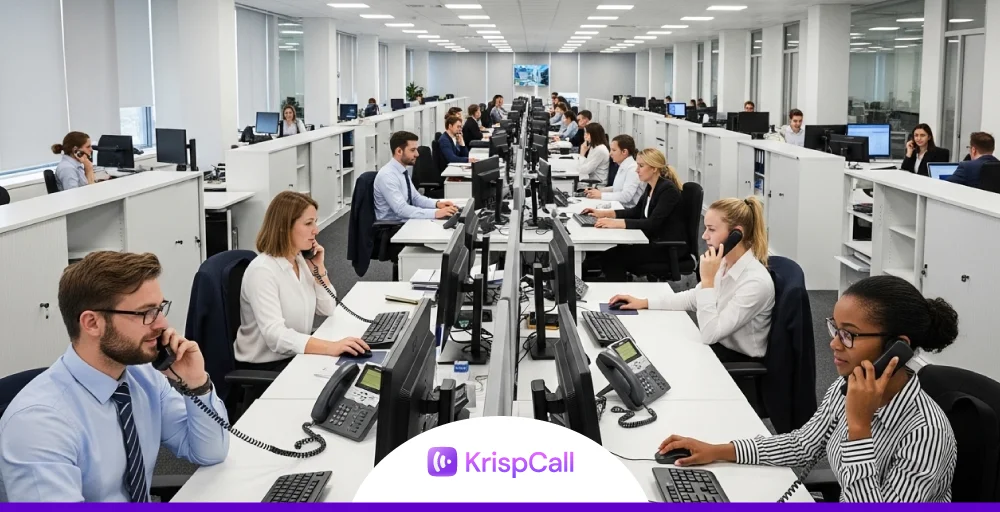
Traditionally, call centers are voice-only environments, with agents using headsets connected to a phone system to handle large volumes of calls. Technologies like SIP trunks power these setups and rely on features such as interactive voice response (IVR), automatic call distribution (ACD), and call monitoring.
What is a contact center?
A contact center is a central hub where a company manages customer interactions across various communication channels, including phone calls, SMS, emails, live chat, video conferencing, and social media. Unlike traditional call centers that solely manage voice calls, modern contact centers provide a more flexible customer experience.

Modern contact centers leverage advanced tools such as CRM integrations, AI-powered chatbots, and performance analytics. These tools help your team deliver personalized interactions and real-time assistance. Whether you’re handling sales inquiries, technical support, or post-purchase care, contact center services boost satisfaction, increase operational efficiency, and build trust and loyalty.
Related 👉: Best Call Center Software in Jamaica
Key differences between call center and contact center
The terms call center and contact center are used interchangeably, but they are not exactly the same. The call center primarily handles customer service through phone calls, while the contact center solutions handle multiple types of customer contact.
Let’s explore the key difference between a call center and a contact center software to decide the best approach for your business:
| Aspect | Call center | Contact center |
| Communication channel | Voice calls only (inbound & outbound) | Voice, video, live chat, email, SMS, social media |
| Technology used | PBX systems, basic CRM, phone lines | Cloud-based platforms, omnichannel tools, and advanced CRM integrations |
| Customer experience | Limited to phone support; slower resolution times | Faster and personalized support across all channels |
| Scalability | Scaling requires more hardware and an agent | Easily scalable |
| Analytics | Limited analytics | Real-time analytics across all channels |
| Agent skillset | Strong verbal skills for phone support | Multichannel communication, writing skills, multitasking, and tech knowledge |
| Integration capabilities | Limited integration only within business tools | Extensive integration with CRM, marketing, ticketing, and analytics platforms, |
| Automation capabilities | Basic IVR and call routing | AI chatbots, intelligent call routing, and predictive analytics |
| Cost structure | Lower initial and recurring costs | Higher initial and recurring costs |
1. Communication channels
Call center: It consists of only one communication channel, i.e., the VoIP phone system. Customers reach out via phone, and agents handle their queries only through verbal communication.
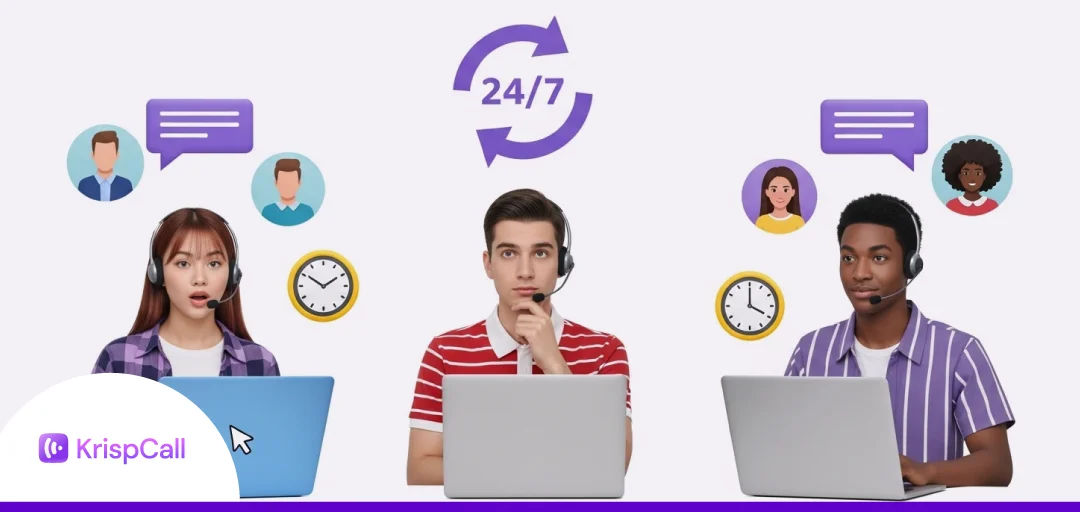
Contact center: It expands beyond just phone support. Customers can communicate across various channels such as phone, email, social media, knowledge bases, text, video, and many more.
2. Technology used
Call center: Most call center software uses basic call center technology, including phone lines and basic CRM tools. These setups tend to be more hardware-based.
Contact center: It uses more advanced and cloud-based tools, including unified communications platforms, AI-powered chatbots, real-time analytics dashboards, and integrations with CRMs and ticketing systems.
3. Customer experience
Call center: It focuses on handling high volumes of customer calls quickly and efficiently. Call center agents usually provide the basic help, and customers might also face long wait times during the peak hours.
Contact center: It provides personalized service by tracking customer history across all channels. With a holistic view of the entire customer journey map, they can offer more proactive support to customers, which results in higher customer satisfaction and loyalty.
4. Analytics
Call center: It often lacks sophisticated analytics, which makes it harder to identify performance gaps or understand broader customer trends.
Contact center: It provides deep, built-in analytics for valuable insights into customer behavior, channel performance, and agent efficiency, all in one dashboard.
5. Scalability
Call center: Scaling call centers is challenging and expensive. It requires extra infrastructure, which requires a hefty amount to add new lines, hire more agents, or expand to new locations.
Contact center: Most of the contact centers are cloud-based, which makes it easier to scale. You can add new agents, channels, or expand to new markets without investing in hardware.
6. Agent skillset
Call center: Call center agents require both soft and hard skills to deliver good customer service, such as strong communication, active listening, product knowledge, problem-solving, patience, and empathy.
Contact center: Agents in the contact center require even more additional skills than call center agents. They must be good at communication, both verbally and in chat, within social media handles. In addition, they must know how to craft engaging cold emails and be familiar with chatbots.
7. Integration capabilities
Call center: As it primarily focuses on voice communication, its integration capabilities are limited to call handling tools such as PBX systems, IVR, call routing, and voice analytics.
Contact center: It supports multi-channel communication, so its integration capabilities are much broader. They connect with CRM software, help desk platforms, marketing tools, and AI tools (chatbots and sentiment analysis).
8. Automation capabilities
Call center: Automation is limited, typically to voice workflows like IVR menus or call routing. Repetitive tasks often require manual intervention by agents.
Contact center: It offers more advanced automation across multiple communication channels. It automates email responses, routes tickets, and handles FAQs in live chats without an agent’s intervention.
9. Cost structure
Call center: They are less costly due to simpler setups and software needs. Costs typically include agent salaries, on-premise hardware, and telephony fees.
Contact center: They are more expensive due to their complex setups, integrations, and specialized training for agents on different tools.
10. Customer self-service options
Call center: Customer self-service option is limited to Interactive Voice Response (IVR) systems that only handle simple tasks such as directing calls to the right agents via a menu and checking account details.
Contact center: Whereas a contact center provides a wider range of self-service options across multiple channels, such as AI-powered chatbots, online knowledge bases, community forums, and a virtual assistant.
Which one fits your business needs?
The right options between call center vs contact center depend on your business needs, customer communication preferences, and how you plan to deliver customer support.
If your business is primarily phone-based, handles high call volumes, and customers do not expect support on other channels. Then choose an inbound call center; this solution is more straightforward and cost-effective to set up and maintain, making it ideal for sectors like telemarketing, banking, financial services, healthcare, or travel agencies.
But if your aim is to provide a personalized, multi-channel support experience. This is the better choice if your customers expect to reach you via chat, email, social media, or text. A contact center is essential for businesses that require flexibility, scalability, real-time data, automation, and a focus on long-term customer loyalty.
Here is guidance that helps you choose whether a call center or a contact center is right for your business:
Your business might need inbound and outbound call center software if:
- Your customers contact you only over the phone
- Your team handles most interactions through phones
- You focus on quick, high-volume interactions
- You need a cost-effective and voice-based solution
- You focus on outbound sales calls rather than inbound customer calls
Your business might need a contact center software if:
- Your customers reach out through multiple digital channels
- You want to offer multi-channel support
- You need better data, insights, and reporting
- You have a remote and hybrid team
- Your business is ready to scale
The rise of contact centers in modern business
Modern businesses are embracing contact centers as a service (CCaaS) because customer behavior has fundamentally changed. Customers expect to communicate on their own terms, whether that’s through phone calls, social media, email, or live chat. A traditional call center, which is limited to phone-only support, can no longer meet these diverse demands. The shift to a multichannel contact center approach is essential for staying competitive and satisfying modern consumer expectations.
By integrating all communication channels into a single platform, contact centers give businesses a complete view of the customer journey map. This allows companies to provide more personalized and proactive support, which in turn leads to higher customer satisfaction and loyalty. The use of advanced technology and data analytics also helps businesses operate more efficiently, turning the contact center from a simple support function into a strategic asset for growth.
Choose the best for your customer service.
Choosing the right communication investment starts with understanding how your business currently handles customer interactions and what your customers’ preferences are. Start looking at your challenges, customer needs, and team workflows, and choose the system by considering your goals, budget, scalability, and integration options.
If your team is small and customer interactions happens over the phone, a call center can be a great solution. However, if your business is large and customers expect support through email, chat, or social media, a cloud-based contact center is a better long-term choice.
Still confused? Check out KrispCall, one solution for both needs. KrispCall provides affordable yet powerful VoIP features for modernizing small business customer service operations. Alongside, large businesses can also leverage the use of KrispCall as its plans are suitable for every business size.
Get tons of CRM integrations, unlimited virtual numbers, and connect with your customers through multiple channels and improve long-term customer relationships using KrispCall. Book a demo to find out why 1000+ companies trust KrispCall as their reliable solution.