


Every dialed number carries potential. Whether it becomes a booked meeting, a lost lead, or a valuable insight depends on how well it’s tracked.
Most teams make hundreds of outbound calls, but only a few know which ones truly move deals forward or spark real interest. Without tracking, calls become activity, and with tracking, calls become strategy.
This blog explains the complete picture of outbound call tracking: what it is, how it works, key metrics to measure, and why it matters for revenue-focused teams.
✨ Key Takeaways
- Outbound call tracking helps convert calling activity into measurable data that guides smarter sales decisions.
- Monitoring key KPIs like call volume, answer rate, call duration, and conversion rate reveals how well your outreach strategies are performing.
- Dialer types such as click-to-call, power, preview, and predictive dialers play an important role in tracking accuracy and calling efficiency.
- Compliance practices like call consent, encryption, and list scrubbing protect both customer trust and business credibility.
What is outbound call tracking?
Outbound call tracking is the process of analyzing and monitoring data from phone calls (cold call, telesales, or follow-up call) made to customers, leads, or prospects. It turns them into valuable, actionable insights that can be used to refine strategy and generate ideas to improve overall performance.
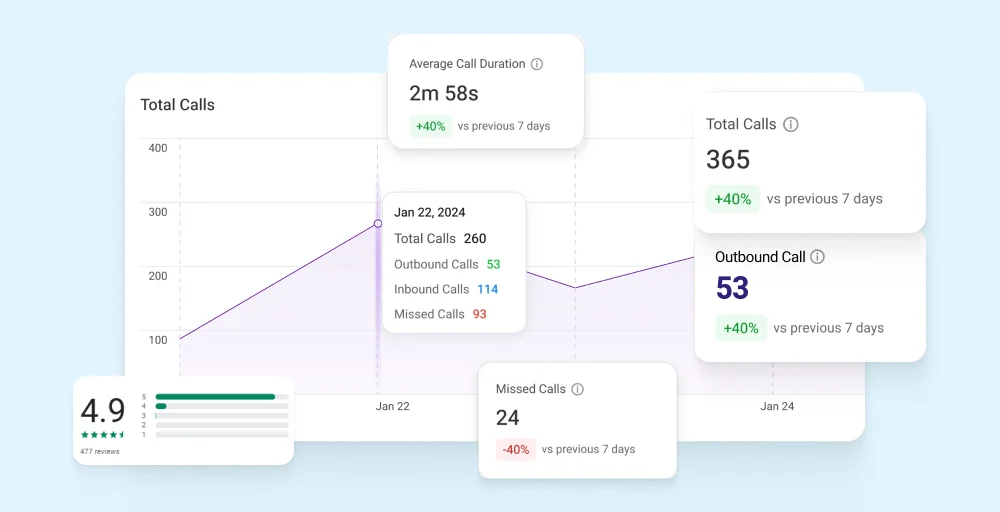
The whole outbound call tracking involves:
- Call initiation: The first step is to initiate an outbound call to any prospects, leads, or your own customers. Use any outbound call tracking software to initiate the call to ensure all data is captured.
- Data logging: The tracking platform automatically logs key metadata, including call duration, time of day the call was made, the agent who initiated the call, and call outcomes (e.g., connected, dropped, no answer, or voicemail).
- Call recording and transcription: Many outbound call tracking platforms can record and transcribe the whole conversation to coach agents, refine sales strategies, and maintain quality.
- CRM integration: The software then syncs the collected data to your Customer Relationship Management (CRM) system.
- Analytics and reporting: The data is used to generate reports and insights that serve as benchmarks for your reps, ROI, conversion rates, and even your customer experience.
Benefits of outbound call tracking
Outbound call tracking gives teams real visibility into their outbound efforts, helping them respond faster, coach smarter, and refine their telemarketing strategies for better outcomes.
- Faster lead response and follow-up prioritization: Tracking calls helps reveal which leads are most engaged, allowing the team to prioritize high-intent prospects. According to research, businesses are 7 times more likely to qualify a lead if they contact them within an hour.
- Data for coaching (real recordings + metrics): Managers have easy access to call recordings, call durations, sentiment clues, and performance that help improve agent conversations. Real calls become practical examples for refining tone, phrasing, and objection handling.
- Rep performance visibility: Tracking calls will show exactly how each agent performs with key metrics like dials made, calls connected, meetings booked, and conversions generated. This clarity helps identify which agents are performing well and which one needs coaching.
- Campaign optimization: Tracking sales calls helps you uncover best-performing scripts, sales modes, and hours with the highest answer and conversion rates. This uncovered data helps fine-tune campaigns for efficiency instead of guessing what works.
- Attribution and LTV tracking tied to outbound touches: Call tracking helps connect every outbound touchpoint from first call to final follow-up to actual revenue results. This linkage helps teams accurately measure which calls influence deals, customer retention, and which campaigns drive high-value customers, and calculate lifetime value with greater accuracy.
Essential outbound call tracking metrics (KPIs)
When you track the right outbound call metrics, you can easily understand your performance, identify improvement areas, and build call analytics strategies that consistently drive results.
1. Call volume
Call volume is the total number of outbound calls a call center places over a certain period of time. It provides a clear view of productivity levels and helps assess whether resources are being used effectively. When compared with conversion data, it also highlights whether high call counts are leading to actual results.
Example: A manager finds that Agent A makes twice as many calls as Agent B but closes fewer deals. By comparing call volume with call duration and outcomes, it becomes easier to determine if the issue lies in call quality, targeting, or effort distribution.
2. Average handle time
Average handle time (AHT) is the total time spent on each outbound call by an agent, including talk time and after-call work. It helps assess how efficiently agents manage conversations and wrap up each task.
Example: Agent A spends an average of 3 minutes per call, while Agent B spends 8 minutes but closes more deals. Comparing handle time with conversion rate helps determine whether longer calls are creating better outcomes or if time can be used more effectively.
3. Answer rate
Answer rate refers to the percentage of outbound calls that are successfully answered by prospects or leads. It also helps to measure how effectively your dialing strategies, timing, and phone number quality are working.
Example: One campaign has an answer rate of just 20%, while another reaches 45%. By reviewing call timing, checking if numbers are being flagged as spam, and refining the lead list, the team improves the lower-performing campaigns’ reachability, raising their answer rate and overall engagement.
4. Conversion rate
Conversion rate indicates the percentage of outbound calls that successfully lead to desired results, such as bookings, sales, or follow-ups. It is the clearest indicator of call effectiveness, which reflects your agent’s skill, accuracy, and campaign quality.
Example: Agent A books meetings on 15% of outbound calls, while Agent B converts at 6%. This data helps managers recognize effective approaches and replicate successful scripts or strategies across the team.
5. Callback rate
The callback rate measures how many prospects return a missed or unanswered outbound call. It is super helpful to measure the effectiveness of voicemail messaging, caller ID trust, and lead interest. A higher callback rate often means stronger engagement and better targeting.
Example: A campaign using personalized voicemails sees a 12% callback rate, compared to just 4% for generic voicemail scripts. More of these calls return as inbound calls, showing that personalized messages encourage prospects to reach back and engage.
6. Call outcomes
Even when the end goal is the same, the outcome of every call is never the same. So, it is important to categorize each outbound call as interested, scheduled, not interested, follow-up required, or no answer to evaluate call quality, lead readiness, and future follow-up strategies.
Example: A manager notices that many calls end with “follow-up required” instead of immediate booking. This insight guides script adjustment to encourage faster decision-making or clearer next steps.
7. Call duration
Call duration is a metric that tracks how long an agents speak with prospects during each phone call. It helps assess engagement and conversation depth. Very short calls often indicate poor lead quality or ineffective openers, while overly long calls may suggest unclear messaging.
Example: Agent A consistently has calls lasting under 30 seconds, suggesting weak introductions or poor targeting. Another agent averages 5 to 6 minutes and secures more appointments, showing the value of meaningful, structured conversations.
Dialer types and their role in outbound call tracking
In outbound call tracking, the type of dialer used shapes how efficiently agents move through the call list, as each dialer serves a different calling style.
4 different sales dialer types and their role in outbound call tracking are:
1. Click-to-Call
Best for: Sales reps working on CRM-driven outreach, accuracy-focused teams, and anyone managing lead-based calling.
Click-to-Call (or list dialing) dialer connects directly from your CRM and allows agents to place calls with a single click while keeping everything tied to customer records. It supports both outbound and inbound calls, ensuring every interaction is logged with minimal effort.
Benefits: Logs every call automatically, reduces errors from manual entries, and links each call to contacts, deals, or campaigns for accurate tracking.
2. Preview Dialer
Best for: High-value accounts, upsell and renewal calls, support with complex queries, or compliance-heavy sales.
Preview dialer, as the name suggests, presents the contact’s CRM data before calling, which gives agents time to assess history, notes, and prior conversations. It allows thoughtful outreach, where context shapes the call strategy.
Benefits: Personalized interactions, improved customer satisfaction, ensures cleaner logging, and strengthens tracking accuracy.
3. Power/Progressive Dialers
Best for: High-volume sales campaigns, customer service follow-ups, marketing, and promotions.
A power dialer is a type of dialer that automatically dials the next number once a call ends, keeping a steady pace while leaving enough time for brief call notes or task setup.
Benefits: Capture timestamps, call attempts, outcomes, and leave time for accurate tagging or workflow triggers.
4. Predictive Dialer
Best for: Consumer (B2C) campaigns, debt collection, Time-sensitive campaigns, surveys, or large call centers.
Predictive dialers place multiple calls at once and connect agents only when someone answers. This drives high-volume calling, ideal for campaigns focused on reach rather than detailed personalization.
Benefits: Logs abandoned calls, pacing data, dropped connects, and connect rate, helping teams stay compliant and refine outbound strategy.
Call recording laws and compliance best practices
Outbound calling is not an illegal thing, but it does come with both legal and moral responsibilities. Follow these best practices to stay compliant and protect your business as well as customer trust.
- Notify contacts before recording calls: Give the caller clear notice before recording. Request constant verbally or through an SMS message at the beginning of the call.
- Document consent details: Record when and how the consent was given. Keep these records stored alongside customer details for reference.
- Securely store and encrypt recordings: Use encrypted, access-controlled systems to store recordings. This protects against tampering and supports regulatory compliance.
- Regularly scrub outbound lists against DNC registries: Update calling lists frequently by checking against national and state Do Not Call registries to avoid contacting individuals who have opted out.
- Leverage IVR for large-scale compliance disclosures: Interactive Voice Response (IVR) can handle automated compliance notices at scale, ensuring disclosures are consistent and delivered before the call connects to an agent.
Track outbound calls smarter with KrispCall!
KrispCall captures every outbound interaction with accurate logs, recordings, outcomes, and performance metrics, giving teams full clarity over call impact. It syncs automatically with your CRM, supports call tagging, and transcription.

With compliance tools, coaching data, and real-time call visibility, KrispCall helps managers refine scripts, improve conversations, and guide agents effectively. It turns outbound calls into measurable results, revealing which calls drive revenue, follow-ups, and long-term customer value.
Ready to make your outbound calls more insightful and result-driven? Get started with KrispCall today.