

The average cold call has a 4.8% success rate. But reps using a tested, well-structured script? They book 3–5x more meetings and generate more qualified meetings. Yet most sales reps still pick up the phone with nothing more than a vague idea of what they want to say, and wonder why prospects hang up.
Cold calling isn’t dead. It’s just harder to do without the right words, the right sales strategies, and a repeatable sales process.
This guide gives you exactly that: the actual scripts you can copy, adapt, and use today, not vague advice about “building rapport” or “finding pain points.” Whether you’re new to outbound sales or a seasoned rep refining your own cold call script, you’ll find templates for every situation.
Here’s what’s covered: B2B and SaaS cold call script examples, voicemail and gatekeeper scripts, objection-handling responses, industry-specific templates, and proven tips to make every call land better.
✨ TL;DR
- A great cold-calling script has five parts: an opener, a relevance hook, a value statement, a qualifying question, and a soft CTA.
- Common cold calling templates include first-time outreach, personalized approaches, and competitor pain points. Industry-specific scripts are designed for B2B, SaaS, real estate, insurance, recruitment, and financial services.
- Cold calling tips to improve sales include researching before calling, timing it right, using a permission opener, focusing on outcomes, listening actively, addressing objections with curiosity, personalizing voicemail, following up multiple times, and testing your scripts.
- Common mistakes that businesses make while cold calling are failing to research prospects, delivering lengthy pitches, using high-pressure tactics, neglecting follow-ups, not listening, lacking empathy on objections, calling the wrong person, and ignoring call data.
Is cold calling still relevant in 2026?
Yes, but the way it works has changed. Cold calling has evolved from a volume game into a precision sport. According to RAIN Group research, 57% of C-level buyers, 51% of directors, and 47% of managers say they prefer to be contacted by phone.
The reps who struggle are the ones dialing without context, a script, or a clear reason for calling. The reps who win are those who combine smart targeting, genuine personalization, and a structured approach to the call itself.
In 2026, cold calling is still one of the fastest ways to start a real conversation with a potential customer, especially in B2B. Effective business communication starts with knowing what to say when someone answers the phone.
What makes a good cold calling script?
Before diving into the templates, it helps to understand what separates a script that books meetings from one that gets you hung up on. A good cold calling script isn’t a rigid monologue; it’s a framework that supports effective cold calling while leaving room for genuine human interaction.
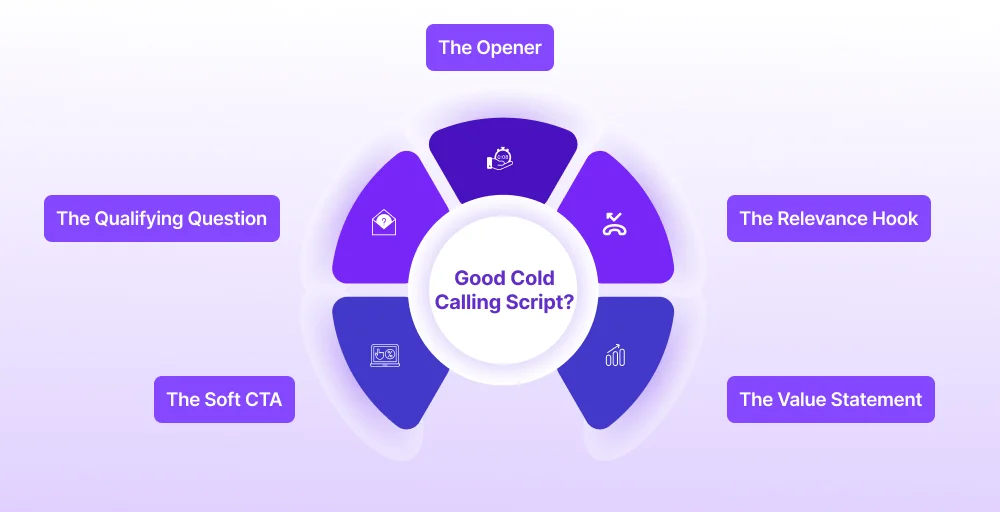
Every effective cold call script is built around five core elements:
1. The Opener: Your first job is to earn 30 seconds of attention, not deliver a pitch. A permission-based opener like “I hope I’m not catching you at a bad time, do you have a moment to chat?” signals respect for the prospect’s time and sets a collaborative tone from the start.
2. The Relevance Hook: This is where you answer the prospect’s unspoken question: why are you calling me specifically? A personalization signal, “I noticed you recently expanded your sales team” or “I saw your company just entered the enterprise market”, shows you’ve done your homework and understand their target markets.
3. The Value Statement: Lead with outcomes, not features. Instead of explaining what your product does, share what it’s helped similar companies achieve: “We helped [Company X] cut onboarding time by 30% in the first quarter.” That’s what moves the needle.
4. The Qualifying Question: Before you go any deeper, confirm you’re talking to the right person about the right problem. An open-ended question like “How are you currently handling [the challenge you solve]?” does double duty; it qualifies the lead and gets the prospect talking.
5. The Soft CTA: Don’t try to close on a cold call. The goal is to earn the next call. Offer two specific time options, “Would Tuesday at 2 pm or Thursday at 10 am work for a 20-minute call?”, to make saying yes as easy as possible.
With these five elements in place, every sales call script in this guide follows a structure that’s been tested and refined across thousands of sales calls.
Related Article 👉: How to Choose the Best Cold Calling Software?
25 proven cold calling script templates
The cold-calling sales script templates below are organized by situation, so you can find exactly what you need fast. Whether you’re making cold calls for the first time, navigating a tough objection, or trying to rebook a stale lead, there’s a script here for it.
Common cold calling templates
These foundational scripts work across industries and roles. Start here if you’re building a new outreach cadence or training a team on the basics.
1. Classic cold call template
When you are reaching out to a prospect for the first time with little context, a clean and direct approach works best. This template gives your sales reps a reliable starting point that respects the prospect’s time while clearly communicating your value.
Sample script:
“Hi [Name], this is [Your Name] from [Company Name]. I know I’m calling out of the blue, so I’ll be quick.
We work with [type of company] to help them [specific outcome, e.g, cut onboarding time by 30%].
I wanted to see if that’s something your team is currently focused on. Do you have just a few minutes to chat?”
2. Personalized cold calling script
Sometimes the best way to turn cold calls into real conversations is to show prospects you’ve done your homework before dialing. Many sales managers encourage reps to personalize outreach using LinkedIn activity, company announcements, or insights from a trusted data provider.
Script:
“Hi [Name], I’m [Your Name] from [Company]. I noticed [specific thing, e.g., ‘you recently expanded your sales team’ or ‘you posted about scaling your outbound process’].
That’s exactly the kind of situation where we tend to help; we’ve worked with [similar company] to [specific outcome].
Would it make sense to have a quick call this week to see if we can help you do the same?”
3. Competitor pain point script
If you know a prospect is already using a competing tool, that’s not a dead end, it’s an opening. This cold-calling sales script lets you acknowledge their current setup while positioning your solution around the specific challenges they’re likely already facing.
Script:
“Hi [Name], [Your Name] here from [Company].
A lot of [industry] teams using [Competitor Tool] tell us they run into [specific pain point, e.g., ‘limited reporting’ or ‘high per-seat pricing’]. Is that something your team has felt too?
We built [Company] specifically to solve that, and [Company X] went from [problem] to [outcome] within [timeframe].
Worth a quick call to see if we’d be a better fit?”
First-time outreaching scripts for specific industries
Different industries come with different expectations, vocabulary, and trust barriers. These scripts are tailored to the nuances of each sector, so your opening line doesn’t feel generic.
4. B2B cold calling script
B2B cold calling often means navigating complex organizations to reach the right decision makers. This script is built for sales reps targeting mid-market or enterprise buyers who need a clear business case before they give you a few minutes of their time.
Script:
“Hi [Name], this is [Your Name] from [Company].
I work specifically with [job titles] at [industry] companies who are trying to [business goal, e.g., ‘reduce manual reporting work’ or ‘scale their outbound sales’].
We recently helped [similar company] achieve [specific result] in [timeframe].
I’d love to learn more about your current setup. Would a 15-minute discovery call this week work for you?”
Related Article 👉: Outbound Call Tracking Guide for Sales & Management
5. SaaS cold calling script
SaaS cold calling requires connecting your value proposition to something the prospect is actively experiencing in their product journey. Use this script to reach more clients by targeting product, growth, or technical buyers who respond better to outcome-driven conversations than to feature lists.
Script:
“Hi [Name], I’m [Your Name] from [SaaS Company].
We help SaaS teams achieve [specific outcome, e.g., ‘reduce churn by identifying at-risk accounts earlier’]. I noticed [personalization e.g., ‘your team recently launched a new onboarding flow’], which suggests a specific challenge might be on your radar.
We’ve helped [similar SaaS company] [outcome]. I’d love to explore whether we can do the same for you.
Do you have 15 minutes this week for a discovery call?”
6. Real estate cold calling scripts
Real estate cold calling is one of the most relationship-driven forms of outreach; prospects need to trust you before they’ll even consider having a conversation. This script helps real estate agents initiate a meaningful conversation with sellers, buyers, or expired-listing contacts without coming across as pushy.
Script:
“Hi [Name], my name is [Your Name] with [Agency].
I noticed your home was listed recently, but didn’t sell. I know that can be frustrating, especially if you had a timeline in mind.
I’ve helped several homeowners in [neighborhood] sell within [timeframe] after their listing expired. I have a different approach I’d love to share.
Would you be open to a short call to walk through what I’d do differently?”
7. Cold calling scripts for Insurance
Insurance prospects are often skeptical of unsolicited phone calls, which means your opening needs to feel genuinely helpful rather than sales-driven. This script is designed to ease that tension early and position you as an advisor, not just another sales rep.
Script:
“Hi [Name], this is [Your Name] from [Agency].
I specialize in helping [individuals/businesses] in [location or industry] ensure they’re not overpaying for coverage or, worse, underinsured.
Many of the clients I work with found they were missing key protections without realizing it.
Could I take just a few minutes of your time to ask a couple of questions and see if your current plan is still the best fit for you?”
8. Recruitment cold calling script
Reaching out to passive candidates requires a different kind of cold-calling technique, one built on respect and relevance rather than urgency. This script works best when you’ve identified a strong fit and want to open the door without putting any pressure on the prospect.
“Script:
“Hi [Name], I’m [Your Name] from [Recruiting Firm or Company].
I came across your profile and was genuinely impressed by your work at [Company]. I’m working on a [role] opportunity with a company that I think could be a strong next step for you.
I know you’re likely not actively looking, but would you have a few minutes to hear more? No pressure at all.”
9. Script for decision-makers
When you finally get a C-level executive or VP on the phone, you have a narrow window to make your case. This script is built for those moments, concise, outcome-focused, and designed to get to the point quickly without wasting the prospect’s time.
Script:
“Hi [Name], [Your Name] from [Company].
I’ll be brief. I know your time is valuable.
We work with [role]s at companies like [Reference Company] to [specific business outcome]. I’d love to get 15 minutes on your calendar to see if we can do the same for you.
Is there a time this week that works?”
10. Cold calling script for Financial Services
Financial services prospects tend to be cautious, especially about unsolicited phone calls. This script is best for account executives takes a consultative approach, focusing on adding value upfront rather than leading with a hard sales pitch.
Script:
“Hi [Name], I’m [Your Name] with [Company].
I work with [business owners/individuals] to help them [goal, e.g., ‘optimize cash flow’ or ‘reduce tax liability’]. Most of the clients I work with found that a small adjustment to their current strategy made a significant difference.
I’m not here to sell you anything today, just to see if a quick conversation might be worth your while.
Do you have a few minutes this week?”
Follow-Up & relationship-building scripts
The first call rarely closes a deal, but the follow-up is where most reps fall short. These scripts give you a confident, natural reason to re-engage at every stage of the relationship.
11. Referral & warm introduction script
A mutual connection who suggested you reach out can instantly transform a cold outreach into a warm call. This script helps you lead with that social proof so the initial cold call feels less like an interruption and more like a natural next step.
Script:
“Hi [Name], my name is [Your Name] from [Company]. [Mutual Connection] suggested I give you a call; they thought what we’re doing might be relevant to what you’re working on.
We helped [Mutual Connection’s Company] achieve [result], and they thought it might be useful to you as well.
Do you have a few minutes to chat?”
12. Script for following up after a cold email
Many sales reps send cold emails and never follow up, so many warm leads go cold unnecessarily. Use this script when a prospect has opened your email but hasn’t replied, turning that silent signal into a real conversation.
Script:
“Hi [Name], [Your Name] here from [Company].
I sent you an email last week about [topic] and wanted to follow up with a quick call.
I know inboxes get busy, but I wanted to confirm the information I shared is relevant to what you’re working on right now.
Do you have a minute?”
13. Event follow-up cold calling script
Following up after a trade show, webinar, or conference gives you a natural reason to call that doesn’t feel out of the blue. This script helps you reconnect quickly while the interaction is still fresh in the prospect’s mind.
Script:
“Hi [Name], this is [Your Name] from [Company]. We actually connected briefly at [Event Name] last week.
I wanted to follow up on our conversation about [topic]. I’ve been thinking about what you mentioned regarding [specific challenge], and I think we might be able to help.
Would a short call make sense to dig into that a bit more?”
14. Script for customer retention campaigns
Keeping an existing customer engaged is often more valuable than chasing a new one, but many sales teams neglect outreach until it’s too late. This script is designed for proactive check-ins that reinforce value and catch churn risks before they become losses.
Script:
“Hi [Name], [Your Name] here from [Company].
I wanted to check in and see how things have been going since you started using [Product/Service]. We’ve recently added [new feature or capability], and I wanted to make sure you’re getting full value.
Is there anything you’re running into that we can help with?”
15. Script for reactivating old leads
Leads that went quiet twelve months ago aren’t necessarily dead; sometimes the timing just wasn’t right. This script gives sales reps a confident way to re-open the door without making the follow-up feel awkward or forced.
Script:
“Hi [Name], this is [Your Name] from [Company]. We spoke a few months back about [topic], but the timing wasn’t right.
I’m reaching out again because [reason, e.g., ‘we’ve launched a new feature that directly addresses what you mentioned’ or ‘I saw your company recently expanded’].
Has anything changed on your end? It might be worth a fresh look.”
Objection & difficult situation scripts
Every sales rep faces resistance. The difference between a booking and a dead end often comes down to how you respond in the first three seconds after an objection. These scripts give you a calm, confident answer for the most common roadblocks.
16. Cold calling script for uninterested prospect
When a prospect seems firmly uninterested, most sales reps back off too quickly. This script takes a more direct approach, cutting through resistance with a single, honest feedback that handles sales objections and puts the value proposition front and center.
Script:
“I hear you, I’ll be honest, most cold calls aren’t worth your time.
But I’m not calling to pitch you. I just want to ask one question: is [specific pain point] something your team is actively dealing with?
If not, I’ll let you go. If it is, it might be worth two minutes.”
17. Script for gatekeepers
Gatekeepers aren’t obstacles, they’re people who can either help you reach the right contact or shut the door entirely. This script treats them as partners in the process, which tends to get far better results than trying to slip past them.
Script:
“Hi, I’m [Your Name] from [Company]. I’m hoping you can help me. I’m trying to reach the right person who handles [function, e.g., ‘sales tools’ or ‘vendor relationships’]. Could you point me in the right direction?”
18. “I don’t have time to talk” response script
This is one of the most common objections in cold calling, and most reps handle it by apologizing and hanging up. Instead, use this script to acknowledge the time constrain while keeping a small foothold in the conversation.
Script:
“Totally understand, I’ll be quick. I just have one question: is [pain point] something you’re dealing with right now?
If not, I’ll let you go. If it is, I can follow up at a better time. Would [Thursday afternoon] work for a five-minute call?”
19. Script for “we’re already using another provider.”
Hearing that a prospect already has a solution in place doesn’t mean the conversation is over; it means you need to ask the right follow-up question. This script makes your follow-up email far more likely to land.
Script:
“That makes sense, most companies in your space are using something.
Can I ask, are you fully happy with it, or are there specific challenges you’re still running into?
I ask because many teams come to us after [common pain point with competitor]. If that’s not something you’re dealing with, we’re probably not a fit. But if it is, it might be worth a quick call.”
20. “Send me an email” response script
“Send me an email” is often a polite way of ending a call, not a genuine request. This script helps you honor the ask while getting one small piece of valuable information that makes your follow-up email far more likely to land.
Script:
“Absolutely, I’ll do that.
Just so the email is actually useful, can I ask one quick question: is [key pain point] something you’re actively working on, or is that not a priority right now?
That way, I can make sure what I send is actually relevant to you.”
21. Template to deal with customers in a bad mood
Sometimes a prospect picks up the phone at the worst possible moment and takes it out on you. Rather than pushing through the tension of abandoning the call, this script helps you reset the dynamic with empathy and give the prospect a sense of control.
Script:
“I can tell this isn’t a great time. I’m sorry for the bad timing.
I’ll make this fast: I just want to know if [problem] is something you’re currently dealing with. If yes, I have something that might be worth your time. If not, I’ll let you go and won’t bother you again.
Which is it?”
Interested & appointment-setting scripts
When a prospect shows genuine interest, the risk flips; now the danger is losing momentum by not moving quickly enough. These scripts help you qualify, confirm, and book before the energy fades.
22. Script for interested prospect
When a prospect responds positively, many sales reps get caught off guard and lose the momentum. This script helps you deep dive into that interest immediately, qualifying the lead and moving toward a concrete next step while the energy is still there.
Script:
“That’s great to hear. Let me ask you a couple of quick questions so I can make sure what I share with you is actually useful.
[Qualifying question 1: about their current setup] [Qualifying question 2: about their timeline or goal]
Based on what you’ve told me, I think [solution] could really help. Would it make sense to schedule a deeper discovery call this week?”
23. Script for lead qualification
Not every interested prospect is the right fit, and finding that out early saves everyone time. This script walks sales reps through the key qualifying questions that separate serious buyers from tire-kickers.
Script:
“Before I take up more of your time, let me ask a few quick questions to see if we’d even be a good fit.
[Question 1: company size or structure] [Question 2: current tool or solution in place] [Question 3: timeline for making a change]
Based on your answers, I think [yes, we’re a strong fit / let me share a bit more / honestly, we might not be the right fit right now]. Here’s what I’d suggest as a next step…”
24. Cold calling template for appointment setting
When the goal of the call is simply to book a meeting, everything else is secondary. This script keeps the conversation focused on one outcome, getting a specific time on the calendar, without overcomplicating the close.
Script:
“Based on what you’ve shared, I think it makes sense for us to get [colleague/solution expert] on a call with us to go deeper.
I have [Tuesday at 10 am] or [Thursday afternoon] open, which works better for you?”
25. Closing the deal script
Sometimes a cold call goes incredibly well, and a stranger becomes a customer in just a few minutes. When a buyer is almost ready to say yes, this script helps you get their final agreement.
Script:
“Based on everything we’ve discussed, the [pain point] you mentioned, the timeline you’re working toward, and what we’ve shown you, I believe [Product/Service] is the right fit.
I’d like to move forward and get you started. What would need to happen on your end to make that official this week?”
12 cold calling tips for successful sales in 2026
Having the right script is half the battle. How you use the entire script makes all the difference. These 12 tips cover the habits and techniques that separate top-performing reps from the ones who struggle to book a meeting.
So, for the successful sales following the below cold calling tips:
- Research before every call: Spend 3–5 minutes on LinkedIn, the company website, or recent news before dialing. Knowing even one relevant detail about a prospect’s business transforms a cold call into a warm one.
- Call at the right time: Studies consistently show that mid-morning (10–11 am) and late afternoon (4–5 pm) on Tuesdays, Wednesdays, and Thursdays produce the highest contact rates for making cold calls. Avoid Monday mornings and Friday afternoons whenever possible.
- Use a permission-based opener: Starting with “Did I catch you at a bad time?” outperforms “Do you have a minute to talk?” because it gives the prospect a sense of control, and when they say “actually it’s fine,” they’ve psychologically opted in. Choosing the best cold-calling software can further improve your outreach success.
- Lead with outcomes, not features: Prospects don’t care about what your product does. They care about what it can do for them. Replace “We offer a cloud-based CRM” with “We helped [Company] increase their pipeline by 40% in 90 days.”
- Slow down and listen: Most sales reps talk too fast when they’re nervous. Slow your pace, pause after key points, and listen actively when the prospect answers. Silence on a cold call isn’t awkward; it’s an invitation for the prospect to engage.
- Handle objections with curiosity, not defensiveness: When a prospect pushes back, your instinct might be to defend your product. Instead, get curious: “That’s fair, can I ask what’s driving that concern?” Curiosity disarms resistance.
- Always confirm the next step before hanging up: Don’t end a call without a specific, agreed-upon next action, a booked meeting, a follow-up call time, or even just permission to send an email. Vague endings like “I’ll be in touch” rarely lead anywhere.
- Use a local or recognizable number: Call answer rates drop significantly when prospects see an unknown area code or a blocked number. Choosing the best cold-calling software with local-presence features can meaningfully increase pickup rates.
- Record and review your calls: Listening back to your own calls, even just 10 minutes a week, is one of the fastest ways to improve. You’ll catch filler words, missed cues, and places where your script isn’t landing.
- Personalize your voicemail: When you hit voicemail, don’t recite a generic pitch. Reference something specific about their business, state your value clearly in one sentence, and give them a clear reason to call back or watch for your email.
- Follow up more than once: Research shows it takes an average of 8 touchpoints to reach a decision-maker. Most reps give up after two. Build a cadence that combines calls, emails, and LinkedIn touches over several weeks.
- Test and iterate your scripts: A script isn’t a finished product; it’s a hypothesis. Track which openers get you past 30 seconds, which value statements generate questions, and which CTAs convert. Then update accordingly.
Common mistakes businesses often make while cold calling
Even experienced representatives fall into these traps. Recognizing them is the first step to correcting these issues. Let’s examine some common mistakes made during cold calling:
- Failing to research prospects thoroughly: Calling without context leads to generic, forgettable conversations. Not knowing even basic facts about a prospect’s company signals that you don’t value their time, and they’ll respond accordingly.
- Delivering lengthy and unclear pitches: Long-winded, jargon-heavy pitches lose prospects in the first 20 seconds. If you can’t explain your value in two sentences, you’re not ready to make the call.
- Using high-pressure tactics: Prospects can sense genuine urgency from a mile away. Aggressive language and manufactured deadlines may have worked in the 1990s, but today, they damage your brand and kill trust instantly.
- Neglecting to follow up: A surprising number of sales reps treat an unanswered call as a dead lead. Consistent, multi-touch follow-up is where most deals are actually won. Giving up after one or two attempts means leaving real opportunities on the table.
- Not actively listening: Steamrolling through a script without picking up on what the prospect is actually saying is one of the most common cold-calling mistakes. Prospects drop signals about their priorities, frustrations, and timelines that a good rep picks up and uses.
- Lacking empathy and failing to adapt to objections: Treating objections as obstacles rather than information shuts conversations down. When a prospect raises a concern, they’re usually telling you what they actually care about. Meet them there.
- Calling the wrong person: Reaching someone who isn’t involved in the decision is a wasted call, and sometimes a liability if that person blocks your access to the real stakeholder. Do your homework on org structure before you dial.
- Ignoring call data and patterns: If you’re not tracking which scripts perform, which industries convert, and which times of day produce the best results, you’re flying blind. Every call is a data point; make sure you’re learning from it.
How KrispCall helps you execute cold calling scripts at scale
Having the right script is only valuable if your calling infrastructure can support it. KrispCall gives sales teams everything they need to run script-based outreach at volume and actually improve over time.
- Power Dialer: Run script-based outreach at volume without manual dialing. Explore the best auto dialer software for call centers & cold calling to spend more time talking and less time clicking.
- Call Notes & Call Tags: Save context from each call to personalize follow-ups. When you call back next week, you’ll know exactly where you left off.
- Call Recording: Review your scripts in action and coach your team on what’s working and what isn’t. Real calls are the best training material.
- CRM Integration: Carry script outcomes directly into your sales workflow. No more copy-pasting notes between tools.
- AI Call Analysis: Identify which script lines trigger objections, which openers generate engagement, and where conversations tend to break down.
Book a demo to enhance your business cold calling efficiency with KrispCall.