


Only 5% of call centers reach a world-class FCR rate of 80% or higher, which is an elite benchmark in customer experience. That’s why call center benchmarks have become a competitive necessity.
By focusing on the right call center KPIs, contact center leaders can spot inefficiencies early and improve both customer satisfaction and agent productivity.
In this guide, we’ll highlight the five most important call center metrics to target. Use them to sharpen performance, boost efficiency, and meet your customer expectations.
✨ Key Takeaways
- Call center benchmarks are the performance targets that are used to measure the efficiency and effectiveness of the call center operations.
- The primary call center benchmarking metrics are conversion rate, pipeline velocity, first call resolution, customer satisfaction score, and average handle time.
- Benchmarking a call center involves defining KPIs, analyzing performance data, comparing with industry standards, setting targets, and continuous monitoring.
What is call center benchmarking?
Call center benchmarking is the strategic process of comparing your business performance metrics against industry standards, top-performing contact centers, and their best practices.

This strategy involves measuring call center metrics and KPIS to organize processes like call resolution, call center productivity, customer satisfaction, and more.
The measured insights from call benchmarks help you identify areas for continuous improvement and optimization. Plus, you can use these insights to establish realistic goals and gain a competitive advantage.
One call center benchmark example includes retail companies using KPIs like Service Level and First Call Resolution (FCR) to improve call center efficiency and enhance customer satisfaction.
Why call center benchmarks matter?
Call center benchmarks are crucial to identify areas of improvement to build strategies and stay ahead of industry standards. Let’s discuss them in brief:
- It keeps clear performance standards: Call center benchmarks provide a clear reference point to compare your performance standards. This means you can measure your metrics, processes, and practices against the call center industry standards. It helps you find the performance gap and monitor their progression over time.
- Identifies areas for efficiency gains: Contact center benchmarks compare call center KPIs like call resolution, wait time, and more. It then reveals areas where agents need training. Meaning you can improve agent efficiency in these metrics to increase agent productivity. This helps to reduce call center pricing and staffing needs.
- Understands business KPI results: Call benchmarking gives meaning to your metrics by measuring them against call center KPI benchmarks by industry. It helps you identify areas of strength and weakness for your contact center. These insights help you optimize agent performance and customer experience to meet customer satisfaction.
- Guides decisions using data insights: Call center benchmarking also turns raw call metrics into actionable data insights. These data-driven insights show where to allocate resources and which processes require improvement. This approach helps you guide through call center management for smarter decisions.
- Simplifies operations for better productivity: Call center benchmarks simplify work by aligning your processes with call center industry standards. This removes redundant steps, reduces the cost per call, and makes it easier to optimize staffing and agent performance.
5 Key call center metrics for benchmarks
To improve call center performance management, you need to track the right call center tracking metrics. These metrics serve as reliable call center benchmarks that show where your team is doing well and where improvements are needed.
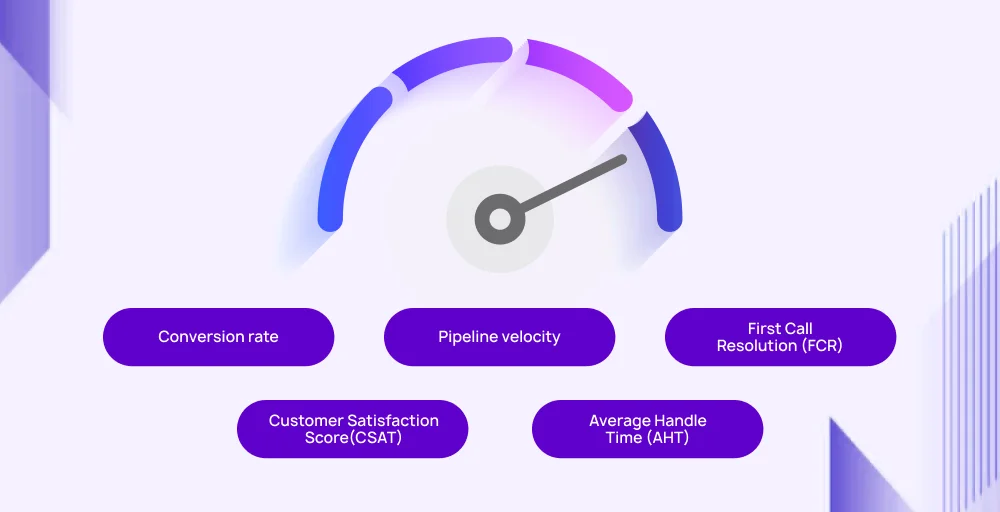
Focusing on the most impactful KPIs enables you to enhance virtual call center productivity and deliver a better customer experience.
Here are 5 of the most important call center KPI benchmarks that you need to target.
1. Conversion rate
Conversion rate measures the percentage of outbound calls that lead to a sale, booked appointment, or qualified lead. It is a critical call metric for sales-driven call centers because it shows how effective your outbound team is at moving prospects closer to conversion.
Conversion rate = (conversions ÷ total audience) x 100
This call benchmark helps identify weak spots in the sales process and eventually guides you to make adjustments to improve close rates.
2. Pipeline velocity
Pipeline velocity measures how quickly prospects move through the sales funnel from first contact to final conversion. For contact center benchmarks, this metric provides valuable insight into the efficiency of sales processes.
Pipeline Velocity = [ Number of Opportunities×Average Deal Size×Win Rate] ÷ [Sales Cycle Length (in days)]
By monitoring Pipeline velocity, sales leaders can identify bottlenecks and take steps to improve call center efficiency. It highlights whether the outbound call center team is nurturing prospects effectively or letting them sit idle.
3. First Call Resolution (FCR)
First Call Resolution (FCR) is a metric that measures the percentage of customer issues resolved during the first interaction without the need for follow-ups or escalations.
Achieving high first-call resolution benchmarks is vital for customer satisfaction because it shows that agents can solve problems quickly and efficiently. A strong FCR rate also reduces repeat calls and eases agent workloads.
FCR = (Number of issues resolved on the first contact ÷ Total number of first contact cases) × 100.
Industry research shows that businesses should now aim for an FCR rate of 80% or higher, up from the old standard of 70%. This improvement not only drives higher CSAT scores but also reduces operational costs.
4. Customer Satisfaction Score (CSAT)
The Customer Satisfaction Score (CSAT) is one of the most important customer engagement metrics in call center benchmarking.
CSAT measures through surveys or feedback after a call to reflect how happy customers are with the service they received. Low scores often indicate long wait times, poor customer interaction, or unresolved issues. On the other hand, high CSAT scores are a clear sign of excellent support.
CSAT = (Number of positive ratings ÷ total number of responses) × 100
Its benchmark suggests businesses should aim for 85% or higher. Since it is directly based on customer feedback, tracking it alongside best customer service benchmarks provides a complete picture of service quality.
5. Average Handle Time (AHT)
Average Handle Time (AHT) tracks the average duration of calls. It includes talk time, hold time, and wrap-up work.
A shorter AHT usually indicates faster issue resolution, but if too short, it may compromise service quality. The key is finding the right balance.
AHT = (Talk Time + Hold Time + After Call Work) ÷ Total Number of Calls Handled
Traditionally, six minutes was considered the standard benchmark. But with modern contact center trends, the focus has shifted to quality over speed. The goal is not just faster call management, but better experiences that improve loyalty and reduce churn.
Call center benchmarks by industry
Every industry has unique customer expectations, so relying only on general call center benchmarks isn’t enough.
To improve call center performance, you need to compare results with call center industry benchmarks specific to your sector. This approach ensures more accurate contact center performance management and helps set realistic improvement goals.
Here are four industries where call center benchmarking is most impactful:
1. Financial services
In financial services, accuracy, speed, and security are essential. Customers expect clear answers about accounts, payments, or policies without unnecessary delays.
Call center KPIs in this sector reflect the need for fast resolutions while maintaining compliance. Typical benchmarks include an FCR rate of 67%-71%, an AHT of 6-7 minutes, and CSAT scores above 80%.
These cloud contact center benchmarks highlight the importance of reducing escalations and building trust. By aligning with these numbers, financial institutions can strengthen call center performance benchmarks and maintain long-term customer loyalty.
2. Retail services
Retail call center technology deals with simple queries like product returns, order tracking, or subscription management. That’s why call center industry benchmarks in this sector are generally higher compared to others.
Retail centers often achieve an FCR rate of 78%, an Average Speed of Answer (ASA) under 30 seconds, and CSAT benchmarks around 85% or higher. These results show how retail brands benefit from faster resolutions and omnichannel support.
Call center analytics in retail also reveal that speed directly improves loyalty. All this makes it one of the great customer service benchmarks for this industry.
3. Healthcare facilities
Benchmarking in healthcare is essential mainly to manage complex and sensitive customer inquiries. Most incoming calls in healthcare involve medical advice, appointment scheduling, or insurance details, all of which require empathy and accuracy.
Industry standards show FCR rates near 71%, AHT around 6.6 minutes, and call abandonment near 7%. These call center metrics reflect the balance healthcare centers must strike between efficiency and compassionate service.
By following call center best practices, providers can deliver reliable care while maintaining compliance with strict regulations.
4. Banking operations
Banking call centers handle sensitive services such as payments, account inquiries, and card disputes. Therefore, for banks, customers value security and speed above all else. Therefore, call center performance in this sector relies heavily on accurate resolutions.
Typical benchmarks include an FCR of ~71%, an AHT of around 6 minutes, and CSAT scores above 80%. These customer service benchmarks confirm that satisfaction is tied closely to accuracy and timely support.
Therefore, bank can align their results with these call center performance benchmarks to help them reduce repeat calls and enhance the overall contact center performance.
5 Expert steps to benchmark your call center
The process of getting started with call center benchmarking is straightforward when broken into clear steps. Follow these five expert-recommended actions to improve your call center operations:
1. Define call center KPIs
The first step is to decide which call center KPIs are most relevant for your business. The most important call center metrics examples are FCR, AHT, CSAT, and NPS.
Choosing the right contact center KPIs ensures you measure what really matters instead of tracking unnecessary data.
When defining KPIs, make sure they connect directly to your business goals. For example, if your main objective is reducing costs, AHT may take priority. But if you want to improve loyalty, CSAT or Quality of service should be the focus. This step gives you a clear starting point for call center performance management.
2. Gather and analyze performance data
Once KPIs are defined, collect accurate data to understand where your call center performance stands today. Then, choose a call center software with dashboards, real-time reporting, and CRM integration. All this helps you analyze call flows, spot trends, and measure historical results.
This step also includes reviewing metrics like abandonment rate or agent utilization. Accurate data collection gives you a baseline that acts as your reference point for improvement.
Without solid performance data, it’s difficult to apply call center benchmarks or measure progress effectively.
3. Compare your performance data with industry benchmarks
After collecting data, compare it against call center industry benchmarks. This helps you identify where you stand relative to direct competitors and contact center benchmarks across the industry.
If your FCR is 65% while the industry average is 75%, that’s a clear signal for improvement.
On top of that, competitive benchmarking is also about highlighting strengths. For that, compare your call center metrics to call center KPI benchmarks. This helps you celebrate areas where your team is already outperforming. It ensures you can build on success while addressing gaps.
4. Set realistic targets and benchmarks
With data in hand, establish achievable goals for your team. Use a mix of internal baselines, industry standards, and call center best practices to define targets.
For example, if your AHT is 15 minutes and industry averages are closer to six, aim for 10 minutes first while maintaining strong customer experience scores.
Setting realistic benchmarks avoids overwhelming your team and provides a structured path for progress. This is where many call center performance management becomes actionable.
5. Implement ongoing monitoring and analysis
Benchmarking doesn’t stop once goals are set. You need to continuously monitor KPIs and track progress with detailed call center analytics.
Regular reporting helps identify whether changes are improving the operations or if a new call center strategy is needed.
Monitoring should also include customer-focused metrics like CSAT, callback messaging, and call center email quality monitoring. As a result, you will be able to increase efficiency and have more satisfied customers.
By following all these steps, you turn raw contact center metrics calculations into strategies that enhance agent performance and promise call center quality assurance..


Tips to improve your benchmark performance
You can improve your call center benchmarking results by following practical tips that improve both your agent productivity and customer experience. Here are some effective ways to enhance your performance:
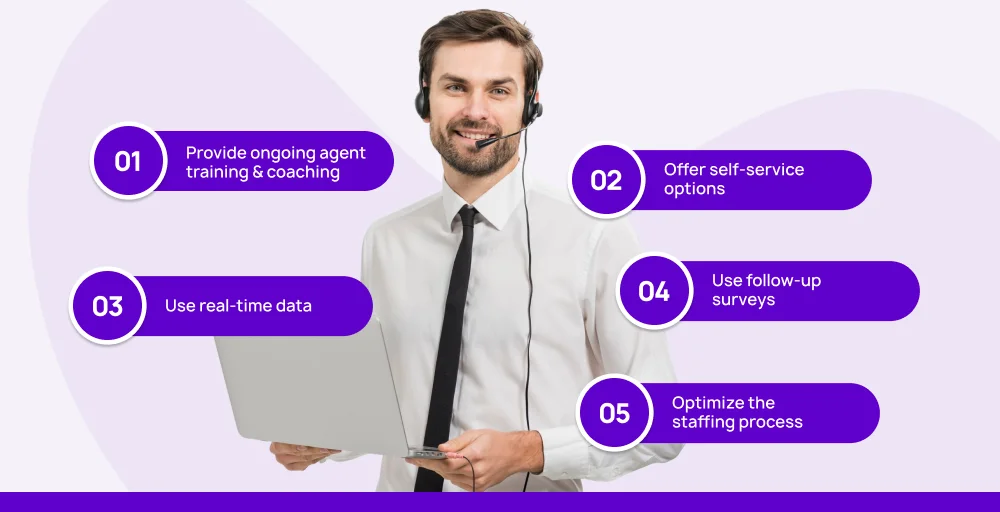
- Provide ongoing agent training & coaching: Regular training keeps agents up to date with best practices, so they can resolve issues faster and with more accuracy. With consistent coaching, they also build confidence and align more closely with your key call center KPIs.
- Offer self-service options: Giving customers tools like IVR menus, FAQs, or chatbots lets them solve simple issues on their own. This not only reduces call volumes but also frees agents to focus on more complex customer needs.
- Use real-time data: Live performance tracking helps call center managers spot problems the moment they occur. By acting quickly on these insights, you can optimize call flows and maintain a steady quality of service.
- Use follow-up surveys: Feedback tools like Net Promoter Score (NPS) or CSAT highlight how customers feel right after interactions. These insights turn into actionable steps that strengthen call center performance management.
- Optimize the staffing process: Smarter scheduling ensures the right number of agents are available during peak demand. As a result, customers face shorter wait times, while agents avoid burnout and stay productive.
Improve benchmark tracking with KrispCall
Tracking your call center performance benchmarks is the only way to see how you stack up against industry standards. KrispCall makes this process effortless with built-in call analytics that turn raw data into clear insights.
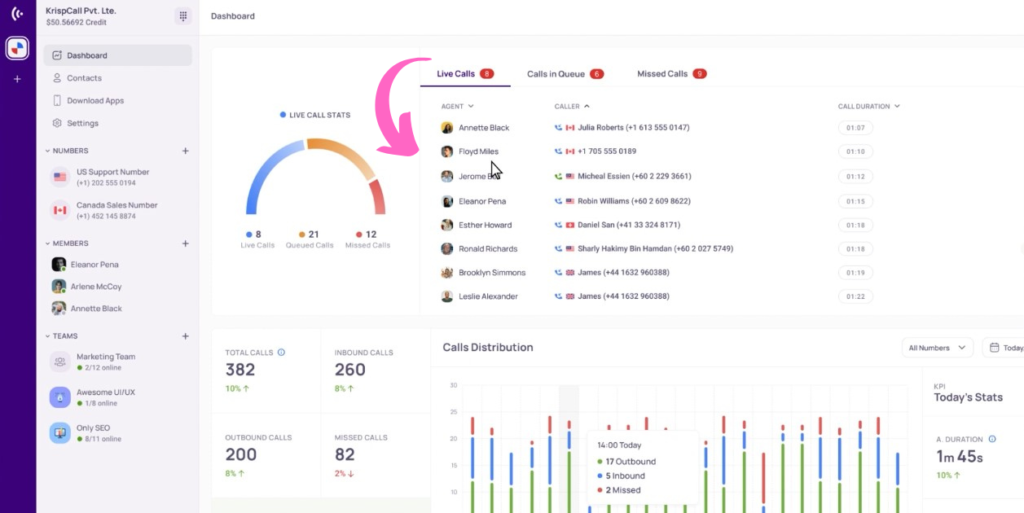
From real-time monitoring to detailed call center metrics, KrispCall helps you spot gaps, optimize staffing, and improve customer satisfaction. It’s an all-in-one platform that works for any industry, giving you the tools to stay ahead of rising customer expectations.
Don’t just measure performance, elevate it. Book a free demo and see how easily you can outperform the competition. Try KrispCall today.