

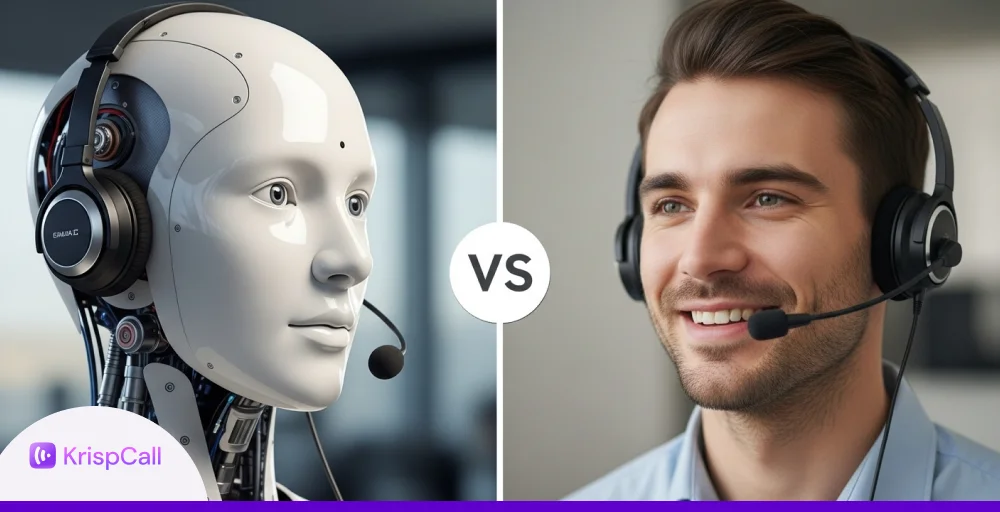
AI technology is growing and evolving, leading businesses to face a dilemma in customer support: relying on AI voice assistants for speed and efficiency or human agents for empathy and problem-solving.
Both AI and humans bring unique strengths, but they also have clear limitations. Understanding where each one stands out helps companies design better support strategies and deliver the right balance of automation and personal care.
In this blog, we will explore the key differences between an AI voice assistant vs human agent.
✨ Key Takeaways
- AI voice assistants excel at speed, scalability, and 24/7 availability.
- Human agents bring empathy, cultural awareness, and complex problem-solving.
- The most effective support model blends AI efficiency with human connection.
What is an AI Voice Assistant?
An AI voice assistant is a software application that uses voice AI technology, automatic speech recognition (ASR), machine learning (ML), and natural language processing (NLP) to interact with people through spoken conversation.
An artificial intelligence assistant listens to questions or requests of callers, interprets the intent, and responds in real-time. Businesses often use AI voice assistants to answer customer queries 24/7, set reminders, and schedule or route calls to the appropriate agent or department.
Key advantages of AI Voice Agents
A virtual receptionist enhances customer service by delivering consistent support and reducing the workload on human staff.
Here are the key advantages:
- Automated routine tasks: AI voice agents handle repetitive tasks such as appointment booking, order status checks, and account verification without requiring human intervention.
- Cost savings & scalability: AI agents reduce the need for large support teams and allow businesses to handle higher call volumes without significantly increasing costs. You can also estimate potential savings and efficiency gains using an AI voice agent ROI calculator to understand the financial impact before implementation.
- 24/7 availability: Virtual assistants AI provides uninterrupted service, ensuring customers can reach out at any time, across time zones and business hours.
- Data-driven insights: AI agent analyzes conversation patterns to identify customer preferences, recurring issues, and opportunities for service improvement.
- Personalization and instant response: An AI voice assistant uses stored customer data to tailor replies and deliver answers immediately, creating faster and more relevant interactions.
Challenges and limitations of AI voice assistants
AI voice assistants are a trending topic among industry professionals. It brings speed and convenience but also faces certain limitations that affect its effectiveness.
- Limited context and understanding: AI systems lack the depth to understand the complex conversations or questions that require deeper reasoning. This can lead to incomplete or inaccurate responses.
- Language and accent barriers: Different speaking styles, regional accents, or multilingual conversations may cause misinterpretation, reducing the quality of the interaction.
- Privacy and security risks: The voice assistant learns or trains itself from the recordings of customer conversations. This can raise concerns about data storage, usage, and potential breaches.
- Lack of emotional intelligence: AI cannot detect subtle emotional cues or provide empathy, making it less effective in sensitive or emotionally charged situations.
- Inconsistent performance: The performance of the AI agent may vary depending on the background noise, technical glitches, or limitations in speech recognition models.
The enduring value of human agents
It is a fact that almost every business around the world is using AI in business. But even with the rise of AI, human agents still play a major role in customer success or service. Human ability to understand nuance, provide empathy, and respond accordingly makes them indispensable in tricky situations
Areas where human agents perform better
The key area where human agents perform better or makes the biggest impact are:

- Complex problem-solving: Human agents are good at resolving customers’ concerns, which requires critical thinking and creativity. They can analyze the tone and the intent at once and develop unique solutions instantly.
- Handling ambiguity & open-ended requests: AI relies heavily on structured or predefined inputs, but human agents can work through even the unclear or incomplete information. They ask clarifying questions, adapt to the flow of the conversation, and provide tailored answers.
- Emotional intelligence & empathy: Humans are emotionally intelligent, and they can connect to another human on an emotional level. They can pick up on tone, frustration, or anxiety and respond with compassion and reassurance in sensitive situations.
- Cultural sensitivity & personalization: Human agents can understand what’s sensitive and what’s not, so they can adjust their language, tone, and approach based on the customer’s background and preference. This adaptability helps avoid misunderstandings and makes the interaction feel more genuine.
- Flexibility in unscripted interactions: Humans know how to think quickly and shift communication styles depending on the customers or the situation. It ensures that customers receive thoughtful and responsive support, regardless of the unpredictability of the interaction.
Challenges and limitations of human agents
In the midst of AI vs humanity, one cannot forget the fact that humans also face practical challenges that can affect consistency and efficiency, despite bringing empathy and adaptability into the conversation.
- Limited availability: Human agents cannot work all day and night, so they work within set shifts. Working in shifts can create limitations in availability, where the agents that customers want may be on leave, or their shift may have just ended.
- Inconsistency and human error: The performance of humans is very unpredictable. Even experienced agents can make mistakes under pressure. These errors in judgment or communication can negatively impact customer satisfaction scores (CSAT).
- Slower information retrieval: Not every information is embedded in the agent’s mind. They need to look up certain information to confirm policies or cross-check information across the service channels, which can drag out resolution time.
- Training and onboarding time: Every business has its own way of doing things, so training new agents to meet the standard requires investment in training and mentorship. Unlike an AI system that scales instantly once deployed, human onboarding is time-intensive.
- Emotional fatigue and burnout: Human energy can easily be drained with continuous exposure to complaints, high call volumes, and stressful conversions. This drainage can lead to fatigue and burnout among agents.
AI voice agents vs human agents: Key factors to consider
Both AI voice and human agents provide customer support. The key difference lies in their tasks as AI voice agents manage common customer queries, repetitive tasks, and provide 24/7 customer support. In contrast, human agents solve the complex queries, adapt to different situations, and offer personalized service.
Here is the comparison table between AI voice and human agents.
| Key Factor | AI Voce Assistant | Human Agent |
| Availability | 24/7 service | Limited to shifts and working hours |
| Scalability | Unlimited with the proper infrastructure | Scaling requires hiring, training, and management |
| Empathy | Limited, follows scripted or data-driven responses | Natural empathy and emotional intelligence |
| Learning method | Improves with more data and training | Learns through personal experience, coaching, and situational judgment |
| Cost per interaction | Low, scales easily without overhead | Higher costs due to salaries, benefits, and training |
| Multilingual support | Can quickly switch between languages with added models | Relies on individual agents’ language skills |
| Task complexity | Performs well with straightforward, repetitive tasks | Handles open-ended, ambiguous, or multi-layered requests |
| Decision autonomy | Follows rules and workflows with limited flexibility | Full contextual reasoning and ability to adapt |
| Customer tier fit | Suitable for general inquiries and frontline support | Essential for VIP or enterprise clients expecting personalized service |
Why does the best support use both AI and human help?
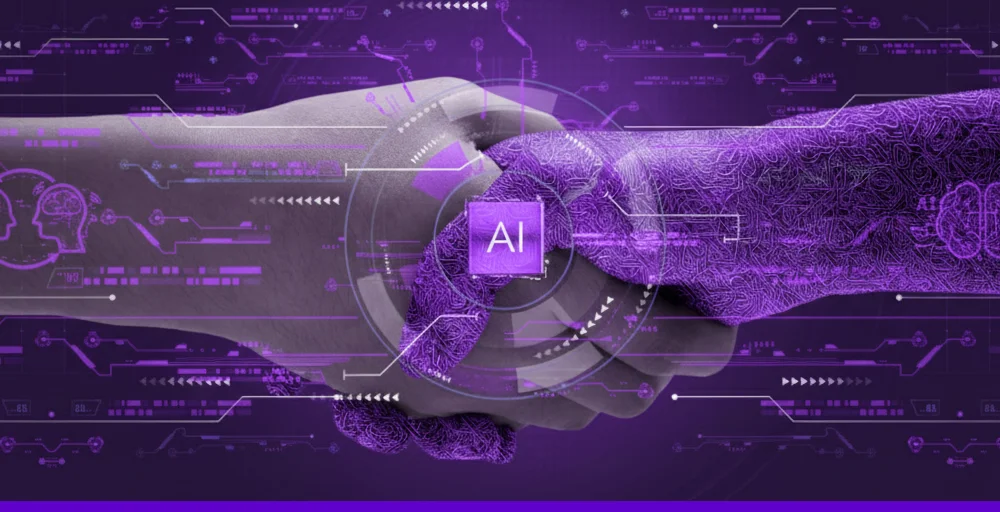
The best customer service strategies combine the efficiency of AI with the empathy and judgment of human agents to create a balanced system that delivers speed, accuracy, and personalized care.
- 24/7 availability without losing the human touch: AI voice assistants can keep the customer support line open 24/7, which ensures customers always have access to help. When complex or emotional issues arise, human agents can step in to provide the empathy and understanding that technology alone cannot deliver.
- Faster response times with human oversight: AI can instantly answer common questions or gather essential details, while humans monitor and guide the process. This collaboration shortened wait times without compromising quality, as agents ensure the final response is accurate and thoughtful.
- Improved accuracy with real-time AI support: During live calls, AI tools can suggest responses, pull up customer data, or flag relevant knowledge base articles for agents. This reduces errors and gives customers precise answers, while still allowing agents to use their judgement.
- Efficient call routing and prioritization: AI systems can analyze incoming calls, sort them by urgency, and route them to the right agent or department. This prevents bottlenecks, ensures critical cases are handled first, and makes better use of human resources.
- Enhanced customer satisfaction and retention: Businesses can resolve issues quickly while still showing care and attention by blending automation with human expertise. This combination helps build an effective customer retention strategy, improves customer loyalty and trust, and reduces churn over time.
Why KrispCall is the reliable choice for AI Voice
Providing fast, personalized, and empathetic customer support is hard when companies only utilize or rely on AI or human agents. Best support systems demand both.
That’s where KrispCall stands out. KrispCall is built to support both AI tools and human agents. With KrispCall, you get:
- Conversation intelligence tools that automatically summarize calls, highlight action items, and detect customer sentiment.
- AI reply helps your agents automate answers to common customer inquiries.
- Call transcription turns recorded calls into text with a single click, which makes it easy to reference past conversations, improve training, and maintain records.
- Deep CRM and helpdesk integrations that bring customer history and context directly into the conversation.
- Comprehensive call analytics with live and historical dashboards to guide staffing decisions and rack agent performance.
Ready to simplify your business conversation? Book a demo with KrispCall today!
Frequently Asked Questions
Can AI agents replace human agents?
It is not really possible to completely replace human agents with AI. But, in the future, both AI assistants and human agents will need to work together to strike a balance between technology and humanity.