



Have you ever been to a website and felt like it knew exactly what you were looking for, which led you to browse, do something, or even check out without hesitation?
For businesses to understand how their visitors move through each stage of the online journey in the hopes of converting them into paying loyal customers, they must understand the customers’ online journey.
In this blog, we will explore digital customer journey, its importance, stages, and lay out the steps to create one that boost customer engagement and loyalty.
✨ Key Takeaways
- A digital customer journey that is optimized uses technologies like customer journey planning and CX tools to decrease attrition, increase satisfaction, and promote retention.
- Customer journey encompasses all online interactions, and it is critical to improving both customer satisfaction and customer retention.
- A well-optimized digital customer journey strategy increases satisfaction, boosts retention, and turns customers into loyal brand advocates.
What is a digital customer journey?
A digital customer journey refers to the entire customer experience a consumer undergoes when interacting with a single online brand, encompassing the initial interaction with the business, the purchase, and the customer’s post-purchase activities.
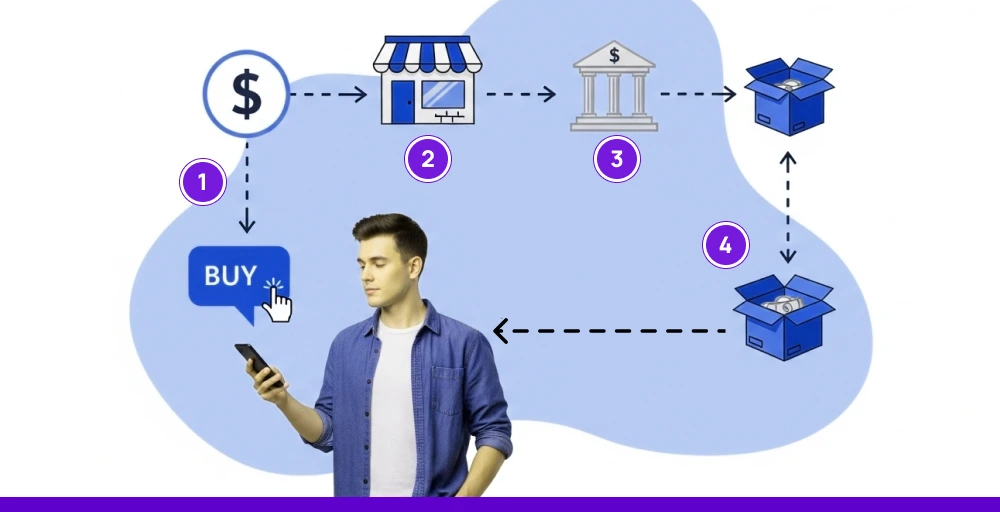
Additionally, the digital customer journey includes all of your brand’s online customer touchpoints, including visiting your website, reading reviews, subscribing to your email newsletter, and contacting customer service teams.
By understanding the digital customer journey at every stage, organizations can focus on increasing the experience and decreasing customer churn. Customer journey mapping provides organizations with transparency of the different stages of the customer’s digital journey, with the ultimate goal of increasing engagement, satisfaction, and retention.
What are the 5 stages of the digital customer journey?
If you want to build a cohesive and effective digital customer journey to convert cold leads, you must understand the basic stages of your customers’ online journey. Each stage contributes to the overall personalized customer experience and long-term customer retention.
Here are five digital customer journey stages:
1. Awareness: Discovery
It all starts here. At the awareness stage, your potential customers connect with your brand for the first time because they discovered you by clicking an online ad, viewing your social media, found you through a search engine, or landed on your blog page.
At this stage, your goal is to capture their interest and click through to see what value you can provide. Building a solid digital experience starts with being in the right place at the right time, navigating them to the right resources that allow them to go further.
2. Consideration: Evaluation
During the consideration stage, the customer is now familiar with your brand and products, and they are comparing them with competitors. They compare your prices, reviews, sign up for emails, and talk to customer service. This stage is where you can provide extensive information, answer questions, and show what makes you different.
Improving digital customer experience in this situation is a matter of design simplicity and usability while enabling comparability and trustworthiness via customer feedback and testimonials.
3. Decision: Selection
Now is the time of ‘yes’ when the consumer wants to buy. Your task is to make the buying process quick, easy, and secure. Fast checkouts, clear calls to action, and helpful customer support go a long way toward turning that intention into action.
By creating an easy UX design and eliminating last-minute concerns, you can increase satisfaction and reach a secure buying decision. Organizations can use digital customer journey maps to discover and eliminate friction points that slow down conversion.
4. Retention: Loyalty
Just because a customer makes a purchase doesn’t mean the journey is over. The retention stage is about interacting, retaining, and engaging customers. You can take personal follow-ups, valuable content, loyalty programs, and real-time support, and use these tools to either establish retention with your customers or add additional value through customer retention.
An intense digital transformation customer journey has post-purchase strategies that turn one-time buyers into repeat buyers. This is where you can genuinely be customer-focused, using customer experience management to build enduring relationships. Once a customer has made a purchase, the journey does not stop there.
5. Advocacy: Promotion
The final step is advocacy, in which happy customers become brand advocates. They share positive reviews, refer their friends, and post comments about it on social media. Building advocacy is about repeatedly making promises and being memorable in customer interactions, such that customers are driven to share their experiences.
Providing great digital experiences is a guaranteed method of generating organic promotion and word-of-mouth growth. Referral initiatives, loyalty benefits, and basic feedback tools help expand this stage. A practical digital customer journey example typically concludes with loyal customers becoming promoters, generating new leads, and revisiting the journey anew.
What is a digital customer journey map?
A digital customer journey map is a visual representation of all the steps a customer takes while interacting with your company digitally. It represents the whole digital customer journey (the entire experience of a customer from that first time they hear about you until they’re a loyal customer or brand advocate).
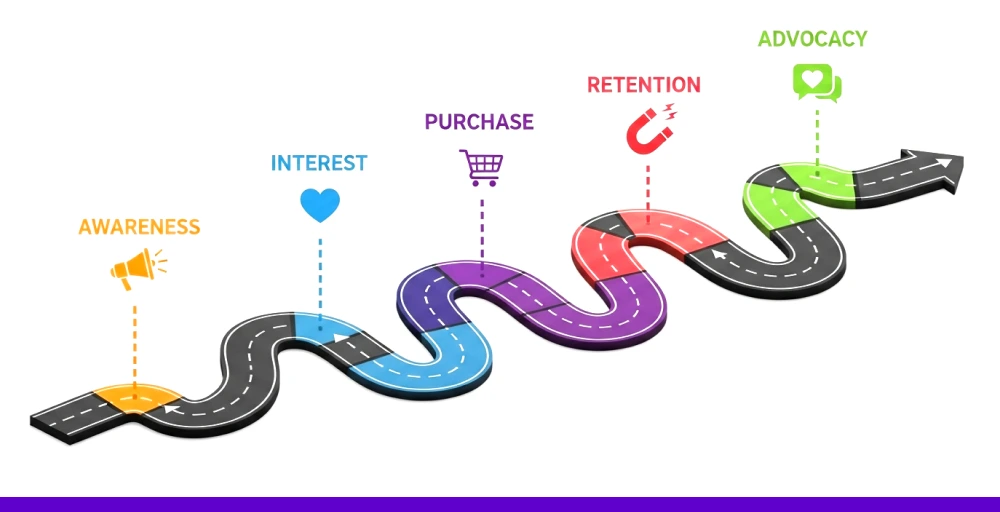
All of the touchpoints in your digital journey include visiting your website, reading reviews, signing up for emails, and contacting customer service, to name a few.
When using a digital customer journey map, a business can better understand customer behavior, identify pain points, and enhance the overall digital experience for customers.
Benefits of optimizing digital customer journey
Optimizing the digital customer journey enables businesses to create seamless, engaging experiences that guide customers from discovery through loyalty.
When each interaction is honest, helpful, and consistent, it improves overall customer experience and strengthens your brand’s ability to retain and delight customers.
Among the most important advantages of customer digital journey optimization are:
1. Increased customer satisfaction: A simple, seamless, and personalized experience powers total customer satisfaction. Customers are less likely to lose interest and become dissatisfied with your company if they receive the right information and support at the right time.
2. Increased customer retention: By fixing pain points and delivering repeat value, you can fuel increased customer retention. A smoothly optimized experience brings customers back and lowers your churn rate.
3. Enhanced customer experience management: Through CX tools and customer analytics, you can track customer behavior and make data-driven optimizations. This strengthens your ideal customer experience management strategy, ensuring that every touchpoint in the digital journey creates value.
4. Increased conversions: Smoothly transitioning customers from the awareness to the decision stage generates more conversions. An optimized digital consumer journey removes friction and encourages users to perform activities such as making purchases or signing up.
5. Customer advocacy increased: A great experience turns satisfied shoppers into brand advocates. Happy customers share their knowledge with others, write positive reviews, and spread the word, fueling growth through customer-led strategies and word-of-mouth marketing efforts.
How to build a digital customer journey map?
Creating a transparent and implementable digital customer journey map allows you to understand your customers’ online behavior, improve the customer experience, and meet their needs.
With these simple steps, you can craft a journey that facilitates greater engagement, improved customer retention, and more intelligent business decisions.
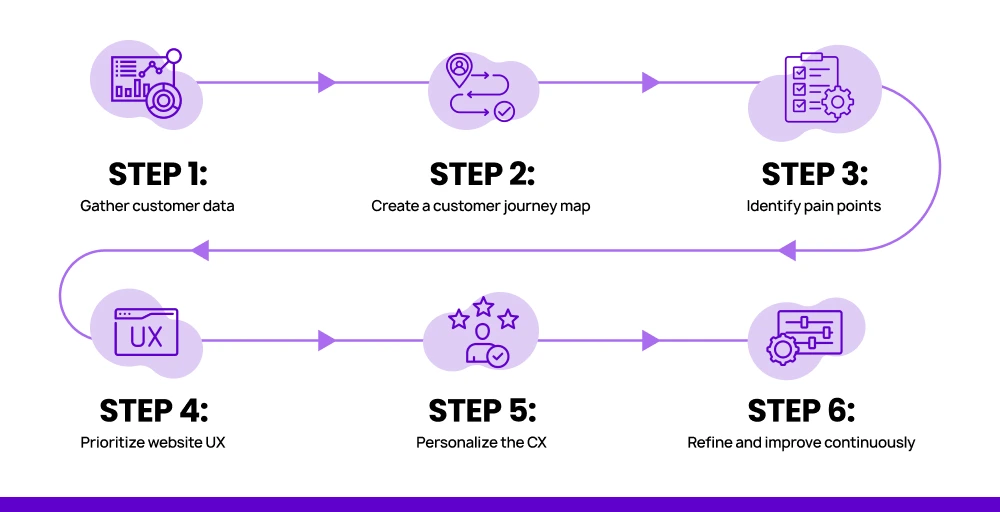
Step 1: Gather customer data
A digital customer journey map allows you to visualize how customers interact with your brand online. It shows major customer behaviors, pain points, and opportunities for improving customer experience, retention, and conversion.
- Find out how customers act through digital channels.
- Use website analytics to track visits, bounce rate, and user flow across key pages.
- Analyze call center metrics like call duration and satisfaction scores.
- Collect data from social media, email campaigns, and live chat.
- Leverage customer surveys and social listening tools to analyze sentiment and expectations.
Step 2: Create a customer journey map
With information at hand, build a visual map showing every step of the customer’s digital journey from awareness to advocacy. Utilize a digital customer journey map template for mapping out steps and channels. Such a map indicates where customers drop off or require additional assistance.
- Map crucial steps: awareness, consideration, decision, retention, advocacy.
- Insert all touchpoints of consequence (e.g., website, email, advertising, customer support).
- Use a customer journey map template to create a concise visual flow.
- Think about making separate maps for different customer personas.
Step 3: Identify pain points
Recognize customer pain points where customers become stuck, confused, or slowed down. These are typically places of frustration and higher churn. Utilize customer journey analytics and customer surveys to identify these points and address them.
- See intricate navigation, missing information or slow response times.
- Watch user actions to identify where they are disengaging or struggling.
- Journey analytics and in-the-moment surveys can lead to improving those experiences.
By fixing these pain points, you will reduce churn and increase customer satisfaction.
Step 4: Prioritize website UX
Ensure an effortless and responsive web experience. Here, you need to make sure that your site is fast, responsive, and guides users through every action in a clear, straightforward manner. Solid website UX (user experience) supports an effortless digital experience and drives conversions in decision-making.
- Optimize your site speed, design, and friendliness on mobile.
- Leverage heatmaps, scroll maps, and session recordings to identify friction.
- Test improvements using A/B testing and live user feedback, including interactive elements like spin-to-win wheels to boost engagement without hurting the user journey.
- Excellent website UX helps fuel conversion and growth in the digital world.
Step 5: Personalize the CX
Personalization makes the experience more significant. Use names, behavior-based suggestions, and customized content. Customer focus tightens the CX (customer experience), built on stronger relationships and greater customer loyalty.
- Use names, likes, and behavior to customize messaging.
- Show customized product recommendations based on past activity.
- Create segmented journeys for different populations and activities.
- Personalization stimulates deeper customer engagement and loyalty.
Step 6: Refine and improve continuously
The digital transformation customer journey is an ongoing process. Review your map periodically, test new ideas, and adjust according to changing customer behavior and demand. Utilize CX tools to track progress and ensure your strategy remains aligned with expectations.
- Consider and update your journey map from time to time.
- Monitor KPIs and customer feedback for insight.
- Test and fix new strategies based on behavior patterns.
- Use CX tools to ensure your map is aligned with customer expectations.
Digital customer journey examples
Understanding how the digital customer journey works can help you design better experiences for your customers. These two simple, actionable examples show how companies take customers through the first interaction to loyalty using a strong customer-first strategy and intelligent customer mapping.
Example 1: Online apparel company
A consumer sees an Instagram advertisement for a fashion jacket (Awareness). They click on the link, browse the store, and read reviews (Consideration). They check prices and sizes, ultimately making a purchase and checking out seamlessly (Decision). Post-purchase, they receive updates on their order, fashion advice, and a next-time use reward code (Retention).
Someday, they share a picture of what they are wearing on social media and tag the brand (Advocacy). This is one of the ways a business can leverage a well-crafted digital customer journey and targeted content to drive satisfaction and loyalty.
Example 2: SaaS company (Software Tool)
A startup founder seeks customer support management software and comes across an informative blog post on Google (Awareness). They visit the SaaS company’s website and take it for a trial (Consideration). They receive onboard emails, tutorial videos, and quick responses from customer support (Decision). Upon subscribing, they receive monthly newsletters and customer feedback surveys (Retention). They later recommend the application in a LinkedIn blog post (Advocacy).
This journey illustrates how digital customer experience and effective customer experience management can foster loyalty through ongoing value and support.
Conclusion
A well-thought-out digital customer journey is the basis of a successful digital customer experience. By understanding a customer’s journey as they move through the decisions around awareness, consideration, decision, retention, and advocacy, businesses have the opportunity to provide personalized experiences that take customers from discovery to loyalty.
The goal of an organized and purposeful digital customer journey is for customers to experience more than just being converted as a lead into a transactional customer, but rather, become a lifecycle relationship built by personal connections with the brand, as now an advocate for your brand.
Frequently Asked Questions
What is the information that you can collect with digital customer journey mapping?
- Web analytics: Track user clicks, site time, bounce rates, and devices.
- Sales data: See purchase patterns, cart abandonment, and buying habits
- Ad performance: Monitor ad clicks and assign them to sales outcomes.
- Loyalty insights: Analyze use and engagement from participants in your loyalty program.
- Survey feedback: Capture opinions directly from customers at pivotal touchpoints.