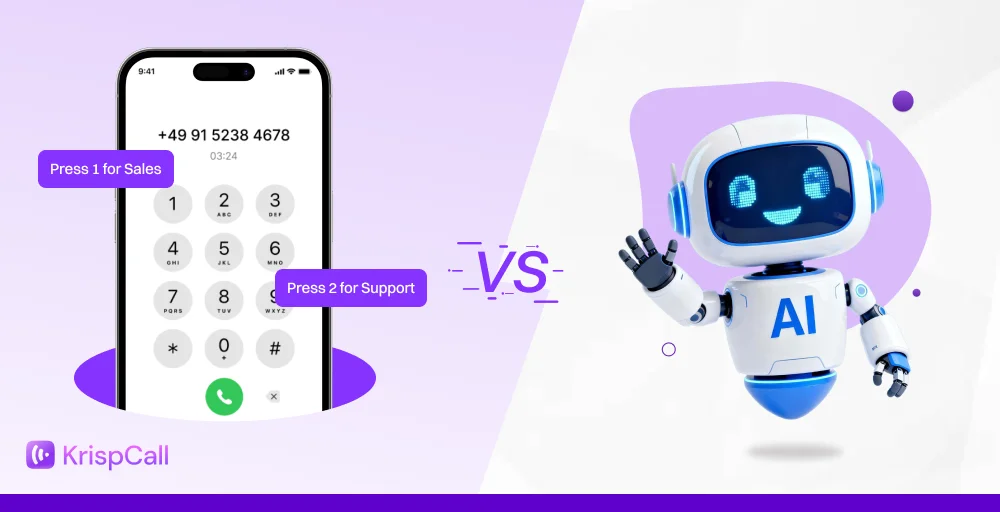


If your team already tried a chatbot a few years ago and quietly stopped using it, you’re not alone. Most old bots could only follow a script. The moment a customer typed something the script didn’t expect, the bot broke down, and the customer got sent to a human agent anyway.
Generative AI is different. It doesn’t just pick a pre-written answer from a list. It actually understands what the customer is asking, checks the right information, and writes a real, accurate answer on the spot. This is why so many customer service leaders are giving AI a second look, even if their last attempt didn’t go well.
In this guide, we’ll cover what generative AI is, how it works, where it creates real business value, the risks to watch out for, and simple steps to start using it in your support operations without putting your entire customer experience at risk on day one.
As customer expectations keep rising, most customer service functions can’t scale with people alone, which is exactly the gap that generative AI solutions are built to fill.
✨ Key Takeaways
- Generative AI in customer support uses large language models (LLMs) to understand customer intent and generate personalized, context-aware responses in real time.
- Unlike traditional chatbots, generative AI creates original responses, understands natural language, and can use company knowledge to provide accurate answers.
- Businesses use generative AI to automate customer support, assist agents, reduce response times, lower costs, and provide 24/7 multilingual service.
- Successful implementation requires a reliable knowledge base, human escalation for complex cases, and continuous monitoring to ensure accuracy and compliance.
What Is Generative AI in Customer Support?
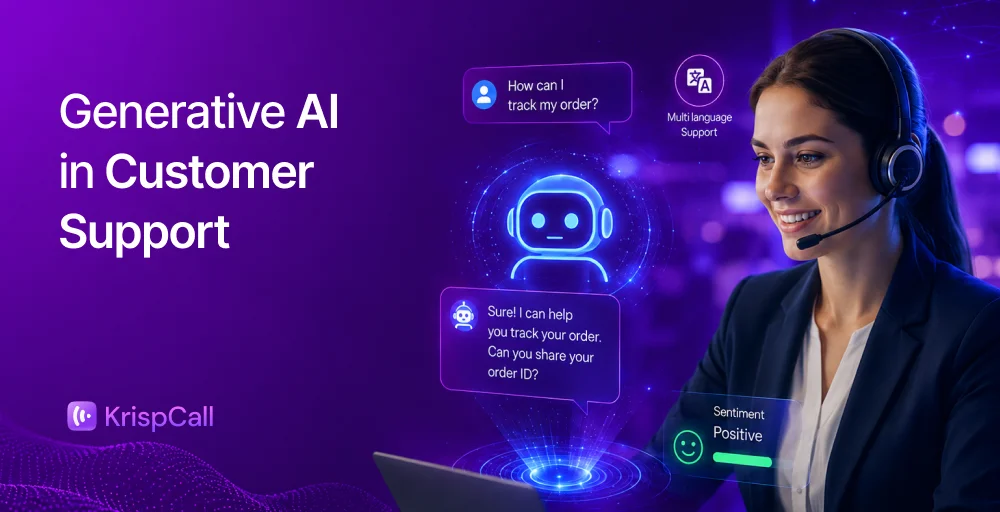
Generative AI in customer support is artificial intelligence that understands a customer’s intent and generates an original, context-aware response in real time, instead of matching a query to a pre-written answer.

It draws on large language models (LLMs), machine learning algorithms, natural language processing (NLP), and retrieval-augmented generation (RAG) to combine your company’s own knowledge base with natural conversation.
AI in customer service isn’t new, but generative AI raises the bar. Unlike a traditional chatbot, it can remember the conversation, understand customer queries phrased in many different ways, learn from historical data over time, and, increasingly, take action, like updating an account, instead of just explaining how to do it.
That’s what makes personalized support and personalized responses possible at scale.
How Generative AI Works in Customer Support?
Generative AI transforms customer support from rigid, rule-based scripts into a natural conversation. Instead of making customers click through fixed menu options, it understands plain language, finds the exact information needed, and writes a tailored response in real time.
Every automated interaction follows the same process to stay accurate, fast, and consistent.
1. Inquiry ingestion
The customer reaches out by chat, email, or voice. The system cleans up the message but keeps details such as punctuation or repeated words that signal urgency.
2. Intent & sentiment analysis
Natural language processing (NLP) models evaluate the text to extract core intent, primary entities (e.g., account numbers, product names), and customer sentiment analysis. This step identifies whether the customer is frustrated, what problem they face, and what the customer’s needs.
3. Knowledge retrieval
To prevent hallucinations, the system runs the query through a Retrieval-Augmented Generation (RAG) pipeline. It searches internal databases, help center articles, and other connected systems to find verified facts related to the customer’s question, so it can generate relevant responses rather than guesses.
4. Response generation & guardrails
The Large Language Model (LLM) takes the user’s original query, the detected intent, and the retrieved factual data. It synthesizes this information to draft personalized, appropriate responses that match the company’s established brand voice. Before delivery, safety guardrails scan the response to verify accuracy and block sensitive data exposure.
5. Action execution or escalation
The system executes the resolution, such as processing a refund via API or updating a ticket status. If the intent requires deep problem-solving or the customer is highly frustrated, the system smoothly escalates the session to a live support agent, along with a concise interaction summary.
Generative AI vs. Traditional Chatbots vs. Agentic AI
These three terms get used interchangeably, but they describe genuinely different technologies. So, understanding the difference is the fastest way to evaluate whether a tool you are being sold is actually generative AI or a rule-based bot.
| Attributes | Generative AI | Traditional Chatbots | Agentic AI |
| How it decides | Reasons over context using an LLM | Fixed decision trees and IF/THEN scripts | Reason over context and plan multi-step actions |
| Handles unexpected input | Understands nuance and varied phrasing | Breaks down with typos or off-script phrasing | Understands nuance and adapts its plans |
| Flexibility | High. Understands slang, typos, context, and multi-part questions | Zero. Fails if the user typos or phrases a query uniquely | Dynamic. Can pivot strategies mid-conversation to solve a problem |
| Output | Generates an original response | Retrieves a pre-written answer | Generates a response and executes tasks |
| Tone | Conversational, adaptive, and written dynamically in real time | Scripted, robotic, and pre-written by humans | Professional, context-aware, and highly personalized |
| Learning model | Pre-trained, but heavily dependent on external knowledge bases (RAG) | Manual updates. A human must manually add rules | Continuous loop feedback evaluates its own paths for efficiency |
| Action capability | Primarily international; synthesizes and explains data | Limited to basic, hard-coded API triggers (e.g., check balance) | Full execution. Can chain complex actions across multiple internal tools. |
Generative AI Use Cases in Customer Support
Generative AI’s value isn’t limited to a single channel; it works across multiple channels like chat, SMS, voice, and email, which is where much of the hype around “AI chatbots” undersells it. Here’s where it makes the biggest difference for customer service teams:
- 24/7 chat and SMS resolution: Customers get accurate answers, natural-language answers to common customer queries, routine questions, order status, billing details, appointment changes- at any hour. This eliminates long wait times, reduces support queues, and creates a more efficient customer support experience for everyone.
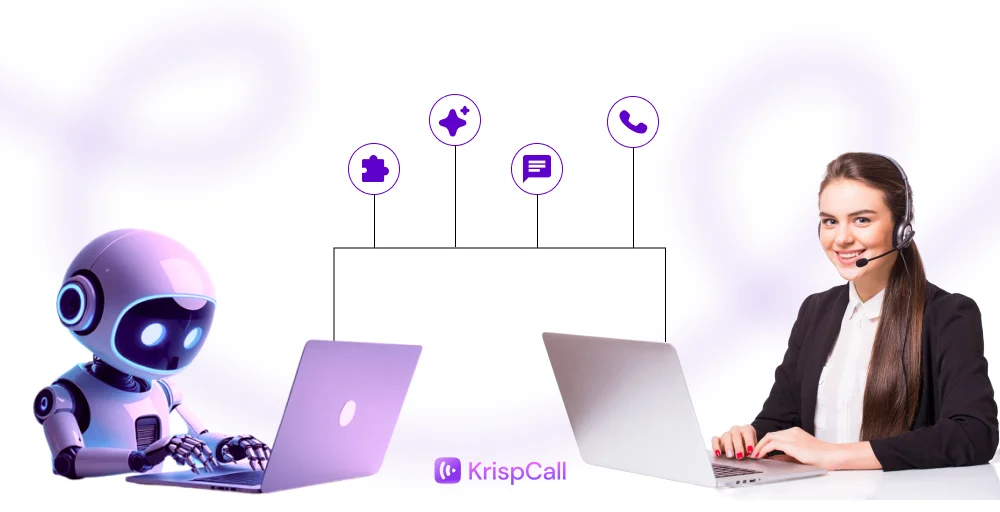
- AI agent assist: Rather than fully automating a conversation, generative AI can sit alongside a human agent, suggesting responses that the agent can approve or edit, retrieving relevant policy information mid-call, and generating a summary the moment a call or chat ends. This is one of the simplest ways to boost agent productivity and reduce average handle time.
- Proactive outreach or personalized recommendations: Instead of waiting for a customer to notice a delayed shipment or an upcoming renewal, generative AI can flag the issue and reach out. It then offering personalized assistance, preventing a support ticket from being created in the first place.
- Intelligent, cross-channel routing: When a request requires a specialist or a human agent, generative AI can route it to the right person with full context already attached, reducing transfers and repeated explanations.
- Conversation intelligence at scale: Because generative AI models can process every conversation instead of a small sample, they can spot patterns in contact center sentiment, complaints, and emerging issues that a QA team might take weeks to notice by hand.
Examples of Businesses Using Generative AI in Customer Service
Generative AI has changed customer support from fixed menu options to flexible conversations. It processes natural language in real-time, enabling businesses to grow while providing fast, helpful assistance.
Here are some examples of how global brands use generative AI for transforming customer service experience:
1. Automated customer inquiries (Klarna)
In one of the most widely cited case studies of generative AI adoption, the fintech firm Klarna launched an AI assistant powered by OpenAI. In its first month alone, the AI handled 2.4 million customer support conversations, equaling the workload of 700 full-time human agents.
- The Impact: It resolved customer queries in less than 2 minutes (compared to 11 minutes previously), while maintaining a high resolution rate and operating across 23 countries in multiple languages.
2. In-App owner assistance (Volkswagen)
Volkswagen integrated Google’s Gemini models into its myVW mobile application to create an intelligent virtual assistant. Instead of flipping through a massive paper glovebox manual, drivers can ask natural questions like, “How do I change a flat tire?” or “What does this digital cockpit dashboard light mean?”
- The Impact: Because the AI features multimodal capabilities, users can simply point their smartphone camera at their car’s dashboard, and the AI instantly recognizes the icon and explains the necessary action.
3. Real-time agent assistance (MetLife)
Generative AI isn’t just replacing human contact; it’s also acting as a “co-pilot” for human agents. The insurance giant MetLife utilizes AI to analyze customer sentiment and customer history mid-call. It drafts tailored, empathetic email responses and summarizes long ticket histories for human specialists.
The Impact: This hybrid approach resulted in a 3.5% increase in first-call resolutions and boosted overall consumer satisfaction scores by 13% by reducing the time customers spent on hold.
Benefits of Generative AI for Customer Support Teams
Once a generative AI implementation system is live, the impact tends to show up directly in the metrics support leaders already track, not just as a vague productivity boost. Here are five key benefits worth quantifying before and after a rollout.

- Reduce operational costs: By automating routine tasks and answering common customer queries on its own, generative AI reduces the cost per ticket or call center price. This lets support operations grow without needing to add staff at the same pace.
- Faster resolution times: With instant access to knowledge bases and CRM data, both AI and AI-assisted agents can answer customer questions faster. This directly improves average handle time (AHT) and first-contact resolution (FCR).
- Less repetitive work, better retention: Agents spend less time answering the same handful of questions every day and more time on complex, judgment-based cases, the work that actually keeps people engaged in a support role. Lower burnout tends to translate into lower turnover of call centers, which is one of the most expensive problems.
- More consistent, on-brand responses. Because generative AI draws from the same verified knowledge base every time, it reduces the variation you typically see between different agents, shifts, or locations. This helps keep your customer service experience the same across every channel.
- 24/7 support, multilingual coverage: Support no longer has to pause outside business hours or scale a separate offshore team to cover multiple time zones and languages. Generative AI can maintain consistent service quality around the clock, leading to improved customer satisfaction across the board.
Challenges and Risks to Watch
Generative AI isn’t risk-free, and any guide that skips past this section isn’t being straight with you. Here are the five risks worth planning for before rollout, each paired with how teams typically mitigate it.
1. Hallucinations
Sometimes generative AI can give a confident-sounding but incorrect answer. How to manage it: keep a human check in place for sensitive or high-stakes replies, and connect the AI only to verified, up-to-date information rather than letting it guess.
2. The empathy gap
AI can sound polite, but it doesn’t truly understand emotion the way a person does. In sensitive situations, like a customer facing real financial trouble, an AI trying to sound caring can come across as insincere. How to manage it: set clear rules for when a conversation should automatically be routed to a human agent.
3. Data privacy and compliance
Regulations like GDPR require transparency about when a customer is interacting with an AI bot rather than a human agent. They also impose strict requirements around call center compliance, ensuring customer data is collected, stored, processed, and protected in accordance with applicable privacy and security regulations.
4. Over-automation
Automating too many customer interactions too quickly can eliminate opportunities for human support when customers genuinely need empathy, judgment, or complex problem-solving. While automation may improve efficiency metrics, excessive reliance on AI can reduce customer satisfaction and negatively impact the overall support experience.
5. Knowledge base drift
Generative AI is only as accurate as the information it retrieves from your knowledge base. If help center articles, FAQs, or policy documents become outdated, the AI can generate inaccurate or inconsistent responses, reducing customer trust and support quality.
How to Implement Generative AI in Your Support Operation?
Implementing generative AI doesn’t need to be an all-or-nothing transformation. Organizations that achieve the best results typically adopt a phased approach, allowing them to validate performance, minimize risk, and continuously improve the customer experience.
For the successful implementation of generative AI in your customer support workflows and operations, follow the given steps:
Step 1: Audit and centralize your knowledge base
Start by reviewing and consolidating your FAQs, policy documents, help articles, and training materials into a single, up-to-date knowledge base. Since generative AI relies on this information to generate responses, inaccurate or outdated documentation can lead to incorrect answers and inconsistent customer experiences.
Step 2: Start with a low-stakes pilot channel
Begin with a support channel such as chat or SMS that handles routine, repetitive requests like order tracking, appointment scheduling, or account inquiries. Starting with a limited pilot allows you to evaluate performance, gather customer feedback, and refine the AI before expanding to more complex interactions.
Step 3: Establish human escalation rules
Define clear criteria for when to transfer conversations to a human agent before deployment. Issues involving complaints, refunds, sensitive customer information, or high-value accounts should always have a seamless escalation path to ensure customers receive the appropriate level of support.
Step 4: Track the right metrics
Evaluate success using call center metrics instead of relying solely on customer satisfaction (CSAT). Track key indicators such as AI resolution rate, deflection rate, containment rate, average response time, first-contact resolution, and customer sentiment to measure both support efficiency and service quality.
Step 5: Scale gradually across channels
Once the pilot consistently meets your performance goals, expand generative AI to additional support channels such as email, voice, or social messaging. A phased rollout enables continuous optimization while minimizing operational disruptions and maintaining a high-quality customer experience.
This sequence directly answers the question that many support leaders are really asking: how can generative AI enhance customer support without disrupting it? The answer is incremental rollout, clear escalation rules, and metrics that go beyond satisfaction scores.
What Makes KrispCall AI Receptionist Better?
Most AI receptionist tools are built around voice calls only, leaving chat and SMS as an afterthought, or a totally separate tool your team has to manage.

KrispCall’s AI Receptionist works differently and stands out by replacing clunky, multi-layered menus with a conversational, context-aware voice agent that understands caller intent. It automates 24/7 self-service, instantly qualifies leads, and syncs data with your CRM to reduce human workload
KrispCall Features:
- AI Voice Agent for 24/7 call handling: KrispCall’s AI Voice Agent answers FAQs, qualifies leads, and automatically routes hot prospects to the right service reps, so no call goes unanswered, and no lead goes cold, even after hours.
- AI Copilot and call intelligence: Every call comes with AI-generated reply suggestions, automatic transcription, and a concise call summary, so support agents spend less time on manual documentation and more time on the actual customer.
- Smart IVR and call routing: Multi-level IVR and intelligent call routing route each caller to the right agent or department, reducing wait times and escalating to a live agent when necessary.
- Real-time CRM sync: KrispCall integrates with HubSpot, Salesforce, Zendesk, Pipedrive, and 100+ other call center tools, automatically keeping customer details, support tickets, and call history up to date with no manual data entry.
- Global virtual numbers: With local, mobile, and toll-free numbers in 100+ countries, growing teams can offer local-feeling support worldwide from a single platform.