


Imagine answering a call to a business and knowing your personal information is safe, while being treated fairly by the representative. That’s contact center compliance, which protects both customers and companies by making sure rules and regulations are followed during every call.
But when compliance goes wrong, the consequences aren’t small. Poor governance, outdated tech, or a lack of processes can lead to massive fines, lawsuits, and a damaged reputation. In some cases, it could halt operations entirely.
In this blog, we’ll explain what contact center compliance really is, why it matters, and how companies can stay on the right path. Whether you have a support team or just want the basics, this short guide will cover everything you need to know.
✨ Key Takeaways
- Contact center compliance means following laws like HIPAA, PCI DSS, and GDPR to protect customer data and ensure agents act responsibly and legally on every call.
- Failure to comply with regulations can lead to catastrophic risks to the business, such as hefty fines, costly litigation, loss of service, and the complete loss of customer trust.
- Compliance best practices involve continuous training of agents, technology that allows the contact center to have a secure environment, explicit consent, monitored systems, and updating policies as laws change.
What is contact center compliance?
Contact center compliance means making sure a contact center follows all the rules and guidelines set by the law and the company itself. This includes how agents talk to customers, how private data like credit card numbers or medical info is handled, and how phone calls or messages are sent out. It also covers how technology is used to keep everything safe and secure.
Besides, the primary goal of compliance is to protect the company and the customer data. For companies, it saves them from legal problems, fines, or reputation damage that can be caused by noncompliance with the law. For customers, it is important that their data is kept confidential and that they are treated fairly.
Why is contact center compliance essential?
Contact center compliance is crucial to protect customer and company data from hackers and avoid hefty fines.
Here’s why contact center compliance is important:
1. Heavy fines and penalties
Breaking rules can cost your business a significant amount of money. If you are not following TCPA regulations when autodialing or sending texts, it can lead to fines for each call or message. Additionally, HIPAA violations at healthcare call centers have resulted in million-dollar settlements.
For healthcare teams, it also helps to validate where sensitive patient-facing systems run, the US healthcare cloud infrastructure from Atlantic is one example tied to regulated data handling. Neglecting PCI DSS compliance can result in additional fees from banks and credit card companies. So, a call center software must follow the rules and regulations to avoid these hefty fines.
2. Loss of customer trust
Once there is a data breach or customers sense that their data is being treated unjustly, regaining their trust becomes a challenge. One mistake can harm your brand reputation. Customers want to ensure their information is not misused.
Following contact center compliance helps you to store customer data safely and securely and avoid losing customers due to trust issues.
3. Disruption of business operation
Companies can temporarily shut down or be forced to suspend their core operations, such as payment processing, if contact center operations fail to comply with strict rules and guidelines.
Utilizing compliant contact center technology keeps you in business and open while complying with the regulations.
4. Risk of lawsuit
Non-compliance with call rules can have legal issues, especially in the case of lawsuits by customers for improper use of their data. Cases involving one or multiple individuals can be expensive and harmful for your business.
This is the reason why agent training and established procedures form such an essential part of call center regulatory compliance.
Implementing a governance risk and compliance software ensures that all communication processes align with legal standards, minimize operational risks, and maintain data integrity across customer interactions
5. Keeps everything running smoother
If a contact center compliance checklist is used, things are going to work more smoothly. Everyone knows what they need to do; there’s less chance of mistakes being made, and it’s easier to meet objectives like your service level agreement (SLA). Call center compliance monitoring also makes it easier to catch and fix problems early.
How do businesses maintain compliance in their contact centers?
To protect customer data, avoid legal issues, and build trust, businesses must adhere to compliance standards.
The following are three key ways businesses maintain compliance:
1. Implementing compliance-focused contact center technology
Businesses can utilize reliable and customizable contact center solutions that include various levels of data protection, call recording security, user access control, and real-time call monitoring. Such tools help ensure adherence to strict regulations such as PCI DSS, HIPAA, and GDPR when accepting payments and/or processing personal information.
2. Complying with an open contact center compliance checklist
Successful companies follow a formal contact center compliance checklist that covers data processing, customer opt-in, call compliance, and internal policy confirmation. This sets standard behavior across agents and keeps call center compliance policies aligned with laws like TCPA and Do Not Call Registry legislation.
3. Regular training and monitoring
Maintaining compliance requires continuous monitoring and training. Agents are required to complete compliance training focused on federal laws such as HIPAA and international standards like GDPR. Meanwhile, managers utilize call center compliance monitoring tools to identify potential issues early, thereby helping to prevent violations of legal standards.
Top contact center compliance regulations [2026 update]
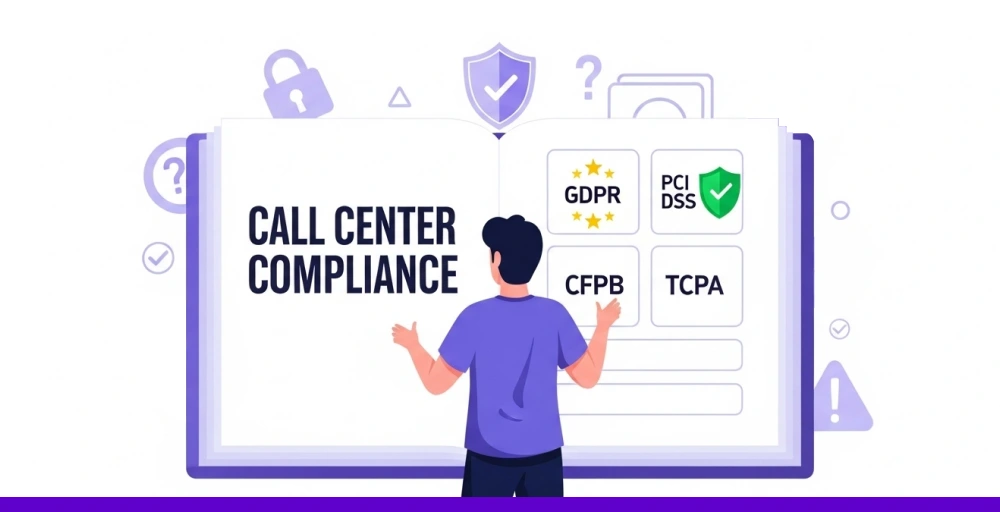
Contact centers handle sensitive customer information on a regular basis, and following appropriate laws and regulations isn’t optional; it’s a must-have. From protecting personal data to protecting against unwanted calls, these essential contact center compliances help your business stay secure, compliant, and trusted.
1. PCI DSS (Payment Card Industry Data Security Standard)
PCI DSS is mandatory for any contact center that takes credit card payments. It issues security recommendations for storing, gathering, and processing cardholder data to protect both the business and the customer.
Purpose:
PCI DSS exists to protect cardholder data whenever customers make payments by card. It helps prevent fraud, data theft, and fines from banks or card networks.
Requirements:
- Do not store CVV numbers or sensitive payment information following authorization, even when encrypted.
- Use PCI-compliant call center software and systems that implement the 12 core security standards of PCI, including secure networks, encrypted storage, and recurring audits.
- Limit access to card data and have the individual use their own login credentials.
- Train your agents on secure payment processing and fraud protection.
- Know your level of PCI compliance (based on volume of transactions) and use the correct validation methods.
2. TCPA (Telephone Consumer Protection Act)
TCPA is among the most significant call center laws for sending text messages or conducting outbound calls, particularly with the use of autodialers or recorded messages. It targets the protection of consumers from unwanted or spammy contact.
Purpose:
The Telephone Consumer Protection Act (TCPA) is legislation that reflects the law’s concern for consumer privacy by regulating telemarketing communications, including calls, messages, and prerecorded message calls.
Requirements:
- Getting express written consent in advance of sending a marketing message or robocall is essential.
- Remember to adhere to internal and national Do Not Call Registry lists.
- Call only between 8:00 a.m. and 9:00 p.m. local time.
- Always identify yourself, say why you are calling, and give the number to call back.
- Keep records to show that consent was obtained and that you are abiding by the DNC lists when making recruiting calls.
3. GDPR
GDPR is one of the most important pieces of legislation where data privacy laws are gaining grip around the world. The General Data Protection Regulation (GDPR) has made strict requirements for consent and data handling for its relevant call centers, and the implications of non-compliance in terms of legal action. Besides, the law applies in many other regions, like CCPA/ CCRA for California residents.
Purpose:
GDPR is the data privacy law that helps people control their personal data. It also ensures that cloud call centers and other businesses use personal data transparently.
Requirements
- Must have a proper and lawful reason before collecting or using someone’s data.
- Collected data needs to be clearly explained through a notice during a call.
- People must be able to access, change, or delete their data.
- Only necessary things are supposed to be collected, and don’t ask for extra information if it is not needed.
- To prevent data leaks and report breaches, there must be secure contact center technology.
4. Do Not Call Registry
The Do Not Call Registry is a national list of people who opt out of sales calls. It is mainly used in the context of telemarketing and call center standards.
Purpose:
The DNC Registry helps people avoid unwanted calls. It also sets boundaries for call center compliance and gives them a way to opt out of telemarketing.
Requirements
- Remove DNC numbers and regularly update the contact list.
- Try to keep a personal internal DNC list and follow it.
- Also, guide or train agents to respect DNC requests during live calls.
- Prioritize calling only those who’ve given explicit permission or have a good business relationship.
5. HIPAA (Health Insurance Portability and Accountability Act)
HIPAA specifically applies to healthcare-related call centers or any contact center that is working with patient data or health information. It specifically protects PHI (protected health information) and regulates the transfer, storage, and disclosure of PHI.
Purpose:
HIPAA’s purpose is to protect the confidentiality of the patient and ensure the sharing of sensitive health data only when necessary or permitted.
Requirements:
- Always confirm the identities of patients before discussing or accessing protected health information (PHI).
- Store and exchange patient information through secure systems with contact center security features like encryption and access control.
- Secure written consent before sharing PHI for anything besides treatment or payment.
- Execute Business Associate Agreements (BAAs) with any third-party vendor that deals with patient information.
- Comply with administrative, physical, and technical safeguards to prevent data breaches.
6. TSR (Telemarketing Sales Rule)
The FTC enforces the Telemarketing Sales Rule to safeguard consumers from fake telemarketers. Established in 1995, it adds extra protection and ensures that telemarketing practices are transparent and honest. TSR also works closely with TCPA.
Purpose
To protect consumers from deceptive and abusive telemarketing practices.
Requirements
- Helps customers to know who you are, what you are selling, and the full cost.
- Don’t lie or make false promises about the product and service.
- In certain situations, you need to get permission before billing customers.
- Keep records of calls and follow proper scripts using your call center software.
7. FDCPA (Fair Debt Collection Practices Act)
In 1978, the FDCPA was enacted to address widespread reports of abusive, deceptive, and unfair debt collection practices. Now, to treat people fairly and ethically, the FDCPA needs debt collectors.
Purpose
To protect consumers from abusive debt collection practices.
Requirements
- Never threaten or lie to people about a debt.
- Don’t call too often during early morning or late at night.
- Gives clear info about the debt, including the amount and who it’s owed to.
- Train agents to stay calm, respectful, and professional during every call.


Challenges & mistakes of contact center compliance
Even when contact centers try their best to stay compliant, there are always some frequent errors and issues that can be risky. The majority of these issues usually come from ignorance, poor tools, or training deficiencies. Detection of such issues in advance will help your contact center avoid bigger issues down the road.
Some of the most common issues and mistakes are as follows:
- Lack of staff training: Agents often are not adequately trained regarding contact center compliance regulations like HIPAA, TCPA, or PCI DSS. Lacking this knowledge, even small mistakes have consequential outcomes.
- Failing to update with changing regulations: Regulations like GDPR, call center regulatory compliance, or Do Not Call Registry legislation may often be subject to a shift. Many contact centers fail to update practices beforehand, and this leads to violations.
- Improper call recordings or consent issues: One of the most common call compliance mistakes is improper call recordings or consent issues. It is especially risky in nations with robust privacy laws.
- Outdated contact center technology: Running outdated or vulnerable call center software puts customer data at risk. Without strong contact center security, it becomes harder to become compliant with standards like PCI DSS.
- Inconsistent internal policies: If nobody is playing by a certain contact center compliance checklist or playing by their own rules, it’s easy to get it wrong. Written procedure brings everyone onto the same page.
- Ignoring local or international laws: There are cloud contact centers for customers from different places. One of the most frequent errors is ignoring local data and call center compliance laws, which may be different.
Contact center compliance best practices
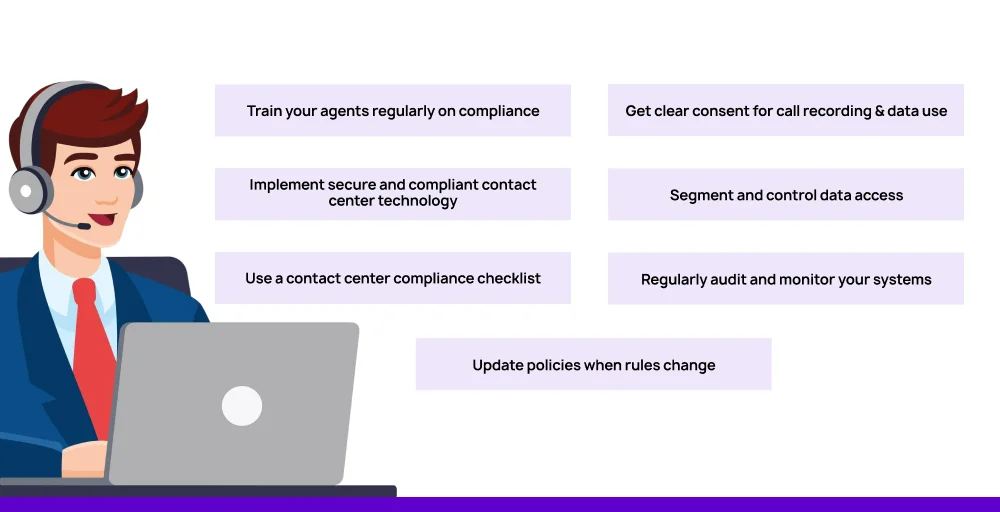
Regardless of the legal implications, protection of customer data, or establishing trust with customers, your contact center should adopt robust compliance practices.
Whether you have a small support team or a large cloud contact center here are some of the important compliance best practices to consider for your contact center:
1. Train your agents regularly on compliance
Ignorance stands as the biggest threat to any contact center’s business. Your representatives must be familiar with regulations like HIPAA, TCPA, PCI DSS, as well as call center compliance requirements. They should be trained on a continuous basis to understand how to handle sensitive information.
Additionally, call center agents must be trained to obtain consent from customers to communicate.
Training must also incorporate procedures for handling call recordings, outbound calls, and handling personal data securely.
2. Implement secure and compliant contact center technology
Your contact center technology is a significant aspect of being compliant. Implement tools that offer data encryption, secure storage, role-based access, and call center compliance monitoring. Verify that vendors meet or exceed standards for PCI DSS, GDPR, and HIPAA.
Choosing the right call center software assures you can track, record, and deal with calls without infringing on customer privacy or breaking regulations.
3. Use a contact center compliance checklist
Keeping a contact center compliance checklist means that you are abiding by all the regulations your company is required to comply with. This should include practices like gaining permission, avoiding the Do Not Call Registry list, performing proper disclosures, and handling data securely.
The checklist also helps agents behave consistently and helps managers review the compliance department or location.
4. Get clear consent for call recording and data use
Always get and document customer consent to record a call, collect personal data, or send follow-up messages. This is most critical for GDPR, TCPA, and even some call center PCI compliance rules.
Your agents must notify customers when a call is being recorded, why they’re collecting their information, and how it will be used.
5. Segment and control data access
Not every employee needs to view all customer information. Limit access to personal customer information by job functions. This is crucial under HIPAA and PCI DSS directives, which require contact compliance centers to be adequately staffed with internal security.
Using features like access control and audit trails in your call center software ensures that only authorized staff can access or change personal details.
6. Regularly audit and monitor your systems
Don’t wait for a problem to arise. Implement ongoing call center compliance monitoring to make sure calls, messages, and procedures adhere to rules. Observe the way agents interact with customers and listen to call recordings to ensure best practices are being followed.
Automatic warnings or reports can alert you to infractions early on so that you can take corrective actions before they incur fines or damage your reputation.
7. Update policies when rules change
Regulations like GDPR, TCPA, or TSR can change, and your contact center policies must be updated accordingly. Appoint a compliance officer or lawyer to keep track of changes. Post-change, update your contact center compliance checklist, retrain staff, and adjust workflows if required.
Stay on top enables your contact center to avoid unintentional noncompliance and proves to customers you care about data protection.
Ensure call center compliance with the KrispCall secure system
It’s easy to ensure your call center remains compliant with KrispCall’s secure contact center platform. Built with compliance in mind, KrispCall supports major regulations like HIPAA, PCI DSS, GDPR, and TCPA, helping keep your business secure without extra hassle. Some of the compliance features of the KrispCall secure system include:
- Data encryption & secure infrastructure: All voice and messaging data is encrypted in transit (using TLS and VPN) and encrypted at rest with enterprise‑grade methods.
- Role-based access control: Every agent gets a unique account with defined access roles, limiting rights strictly to what’s necessary for their job.
- Transparency & client oversight: Clients can audit KrispCall’s data practices, once per year (or more if mandated by law), using third-party auditors if needed.
- HIPAA compliance & health data protection: KrispCall supports HIPAA and PHIPA healthcare providers can sign Business Associate Agreements (BAAs) to handle ePHI securely.