


Contact centers work as a central hub for businesses, handling calls, chats, emails, and even social media. So, they must be advanced, flexible, and secure. And the foundation that makes it possible is contact center architecture.
The design, technology, and processes behind call center architecture determine how efficiently your team can respond, how easily data flows, and how quickly insights turn into action.
In this guide, we’ll explore the definition of cloud contact center architecture, how customer data flows through a modern contact center, the essential tools that power it, and best practices for optimizing performance.
✨ Key Takeaways
- Contact center architecture combines software, hardware, and network systems to manage and streamline customer interactions across multiple channels.
- Modern contact centers rely on analytics, dashboards, speech analysis, and AI-driven insights to optimize performance and make data-driven decisions.
- Omnichannel support ensures customers can interact through voice, email, chat, SMS, or social media while maintaining a unified experience.
What is contact center architecture?
Contact center architecture is an integrated framework of software, hardware, and network components that enables the contact center to manage customer interactions across multiple channels. It defines how data flows across systems and integrates with tools like CRM and workforce management platforms.
Leveraging this integration capability, contact centers can effectively utilize all their available resources for maximum efficiency and cost savings.
A well-designed contact center solution architecture helps organizations deliver exceptional customer experiences by enabling faster resolutions, improved personalization, and seamless interactions across all channels.
The flow of customer data through a modern contact center
At first glance, updating customer records might look simple, but behind the scenes, a complex system is at work.
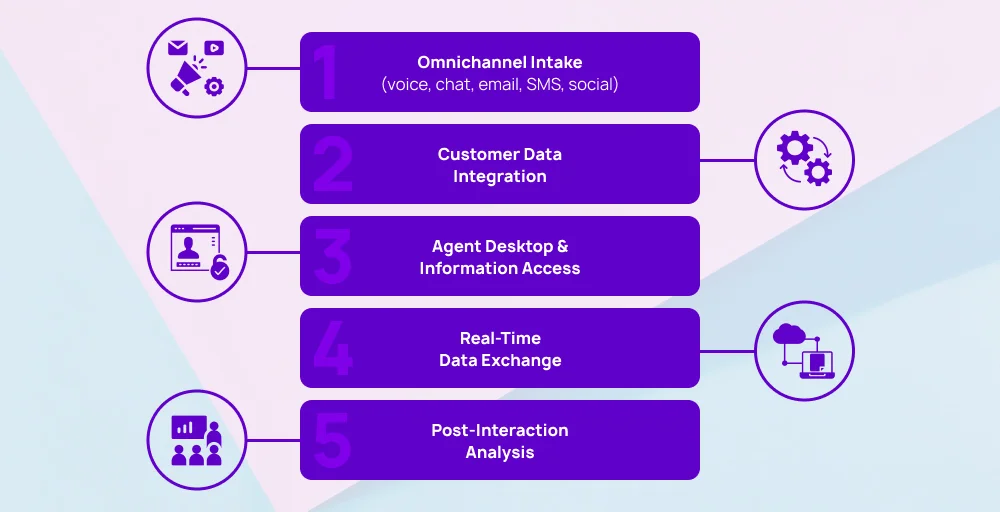
Customer data flows through a dynamic system that integrates various channels and data sources, which involves collecting, analyzing, and utilizing data to personalize interactions and improve efficiency.
1. Omnichannel intake
Customer expectations are increasing, and they expect support through whichever channel is convenient for them, whether it’s:
- Voice calls
- Live chat
- SMS
- Social media
The capability to manage all communications channels under one system is what defines omnichannel support.
In cloud contact-center, CCaaS (Contact Center as a Service) solutions are built around this principle. It routes every interaction to the right destination by applying business rules such as urgency, issue type, or customer priority.
Behind the scenes, the process isn’t random. Everything goes through an automated workflow, combined with agent skill mapping and resource planning. Two critical mechanisms drive this process: skill-based routing, which aligns queries with agent expertise, and workforce management, which ensures proper staffing levels.
2. Customer data integration
Customer data integrations bridge customer relationship management (CRM) and computer telephony integration (CTI) to give agents a single, unified view of customer information. The process begins when an agent answers a call or responds to a web chat. The contact center then immediately triggers an API request to extract customer data from the integrated platform, mostly CRM.
These two CTI and CRM integrations enable agents to view customer records, including name, phone number, and email addresses. Beyond basic caller details, call center agents can also view additional context like previous interactions, issues, and purchase history.
3. Agent desktop & information access
When the agent receives a call, they need the caller’s details to provide personalized support. With relevant details like account information, previous interactions, complaints, and service history, agents can make informed decisions and provide personalized support.
Modern contact center platforms support this by combining intuitive interfaces with fast information retrieval (from internal databases of integrated third-party systems).
The result? Smooth interaction and excellent customer experience.
Additionally, the unified access isn’t limited to frontline agents. It extends to collaboration with non-contact center staff, such as subject matter experts and product managers. That means, when a customer issue requires more profound technical expertise, agents can seamlessly involve back-end teams without disrupting the flow of support.
4. Real-time data exchange
Modern contact centers and other integrated systems (CRMs, CTI, ticketing platforms, and analytics tools) seamlessly exchange customer data in real-time.
From the moment a customer initiates contact, data flows through integrated platforms to create a unified view of the interaction. For instance, support tickets can be instantly connected to related email threads, giving agents a full context of the customer’s issue.
Likewise, call notes from previous interactions can be connected with current call logs, providing a holistic picture of the customer’s experience.
5. Post-Interaction Analysis
When customer interaction is completed, it is stored for post-interaction analysis. Using call center analytics tools, managers can gain insights from this data, enabling them to evaluate agent performance, identify areas for improvement, and spot trends.
These insights help to improve call center operations, maintain high standards of quality assurance, and ensure compliance with industry regulations.
Essential tools in a contact center architecture
Smooth contact center operations require essential tools. From call management to staff alignment, these features ensure that every aspect of the contact center runs efficiently.

Here are the vital tools in a contact center architecture:
1. Automatic call distribution
Automatic call distribution (ACD) intelligently routes incoming calls to the most appropriate agent or department based on predefined rules (skill set, current workload, and call type).
For example, when a customer calls a larger electronics store asking about a specific model of a washing machine, an ACD system can detect relevant keywords of IVR inputs and route the call to an agent trained to handle the appliance.
This means the customer gets expert advice immediately, without unnecessary transfers or wait times.
2. Interactive Voice Response (IVR)
IVR leverages pre-recorded menus and caller input to direct calls to the correct department. When a customer calls a business, the IVR answers automatically and presents options such as “Press 1 for support, Press 2 for sales, Press 3 for billing.” As per the caller’s input, the call is routed to the right agent.
3. Computer telephony integration (CTI)
Computer telephony integration connects phone systems with computer applications that allow agents to access important customer information the moment a call arrives.
Agents can view details like account information, previous interaction, and contact history right on their screen. With CTI, call center agents can handle interactions more efficiently.
4. Workforce management (WFM)
Workforce management forecasts call volumes, helps agent scheduling, and ensures enough agents are available to meet customer demand. Proper WFM directly impacts both customer experience and agent satisfaction.
If staffing doesn’t align with incoming inquiries, customers may face long hold times or inconsistent service, while gents can experience stress and burnout.
5. AI & automation
Modern contact centers are increasingly powered by AI and automation using tools like chatbots and virtual assistants to handle routine inquiries and support tasks. These technologies can respond instantly to common questions, provide self-service options, and even guide customers through processes like password resets or order tracking.
For example, a customer asking about store hours or shipping status can receive instant answers from a chatbot.
6. Quality assurance & monitoring
Quality assurance in a contact center monitors agent interactions to meet established quality standards. Using technologies like speech analytics, natural language processing (NLP), and machine learning, these systems can assess agent tone and check for adherence to scripts.
In addition, it also flags interactions where a customer might be dissatisfied based on their language or sentiment.
How contact centers use data to improve performance?
Contact centers rely on advanced reporting and analytics to transform raw interaction data into actionable insights.
Through real-time dashboards, managers monitor queues, agent activity, and service levels to make immediate adjustments and maintain smooth operations.
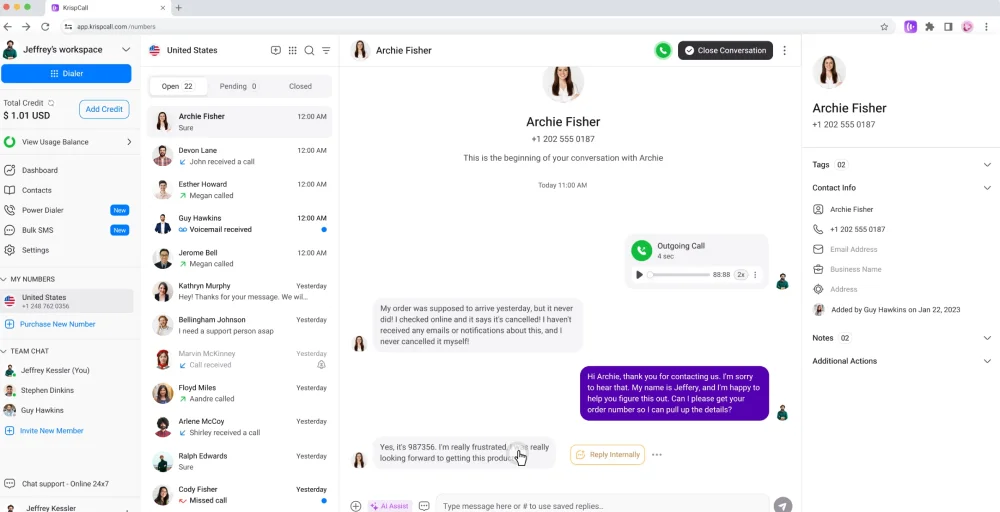
Here are four reporting capabilities every top-tier contact center platform should deliver.
1. Comprehensive performance reporting
Performance reporting gives managers a clear view of key call center metrics such as call volume, average handle time, agent productivity, customer satisfaction, and first call resolution (FCR). Every call and chat is analyzed and converted into actionable data points like call duration, response speed, and customer effort.
2. Intuitive dashboard
Dashboard simplifies complex data by presenting key metrics like net promoter score (NPS), customer satisfaction, FCR, and agent utilization in a clear, visual format. With customizable views tailored to business priorities, dashboards highlight the most relevant data, enabling faster, data-driven decisions.
3. Speech analytics & sentiment analysis
Speech analytics, also known as voice analytics, converts customer conversations into meaningful insights by detecting keywords, emotions, and recurring patterns. This allows managers to quickly identify sentiment, whether frustration, satisfaction, or confusion, and take proactive steps to improve the experience.
4. AI-powered predictive insights
AI-driven analytics take reporting a step further by forecasting customer needs, predicting call volumes, and highlighting potential churn risks. With predictive insights, businesses can improve resource planning, personalize customer interactions, and continuously optimize operations. It shifts analytics from reactive reporting to proactive strategy, giving contact centers a competitive edge.
Built-in robustness of modern contact centers
Developing basic contact center software is simple, but creating enterprise-grade contact center solutions demands much more. Top-tier contact centers require advanced security, compliance, and disaster recovery.
These core areas outweigh everything else in importance.
1. Scalability & flexibility
Whether a small or larger enterprise, it’s crucial to invest in a contact center that is flexible and scalable. It must accommodate sudden call volume spikes, support new features, and seamlessly integrate with other business applications.
For example, if your company needs to add 50 agents overnight, the platform should facilitate this without requiring additional hardware, causing service disruptions, or experiencing delays.
For a BPO (Business process outsourcing) contact center, seek agreements that accommodate seasonal surges or unextended staffing adjustments to ensure your contact center remains responsive, efficient, and cost-effective.
2. Security & compliance
With the vast amount of customer data flowing through your contact center, protecting that information is important.
Data privacy is a key part of maintaining trust and staying compliant with regulations. To reduce risks, always check that your contact center provider follows guidelines for standards such as:
- HIPAA: Protects sensitive health information.
- FINRA: Regulates financial communications and recordkeeping.
- GDPR: Ensures personal data privacy for EU customers.
- PCI DSS: Secures payment card information.
Modern contact center platforms include built-in security features, alerts, and prompts that help agents follow best practices and keep business aligned with industry requirements.
3. Disaster recovery & uptime guarantees
Reliability is non-negotiable when you invest a significant budget into contact center software. It must have backup for business continuity during outages or unexpected events to ensure your operations won’t shut down.
If your customers count on consistent support from you, it’s only fair that you can rely on the same level of support from your technology partner.
Leading cloud providers support their services with a 99.999% uptime guarantee.
Take KrispCall as an example, which is designed with enterprise-level reliability in mind, aiming to prevent outages and ensure users never miss critical calls.
Best Practices for Designing a Future-Proof Contact Center Architecture
The contact center is one of the most vital parts of any customer-facing operation, serving as the main hub for customer information, call management, and post-call analysis.
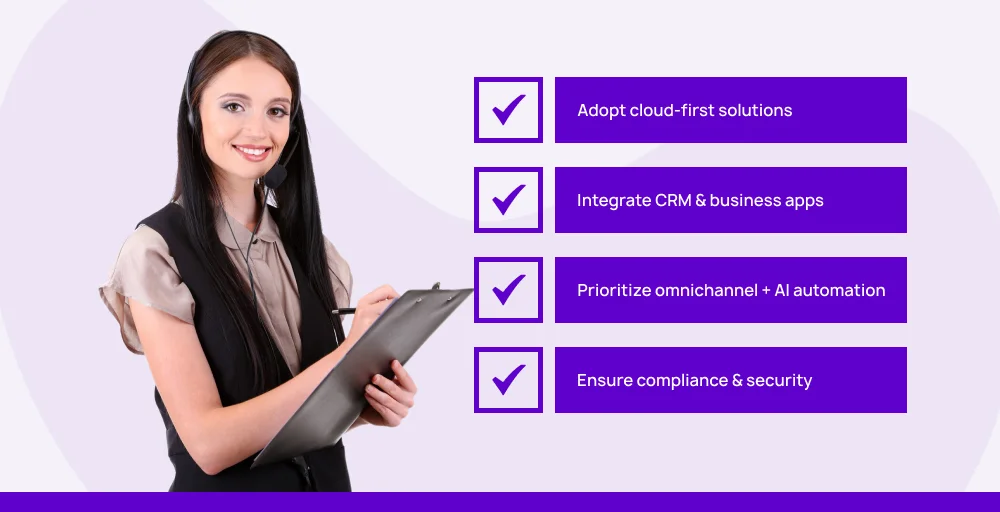
Following best practices for designing a contact center architecture ensures that the system is scalable, resilient, and capable of meeting the evolving needs of the business and its customers.
1. Adopt cloud-first solutions
Traditional systems are no longer sufficient for modern business needs. Moving to cloud-based contact centers allows companies to enhance customer service through advanced call management and analytics capabilities.
Unlike legacy phone systems, you don’t need expensive on-premise hardware. The entire system runs through a network of interconnected data centers, providing on-demand computing resources, such as servers, storage, and network resources, over the internet.
Users can access these systems via the internet using a web browser or softphone app, with virtualization software.
2. Integrate CRM & business apps
Integrating your contact center software with CRM and business applications enables smooth data sharing between them, providing a complete overview of your operations. This integration simplifies workflows, minimizes manual data entry, helps prevent mistakes, and improves customer service.
Agents can view a complete customer’s details, including previous interactions, purchase history, past complaints, and account details. It allows them to deliver personalized service without switching between tools.
Some of the major integrations include helpdesk and ticketing platforms, workforce management (WFM) and quality management (QM) tools, AI and chatbots, and social media & messaging platforms.
3. Prioritize omnichannel + AI automation.
Customers communicate via various channels such as voice, chat, email, SMS, or social media. An omnichannel contact center consolidates all these interactions in a single system, ensuring a smooth experience for both customers and agents.
In addition, AI and automation can manage routine inquiries, direct questions to the appropriate agent, and deliver instant responses, allowing agents to concentrate on more complex issues.
Integrating omnichannel capabilities with AI automation reduces wait times, enhances first-contact resolution, and boosts overall customer satisfaction.
4. Ensure compliance & security
Safeguarding sensitive customer data is crucial for establishing trust and complying with legal obligations.
When customers’ data is not securely stored, businesses lose their trust, which negatively impacts their brand reputation. So, adhering to standards like GDPR, HIPAA, or PCI-DSS, combined with a secure system, role-based access, and encryption, helps to keep the data safe.
Following the rules ensures your organization operates with a secure, compliant infrastructure that protects sensitive information, meets legal requirements, and strengthens customer trust.
KrispCall: The Modern Contact Center Solution
Looking for a cloud-based contact center that scales with your business?
KrispCall combines flexibility, reliability, and enterprise-grade features to keep your teams connected and your customers satisfied.

With a 99.999% uptime guarantee, advanced call routing, and AI-powered analytics, KrispCall ensures your business runs at peak efficiency without interruptions.
KrispCall just doesn’t promise results; it delivers them.
Want to try out? Book a free demo today and learn how KrispCall stands out among other contact centers.