


Long wait times. Repeating information. Getting transferred again and again. These are the top reasons customers lose trust in support services, especially when handling customer inquiries, leading to increased center costs. Nearly 69% of customers prioritize quick responses, and anything less will lead to frustration.
To meet these growing demands, call centers are focusing on implementing AI, along with advanced tools that automate tasks, improve response speed, and support agents during live calls.
In this blog, we’ll explore what an AI call center is, how it works, the key technologies behind it, and best practices for adopting this solution, including agent training to deliver exceptional customer experiences, improve efficiency, and customer satisfaction.
✨ Key Takeaways
- AI call centers use technologies like NLPs, ML, voice recognition, chatbots, and predictive analysis tools to automate routine tasks, improve workflow efficiency, and make customer interaction more personalized.
- When a customer calls an AI call center, the AI system greets the customer, gathers relevant information, and attempts to offer accurate problem resolution through reasoning. For complex issues, it forwards the calls to live agents.
- To make AI call centers more effective, it’s essential to train the AI model using customer data, set clear escalation rules, follow security protocols, and perform regular reviews and maintenance.
- As AI systems continue to evolve, we will likely see call centers with better functionalities such as AI with emotional understanding, generative voice responses, and agentless problem resolutions.
What is an AI call center?
An AI call center uses artificial intelligence to automate tasks, improve workflows, and deliver more personalized customer service across channels like phone calls, emails, and live chat, to make support faster, smarter, and more efficient. It aims to streamline operations, reduce costs, and enhance the overall customer experience by automating simple tasks and providing personalized assistance.
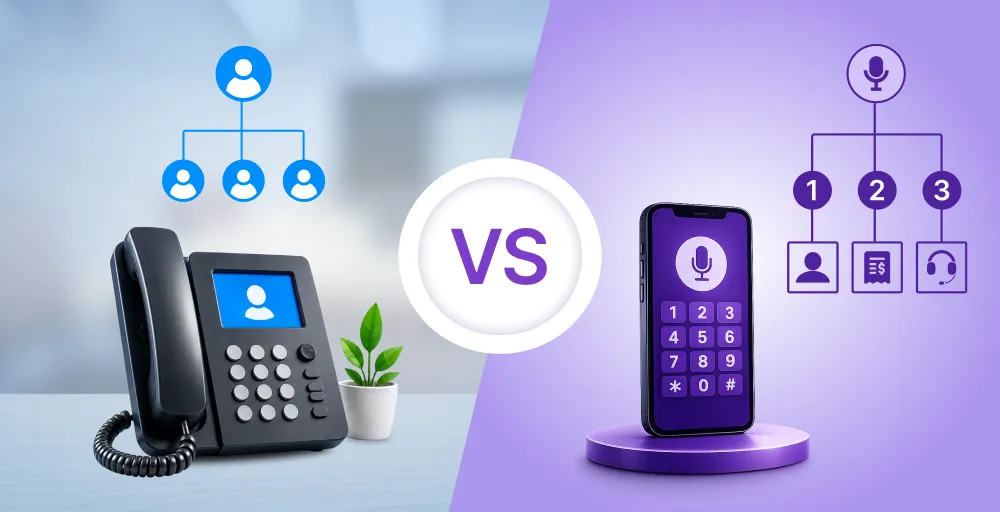
AI in call centers differs from traditional call centers in that they utilize tools such as chatbots, voice bots in customer support, and virtual agents to handle everyday tasks, direct calls more efficiently, and provide personalized assistance.
Traditional call centers, however, depend completely on human agents for all interactions. This can result in longer wait times and inconsistent service.
Technologies used in AI-powered call center software are:
- Natural Language Processing (NLP): This helps AI understand how people talk in real life, so conversations feel more natural and easy.
- Machine learning (ML): The system learns from past experiences. This helps it make better choices, understand what customers need, and connect them to the right person more quickly.
- Voice recognition: Converts spoken words into text, enabling the system to understand and respond.
- Chatbots and virtual assistants: These are smart tools that help answer basic customer questions right away through chat or voice, so customers don’t always need to talk to a real person.
- Predictive analytics: AI analyzes past customer data to predict what someone might need next, helping to solve problems early and offer more personalized assistance.
How do AI call centers work?
AI in call centers makes customer service smoother by using automation and quick decision-making from the moment a customer reaches out to post-call analysis.
1. Customer initiates contact
The process begins when a customer calls the support number or starts a live chat. An AI-powered call center software instantly picks up the interaction, which reduces long wait times for customer queries.
2. AI greets and gathers information
An AI customer service or chatbot welcomes the customer and collects basic details, such as name, account number, and the reason for contact. It uses Natural Language Processing (NLP) to understand the customer’s request naturally.
3. AI verifies and looks up data
The AI connects to internal company tools like CRM or other systems. It finds details like order status, account history, or common questions by analyzing customer profiles. If needed, it verifies the customer’s identity securely.
4. AI attempts resolution automatically
AI handles simple tasks automatically, such as checking order status, updating contact information, or sharing store hours. Customers receive instant answers with real-time guidance when they need to contact an agent.
5. Smart call routing for complex issues
If the problem is complex, the AI uses intelligent call routing to connect the customer with the best available agent. It considers factors like the agent’s skills, language preference, customer history, and even call sentiment.
6. AI assists the human agent
During live calls, AI listens in real time, transcribes the customer conversation, and offers helpful prompts such as relevant knowledge base articles, next-best actions, or compliance reminders.
7. Call analysis and insights
After the interaction, the AI analyzes the call for sentiment, facilitates self-service options, solves unresolved issues, and addresses compliance concerns. It then generates actionable insights and reports that help call center managers improve training and service quality. These insights can also support executive AI training by helping leadership teams better understand customer interactions, operational challenges, and opportunities for strategic improvement.
How are call centers adapting to AI technology?
Call centers are rapidly adopting AI technology to enhance various aspects of their operations, aiming to increase speed, improve service, and achieve greater efficiency in contact center management while also reducing operating costs.
Here’s a breakdown of how call centers are adapting:
1. From manual to automated call center routing
Automate call center workflows with AI systems that now handle call routing by analyzing incoming queries and matching them with the right agent based on skill, availability, and context. This cuts wait times and sends people to the right place faster.
2. Human intervention in human management
Conversational AI tools like chatbots and virtual agents use artificial intelligence to understand customer questions and respond in real time. They handle routine interactions and free up human agents to focus on complex or sensitive issues that need some personal touch.
3. Manual analytics to AI-driven analytics
Instead of manually reviewing a small sample of interactions, AI tools now analyze data from all customer calls, chats, and emails. They deliver real-time insights into trends, customer sentiment, and agent performance. With that, teams can make faster, data-driven decisions.
4. From reactive support to proactive engagement
AI allows call centers to move from reactive problem-solving to proactive customer engagement. AI reviews customer behavior, past interactions, and predictive trends to trigger timely follow-ups, send reminders, or offer accurate solutions before issues appear
5. Manual QA to AI-powered QA
AI automates quality assurance by continuously monitoring all interactions for compliance, tone, and effectiveness. It allows for more consistent evaluations, faster feedback to agents, and proactive improvements to customer experience.
Key features of AI call center solutions
AI call center solutions offer helpful features for both customers and agents. These tools automate and monitor performance of call center tasks, improve conversations, and give real-time coaching.
1. Natural language understanding
One of AI’s most powerful capabilities is understanding human language through Natural Language Processing (NLP), which enables bots or phone menus to interact with users effectively.
As a result, customers can speak naturally with IVR systems or virtual agents. In addition, real-time analysis of customer sentiment makes interactions feel smoother and more human.
2. Sentiment analysis
AI can detect emotional tone in a customer’s voice or message, whether frustrated, satisfied, angry, happy, or neutral. That helps agents respond more effectively, while supervisors can step in to assist agents when customers show signs of upset.
3. Smart call routing
When customers make a call, they must connect with the agent who is most qualified to assist them. AI-powered tools improve call routing by analyzing caller information. They consider previous interactions, the product the caller uses, and demographic details. Then, they identify areas that the best agent to handle the inquiry.
4. Real-time agent assist
The best solutions don’t just serve customers, they assist reps, too. They provide real-time transcription, auto-suggested replies, next-best actions, and relevant knowledge articles during live interaction. It enables customers to respond faster and with greater confidence, thereby improving both efficiency and customer satisfaction.
5. Conversation analytics and learning loop
Conversational AI call center continuously analyzes conversations across all channels to uncover trends, customer pain points, and agent performance metrics. These insights feed back into the system, creating a learning loop that improves future complex interactions, training, and overall service quality.
What are the best practices for implementing an AI call center?
Successfully deploying an AI-powered call center requires thoughtful planning, collaboration, and ongoing evaluation. Here are the key best practices to ensure your AI solutions deliver real value while maintaining trust and agent efficiency through effective quality control.
1. Use real customer data to train AI
Train your AI systems using real-time analytics and non-identifying customer interactions to improve accuracy and relevance in business operations. It helps the AI understand your audience’s language, preferences, and common issues, resulting in more natural and effective responses.

2. You can define clear escalation rules
Not every issue can, or should, be handled by AI. So, set clear rules for when and how the system should escalate conversations to a live agent. It ensures that customers with complex needs are always supported by a human when necessary.
3. Regularly review AI performance
Continuously monitor how your AI is performing across key metrics like resolution rate, customer satisfaction, and error frequency. Use this data to fine-tune responses, expand capabilities, and prevent performance drift over time.
4. Involve human agents in the loop
AI should support, not replace, your human team. Use AI to surface relevant information, suggest next-best actions, and automate repetitive tasks, allowing agents to focus on personalized, high-value service.
5. Ensure data security and compliance
Implement strict data privacy and compliance measures when handling sensitive customer data. Ensure your AI systems comply with industry regulations (such as GDPR or HIPAA) and build customer trust by being transparent about how data is used and protected.
Organizations should also train agents to recognize emerging cybersecurity threats, such as spear-phishing attacks, which increasingly use AI-generated content to impersonate trusted contacts and gain access to sensitive systems or customer information.
For AI call centers that rely on cloud services, Cloud-Native Application Protection Platforms can help monitor and protect APIs, workloads, and data flows across your environment.
What are the future trends in AI call centers?
As AI technology evolves, hybrid call centers are embracing advanced capabilities of contact center AI that are even more personalized, efficient, and emotionally intelligent customer service. Here are some key trends shaping the future:

1. Emotion AI
Emotion AI goes beyond basic sentiment analysis by detecting deeper emotional cues like frustration, sarcasm, or enthusiasm from a caller’s voice or text. It enables more empathetic and responsive interactions, helping agents or AI systems adjust tone and approach in real-time.
2. Generative voice responses
Using advanced generative AI models, future call centers will feature AI that can create natural, human-like voice responses on the fly. These dynamic conversations will sound less robotic and more engaging, improving customer trust and satisfaction.
3. Omnichannel AI assistants
Customers expect consistent support across voice, chat, email, and social platforms. Omnichannel AI assistants will unify these channels, providing seamless transitions and context-aware assistance regardless of how or where the customer reaches out.
4. Agentless call resolution
AI will handle more customer calls without using a human agent, solving simple issues quickly and efficiently. From verifying identity to processing requests and confirming outcomes, agentless systems will reduce costs, shorten resolution times, and deliver faster service, especially for routine tasks.
Related 👉 Call Center Coaching: Definition, Tips & Techniques
Is it time to upgrade to an AI call center?
If your call center faces long wait times, high operational costs, or low customer satisfaction, it’s time to consider AI for customer service. The integration of AI solutions in your call center can help to enhance operational efficiency, improve response time, increase agent productivity, and improve the overall customer experience.
AI helps you scale support, resolve simple issues instantly, and provide agents with real-time assistance. It enables your service agents to adapt to changing customer expectations and offer faster and more personalized support. Whether you start with chatbots or plan a full transformation, by integrating AI in any app or digital solutions, it can future-proof your customer service and ensure long-term success.