

In 2026, AI powered call centers are drastically changing the way businesses used to handle customer support. Instead of replacing human agents, AI call center software allows smart automation tools to work alongside humans. This ensures the service remains fast, reliable, and efficient.
In this blog, we’ll explore how exactly the transformation is taking shape. We’ll dive deep into how AI call centers are evolving, how they assist human agents, the challenges they face, and the impact they have on customer experience.
✨ Key Takeaways
- AI technologies enhance call centers by automating routing tasks and supporting human agents to boost productivity.
- AI call center solutions offer multiple benefits such as better personalization, faster response time, 24/7 availability, and service consistency.
- Despite these advantages, AI cannot show true empathy or understand the customer’s emotions, and is difficult to implement, raising data handling concerns.
- Both AI agents and human agents each have their strengths and weaknesses, but the real advantage comes from combining them.
How are AI call centers emerging?
AI in call centers has come a long way, moving from a “nice-to-have” option to being a fundamental component in business communication. What started as a simple chatbot tool capable of processing basic keywords and scripted commands has evolved into a comprehensive tool that can now handle customer calls autonomously.

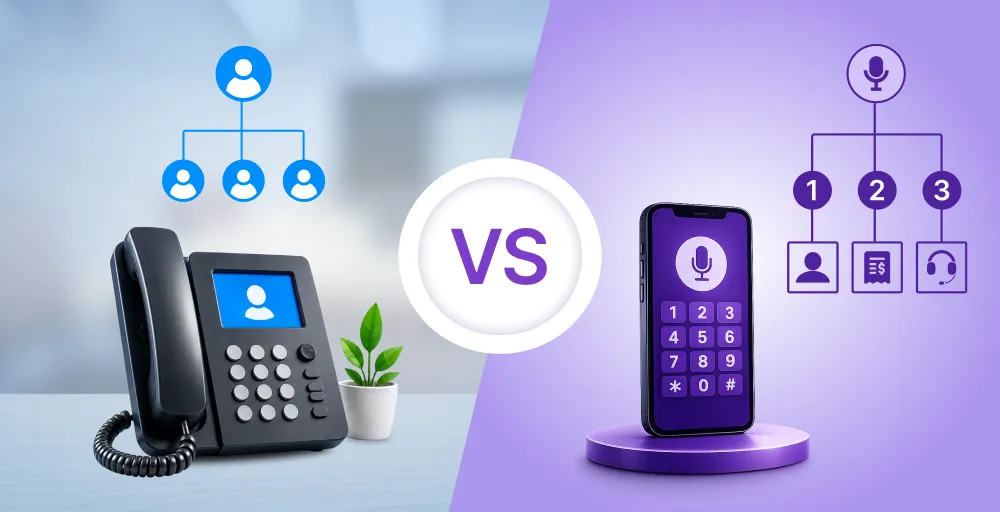
For instance, AI systems analyze incoming calls to route each call to the most suitable agent (based on interaction history, customer data, and skillsets). This minimizes waiting times and allows for faster problem resolution. All thanks to the advancements of modern technologies, machine learning, and language processing models.
Here, virtual agents, also referred to as conversational AI, play a big role in driving customer service automation in AI call centers. They can accurately process the caller’s speech and deliver real-time responses to their queries.
The role of AI voice agents in call centers
AI voice agents in call centers mainly help to improve customer interaction and operational efficiency. They can analyze human speech, deliver personalized responses, and automate routine call management tasks.
Let’s look at some capabilities of an AI-powered voice assistant.
1. Natural language understanding (NLU)
AI voice call center agents go beyond just simple speech recognition. They use advanced Natural Language Understanding (NLU) to understand the customer’s intent. Here, the NLU is responsible for analyzing and converting customers’ spoken words into structured data. This data helps the system identify the customer’s needs, intent, context, and understand their emotions.
Afterwards, the system works together with Natural Language Generation (NLG) and Text-to-Speech (TTS) to respond in a natural human-sounding tone
2. Personalization
For better customer satisfaction and loyalty, it is essential to deliver personalized services. In fact, a study from Zendesk even reports that more than 60% of consumers now expect better personalized service with AI.
AI voice agents can better utilize contextual information from customer data, past interaction history, and purchase history to provide more effective and personalized responses. This allows the virtual agent to create a highly personalized experience for every customer.
3. Multi-language support
Another major highlight of AI voice agents is their advanced linguistic capabilities. Unlike traditional call centers, AI agents can easily understand every language, slang, idiom, accent, etc. This helps to break down communication barriers, allowing businesses to communicate with customers across the globe.
4. Decision-making capabilities
AI virtual agents are also capable of making decisions independently, thereby helping human agents to improve their productivity. The system’s decision process is multi-staged and complex. It involves analyzing relevant data, using machine learning and other reasoning models to determine the best course of action, based on the business’s priorities.
Although AI agents cannot reason like “human experts,” their data-driven decision-making capability allows them to make routine decisions much faster than humans.
5. Third-party integrations
Modern businesses rely on numerous SaaS applications and business tools (such as CRMs, helpdesk platforms, analytics tools, and payment gateways) for their day-to-day operations. AI-powered virtual agents can seamlessly integrate with these existing systems to access relevant information and deliver faster and accurate problem resolution.
AI vs. human agents: Enhancing or replacing?
The discussion around AI and call centers is not about which is better, but about understanding what they can bring to the table together and form a customer service strategy based on it. AI offers speed, efficiency, and accuracy that humans often struggle with, while humans have empathy, compassion, and creativity that AI cannot replicate.
Here are some scenarios that show the expertise of both.
Where AI agents excel
- AI can process and analyze huge volumes of customer data much faster than humans. This makes it easier to accurately find inconsistencies, errors, and gain insight.
- AI agents can automate routine tasks and handle high-volume workloads efficiently and consistently.
- Unlike humans, AI call center agents are capable of working continuously, providing 24/7 customer support.
- Virtual agents have multilingual capabilities, allowing them to communicate with customers in their preferred language.
Where human agents excel
- Compared to AI agents, human support agents are better at handling complex issues that require creative thinking and out-of-the-box solutions.
- Humans have stronger interpersonal skills compared to AI robots. This helps to make communication more impactful and personal, leading to stronger customer relationships.
- Unlike AI agents, humans can show empathy and compassion. They can better understand customer emotions and frustrations.
- Humans are able to quickly adapt to new situations, respond to unique customer requests, and make moral judgments in ways AI systems cannot.
The impact of AI call centers on customer support and experience
With AI call centers, businesses can respond quickly, offer 24/7 support, and make every interaction consistent and personalized. Zendesk even suggests that AI chatbots in call centers can handle up to 80% of routine customer queries independently.

It’s certain that with this popularity and the rapid technological advancements, AI call center companies will continue to evolve, helping businesses improve their service quality and deliver better customer experience.
That being said, here are some of the positive AI impact on call centers:
1. Faster response times
Conversational AI call centers are equipped with all the tools and features that help to efficiently handle large volumes of phone calls. For instance, AI chatbots or virtual agents can reduce waiting times through quick response and assistance (whether it is by providing problem resolution or routing calls to live agents).
2. 24/7 Availability
Virtual agents are capable of providing customer support around the clock. This availability ensures customers can reach out anytime for assistance. Not only does this improve their experience and satisfaction, but it also helps to lower the call center’s operational costs.
3. Personalized interactions
AI systems can process large volumes of customer data (including their interaction history, purchase logs, behavior patterns, etc) and build unique customer personas or profiles. With this complete profile, virtual agents can deliver highly personalized service tailored to each customer’s preferences.
4. Consistency in service
As AI systems have access to all customer data, they can ensure consistency across all touchpoints. Unlike humans, AI systems are preprogrammed to follow pre-defined workflows and service standards, avoiding inconsistencies and errors. As a result, customers will always receive accurate and clear information regardless of the communication channel.
5. Improved self-service options
AI call centers can also enhance a business’s self-service capabilities. With Interactive Voice Response (IVR) systems, knowledge bases, and AI chat assistants, customers can quickly find answers or resolve issues on their own. This reduces the workload on human agents, prevents burnout, and improves their productivity.
Challenges and limitations of AI call centers
Although there are multiple benefits of AI call centers, there are also a few challenges and drawbacks that you should be aware of. It helps you to anticipate potential issues and resolve them proactively.
1. Emotional intelligence
Among the various drawbacks of AI in customer service, the most notable one is its lack of emotional intelligence. While AI systems offer accurate results and enhance efficiency, they aren’t fully capable of understanding human emotions and their frustrations (a much important aspect in customer satisfaction).
This lack of empathy, compassion, and interpersonal communication makes it more challenging for the AI agents to build a stronger relationship with the customer.
2. Data privacy concerns
AI call centers rely on accurate customer data to provide effective and personalized service. But as an autonomous system is collecting, storing, and managing customers’ sensitive information, it raises serious privacy and security concerns. This means that any data breaches or leaks can be subject to legal action, along with damage to reputation and trust.
3. Implementation challenge
Despite the efficiency of AI systems, when it comes to integrating them with your current system, it is not simple. The adoption process is complex and resource-intensive. E.g., employees and agents require specialized training to ensure the AI system works smoothly alongside them.
Moreover, AI call centers also require continuous monitoring and timely maintenance to ensure the system is running optimally. This can often be costly and time-consuming.
The future of call centers with AI
With the rising adoption and evolution of AI technologies, it’s safe to say that it will change the future of all call centers. AI tools are valuable not only for improving the call center workflow efficiency but also for working alongside human agents to boost their productivity.
In practical terms, AI systems will become increasingly efficient at handling routine tasks autonomously (such as call routing, data entry, and simple customer queries). This helps the live agents to focus on more complex issues and build customer relationships.
Moreover, as AI call center technology continues to develop, it will get better at predicting customer needs through data-driven insights. Additionally, it will be able to handle multiple tasks simultaneously, tackle complex queries independently, and assist live agents to provide faster, better personalized service.