

Customer service is no longer a binary choice between chatting with an AI chatbot and waiting on hold for a real person. The smartest support teams are blending both, using AI tools to absorb repetitive, high-volume work while preserving the human connection that customers still expect from live customer service agents.
The challenge isn’t whether to adopt artificial intelligence (AI), but knowing exactly where the line sits: which customer queries are safe to hand to an AI system, and which ones demand a real person on the other end.
Get that balance wrong, and you either burn budget on human support agents doing robotic work, or you erode customer trust by forcing empathy-needing conversations through an AI bot.
This guide breaks down where AI earns its keep, where human insights remain irreplaceable, and how to build a decision framework that finds the right balance for every interaction, every time.
✨ Key Takeaways
- AI helps; it doesn’t replace human agents. Many assume artificial intelligence exists to eliminate customer service roles. In practice, it lets human support agents focus on more important tasks by handling basic inquiries and high-volume requests.
- There are two types of AI that matter. Autonomous AI handles basic tasks directly, like resetting passwords and answering customer questions. Assistive AI works behind the scenes to help human agents respond quicker and with better data-driven insights.
- AI is good at handling simple, repeatable customer queries: basic inquiries, covering after-hours, initial problem checking, sending reminders, and logging customer messages automatically in customer systems.
- Humans are still needed for: sensitive calls, solving complex problems, discussions that need to follow rules, keeping customers from leaving, or managing high-value interactions.
What “AI Customer Service” Actually Means in 2026 (and What It Doesn’t)
AI customer service isn’t just chatbots. It is the full ecosystem of intelligent technologies, including machine learning, natural language processing (NLP), predictive analytics, and automated workflows, designed to streamline service delivery, hyper-personalize, and resolve customer problems across every touchpoint.
It spans conversational voice bots, AI-assisted human agents offering real-time suggestions and sentiment analysis, intelligent IVR call routing, automated post-call summaries, and predictive escalation that helps teams analyze customer data at scale.
To understand its role, you have to distinguish between AI systems that replace human interaction and AI that augments it:
| Feature | Autonomous AI (Replaces) | Assistive AI (Augments) |
| Primary Goal | Direct resolution without human intervention | Speed, context, and empathy enhancement for human reps |
| Where It Lives | On the frontline (web portals, messaging apps, voice channels) | Behind the scenes (agent desktops, CRM sidebars, post-call summaries) |
| Best Used For | High-volume, predictable, transactional tasks | Complex, high-stakes, emotional, or multi-step issues |
The most common mistake leaders make is assuming AI customer service is designed to eliminate support reps. It doesn’t. AI doesn’t replace your workforce; it redeploys it strategically. By letting automated systems absorb high-volume, low-friction tickets, human representatives are freed to handle nuanced, high-stakes, or sensitive issues where empathy and reak problem solving skills matter most.
For example, when a high-value customer calls with a complex billing dispute, modern setups use smart AI call routing and dynamic multi-level IVR systems to instantly bypass basic queues and connect them directly to the most qualified live customer service agents. AI clears the administrative noise so your team can deliver high-touch service where it drives the greatest impact on customer loyalty.
Where AI Wins — Interaction Types Built for Automation
Autonomous AI doesn’t need to handle every customer scenario to deliver massive ROI; they excel at lifting service quality by streamlining specific interactions. They transform service delivery by handling basic tasks instantly, capturing critical intent, and passing contextual data directly to human teams when complex scenarios arise

Here are the key interaction types where AI delivers immediate impact:
- High-volume, low-complexity queries: Autonomous agents and chatbots handle FAQs, password resets, and basic account lookups instantly, using contact-center platforms like Amazon Connect to manage the routing.
- After-hours and overflow coverage: 24/7 AI conversational agents or AI voice bots capture and resolve off-peak requests through self-service options, reducing wait times and improving customer satisfaction score (CSAT).
- First-touch triage and intent capture: AI reads incoming customer messages and acts as an automated virtual receptionist or triage agent, asking qualifying questions, detecting tone and urgency, and routing the ticket to the most qualified human team.
- Proactive outbound notifications: AI triggers automated, transactional alerts such as appointment reminders, service outage updates, and delivery delays directly over SMS, email, or WhatsApp.
- Post-call summaries and CRM logging: Instead of requiring agents to spend time on manual After Call Work (ACW), AI automatically transcribes the conversation, logs structured data, and pushes summaries into CRM platforms like HubSpot or Salesforce.
Where Humans Are Irreplaceable — And Why AI Falls Short
While automation excels in speed and scale, it reaches a hard limit the moment a conversation requires human empathy and a genuine personal connection, reading between the lines, weighing competing interests, sensing what a policy doesn’t cover. AI processes data; it cannot feel urgency, navigate non-linear problems, or build authentic trust.
So, when high-stakes, nuanced, or deeply personal interactions are required, human expertise remains irreplaceable for establishing genuine trust and rapport. Here is why AI falls short in specific, high-touch human domains:
1. Emotionally charged or high-stakes calls
Cancellations, billing errors leading to financial loss, or urgent medical and insurance concerns require more than automated efficiency. While AI can run sentiment analysis to flag negative emotions, it cannot respond with authentic empathy. A customer who feels misunderstood or processed by a bot will simply churn. Humans provide the active listening and emotional validation needed to de-escalate tension.
2. Complex, multi-system problem resolution
Consider B2B SaaS support tickets that span billing, user onboarding, and technical API configurations simultaneously. These non-linear problems rarely fit neatly into a decision tree. Human reps bring lateral thinking and contextual judgment to connect disparate data points across systems and resolve ambiguous customer problems.
3. Compliance and regulated conversations
In healthcare, legal and financial services, strict regulatory frameworks dictate how data is handled and what advice can be given. Specific disclosures, legal verifications, and financial guidance must come from an accountable human professional. Relying on AI in a heavily regulated environment exposes organizations to significant legal risks if an algorithm hallucinates or misinterprets policy. A human-first approach to disclosure keeps organizations accountable even as AI tools assist behind the scenes.
4. Retention and escalation calls
A customer threatening to leave is a critical revenue event. Saving the relationship requires real-time persuasion, strategic flexibility, and the authority to make tailored concessions that AI cannot execute reliably. When an interaction turns sensitive, supervisors rely on call monitoring and live call barge-in to step into the conversation seamlessly and protect customer loyalty.
5. Relationship-building in enterprise accounts
High-LTV enterprise clients expect dedicated account managers and a personalized experience. Deploying AI as the primary touchpoint for enterprise accounts signals that businesses view them as a ticket to close rather than a valued partner. Using intelligent call transfer features ensures these high-priority clients bypass automated queues and receive personalized solutions from their designated human context every time.
AI vs. Human Customer Service — Side-by-Side Comparison
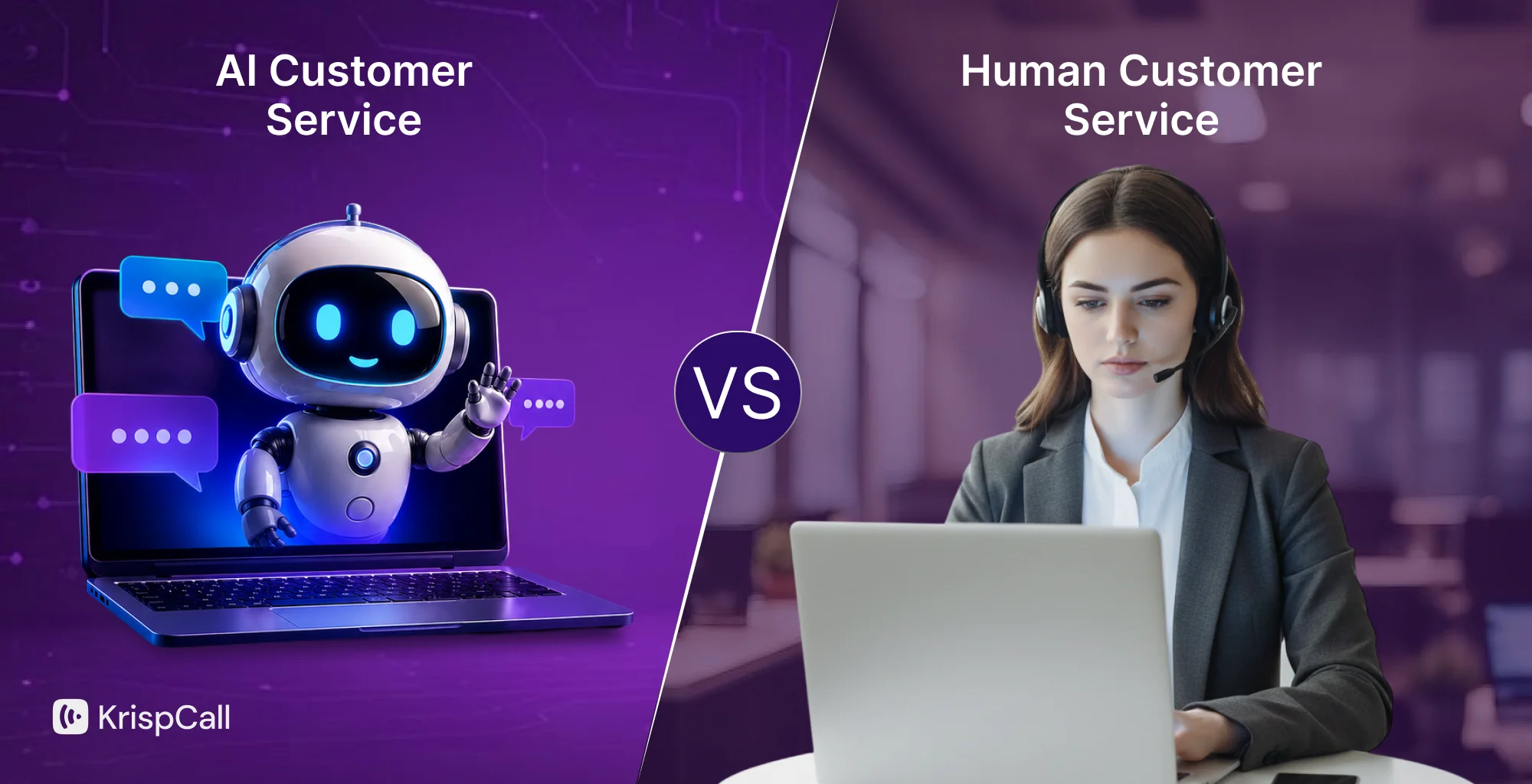
AI handles high-volume, repetitive tasks instantly and cost-effectively, while human agents excel in empathy, complex problem-solving, and emotional intelligence. Businesses that learn to leverage AI well tend to see gains in both service quality and cost efficiency.

A detailed side-by-side comparison of AI vs. human customer service is:
| Dimension | AI | Human Agent |
| Availability | Operates 24/7/365 with no wait times, fatigue, or staffing gaps | Restricted by schedules and shifts |
| Response Speed | Instant for basic queries; slower once escalated | Needs time for detailed, more thorough explanations |
| Empathy | Analytical, struggles with emotions | Capable of deep empathy and rapport |
| Consistency | Adheres to brand guidelines | Prone to human error and mood fluctuations |
| Complex Resolution | Struggles with nuanced issues | Excels in creative problem-solving |
| Cost at Scale | Highly scalable with predictable costs | Higher per-interaction operational costs |
| Escalation Handling | Can route or flag automatically | Skilled in de-escalating issues |
| Personalization | Personalized based on customer data | Adapts tone and solutions dynamically |
| Compliance Accountability | Follows programmed rules consistently, but can’t exercise judgment on novel regulatory questions | Accountable for decisions, can request legal/compliance sign-off, but may occasionally miss disclosures under time pressure |
| Learning/Adaptation | Adapts through machine learning and feedback | Learns via training and peer interactions |
Neither AI nor human customer service is universally better; each excels in different areas depending on customer preferences. AI offers speed, consistency, and scalability for repetitive tasks, while human agents bring empathy and critical thinking for complex issues. Ideally coordinated through a unified platform so no context gets lost in the handoff.
The best support strategies leverage both: AI manages routine inquiries quickly and escalates more complicated matters to humans when needed.
Rather than replacing human support, AI enhances it by automating repetitive work, reducing response times, and allowing agents to focus on meaningful interactions that boost customer satisfaction and loyalty.
The Decision Framework — How to Route Interactions Correctly
Most organizations fail at AI implementation because they route calls based on department rather than context. To build an efficient setup, every interaction must pass through a strict routing logic before touching an agent or a bot.
Before assigning any customer touchpoint to AI or a human, run it through this four-question decision model:
1. Is this interaction structured and repeatable?
If the answer is yes, checking office hours, verifying an account balance, or resetting a password, route these basic tasks directly to AI chatbot.
2. Does it require emotional judgment or relationship context?
If a call involves an upset account holder or an enterprise client whose customer needs go beyond a script, send it straight to a real human.
3. What is the cost of a wrong answer?
If an error leads to regulatory fines, lost revenue, or customer churn, keep AI out of the driver’s seat.
4. Is the customer frustrated or escalating?
If tension is detected, even midway through an automated flow, escalate complex cases immediately and handle the call to a human.
Put the framework into practice on three immediate steps:
- Audit Your Top 10 Ticket Types: Review your highest-volume support calls over the past 90 days and analyze group tickets by repeatability and risk level. Shift the bottom 20%, the simple, repetitive queries, to self-service voice AI first.
- Set Strict Escalation Rules: Configure your VoIP system with zero-friction escape hatches. If a customer repeats “agent” or shows rising sentiment frustration, route them to a human instantly without repeating questions.
- Equip Agents with Assistive Context: Ensure that when an AI handoff happens, the receiving human agent gets live call transcriptions, sentiment tags, and account history on screen so the caller never has to repeat themselves and agents can add human insights exactly where it’s needed.
What a Best-Practice AI + Human Support Stack Looks Like
The most effective customer support strategy isn’t AI-only or human-only; it’s AI-human collaboration, or you can say a hybrid model where both work together. AI takes care of repetitive, high-volume interactions, while human agents step in for conversations that require empathy, critical thinking, or complex decision-making.
A best-practice AI + human support stack combines automation, live support, CRM integration, analytics, and continuous optimization into a single workflow. Each layer has a specific role, ensuring customers receive fast assistance while agents have the tools and context needed to resolve more challenging issues.
A high-performing support stack connects AI and human capabilities across three distinct phases of every customer interaction:
Layer 1: Before the Call (Intake & Triage)
This layer sets the stage before a human ever says “hello,” filtering noise and establishing context.
- AI Triage: Speech recognition and conversational AI greet callers instantly, filtering out spam or routine queries without occupying queue capacity.
- Intent Capture: Rather than forcing callers through rigid menu options, natural language processing identifies why the customer is calling in their own words.
- Intelligent Queue Management: Using intent and caller ID, smart call routing instantly maps callers to the right agent tier, ensuring high-priority accounts bypass standard wait times.
Layer 2: During the Call (Live Co-Pilot & Supervision)
This layer operates in real time while the customer and agent are actively speaking.
- Real-Time Agent Assist: AI listens to the live conversation and surfaces relevant knowledge base articles, policy guides, or troubleshooting steps directly on the agent’s screen.
- Sentiment Monitoring: Real-time speech analysis monitors voice pitch and phrasing, flagging escalating frustration so reps can adjust their tone immediately.
- Live Escalation Support: Team managers use call monitoring, whispering, and supervisor barge-in to coach agents quietly in their ear or jump directly onto the line during high-risk calls.
Layer 3: After the Call (Automated Workflows)
This layer automates administrative tasks the second the line disconnects, eliminating tedious manual entry.
- Automated Call Summaries: AI listens to the recording and generates concise notes, key takeaways, and action items in seconds.
- Instant CRM Sync: The system automatically logs the call transcript, duration, sentiment score, and AI summary directly into the customer’s profile in Salesforce, HubSpot, or Zendesk.
- Targeted CSAT Triggers: Based on call outcomes and sentiment scores, automated workflows trigger targeted follow-up surveys via SMS or email to measure satisfaction while the interaction is fresh.
Conclusion
AI and human agents aren’t competitors in customer service, they’re teammates with different strengths. AI brings speed, consistency, and round-the-clock availability to the routine, predictable parts of support. Humans bring empathy, judgment, and the ability to navigate ambiguity when things get complicated or emotionally charged.
The organizations that win aren’t the ones that automate the most or the ones that keep everything human, they’re the ones that route each interaction to whichever side of that equation handles it best.
Start by auditing your highest-volume ticket types, build clear escalation triggers, and make sure every AI-to-human handoff carries full context so customers never have to repeat themselves. Do that well, and you get the best of both worlds: fast, scalable service that never loses its human touch when it matters most.