


Voice over Internet Protocol (VoIP) systems have become a core component of modern communication infrastructure, powering everything from internal business calls to customer service operations. However, as the adoption of VoIP systems grows, so do the risks.
VoIP platforms are increasingly targeted by cybercriminals aiming to disrupt services, steal data, or exploit vulnerabilities for financial gain.
This blog will cover what VoIP hacking is, the most common types of VoIP attacks, help you identify the warning signs, and offer practical strategies to strengthen your VoIP security.
✨ Key Takeaways
- In VoIP hacking, hackers gain unauthorized access to your VoIP system, exploit its vulnerabilities, and misuse sensitive information.
- Hackers employ tactics such as eavesdropping, spoofing, phishing, and DDoS attacks to disrupt your business operations.
- Securing your VoIP setup requires strong password, updated software, limited admin access, VPN use, and a trusted VoIP provider.
What is VoIP hacking?
VoIP hacking is a type of cyberattack in which the cybercriminal targets your internet-based business phone system to gain unauthorized access, or disrupt services. Once inside, hackers can then eavesdrop on live conversations, steal sensitive business or customer data, and make fraudulent local and international calls using your account.
VoIP hackers usually target VoIP systems to:
- Intercept and eavesdrop on calls.
- Extract confidential customer details (like phone number, emails, and payment info).
- Make unauthorized local and international calls at your expense.
- Use your VoIP phone system as a means to access other parts of your network.
📄 Case in point: In 2019, California-based VoIP provider – VoiPo exposed over 7 million call logs and 6 million text messages due to an unsecured ElasticSearch server. The breach revealed unencrypted real-time call logs and internal documents, some containing passwords.
Who is most at risk during VoIP attacks?
While a VoIP attack can disrupt anyone’s system, the true vulnerability is determined by what’s at stake. The potential damage and the level of risk depend on the nature of operations or the sensitivity of the data handled.
Here are the key groups that are most vulnerable to a VoIP attack:
- Small businesses: Small businesses often have limited budgets and IT resources, which can leave them with unpatched systems or weak configurations. This can make them vulnerable to security threats. Attackers usually view them as easy entry points for financial fraud or data theft.
- VoIP service providers: VoIP providers managing large-scale VoIP infrastructure hold vast volumes of call logs, account details, and user data. One breach can impact hundreds or thousands of client systems.
- Call centers: Call centers and customer support desks depend on uninterrupted phone activity. Voice over IP attacks cause disruptions, which can lead to dropped calls, leaked conversations, or altered records.
- Healthcare providers: Hospitals and clinics use VoIP for patient coordination or support calls and to handle sensitive information. A breach here can compromise HIPAA compliance and expose patient data.
- Individual users: It is less common for individual users to be a target. But if they use softphones or home-based VoIP systems without proper security protocols, then those exposed devices or unsecured Wi-Fi networks provide hackers a way in.
- Government agencies: Government agencies are more susceptible to these types of attacks because they store the records of every citizen of a nation. Attacking them means gaining access to the whole database of records.
Types of VoIP hacking
VoIP systems rely on the internet to manage calls, which makes them vulnerable to a unique set of cyber threats. Some of the most common types of VoIP hacks are:
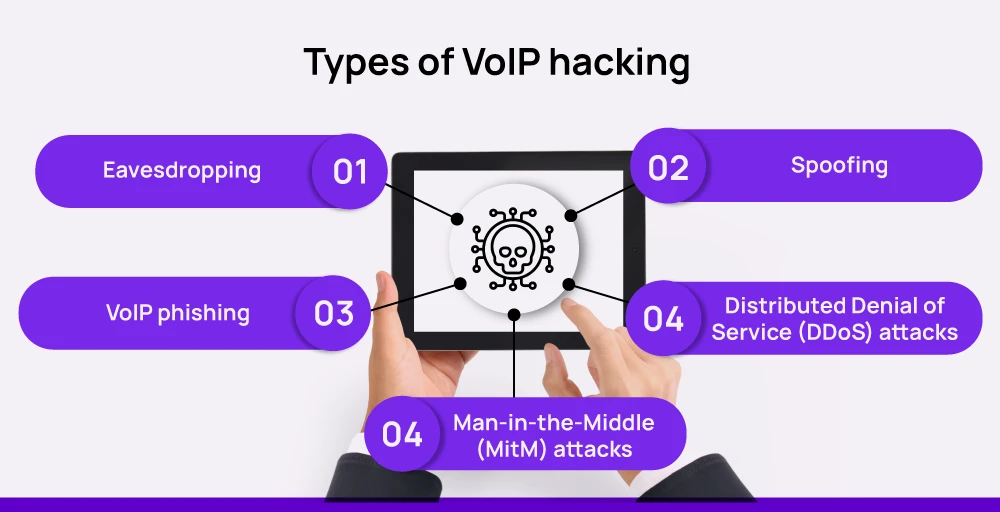
1. Eavesdropping
Hackers silently intercept call data to listen in on private conversations. This tactic is often used for data theft, corporate spying, or gathering credentials shared over the phone.
This usually happens when VoIP calls are not secured or when attackers gain access to unsecured networks like public Wi-Fi. With the right tools, attackers can capture voice packets and reconstruct entire conversation, making encryption & secure connection more essential.
2. Spoofing
Attackers manipulate the caller ID to impersonate a trusted internal number. This form of deception can trick employees into sharing sensitive details or performing unauthorized actions.
Spoofing often plays a key role in social engineering attacks, where hacker reply on trust rather than technical vulnerabilities. VoIP makes it easy to alter caller IDs, companies must train employees to verify suspicious requests—even if the phone number looks legitimate.
3. VoIP phishing
VoIP phishing targets the Voice-over-IP system to extract login details, financial info, or gain access to the system. They carry out a phishing attack by posing as legitimate entities like a service provider or internal IT teams.
For example: A hacker might leave a voicemail pretending to be your VoIP provider and ask for your system login code. If an employee share it, the hacker can easily break into your VoIP system.
4. Distributed Denial of Service (DDoS) attacks
Cybercriminals flood a VoIP phone system with loads of traffic to overwhelm servers and disrupt service availability. This leads to dropped calls, service outages, and communication delays that can paralyze operations.
It not only cause downtime but can also be used as a distraction while hackers attempt other intrusions. Businesses often need firewalls, traffic filter, and rate-limiting tools to identify abnormal traffic and keep their VoIP systems running during such attacks.
5. Man-in-the-Middle (MitM) attacks
In a MitM attack, the hacker places themselves between two VoIP endpoints (the caller and the recipient). They can then monitor, record, or alter call content in real-time, without either party knowing.
These attacks mostly occur on unsecured networks or when encryption is weak, allowing hackers to intercept data packets easily.
How does a VoIP system get hacked?
A VoIP system gets hacked when hackers exploit some gaps in VoIP security or due to the errors of humans.
Here are the most common ways a VoIP system can get hacked:
- Weak or default passwords: Many VoIP users use simple or default passwords on their devices or web portals. Hackers use automated tools to guess these logins and gain instant control.
- Social engineering: Cybercriminals call employees pretending to be vendors, partners, or IT staff. They request access credentials or technical details, which can grant them control over the entire system.
- Unsecured remote access: If your team uses remote access tools without safeguards like multi-factor authentication or a secure VPN, it becomes easy for attackers to slip in.
- Outdated software or firmware: Running outdated VoIP software or unpatched hardware makes your system vulnerable. Known exploits can be used to hijack calls or access backend data.
- Call spoofing and toll fraud: Attackers can exploit caller ID spoofing to impersonate your number and trick other systems. Some also initiate unauthorized international calls to generate expensive bills under your account.
- Infected devices: Malware-infected computers or softphones inside your network can silently capture call data, route calls, or create backdoors into your system.
- Exposed ports and open networks: SIP ports or admin panels, when left open to the internet without firewall rules, invite intrusion. Hackers scan the web specifically for these open points.
Sings that your VoIP system has been hacked
VoIP attacks don’t always announce themselves. In many cases, the signs are subtle until the damage is done. Staying alert to these subtle red flags can help you catch a VoIP hack early.
1. Irregular call activity
One of the most common signs of a hacked system is a sudden spike in outbound calls. You can tell whether or not your VoIP systems have been compromised by checking your call activities.
Check whether calls have been made at odd hours, routed to unfamiliar destinations, or show up in call logs you don’t recognize. Keep an eye on traffic outside your regular business hours or geographical zones.
2. Issues in Call quality

Persistent problems like echoing, call drops, distorted audio, or delayed connections could point to more than just a weak network. These problems can be the result of hackers manipulating call paths or misusing system resources to degrade the call quality.
These changes can also signal that unauthorized users are intercepting or rerouting your calls.
3. Unauthorised system access
Watch for new user accounts that no one on your team created or unexplained changes to system settings. If certain extensions are suddenly reconfigured or admin privileges are modified without approval, someone may have gained access to your VoIP system.
Hacking VoIP setups often starts with exploiting weak credentials to gain internal control.
4. Suspicious network activities
VoIP systems run over an internet connection, so keep a close eye on your network behaviour, like bandwidth spikes or abnormal data flows, which should be investigated as soon as possible.
A compromised system might be transmitting call data externally or serving as a launchpad for further cyberattacks. Monitoring your network traffic can help spot these issues early. Complementing this with regular security practices, such as vulnerability scanning best practices, can help identify hidden weaknesses before they are exploited.
5. Unexpected VoIP bills
If you get charged for long-distance or premium-rate calls you didn’t authorize, then it might be a sign of toll fraud. Apart from those, if you also notice some discrepancies in call durations, destinations, or totals that don’t align with your system’s usage, investigate immediately.
Different ways to protect your VoIP system from being hacked
VoIP hacking is damaging, but it’s not inevitable. You just need the proper security practices in place. These are some of the most effective ways to strengthen your VoIP system against attacks:
I. Use strong and unique Passwords
Passwords are your first line of defense and often your weakest link if not handled properly. Many VoIP hacks happen because default credentials are never changed or reused across multiple systems.
Hackers use automated tools to try common passwords or variations and gain easy access to administrative controls or call data.
To reduce this risk, advise your team to use complex passwords. These passwords should be changed regularly and never stored in unsecured locations like emails or spreadsheets. Use a trusted password manager to help maintain secure access across your business phone system.
II. Set up a VPN for remote workers
When remote employees access your phone network, their connection is only as secure as the internet they’re using. Public Wi-Fi and unsecured home routers expose your system to threats like eavesdropping and session hijacking.
Employees using a softphone or working outside the office should have a VPN installed on their device. This ensures that all VoIP traffic stays private and secure, even in less controlled environments.
VPNs also help prevent hackers from exploiting remote access points as a backdoor into your larger network.
III. Choose a secure VoIP provider
A trustworthy VoIP provider should offer end-to-end encryption, regular security audits, and clearly defined breach response protocols. Providers that use secure VoIP protocols like SRTP and TLS offer additional protection by encrypting voice and signaling traffic.
Before signing a contract, review the provider’s privacy policies and ask about their infrastructure security. Check for certifications or compliance with relevant standards, such as HIPAA-compliant practices if your business handles sensitive data.
A secure provider helps protect your system from both direct attacks and indirect vulnerabilities.
IV. Limit administrative access
Giving administrative rights to every user increases your risk of internal mistakes and external attacks. Admin users can create lines, change settings, and access call logs, all of which can be misused if compromised.
To prevent this, grant admin privileges only to those who absolutely need them. Conduct regular audits of all user roles and remove any inactive or outdated accounts.
By narrowing down access points, you reduce potential vulnerabilities and maintain tighter control over your system.
V. Keep firmware and software updated
Many businesses fall behind on software updates, leaving known vulnerabilities wide open for attackers. VoIP hardware and softphone applications need regular patching to fix bugs, improve performance, and close security holes. Ignoring updates gives hackers more time to exploit outdated systems.
Set a schedule to review and apply firmware and software updates across your entire VoIP setup. Updates should be tested in a secure environment before being rolled out system-wide.
Keeping your system up-to-date is one of the simplest but most effective ways to support strong VoIP cybersecurity.
VI. Regularly monitor logs and system activity
Activity logs are your system’s black box. Call logs reveal who contacted whom, when, and for how long, while access logs show who signed into the system and from where.
Unusual patterns like logins from foreign IPs or call spikes during off-hours can be early signs of a VoIP attack.
Make it a habit to check these logs frequently. Understanding what’s “normal” for your system helps you quickly detect anything suspicious. Some systems allow alerts for unusual behavior, giving you a real-time heads-up if someone is hacking VoIP infrastructure under your nose.
VII. Enable two-factor authentication (2FA)
While strong passwords are essential, they’re no longer enough on their own. Two-factor authentication (2FA) adds another layer of security by requiring a second form of verification, like a one-time code or fingerprint, before granting access.
This makes it harder for hackers to break in, even if they’ve stolen a password.
Implement 2FA for all accounts that access your Voice over IP system, especially administrators. Most modern platforms offer simple 2FA options that integrate with smartphones or authenticator apps. This small step significantly boosts your defenses and can stop a VoIP hack before it starts.
Conclusion
VoIP hacking is a growing threat that no modern business can afford to ignore. From eavesdropping to full system takeovers, the risks are real and costly. But with the right precautions, a secure VoIP phone system can protect your calls, your data, and your reputation.
KrispCall offers built-in safeguards designed to keep your communication network protected from every angle. With features like encrypted calling, user access control, and automatic activity logging, you get peace of mind along with powerful functionality.