


AI voice agents are intelligent assistants that handle spoken customer interactions using natural language. They help with everything from answering queries to scheduling appointments or completing transactions. They are available on demand and around the clock.
AI voice agents help businesses stand out by delivering fast, reliable, and personalized customer interactions. They offer 24/7 support, spanning multiple time zones and regular business hours. Since 89% of customers prefer brands with Voice AI, this technology builds satisfaction and loyalty.
In this blog, you’ll get to know about the AI voice agents, how they work, why they’re important, and how you can implement them.
What is an AI voice agent?
AI voice agents are software systems that use artificial intelligence (AI) and machine learning (ML) to understand and respond to human speech. It uses technologies such as natural language processing (NLP) and speech recognition to engage in discussions, respond to inquiries, and perform tasks, much like a human assistant.
Unlike old, rigid IVR systems, AI voice agents adapt and get smarter with every interaction. They understand natural, even messy or emotional, speech. A modern AI agent can access customer data, schedule appointments, and update tickets on the fly. Each call makes them smarter, faster, and more accurate.
Why are AI voice agents important for businesses?
Using voice agents helps your business stand out by making customer interactions quicker, friendlier, and always available. Instead of waiting on hold or pressing through phone menus, customers get real help right when they need it.
Nearly 97% of businesses that adopted new voice AI technologies reported revenue growth, showing how staying ahead with new tools can set you apart from competitors (PR Newswire).
Benefits of AI voice agents
AI voice agents provide numerous advantages that make them essential for modern businesses. They reduce costs by automating repetitive queries, while still delivering personalized experiences through natural language processing.
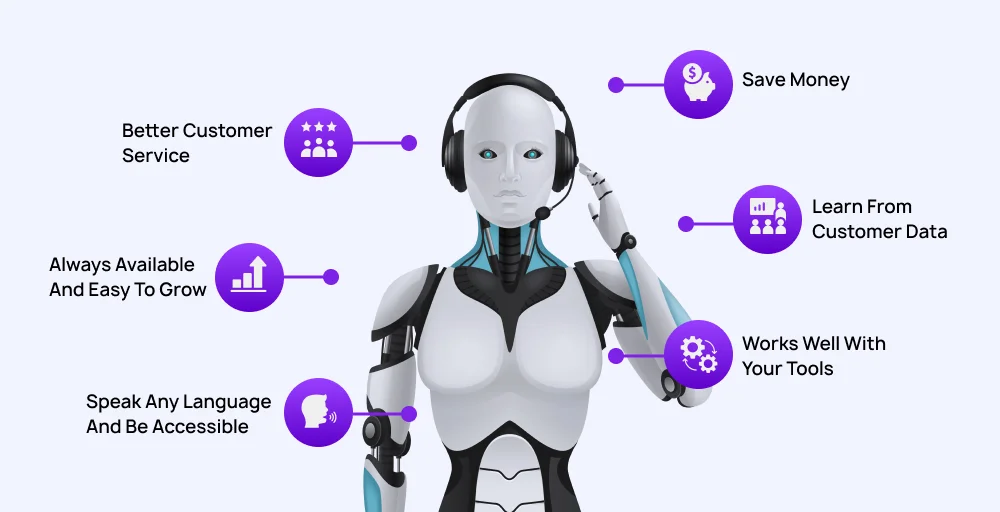
Some of the benefits of using voice AI technology are given below:
1. Better customer service
AI voice agents boost customer service by providing fast, personalized responses. They can handle multiple calls at once. Plus, they remove annoying phone menus. Such AI assistants ensure that customers receive timely support without delays, thereby enhancing their overall satisfaction.
2. Save money
AI voice agents help businesses eliminate the need for additional staff, onboarding expenses, and lower training costs, which will lower the overall budget of your business. Apart from these, they also enable human employees to focus on complex tasks while AI handles all the routine tasks effectively.
3. Always available and easy to grow
Artificial intelligence voice assistants are always available and highly scalable. They operate 24/7, including nights and holidays, and can handle peak periods without requiring additional personnel. As the demand for business is growing day by day, AI will complete its capacity more quickly and easily.
4. Learn from customer data
AI voice agents can learn from customer data. They analyze past interactions and call history. This helps improve their responses over time. They automatically track customer interactions and preferences, and provide insights that support making better business decisions.
5. Speak any language and be accessible
AI voice agents are multilingual and easily accessible. They can communicate in multiple languages, helping businesses reach international audiences and assist customers with disabilities through voice-based interactions.
6. Works well with your tools
Using only AI voice agents alone may not be enough for effective business communication. Integrating tools like CRM systems, calendars, and help desks can enhance operations. These tools automatically log notes and appointments, keeping customer information consistent and up-to-date.
How do voice AI agents work?
Voice AI agents usually use natural language processing (NLP), text-to-speech (TTS), and automatic speech recognition (ASR). These technologies help them communicate with users using voice.
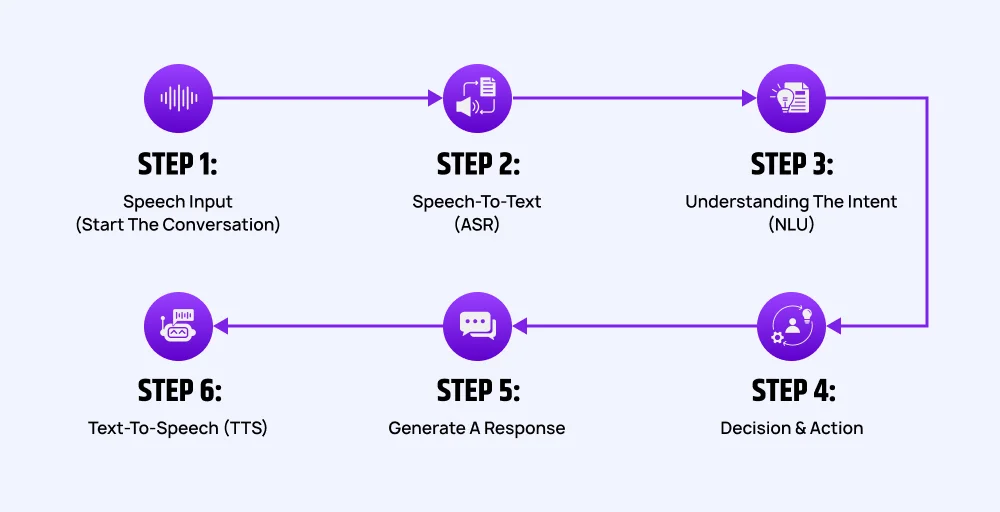
Here is a complete step-by-step breakdown of how the voice AI agents work:
Step 1: Speech input (Starting the conversation)
The customer interacts with the AI agents or virtual assistants and may ask questions such as, “Can I reschedule my appointment date?” or “What’s my total bill?” Then, this voice input is captured as audio or speech.
Step 2: Speech-to-text (ASR)
The customer’s voice is processed by automatic speech recognition (ASR), which converts spoken words into text. ASR accurately handles different accents, speaking speeds, and background noise.
Try converting speech to text totally free: 👉: Speech to Text Generator Tool
Step 3: Understanding the intent (NLU)
Then, the text undergoes natural language understanding (NLU). NLU determines what the customer actually wants, such as rescheduling appointment dates or checking a balance. It also extracts important details, like dates, times, or account numbers.
Step 4: Decision & action
The AI agent finds the right action by linking to backend systems like CRM, scheduling software, and databases. Using tools like retrieval-augmented generation (RAG), it can fetch real-time info or make updates instantly.
Step 5: Generate a response
A large language model (LLM) drafts a natural, human-sounding reply, for example, “Your delivery has been moved to Friday at 10 AM.”
Step 6: Text-to-speech (TTS)
The response is converted back into voice using text-to-speech (TTS) and spoken to the customer, completing the conversation smoothly.
Try converting text to speech totally free: 👉: Text To Voice Generator Tool
Use cases of AI voice agents
AI voice agents are used across various industries, from AI call center operations to handle customer interactions and healthcare for appointment scheduling and patient monitoring.
Some of the major sectors where AI voice agents are crucial:
1. Retail & e-commerce
AI voice agents help the retail & e-commerce industries enhance shopping experiences for customers, providing product recommendations, order tracking, and facilitating returns. They also drive revenue by suggesting cross-sells and upsells during conversations.
Here’s an example conversation of an AI voice agent being used in retail & e-commerce:
Customer: “Where’s my order?”
AI agent: “Your package will arrive tomorrow. Would you like matching accessories?”
Outcome: The customer receives quick information, and the agent suggests an upsell.
2. Banking & finance
AI voice agents in banking and finance help with routine tasks. They check account balances, process transactions, and send fraud alerts for customers. This reduces customer wait times while ensuring secure and consistent service delivery.
Here’s an example conversation of an AI voice agent being used in banking & finance:
Customer: “What’s my account balance?”
AI agent: “Your balance is $2,340. Do you want me to send a mini statement?”
Outcome: Customer query resolved instantly without human intervention.
3. Healthcare
Voice AI technology in healthcare makes patient interactions easier. It helps schedule appointments, share updates, and answer simple health questions. They free up staff time, allowing healthcare providers to focus more on direct patient care.
Here’s an example conversation of an AI voice agent being used in healthcare:
Customer: “I need to book a doctor’s appointment.”
AI agent: “Sure! The next available slot is Tuesday at 10 AM. Should I confirm?”
Outcome: Appointment scheduled automatically, staff workload reduced.
4. Travel & hospitality
For travel & hospitality, intelligent voice agents streamline booking processes for flights, hotels, and rentals while providing real-time updates. They also enhance customer satisfaction by answering FAQs and offering personalized travel recommendations.
Here’s an example conversation of an AI voice agent being used in travel & hospitality:
Customer: “Is my flight on time?”
AI agent: “Yes, your flight is on schedule for 6:45 PM. Would you like directions to your gate?”
Outcome: Customer reassured and receives added value service.
5. Telecom & IT services
In telecom & IT services, AI agents assist customers with troubleshooting, billing inquiries, and service requests. They automate ticket generation for unresolved issues, ensures faster resolutions and reduced support costs.
Here’s an example conversation of an AI voice agent being used in telecom & IT services:
Customer: “My internet isn’t working.”
AI agent: “Let’s run a quick reset. Please unplug your router for 30 seconds.”
Outcome: Customer issue resolved quickly, fewer tickets escalated.
How to implement AI voice agents in your business?
Implementation of AI voice agents in your business can transform customer interactions, but for the success of your call center technology, you need to understand the complete implementation process.
Here are the steps to be followed for the successful deployment of AI virtual voice agents:
Step 1: Choose the right AI voice agent platform
Start by selecting the right platform, which is crucial for the effective integration of AI voice agents in your business. While choosing one of the best AI voice agents, consider factors such as flexibility, scalability, natural language understanding, multi-channel support, and text-to-speech capabilities.
You can use platforms like SynthflowAI and Lindy.AI, which are popular choices for businesses looking for seamless integration and advanced features.
Step 2: Focus on design and the right Voice AI strategy
Next, focus on the design and plan for how your voice AI agent will interact with your customers. Create a proper strategy for defining its use cases and conversational flows, and maintain a consistent tone of voice to ensure engaging and understandable conversations.
Step 3: Integrate with your existing tools
Integrate the AI voice agent with your CRM, helpdesk, analytics, or other internal systems. This connection empowers the agent to access real-time data, enabling it to deliver precise and personalized responses that enhance customer experience.
Step 4: Train and test AI voice agent
Train and test the AI voice agent you have selected. This will help clarify the agent’s role more clearly. Start with customer queries and historical conversations, then run real-world scenarios to evaluate accuracy and responsiveness.
Step 5: Launch and consistently monitor performance
After training and testing your agent, launch it in your business and continuously monitor its performance. This will help you understand agent capabilities and improve them over time.
Is AI a threat to human agents?
Not inherently, when human agents are paired with AI, businesses can achieve exceptional success by enhancing their strengths and processes. Like AI handles a large amount of data, performs repetitive tasks, and recognizes patterns, while human agents still provide context, intuition, ethical judgment, and creative direction.
However, the proper use of AI by human agents can change the perception of it as a threat. AI helps improve decision quality and enhance operational efficiency. It also accelerates innovation across product development, risk management, marketing, and customer experience.