


Voice-based conversational AI is changing the way businesses connect with customers, employees, and markets. By combining voice recognition with AI-powered decision-making, it turns routine conversations into opportunities for efficiency and engagement.
As customer expectations rise, businesses that adopt a conversational AI platform gain a competitive edge. They uncover new opportunities for personalization, trust, and long-term growth.
In this blog, we will discuss the real power of a conversational AI voice, its essential features, significant benefits, key applications, and the future of voice-based conversational AI.
✨ Key Takeaways
- Voice-based conversational AI allows humans to interact with machines through natural speech, using technologies like ASR, NLP, and TTS to create smooth, human-like conversations.
- Voice AI offers major benefits such as multilingual support, cost savings, instant issue resolution, 24/7 availability, personalized service, and increased productivity for both agents and customers.
- Growth tools such as AI Copilot, call analytics, and AI text responders enhance efficiency, accuracy, and personalization.
What is voice-based conversational AI?
Voice-based conversational AI is a form of artificial intelligence that allows humans to interact with machines using natural human-like speech. It allows natural conversations through voice interfaces. It works by combining technologies such as:
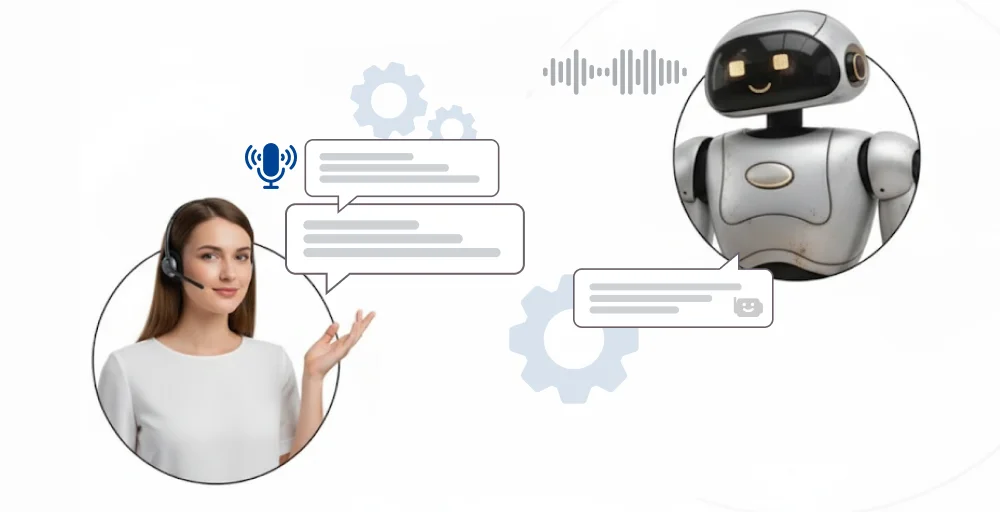
- Automatic speech recognition (ASR): To convert spoken words to text.
- Natural language processing (NLP): To understand the meanings of texts.
- Dialogue management: To maintain conversation flow.
- Natural language generation (NLG): To formulate a response
- Text-to-speech (TTS): To convert the response back into spoken words.
This technology powers applications such as personal assistants and IoT devices, transforming digital interactions into a more natural and accessible experience.
Types of conversational Voice AI
1. AI Voice agents: AI voice agents are automated systems that interact with users using a natural language that we speak in day-to-day life. It can be useful in areas like customer service, sales support, flight booking, and appointment scheduling.
Features:
- Human-like interaction
- Context retention
- Task automation (e.g., booking a flight)
Example: A virtual agent that answers FAQs or troubleshoots issues in a phone line.
2. AI-Powered IVR: AI-powered IVR is an enhancement of traditional IVR with AI to make interactions smarter and conversational. It can be used in call routing, self-service banking, or utility service companies.
Features:
- Natural language understanding (NLU)
- Personalized call flow
- Integration with CRM systems
Example: Instead of pressing numbers, users can speak naturally (e.g., “I want to check my balance”).
3. AI Voice Assistants: AI voice assistants are software programs that are powered by artificial intelligence to understand simple voice queries and respond to them in real time. These AI assistants use natural language processing and machine learning to interpret and learn from the interactions and respond accordingly.
Features:
- Voice command recognition
- Multi-turn dialogue capabilities
- Integration with apps/devices
Example: AI voice agents like Siri, Google Assistant, and Alexa.
4. Real-time voice recognition: It is a technology that converts voice queries into text or commands as they are spoken. It can be used for live transcription, live captions, command execution, and real-time agent coaching.
Features:
- Low-latency transcription
- Speaker identification
- Language/dialect detection
Example: Real-time meeting transcription in Zoom or Google Meet.
Essential features for growth-driven voice solutions
many conversational
1. AI Copilot
AI Copilot is another tool that provides real-time assistance during voice calls to write summaries, draft replies, and keep everything in an orderly and systemized manner for faster follow-ups. Furthermore, it can provide you with:
- Listen in on live conversations (with consent).
- Provide suggested replies or information to agents.
- Autofill forms or trigger workflows based on voice input.
Growth Impact: It speeds up response time, reduces agent training time, and improves accuracy, which leads to better customer experience and higher conversion rates.
2. Call Analytics
Call Analytics is another tool that enables you to view live-time call data and analyze it by equating it with past interactions for the extraction of various key metrics such as total call volume, call duration, inbound calls, outbound calls, and more. Furthermore, it helps you detect peak call hours, trends, and members’ performance in a graph, which further aids in spotting patterns and improving the workflow.
You can easily play call recordings and check the call notes later on. This way, tracking leads and follow-up becomes effortless. You can also tag calls or follow up as per the requirement. Moreover, with CRM integration, every interaction stays synced. This way, you can access the data-driven reports at your fingertips to refine strategy and make possible changes as needed.
It helps you visualize:
- Call duration, sentiment, keyword usage
- Agent performance metrics
- Transcripts and trend reports
Growth Impact: Gives businesses deep insights into customer behavior and service quality to optimize sales, support, and marketing strategies.
3. AI Text Message Responder
An AI text message responder is a tool that enables one to respond to messages using AI automation solely.
This tool is crucial for growth as it enables individuals to schedule appointments, query responses, and chat with agents anytime without the barrier of requiring a live agent. Furthermore, it also hooks the tone and key points from the conversation to give a more personalized response.
For this, pre-written responses or live-time creation of new ones based on the training it has received are used. All the while, one can also seek features like AI paraphrasing or automated text messaging for better assistance.
Growth impact: It sustains fast and consistent conversations for better customer fulfillment and reduces manual workload.
4. AI Reply & Rephrasing
AI reply is another tool that spontaneously responds to buyers’ queries with a momentary response. This reduced the pressure on the AI’s workloads, allowing them to focus on more critical tasks.
On the one hand, it examines the query context and generates a relevant reply, along with prerequisite guidelines. It analyzes the context of the query, then creates a relevant and accurate reply with predefined guidelines to maintain the tone and style of one’s brand. Additionally, it uses past interactions to personalize the conversation.
On a similar note, AI rephrasing is a tool that responds with accuracy and pre-trained texts. It helps paraphrase your text to remove repetition and makes your brand sound more confident. This tool sustains your professional tone and decreases manual errors to enhance customer engagement.
Growth Impact: Improves brand consistency, enhances communication quality, and builds trust with customers, which drives loyalty and retention.
6 Benefits of adopting voice AI for your business
Embracing AI in your business will help you improve your customers’ experience with the necessary insights into problems from the ongoing pattern before they even occur.
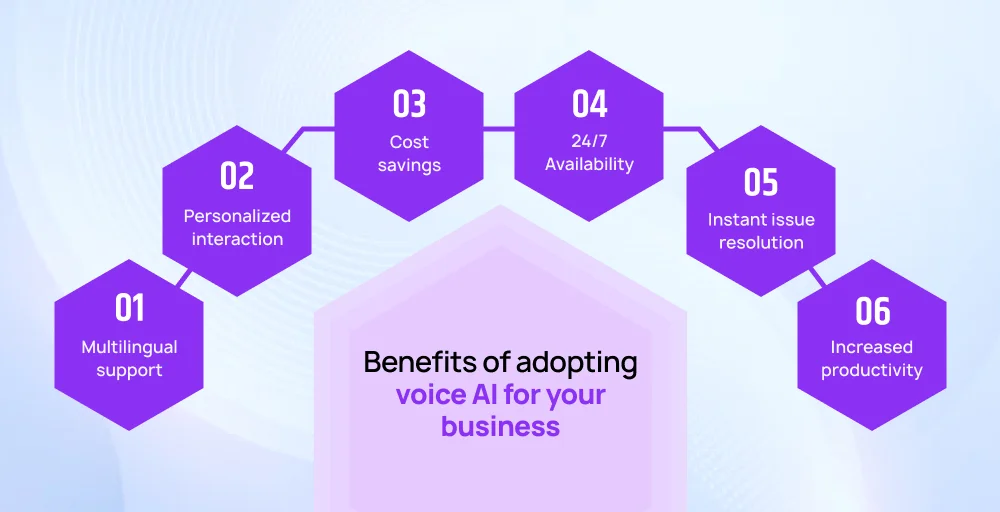
Let’s address the 6 major benefits of adopting AI voice for your business.
1. Multilingual support
Voice AI can communicate in multiple languages. This removes the barriers between businesses and global customers. Instead of hiring large multilingual teams, you can rely on AI to engage customers in their preferred language.
It reduces customer wait times by providing a precise response instantly. This way, Voice AI can help you achieve customer loyalty by making conversations natural and professional at the same time.
2. Personalized interaction
Voice AI personalized interactions benefit users and businesses with customized interactions and convenient support in real-time. Voice AI can respond to the user’s voice query in real time, so that you can eliminate the burden of typing to make the agent understand.
3. Cost savings
Implementing voice AI reduces the need for extensive call center staff, training, and operational overhead. Businesses can manage higher call volumes without increasing workforce costs.
4. 24/7 Availability
Unlike human agents, voice AI never needs a break. It can handle inquiries around the clock. This can be particularly useful for handling customers’ queries during peak hours, weekends, or holidays.
5. Instant issue resolution
Voice AI can quickly provide accurate answers and troubleshoot common issues using the stored knowledge bases and real-time data. This speeds up resolution time and minimizes customer frustration.
6. Increased productivity
By handling repetitive queries and routine tasks, voice AI enables human agents to focus on more complex and high-value conversations. This not only makes teams more productive but also helps businesses deliver a better overall customer experience.
Key applications of voice-based conversational AI
Voice-driven conversational platforms are transforming the way industries operate and engage with their customers. Here are some of the main areas where businesses are already seeing the impact.
Conversational AI platforms are transforming how different industries operate and serve people. Let’s look at some of the key areas where businesses are putting it to use.
1. Call Centers
Call centers are one of the core organizations that benefit from voice AI. Rather than putting customers on long holds or making the customers follow through endless loops of long lists of menu options, AI agents can simply respond to all of them, even at the same time, freeing them from the hassle, all while benefiting the institution. They can answer FAQs, process orders, provide updates, or even schedule appointments without human intervention.
What makes these systems especially effective is their ability to adapt to industry-specific terms while collecting real-time customers’ perceptions. By automating routine calls and capturing valuable data, businesses cut costs, improve satisfaction, and manage higher call volumes with ease.
2. Healthcare Facilities
In the healthcare sector, AI voice companions remove barriers for patients, enabling early and simple diagnosis and regular health monitoring through easy access to services. Instead of surfing through an enormous list of websites and apps, patients can check their medical records and simply tally whatever symptoms are showing up and take early precautions. This makes healthcare more accessible, especially for elderly patients or those who struggle with digital tools.
AI assistants can also act as a first point of contact by asking about symptoms and suggesting possible next steps. This helps providers prioritize urgent cases more efficiently and reduce wait times in order to enhance overall patient care.
3. Finance
Voice-based conversational AI in the finance sector uses virtual assistants to interact with each customer to provide them with personalized support based on their profile. Here, AI voice interacts with customers using natural language and automated services to check balances, loan queries, and detect fraud alerts.
Additionally, it can offer financial advice, guide customers through services, and suggest solutions that match individual profiles depending on their past interactions and customers’ needs. This way, financial institutions can provide customized financial benefits to each individual to win customers’ trust and increase customer lifetime value.
4. Hybrid Chatbots
Hybrid chatbots combine text-based and voice-based conversational AI to allow customers to switch between channels without losing context. For instance, a user may start typing on a live chat and later continue the same conversation via voice.
These chatbots maintain a balance between automation and human support. They resolve routine issues instantly but send complex queries to live agents when needed. This flexibility improves customer experience while keeping operations efficient.
5. E-Commerce
Voice AI is changing how customers purchase goods and services online. It can detect the customer’s sound as they ask and suggest products based on their demands. This way, customers’ queries can be well-handled to boost the overall productivity of an organization.
Buyers can also ask specific questions, for example, “Is this phone 5G compatible?” or “What’s the difference between these two models?” and receive immediate responses. For retailers, this can lead to increased engagement and conversions, while shoppers enjoy a smoother and more interactive experience.
The future of voice-based conversational AI
Voice AI is pushing beyond simple automation, moving personalization and security to new levels. Customers don’t have to type queries and wait; they can interact directly with an AI voice agent that responds in real-time. For businesses, adopting this technology isn’t just about keeping up– it’s about creating more practical, efficient, and customer-friendly service that genuinely solves problems on the spot.
| Trend / Innovation | Opportunities | Emerging Needs |
| Agentic AI (Task Execution) | End-to-end conversationsResolve issues without human agents,Reduce call load | Reliable decision-making logic Continuous learning from complex/edge cases |
| Emotionally Intelligent AI | Detects frustration, happiness, or confusion Responds empathetically to boost CSAT | Advanced tone & emotion detection Cultural nuance understanding |
| Multimodal & Omnichannel | Smooth switch between voice, chat, and email Unified customer view | Real-time context synCRM & helpdesk integration |
| Hyper-Personalization | Context-aware replies, upselling & cross-selling via voice | Secure memory systems Data consent & compliance safeguards |
| Voice Commerce & Transactions | Order, cancel, or track purchases through voice for faster service | Strong voice authentication Advanced fraud prevention systems |
| Multilingual & Localized AI | Support diverse customers in native languages, more inclusive experiences | Accurate NLP for dialects Compliance with regional regulations |
| 24/7 Availability | Round-the-clock service at low cost, instant support during off-hours | Reliable fallback systems Load balancing for peak traffic |
| Security & Privacy | Build trust through secure, confidential conversations | End-to-end encryption Voice biometric verification |
| Smart Device Integration | Voice support via smart speakers, cars, and wearablesProactive reminders | Device compatibility On-device AI processing for stronger privacy |
| Performance & Speed | Real-time responses Smoother customer experiences | Low-latency speech recognition Edge computing deployment |
| Interoperability | Collaboration between multiple AI systems for expanded capabilities | Open API standards Cross-platform agent collaboration |
Transform customer experience with KrispCall’s Voice AI
The way businesses interact with customers is evolving, and Voice AI is at the center of this shift. With KrispCall’s Voice AI, you can automate conversations and build experiences that are faster, personal, and more effective. By combining intelligent automation with a human-like touch, your business can respond instantly, understand customer needs better, and create lasting relationships.
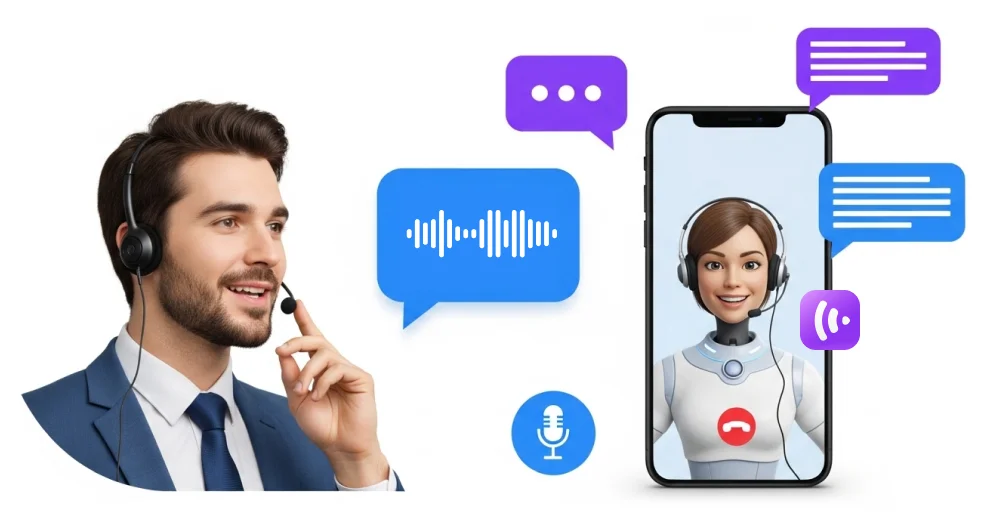
As customer expectations continue to rise, the ability to provide 24/7 support, multilingual interactions, and real-time problem-solving will define the leaders of tomorrow. KrispCall equips you with these capabilities today, helping you stay ahead of the curve and deliver service that feels effortless.
Ready to elevate your customer experience? Discover how KrispCall’s Voice AI can transform the way your business connects with customers.
Frequently Asked Questions
How is AI transforming business strategy?
AI is transforming business strategy by providing real-time insights into customers’ interactions based on their past conversations to inform decisions. It allows employees to focus on higher-value tasks while it handles the routine tasks.