


Think about the last time a brand genuinely impressed you. Maybe it was a support rep who remembered your name, or a checkout so smooth you barely noticed it happened.
Now think about the last time a brand let you down. You remember that one more vividly, and so do the 12 people you told about it.
That gap between those two moments is where businesses are won and lost today. Customers have infinite options, shrinking patience, and a megaphone in their pocket. A great product can be copied overnight, but a consistently outstanding experience is nearly impossible to replicate.
That’s exactly why learning how to improve customer experience isn’t just a customer service initiative. It’s one of the smartest growth strategies your business can invest in.
What is customer experience?
Customer experience is the sum of every interaction a person has with your brand, from the first time they hear about you to the moment they need support after a purchase.
It’s not just what happens. It’s how it feels.
A customer might love your product but leave because your support was slow. They might forgive a shipping delay because your team handled it with care. These small moments, stacked together, shape how people perceive your brand, whether they stay, and whether they tell others about you.
Customer experience is not the same as customer service. Service is one touchpoint. Experience is the entire journey.
And in a world where customers have more choices than ever, the businesses that get this right don’t just earn loyalty. They earn growth.
Why Great Customer Experience Is Harder Than It Looks
Most businesses genuinely want to deliver great experiences. The problem isn’t intention. It’s execution.
Even companies that treat CX as a top priority run into the same obstacles, often without realizing it. Here are the most common ones.
Your systems aren’t talking to each other
Imagine walking into your regular coffee shop, the one you visit every morning, and the person behind the counter asks if it’s your first time there. You have their app, you’re on their loyalty program, and yet to them, you’re a stranger.
That’s exactly how customers feel when the teams meant to help them don’t share the same information. One department knows you made a purchase, another has no idea, and nobody connects the dots. The customer ends up feeling invisible to a brand they’ve been loyal to for years.
More tools, more problems
Investing in the latest tools sounds like progress, but technology alone doesn’t change anything. If your team isn’t properly trained or the new software doesn’t fit into how they already work, people stop using it. They fall back on workarounds and shortcuts, and the result is an inconsistent experience that no tool can fix on its own.
Personalization that misses the point
Customers can tell the difference between a message made for them and one that just has their name dropped in. Without a clear understanding of what your customers actually want and how they behave, attempts to make communication feel personal often come across as hollow or out of touch.
The good news? These are solvable problems. When your teams share the same information, use tools that actually work for them, and truly understand their customers, great experiences stop being the exception and start becoming the norm.
How to improve customer experience?
Your customers aren’t just buying a product or a service. They’re deciding, every single time, whether you’re worth their time, their money, and their trust. Here are ten ways to improve customer experience and make sure the answer is always yes.
1. Truly understand your customers
You can’t deliver a great experience for someone you don’t really know. Think about how Spotify wraps up your year with a personalized summary of everything you listened to. It feels like they actually know you, because they do. They pay close attention to behavior, habits, and preferences and use that to shape every interaction.
You can do the same by going beyond basic demographics. Look at purchase history, track how customers behave on your website, and ask meaningful questions in your surveys like “what nearly stopped you from completing your purchase?” Use that information to build a clearer picture of who your customers are and what they actually need, so you can serve them before they even have to ask.
2. Personalize every interaction
Customers can tell the difference between a message made for them and one made for everyone. When you browse a product on Amazon and come back later to find it waiting alongside other things you’d genuinely want, that’s not a coincidence. That’s a business using what it knows about you to make every visit feel relevant.
Start by using your customer data to tailor communications, recommend relevant products, and adjust your messaging based on where someone is in their journey. Avoid generic emails that could have been sent to anyone. Instead, send the right message to the right person at the right time. Even small touches, like acknowledging a recent purchase or remembering a preference, go a long way in making customers feel valued rather than just marketed to.
3. Listen to feedback and actually act on it
Collecting feedback is easy. Doing something meaningful with it is where most businesses fall short. Slack built much of its early reputation by genuinely responding to user suggestions and making visible changes based on what people said. Customers noticed, talked about it, and stayed loyal because of it.
Gather feedback across every channel, from post-purchase surveys and online reviews to social media comments and live chat transcripts. But don’t stop there. Identify the patterns, prioritize the most common pain points, and make changes that customers can actually see. Then close the loop by letting them know their feedback made a difference. That simple step turns a passive survey into a trust-building moment.
4. Map the customer journey
Every business has blind spots, moments in the customer experience that feel frustrating or broken but go unnoticed because no one has ever walked through them. Think about the last time you tried to cancel a subscription and couldn’t find the button anywhere. That’s a business that never walked through its own customer experience. Those blind spots are exactly what journey mapping helps you find.
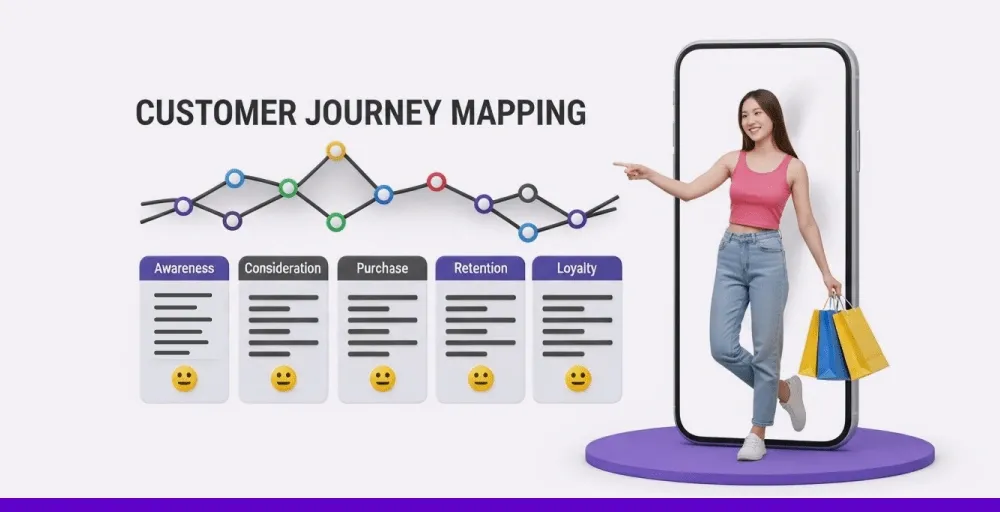
Sit down and trace every step a customer takes with your brand, from the moment they first hear about you to the moment they need support after a purchase. Identify where things flow naturally and where customers get stuck or drop off. Then fix those friction points one by one. Even removing a single unnecessary step from a checkout process or a support flow can make a meaningful difference to how customers feel about your brand.
5. Make it easy to get help
When a customer needs help, the last thing they should have to do is work hard to get it. Nobody wants to call a company, explain their problem in full, get transferred, and have to start all over again. That experience doesn’t just frustrate customers. It makes them question why they chose you in the first place.
Make it easy to reach you by offering multiple contact options like phone, email, live chat, and social media. Use smart routing to connect customers to the right person the first time, without unnecessary transfers. For simple questions, offer self-service options like a well-organized help center or a chatbot that can handle common requests instantly. The goal is to make getting help feel effortless, not exhausting.
6. Equip your team with the right tools
Even the most dedicated employee can only do so much without the right support behind them. Imagine a customer service agent trying to help you while juggling five different systems, none of which talk to each other. They’re doing their best, but the experience feels disjointed because it is. That’s not a people problem. That’s a tool problem.
Give your team a single, unified workspace where they can see a customer’s full history, recent interactions, and relevant details all in one place. Pair that with AI-powered tools that suggest the next best action during a conversation or automatically summarize an interaction afterward. When agents have what they need at their fingertips, they spend less time searching and more time actually helping.
7. Train your team continuously
The quality of your customer experience will never rise above the quality of the people delivering it. Think about the difference between a newly hired hotel receptionist and one who has been there for years. The experienced one remembers your preferences, handles problems without making you feel like a burden, and makes the whole stay feel effortless. That level of service doesn’t come from a one-time training session.
Build a culture of continuous learning by coaching employees regularly based on real customer interactions. Use quality assurance tools to identify where agents are doing well and where they need support, then deliver targeted training that addresses those specific gaps. The better your team gets at handling difficult situations with empathy and confidence, the more consistently great your customer experience becomes.
8. Be consistent across every channel
Customers don’t think in channels. To them, every interaction is with one brand, and they expect it to feel the same every time. You’ve probably experienced this. A brand’s social media feels warm and responsive, but when you email them, you wait days for a generic reply that doesn’t even address your question. To a customer, that’s not two different channels. That’s one brand being unreliable.

Ensure your tone, response times, and quality of service feel the same whether a customer reaches you by phone, email, live chat, or social media. Use a central system that keeps customer history visible across all channels, so no one ever has to repeat themselves. Consistency doesn’t just improve individual interactions. It builds the kind of reliability that makes customers trust you enough to stay.
9. Track the metrics that actually matter
Improving customer experience without measuring it is like driving without a dashboard. You might be moving, but you have no idea how fast, how far, or whether something is about to go wrong. Imagine running a restaurant and only counting how many tables you filled each night, without ever asking whether people enjoyed the meal. You’d miss everything that actually drives people to come back or stay away.

Track metrics that reflect how customers genuinely feel about their experience. Customer satisfaction scores tell you how an interaction landed. Customer effort scores reveal how hard people had to work to get help. Net Promoter Scores show whether customers would recommend you to someone they care about. Review these regularly, look for patterns, and use what you find to make targeted improvements. Numbers only drive growth when you’re measuring the right things.
10. Stay one step ahead
The best customer experiences aren’t just responsive. They’re anticipatory. Think about how your favorite hotel slips a handwritten note into your room acknowledging your anniversary, without you ever mentioning it. That moment stays with you far longer than the room itself. That’s what proactive service does. It turns a transaction into a memory.
Don’t wait for something to go wrong before you reach out. Follow up after a purchase to make sure everything went smoothly. Flag a potential issue before the customer notices it. Reach out ahead of a renewal to check in rather than just send an invoice. Use customer data to anticipate needs and act on them early. When customers feel like you’re looking out for them without being asked, they don’t just stay. They tell others about you.
You may also like 👉: 25 Customer Service Scripts for Every Scenario [Examples + Templates]
Why do companies need to improve customer experience?
If you have made it this far, you already sense that customer experience matters. But there is a difference between knowing it and truly feeling the weight of it. Here is what real customer behavior tells us about why getting this right is no longer a choice.
1. It keeps customers coming back
Customers who feel genuinely valued don’t need a reason to stay. They already have one. Research shows that 88% of customers are more likely to make another purchase after a positive experience. That kind of loyalty isn’t built through discounts or promotions. It’s built through consistent, meaningful interactions that make customers feel like they matter.
2. It directly grows revenue
A better experience doesn’t just retain customers. It makes them spend more. When customers feel understood and well looked after, they stay longer, buy more often, and become more valuable over time. Companies that lead in customer experience outperform their competitors by nearly 80% in revenue growth, proof that great CX is as much a financial strategy as it is a people one.
3. It turns happy customers into advocates
Satisfied customers don’t just come back. They bring others with them. Word of mouth remains one of the most trusted forms of marketing, and it starts with an experience worth talking about. When customers feel genuinely impressed by a brand, they share it. That kind of organic advocacy is something no advertising budget can fully replicate.
4. It reduces customer loss
Every customer who leaves represents not just lost revenue but a missed relationship. Most of the time, churn doesn’t happen suddenly. It builds slowly through small frustrations that go unaddressed. Identifying and fixing those friction points early keeps customers from reaching the point where walking away feels easier than staying.
5. It builds a business that can weather change
Companies with strong customer experience foundations are far better equipped to handle uncertainty. When customers trust a brand and feel connected to it, they are more forgiving during difficult periods and less likely to be swayed by competitors. That kind of resilience is hard to put a number on but impossible to ignore when things get tough.
6. It makes life better for your employees too
Customer experience isn’t just about the people on the outside. When customers are happier, interactions become less stressful and more rewarding for the people handling them. Frontline staff who regularly deal with frustrated or unhappy customers burn out faster and leave sooner. Improving the experience for customers naturally improves the environment for the people delivering it.
Improve your customer experience with KrispCall
Improving customer experience doesn’t start with a massive overhaul. It starts with a decision.
A decision to listen more carefully. To make getting help feel effortless. To show up for your customers consistently, every single time.
But here is what is worth remembering. Customers don’t stay because of your product alone. They stay because of how you make them feel. And every interaction is either strengthening that feeling or quietly wearing it down.
The businesses winning today aren’t always the biggest or the best funded. They are the ones that treat every customer conversation as a chance to build trust rather than just get through the day.
That is exactly what KrispCall helps you do. With everything managed from one place, your team can handle calls, messages, and customer history without jumping between tools or losing context mid-conversation. Smart call routing means customers reach the right person faster. AI powered summaries mean agents always know what happened before. And with CRM integrations that bring customer details right into the conversation, every interaction feels personal rather than rushed.
Great customer experience doesn’t happen by accident. It happens when your team has the right support behind them.
Start small. Stay consistent. And give your customers a reason to keep choosing you.