


Managing customer conversations across multiple tools wastes time and slows response. Many teams still switch platforms to call or access details, causing inefficiencies and missed info.
VoIP Salesforce integration unifies communication and customer data in one system.
This guide explains how it works, its benefits across teams, and top VoIP number providers with seamless Salesforce integration.
✨ Key Takeaways
- VoIP Salesforce integration connects your VoIP phone system to Salesforce CRM, so you can access everything from a single dashboard.
- You can integrate your VoIP with Salesforce’s system for centralized communication, faster workflows, real-time customer insight, and better support team collaboration.
- The best VoIP providers that integrate with Salesforce are KrispCall, OpenPhone, RingCentral, Vonage, and AIrcall.
What is VoIP Salesforce integration?
VoIP Salesforce integration is the process that integrates your existing VoIP (Voice Over Internet Protocol) phone system with the Salesforce CRM. This connection allows you to use your VoIP system within the Salesforce platform.

The integration process relies on Computer Telephony Integration (CTI), a technology that’s responsible for allowing communication between your VoIP system and Salesforce CRM. This ensures that your telephony system and customer data are synchronized for efficient workflow.
Why integrate VoIP with Salesforce?
VoIP integration with Salesforce offers numerous advantages that enhance customer interactions, marketing departments and more.
Here are some of the key benefits of VoIP Salesforce integration:
- Centralized communication and contact management: Integrating VoIP with Salesforce combines your communication channels with the customer data in a single unified platform. This allows your team to access customer history and manage all customer interactions.
- Faster workflows and task automation: CRM phone system integration allows you to access all the essential features like click-to-dial, call transfer, screen pops, and call logging within the Salesforce platform. These features automate manual efforts, thus leading to faster and efficient workflows.
- Real-time customer insights during calls: Integration lets agents see full customer details via a “screen pop” before answering calls. This provides context, enabling faster First Call Resolution (FCR) and more personalized service that improvesa customer experience.
- Better sales and support team collaboration: Customer and call data synced in one platform improve collaboration across departments. Teams, especially sales, can access profiles and history to find clients and cross-sell, boosting conversions and sales.
Key features of VoIP Salesforce integration
With Salesforce softphone integration, you’ll get a handful of useful features that will help to make your workflow more efficient.
Here are 5 notable key features that the unification brings:
1. Click-to-call & SMS within Salesforce
You can easily make phone calls and send and receive SMS directly from Salesforce with a single click. It eliminates the need to manually enter the contact’s VoIP phone number.
2. Automatic call logging and notes
All your incoming and outgoing calls are automatically logged and saved in Salesforce’s database. Plus, you can add notes to the customer profile or call log for further context about the customer.
3. Caller ID with CRM details
Getting an incoming call presents you with all the relevant information (pulled from Salesforce CRM) about the caller, allowing for a tailored and personalized customer experience.
4. Call recording and transcripts
The VoIP telephony aspect allows you to securely record phone calls and generate transcripts. This feature helps to review conversation history for relevant information and ensures compliance.
5. Real-time call analytics and reporting
The Salesforce VoIP phone system can help you get an insight into the overall performance via an intuitive dashboard. Here, you can track the relevant metric, agent performance, and communication patterns for further improvements.
How VoIP Salesforce integration works?
Like we mentioned previously, the VoIP salesforce integration connects your VoIP telephony system with Salesforce CRM. This linking process is carried out via Computer Telephony Integration (CTI).
More specifically, it involves a CTI adapter (also known as the connector) that connects the two platforms. They’re usually provided by your VoIP system vendor or through the Salesforce AppExchange marketplace. This connector is built specifically to work with the Salesforce platform and is responsible for creating a functional link.
Once the connection is established, you can view and use your VoIP phone system’s interface directly through the Salesforce platform. It retains all the VoIP features, allowing you to manage calls within the platform. Aside from features, the integration also links your VoIP contacts with the CRM database for more detailed information.
For example, when you receive a phone call, the system looks for the caller’s info in the CRM database and shows the detailed info after finding a match. For outgoing calls, you can call the customer directly (Click-to-Call) from the contact details section in the CRM.
Use cases and business benefits of VoIP Salesforce integration
When the call data (including history, recording, transcripts, notes, etc) from your VoIP system is synced with the Salesforce CRM, it creates a centralized hub for complete customer information.
Moreover, the VoIP system’s call management features also become directly accessible within the Salesforce interface. This can greatly benefit multiple departments in business, including;
1. Sales teams
Your agents in the sales team can improve sales cycle pacing via efficient workflows. They can quickly look up customer details for more context, automate menial tasks like number dialing or platform switching, and assign notes, organize leads, and create context for closing future deals.
2. Support teams
Customer support teams can greatly benefit from this integration as it allows them to improve their efficiency through faster problem resolution. When customer and call data are in sync, your support agent can get the proper context of the caller, anticipate their needs and issues via past interactions, and deliver personalized service.
Moreover, task automation such as call logging, tagging can also help the agents to prioritize more on the customer rather than lingering on routine tasks. This helps in quick problem resolution and ultimately improves the customer experience.
3. Managers
For managers and supervisors, the integration helps them to get deeper insights of the call and team performance. With real-time call analytics and reporting tools they can track key metrics to identify trends, pinpoint weaknesses and make adjustments for improvements.
Challenges and considerations before integrating
Now that we’ve covered the concept of VoIP salesforce integration, its benefits, and use cases, it’s time to look at the few challenges and considerations involved in the process. These will help you anticipate the potential issues and prepare you for effective implementation.
1. VoIP provider compatibility with Salesforce
Although VoIP system integration can help to improve productivity, you should know that all VoIP integrations are not the same. Meaning, some providers might offer deep-level integration, offering all the core features and functionalities, whereas others might only provide surface-level features.
These inconsistencies can make the integration feel restrictive, buggy, and, oftentimes, even frustrating.
2. Licensing or integration costs
The cost of integration goes beyond just paying the VoIP system subscription fees and CRM licensing fees. It also involves paying for the advanced features, initial setup costs, maintenance, and service support costs. So, it’s important to consider your budget before the integration.
3. Data privacy and call recording regulations
Recording customer calls and dealing with sensitive customer data involves critical legal and ethical considerations. It’s essential to prioritize a comprehensive legal and compliance review before implementing the integration, as non-compliance can lead to severe fines, legal action, and reputational damage.
4. Training needs for sales and support teams.
Introducing an integrated VoIP Salesforce system adds new interfaces and changes operational workflows. It is important to conduct training programs to teach your team oow to use the system, as the overall effectiveness of the integration lies on how well they adapt to the new changes.
Best VoIP providers that integrate with Salesforce
Here are the top VoIP providers with deep and seamless Salesforce integration, designed to optimize communication, enhance CRM functionality, and boost sales and support productivity.
A. KrispCall
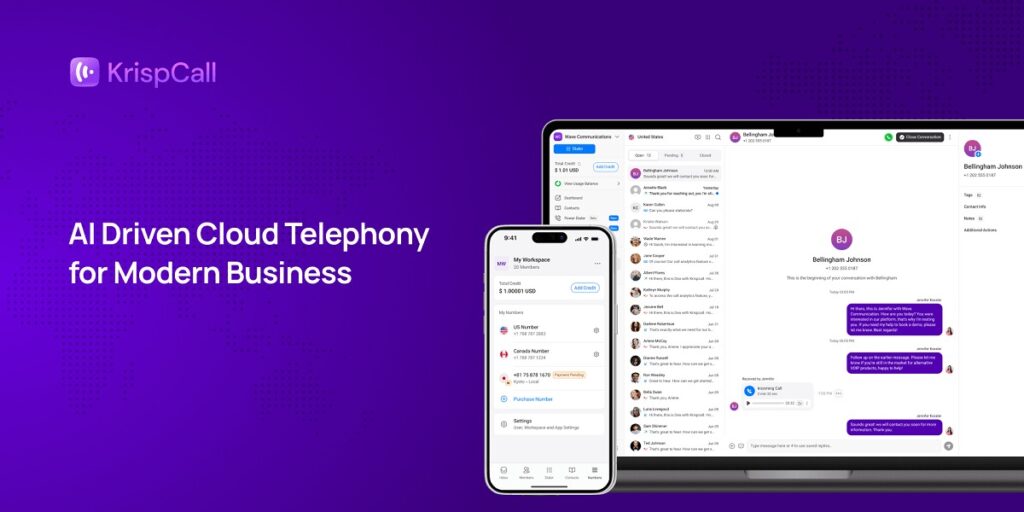
KrispCall’s integration with Salesforce provides your team with a complete, 360-degree view of each customer interaction. By having access to both interaction data and CRM information, you can fine-tune your sales and marketing strategies based on real-time insights into customer behavior and preferences.
With this integration, you can optimize every step of the sales funnel, leading to improved conversion rates and a more effective marketing strategy.
Features
- Automatic call logging.
- Click-to-Dial feature.
- Click-to-SMS feature.
- Global virtual numbers.
- Call recording and voicemail.
Benefits
- Simple integration process with Salesforce
- Cost-effective pricing plans
- Strong global presence
- Useful call management tools
- User-friendly interface
- Responsive 24/7 customer support
B. OpenPhone
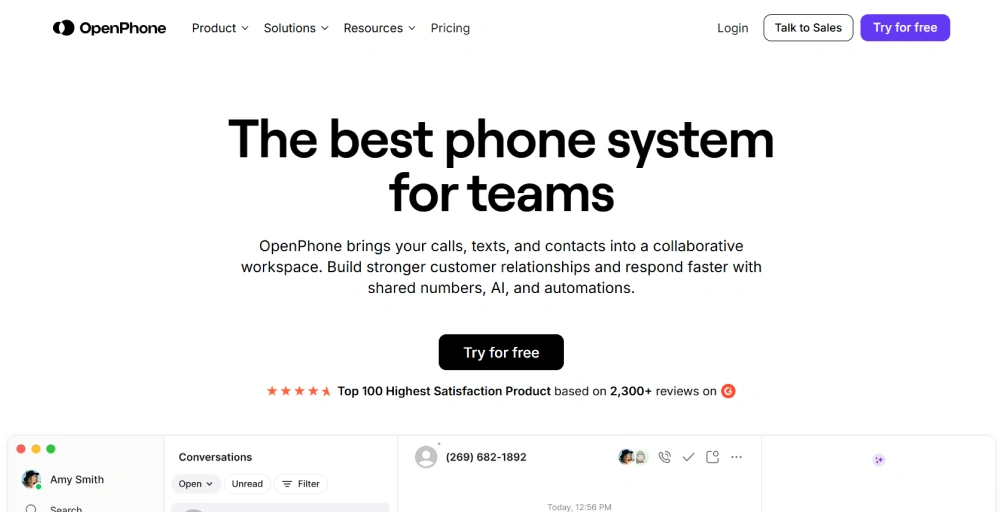
OpenPhone is a user-friendly VoIP platform tailored for small to medium-sized businesses. It offers seamless Salesforce integration, syncing calls, texts, and voicemails to streamline CRM workflows.
It enhances customer engagement with an intuitive interface and global number support, making it easy to manage communications within Salesforce.
Features
- Automatic call, text, and voicemail logging in Salesforce
- Click-to-dial from Salesforce records
- AI-powered call summaries and transcripts
- Number sharing collaboration tools
Benefits
- Easy Salesforce integration setup
- Affordable pricing with free trials
- Streamlined communication tracking in CRM
- Intuitive mobile and web interface
C. RingCentral
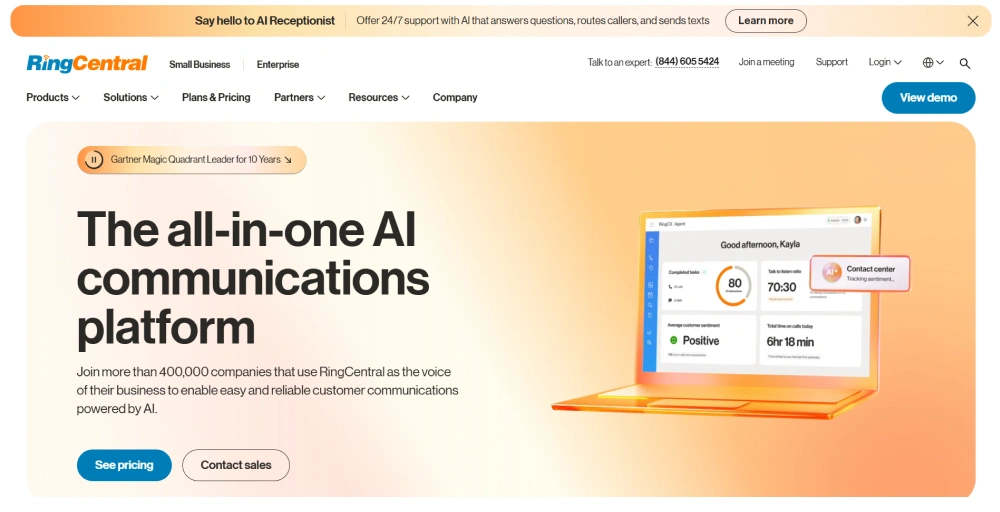
RingCentral is a robust unified communications platform suitable for businesses of all sizes. Its Salesforce integration provides real-time call syncing and customer data access, improving sales and support efficiency.
With its comprehensive omnichannel tools like voice, video, and messaging, it helps teams utilize Salesforce for better customer insights and productivity.
Features
- Screen pops displaying Salesforce customer data during calls
- Seamless integration with Sales Cloud and Service Cloud
- Video conferencing linked to Salesforce activities
- Advanced call queuing for high-volume teams
Benefits
- Unified voice and video in Salesforce
- Strong compliance for regulated industries
- Reliable for large-scale operations
- Offer enterprise-grade CRM efficiency
D. Vonange
Vonage is a versatile VoIP platform that offers strong Salesforce integration through its advanced contact management system.
It syncs communication data in real time, supporting personalized customer interactions. With extensive support for international numbers, Vonage enhances your CRM-driven sales and support strategies.
Features
- Intelligent call routing based on Salesforce data
- Real-time syncing of multi-channel interactions (voice, SMS)
- AI virtual agents for automated Salesforce logging
- Global numbers in 96 countries tied to CRM
- Custom API workflows for Salesforce
Benefits
- Helps to adjust interactions using CRM insights
- Ideal for global contact centers
- Flexible pricing with add-on options
- Enhances automation with AI tools
- Supports complex Salesforce customizations
E. Aircall
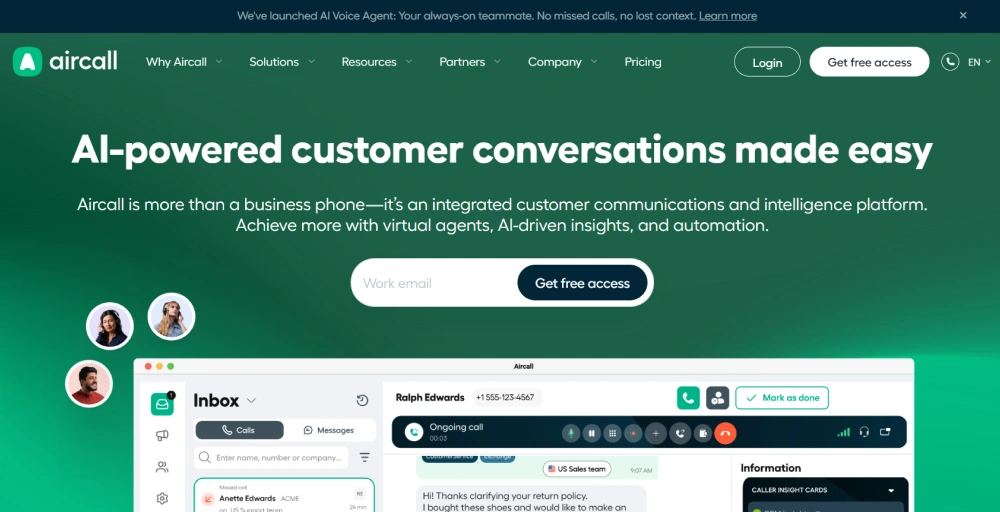
Aircall is a cloud-based VoIP platform offering seamless Salesforce integration designed for sales and support teams. It syncs calls and customer data in real time, enabling efficient call management within Salesforce.
With strong international support and an intuitive interface, Aircall improves CRM-driven customer engagement.
Features
- Automatic call tagging and categorization in Salesforce
- International call routing synced with CRM
- Live call monitoring with Salesforce notes
- Workflow automation via Salesforce triggers
- Number porting for existing Salesforce setups
Benefits
- Simplifies global call management
- Enhances CRM with automated tagging
- Supports number transitions
- Faster deployment for sales teams
The sum-up! Why should you choose VoIP Salesforce integration?
VoIP Salesforce integration simplifies your workflow by bringing all communication into one place, saving time with features like automatic call logging and one-click dialing.
It boosts customer service by giving your team instant access to customer details, making interactions more personal and efficient. Plus, it helps sales and support teams work together better with shared data, driving higher conversions and smarter decisions to grow your business.