

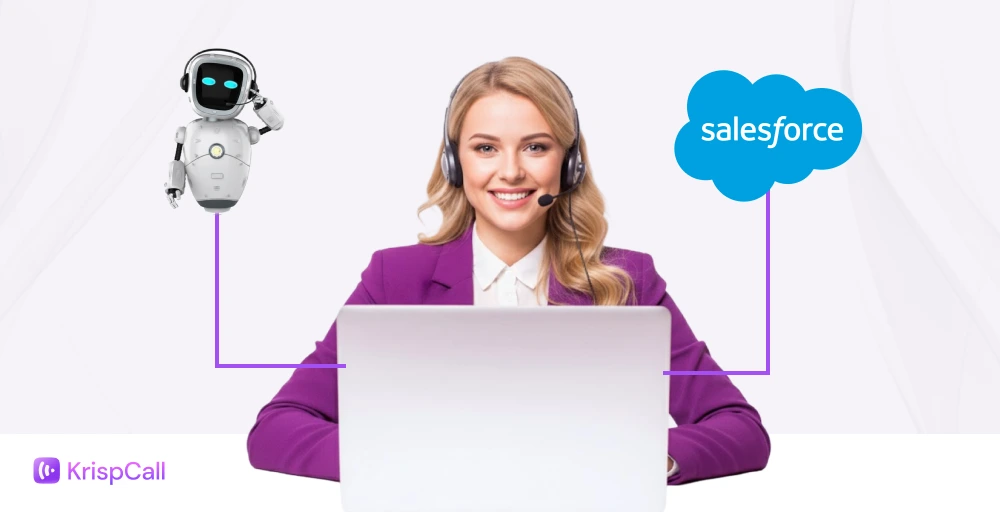
Salesforce has been a go-to CRM for managing customer relationships, sales pipelines, and service operations for a long period of time. And when paired with AI call center solutions, it becomes even more powerful.
From AI-powered analytics to automated call handling, integrating call center software with Salesforce helps teams save time, reduce manual work, and focus on high-value conversations.
In this blog, we’ll explore the best AI call center solutions integrated with Salesforce that enhance agent productivity, improve customer engagement, and simplify contact center management.
✨ Key Takeaways
- AI call center solutions integrated with Salesforce enhance customer experience through smarter routing, sentiment analysis, and personalized interactions.
- AI-powered call logging helps teams save time, maintain accurate CRM data, and improve visibility across every customer interaction.
- Top center platforms like KrispCall, Talkdesk, Zendesk, Aircall, and Harmonix AI offer reliable Salesforce integration for efficient and data-driven telephony.
What are AI call center solutions?
AI contact center solutions are advanced software platforms that use artificial intelligence to manage and enhance customer interactions across different channels, from voice to digital. These solutions also combine automation, analytics, and machine learning technologies to help contact centers handle calls more efficiently and deliver personalized customer experiences.
Unlike traditional call center software that relies heavily on manual input and predefined scripts, AI-driven systems can analyze caller intent, predict needs, and even assist agents in real time.
Features like AI-powered call routing, sentiment analysis, and automated responses make it easier to resolve issues faster and improve overall service quality, something traditional systems can’t achieve on their own.
Top 5 AI call center solutions integrated with Salesforce
Different AI based call center solutions offer different strengths, pricing models, and integration capabilities. The table below gives readers a quick view of key features and pricing before exploring top AI call center solutions in detail.
| AI powered contact center solutions | Key features | Pricing |
| KrispCall | AI rephrasing, AI reply, AI transcription, global calling | Starts at $15 per user per month |
| Talkdesk | Automated customer support tools, Salesforce compatibility, automated workflows | Starts at $85 per user per month |
| Zendesk | Omnichannel service tools, Process automation, Ticket management | Starts $25 per user per month |
| Aircall | Virtual call center, AI-generated call summaries, call transcription | Starts at $40 per license |
| Harmonix AI | Automatic email creation, conversation summaries, automated workflows | Talk to sales |
1. KrispCall
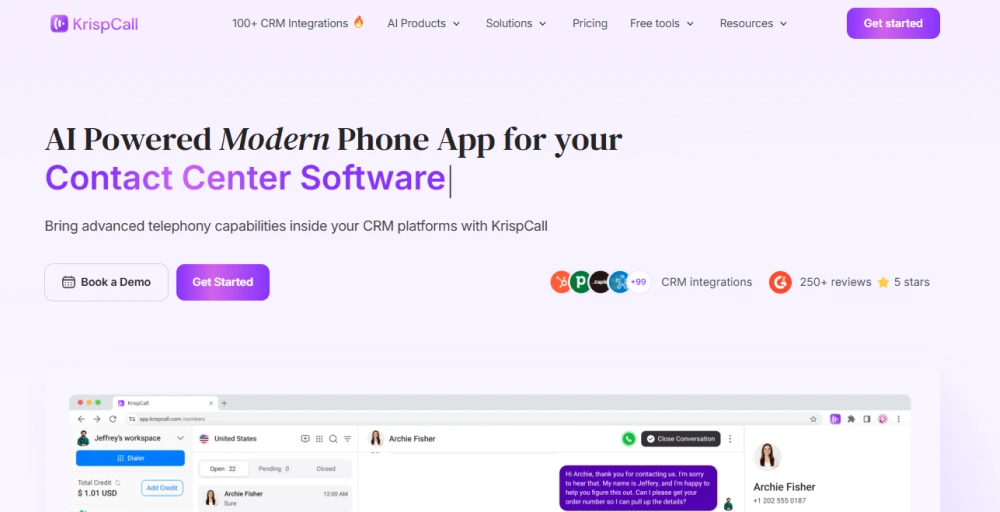
KrispCall connects directly with Salesforce to keep caller data and telephony actions unified in one place. The integration supports teams with capabilities that automatically sync conversation histories, reduce manual tasks, and keep customer records accurate without extra effort.
G2 ratings: 4.5/5 (Read reviews)
Key features
- AI-supported caller insights during live calls
- Automatic call logging inside Salesforce
- Click-to-call from Salesforce records
- Unified Callbox for calls, voicemails, and messages
- Wide global number availability
Pros
- Quick setup with Salesforce.
- Strong call quality for sales and support teams.
- Easy interface for growing teams.
- Affordable plans for businesses at different scales.
Cons
- Advanced AI analytics are available only in higher plans.
- Limited third-party automation compared to larger platforms.
2. Talkdesk
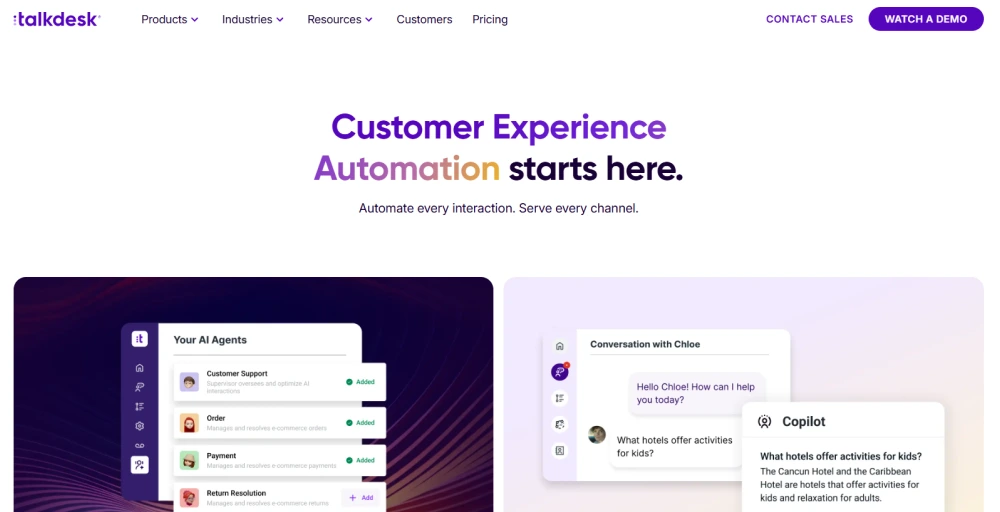
Talkdesk is one of the best AI driven contact center solutions that offers support features to help teams handle calls efficiently while keeping Salesforce updated through direct integration. When integrated with Salesforce, Talkdesk focuses on faster resolutions and clear guidance for agents during customer interactions.
G2 ratings: 4.4/5 (Read reviews)
Key features
- AI assistance for live conversations
- Automated workflows inside Salesforce
- Sentiment tracking and caller intent recognition
- IVR with voice analysis
- Performance analytics for agents
Pros
- Strong AI support for busy support teams.
- Detailed customer interaction analytics.
- Works smoothly with Salesforce tools and dashboards.
Cons
- Pricing can be on the expensive side.
- Complex features may require training for new users.
3. Zendesk
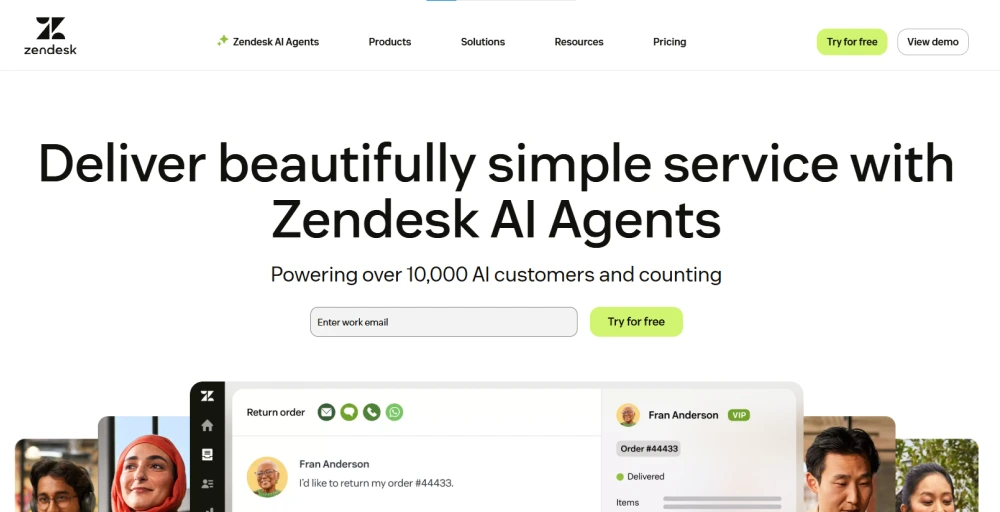
Zendesk brings voice capabilities into its customer service suite and connects them with Salesforce to keep support records aligned. AI tools help teams respond quickly while maintaining helpful guidance throughout every interaction.
G2 ratings: 4.7/5 (Read reviews)
Key features
- AI support for common questions and ticket routing
- Salesforce syncing for contact details and case updates
- Call recording and QA tools
- Call routing based on skills and customer needs
- Multichannel service management
Pros
- Strong service management features in one platform.
- Helpful automation for repetitive tasks.
- Clear visibility into tickets and calls for agents and managers.
Cons
- Configuring multiple channels and routing rules is quite time-consuming.
- Higher tiers are needed for advanced AI tools.
4. Aircall
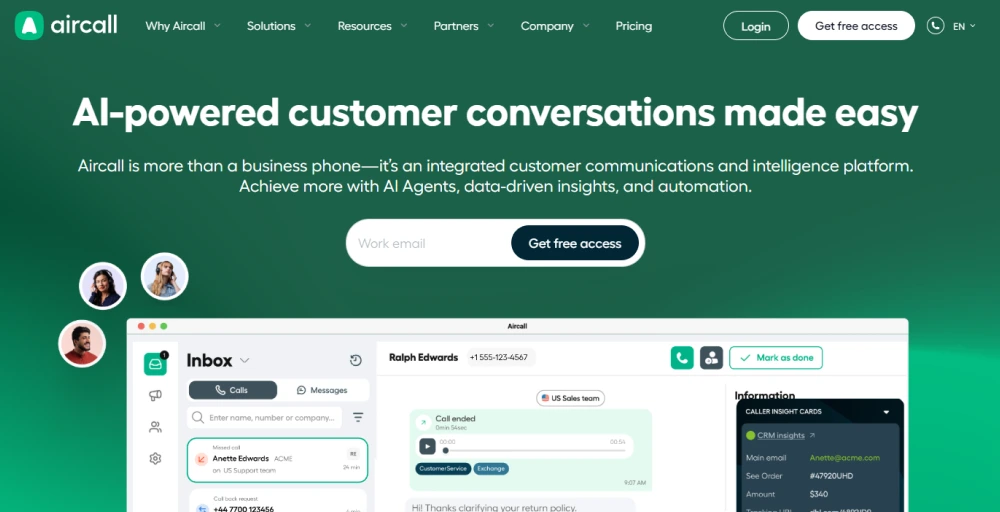
AI call center services like Aircall provide a lightweight telephony experience that pairs well with Salesforce for sales and support use cases. It offers a clear calling experience, quick setup, and AI-enhanced features that assist teams during daily customer conversations.
G2 ratings: 4.4/5 (Read reviews)
Key features
- Direct Salesforce integration with automatic activity logging
- AI-assisted call summaries and notes
- Click-to-call from Salesforce
- Call queues and IVR setup
- Collaboration features like a shared call inbox
Pros
- Easy onboarding for new users.
- Helpful tools for growing call teams.
- Clear telephony controls for sales operations.
Cons
- AI capabilities only expand through add-ons.
- Limited analytics in basic plans.
5. Harmonix AI
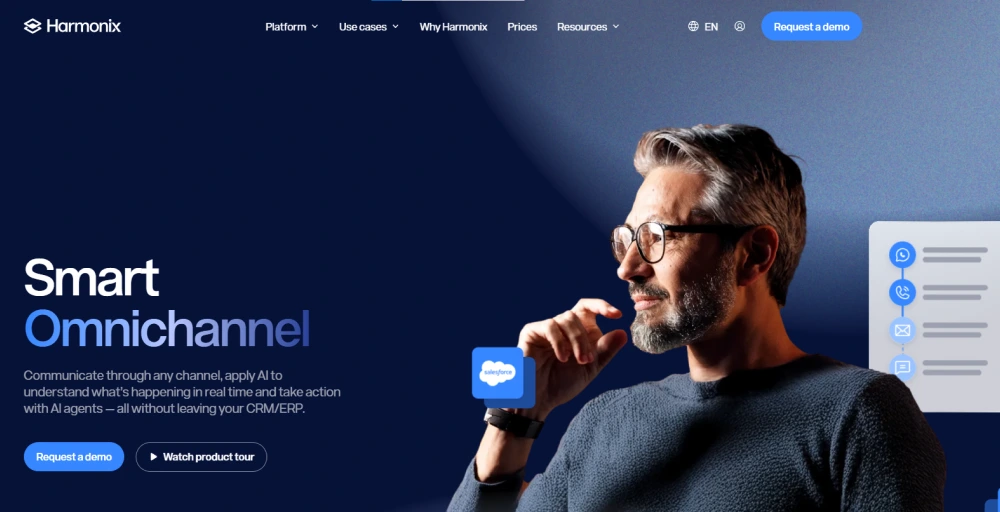
Harmonix AI brings automated voice workflows and guided assistance into Salesforce environments. It focuses on accurate caller understanding, faster handling, and smooth updates to CRM data during and after calls.
G2 ratings: Yet to be listed
Key features
- Conversational analysis for caller intent
- Salesforce-linked call actions and data syncing
- Automated follow-up tasks and notes
- Post-summaries with action items
- Quality scoring based on conversation patterns
Pros
- Strong automation for busy teams.
- Clear insights from voice analytics.
- Helpful suggestions for agents in complex calls.
Cons
- Pricing available only by request.
- Learning curve for advanced features.
Why integrate AI call center solutions with Salesforce?
The main reason for integrating AI powered call center solutions with Salesforce is to bring all the customer conversions, data, and insights into one connected system. By blending AI automation with Salesforce’s CRM depth, businesses can create experiences that feel both efficient and personal.
Here are 5 reasons to integrate AI-powered call center tools with Salesforce:
1. Enhanced customer experience
AI-supported telephony systems analyze caller intent, tone, and history before an agent even answers the call. With Salesforce integration, that intelligence pairs directly with contact details, past interactions, and purchase records.
Agents can greet each customer by name, reference previous cases, and offer relevant solutions instantly. Over time, this personalized, consistent, data-backed approach strengthens customer satisfaction and loyalty.
2. Faster lead response and follow-ups
When AI tools and Salesforce work together, lead handling becomes almost automatic. Calls can trigger instant record creation, tasks, and reminders. The team can set up a system that can automatically highlight high-value leads, ensuring sales teams contact them first.
The integrated AI tools also enable automatic scheduling of follow-up activities and reminders or alerts for important updates, right inside Salesforce. These time-saving features shorten the response window and the gap between first contact and follow-up, keeping sales momentum strong.
3. Increased agent productivity
Manual call logging, transcription, and routing slow down performance in traditional call centers. AI automated these repetitive tasks without extra effort from agents. Integration with Salesforce keeps everything synchronized, so no one wastes time switching between systems.
This automation allows agents to focus on active problem-solving, developing strategies for upselling, or nurturing existing relationships to improve outcomes and morale.
4. Data-driven insights
Rather than manually adding every call to Salesforce’s data pool, AI solutions can automatically turn these calls into a source of strategic information. When integrated with Salesforce analytics, it translates speech patterns, sentiment, and outcomes into clear reports.
Managers can analyze and monitor these reports to identify training needs or areas of improvement. The insights gained afterward can be utilized to make data-driven decisions that improve call routing, customer experience, and even marketing strategies.
5. Scalability and efficiency
For a small business, high call volumes even during peak seasons may not overwhelm, but for a growing business, it can be quite difficult to manage these calls. When you integrate AI-powered solutions with Salesforce, it not only handles the surge but also supports the scalability.
AI solutions allow businesses to automate their workflows and optimize their agent allocation. Teams can set up a system that checks quality to ensure consistent performance across expanding teams.
Challenges of implementing AI solutions with Salesforce
Integrating AI call center tools with Salesforce offers big advantages, but it also comes with a few practical challenges.
Here are common challenges that help businesses prepare their teams, plan ahead, and get the most out of the integration:
1. User adoption
Employees often hesitate to switch from traditional tools to AI-supported systems as they fear AI is gonna take their jobs. This overall lack of understanding and a steep learning curve also adds up to their resistance.
Solution: Give as much time as needed to adjust to new workflows, dashboards, and automation features. Providing consistent training, conducting seminars to help understand the usefulness of AI, and overall internal support are the keys to ensuring adoption across teams.
2. Maintain data accuracy
AI models cannot differentiate between good and bad data on their own. It will learn from what it’s given, meaning only high-quality data input yields accurate, reliable results. So, any outdated or duplicate entries in Salesforce can cause errors in AI-driven workflows.
Solution: Regularly audit your data to maintain consistent, accurate workflows. Try to minimize human errors as much as possible when manually feeding data to AI systems.
3. Data migration and integration issues
Integrating AI tools into Salesforce can involve complex data mapping. Problems often arise during migration when existing fields or formats of one system do not perfectly align with the other system.
Solution: Before executing the integration process, make sure to ensure the AI solution is compatible with Salesforce. Regularly test during setup to prevent loss of important information.
4. Complexity of customization
Each business has its own unique workflows and operational processes. And when your system is built on highly customized traditional Salesforce solutions, integrating AI can create scalability limitations.
Solution: Take time to understand what features can cause what effect in the future, and only customize AI features that are a must, so that you can maintain a balance between operation and simplicity.
5. Continuous update and maintenance
AI models and Salesforce both evolve frequently. Keeping integrations updated ensures compatibility and security, but it does require ongoing technical oversight and significant costs for subscription fees, licenses, and customization as well.
Solution: Preplan your maintenance and updates to avoid disruptions. Try to find common ground on what’s working for your business and what needs an instant update.
How to choose the right AI call center solution for Salesforce?
Selecting the right AI call center platform depends on how well it fits your team’s goals, customer needs, and Salesforce setup. A thoughtful evaluation ensures your investment supports both current requirements and long-term growth.
1. Scalability
Choose a solution that grows with your business. As call volumes and customer bases expand, the platform should handle more users, locations, and interactions without performance loss.
2. Multichannel support
Customers reach out through voice, chat, email, and social channels. Look for AI tools that connect all these touchpoints with Salesforce to provide a unified customer view and consistent experience across every channel.
3. AI Capabilities
Assess how advanced each AI platform truly is. Look for features that will make your daily operational activities and bring tangible value to both customer experience and productivity.
4. Customization options
Look for an AI solution that lets you customize your dashboards and routing rules, and automate workflows as needed. The integration should also align with your Salesforce data model without heavy technical intervention.
5. Cost and ROI
Compare not just pricing but long-term returns as well. Consider how much time, accuracy, and efficiency the system delivers relative to its subscription cost. The most cost-effective option is one that delivers measurable improvements in call handling and customer satisfaction.
6. Seamless Salesforce integration
Strong compatibility with Salesforce is non-negotiable. The platform should sync data automatically, avoid duplication, and support real-time updates between systems to maintain a single source of truth.
What makes KrispCall a standout AI call center solution for Salesforce users?
KrispCall combines powerful AI features with direct Salesforce integration, creating a complete environment for sales and support teams. It simplifies how agents manage calls, access data, and maintain custom relationships, all without a single, connected workspace.
1. Seamless Salesforce integration
KrispCall connects effortlessly with Salesforce, syncing call logs, notes, and contact details automatically. This ensures every customer interaction is documented and accessible in real time, without manual effort.
2. Advanced AI capabilities
AI tools assist agents during live calls with real-time insights, call summaries, and task automation. These features reduce repetitive work, improve accuracy, and speed up resolutions.
3. Unified telephony hub
KrispCall centralizes voice calls, messages, and voicemails in one place. Agents can manage multiple channels without switching platforms, keeping workflows organized and efficient.
4. Enhanced sales and support performance
With better visibility into customer data and AI-guided insights, teams can handle leads and support requests more effectively. Managers can monitor performance, identify trends, and refine strategies based on accurate call analytics.
5. Easy setup and support
KrispCall is designed for quick implementation. It’s a simple setup process, and a responsive support team makes onboarding smooth for businesses of any size.
Final thoughts!
AI call center solutions have redefined how businesses interact with customers. When combined with Salesforce, they bring data, automation, and telephony into one synchronized system that drives efficiency and clarity across the call.
Each platform offers a unique strength, but KrispCall delivers a particularly balanced experience with simple setup, strong AI tools, and seamless Salesforce integration. It helps teams manage calls, leads, and customer records with precision and ease.
If you’re ready to experience faster workflows, sharper insights, and smoother telephony within Salesforce, book a free demo with KrispCall today and see how it reshapes your customer experience.