



Remember the twisted-pair copper wire line on your home landline phone, fax machine, or old POS (Point-of-Sales) system used for credit card payment. Yes, that’s a “POTS Line”.
Even today, these lines are not completely obsolete due to their reliability and multifarious purposes. However, the emergence of modern telecommunication, especially internet-based solutions, will definitely raise the question. Is it still worthy?
Well, this blog will equip you with the comprehensive details on the POTS line, including its mechanism and how it differs from VoIP. As a bonus, we will also cover the best POTS alternative to ponder if you’re considering switching to VoIP.
✨ Key Takeaways
- A POTS line is a traditional analog phone line that uses physical copper wires to transmit voice signals.
- These POTS lines are generally used for fax transmission, credit card processing systems, security alarm systems, and digital subscriber lines (DSL).
- POTS line works by creating a dedicated circuit between two telephones during a call to improve connection quality.
What is a POTS line?
POTS, also called Plain Old Telephone Service, is a traditional phone line service that uses twisted-pair copper wire for voice transmission. It is well known for its dependability, but it has become less common nowadays. You can consider POTS as the landline service that is used at home or a small business.
POTS is also often referred to as PSTN, short for Public Switched Telephone Network. However, both are different and denote distinct entities.

POTS is an old telecommunication service that runs through the PSTN. In contrast, PSTN is a network made of copper wires and other hardware equipment to enable voice communication over landlines. Simply put:
- POTS = the old analog phone service.
- PSTN = the overall network infrastructure that includes POTS and other digital services.
The term “POTS” emerged as a retronym, a new name for an old technology, after modern communication methods like ISDN, cellular networks, and VoIP (Voice over IP) became more common.
What are POTS lines used for?
Despite the emergence of digital alternatives like internet-based calling and mobile phones, POTS lines aren’t becoming fully obsolete. These lines still have multiple purposes, such as:
- Fax transmission: Certain industries, such as legal, healthcare, and government, still use the POTS lines to fax documents, including records, signatures, or to exchange sensitive information, or even pay for research paper for reading case studies relevant to their fields.
- Credit card processing systems: Most of the Point-of-Sales (POS) systems run through a POTS line for processing debit and credit card payments. This system is mainly used by small businesses, retail shops, or locations with inconsistent internet access.
- Security and alarm system: The residential and commercial security systems still rely on the dedicated POTS line for monitoring and directing emergency services. It can execute even during local power outages, making it an exceptionally dependable choice for security infrastructure.
- Digital Subscriber Lines (DSL): Early broadband internet still relied on the POTS lines to operate its service. For instance, DSL utilizes the POTS lines to deliver internet connectivity and traditional voice simultaneously.
How does the POTS line work?
The core mechanism of the POTS line lies in building and maintaining a dedicated electrical circuit between two telephones for the entire duration of a call. Here is the step-by-step breakdown of the POTS lines mechanism:
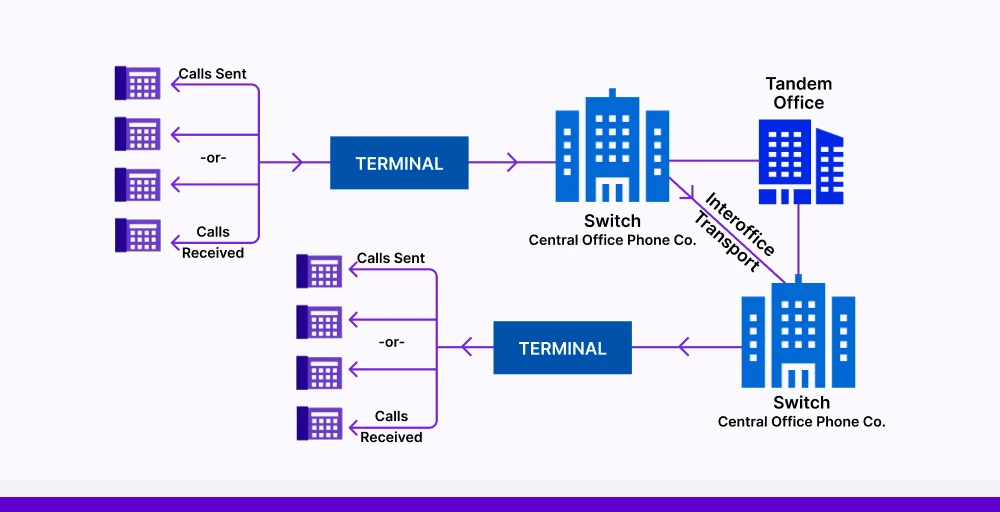
Step 1: Analog signaling from the handset
Initially, when you make a call and start speaking, the handset’s microphone works as a transducer. The handset microphone converts sound waves into a corresponding analog electrical signal.
Step 2: Transmission to the local loop and network interface
Now, analog electrical signals travel from your telephone through the twisted-pair copper wires. From this point, your line, which is also known as the “local loop,“ directly connects with the nearest telephone company, central office, or exchange via an aerial cable.
Step 3: Routing through automated switches
Once the electrical signal is received by the central office electronic switches, these switches interpret the tones generated as you dial the phone number. It then acts as an intelligent call routing and determines the exact destination within the dedicated PSTN based on the dialed digits.
Step 4: Establishing a dedicated circuit
After successful interpretation of the entered number, the switches will then establish the direct connection between the recipient’s phone and your phone. For an international call, the call will route through various interconnected regional, local, national, or international switches.
Step 5: Voice reconstruction and signal decoding
When the electrical signals reach the receiver’s phone, the headset will decode those signals back into sound waves. This allows the receiver to hear your voice as if you were speaking to them.
Step 6: Call termination
The dedicated circuit remains active during the conversation. Once either party hangs up, the switches detect the disconnections and the circuit is released, making the line available for new calls.
POTS technology: An overview
Plain Old Telephone Service (POTS) is the old analog voice transmission system that has been the backbone of telephone communication for over 100 years. It’s a dedicated copper wire circuit between two endpoints that allows real-time voice communication.
POTS is circuit switched; a physical, electrical path is established between the callers for the entire duration of the call. It’s powered by the telephone line itself, so it will work during power outages, an advantage over many digital systems.
Moreover, the modems are vital for updating POTS with digital technology. The DSL (Digital Subscriber Line) modem supports multiple users, while the ISDN (Integrated Services Digital Network) provides enhanced quality, speed, and advanced features for both data and voice communication.
Pros of POTS line
Even though the POTS line uses the traditional way of telecommunication, this line still provides multiple advantages to organizations.
- Exceptional reliability: Inherent reliability is one of the significant benefits of the POTS line. Even during the local power outages, these lines are fully functional, making them a crucial lifeline for emergencies.
- Independence from internet connectivity: POTS line does not rely on an active internet connection, unlike a modern VoIP system. Its operations are executed through cable lines, so there are no issues like network congestion, Wi-Fi dropout, and broadband speed fluctuations.
- Compatibility with legacy equipment: POTS lines provide seamless compatibility with devices such as credit card terminals, older fax machines, or security systems. It eliminates the need for expensive upgrades to integrate with existing equipment.
- Ease of use and familiarity: POTS operations are user-friendly, and most people are familiar with the traditional phone headset and dialing that are used on the POTS technology.
Cons of POTS line
POTS line comes with several limitations that make it less suitable for today’s communication needs:
- Limited features and functionality: One of the major drawbacks of POTS lines is that they lack several modern communication features such as video conferencing, call forwarding, call waiting, or caller ID. If your business requirements are beyond basic voice calling, then POTS is not perfect for you.
- Higher installation and maintenance costs: In the installation phase, the POTS line needs the expensive physical copper wire and dedicated phone jacks for the connection. However, these requirements are fully eliminated on the VoIP system.
- Inferior voice quality: The quality of the voice over POTS communication can be lower, in contrast to the digital system. As it works on the analog signals, these signals are usually more susceptible to static, noise, and signal degradation, especially during long-distance communication.
- Lack of flexibility and scalability: Accommodating business growth can be difficult as they have to install on-premises. Moreover, adding new POTS lines needs physical installation, which is a time-consuming, costly, and cumbersome process.
POTS vs VoIP: What are the differences?
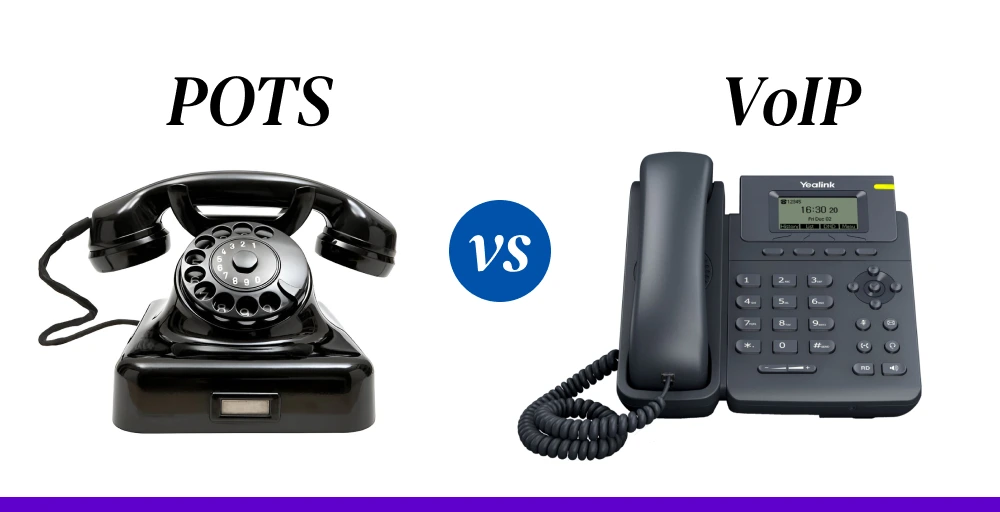
Both POTS and VoIP provide telecommunication services. However, these two are distinct entities, and their features differ from each other.
Their difference lies in their core mechanism and the equipment they use. The POTS works on the analog signal and uses the traditional wire, like twisted-pair copper wire, whilst the VoIP operates through the internet using digital data packets to transmit the voice from one destination to another.
Here is the list of differences between POTS vs VoIP based on multifarious factors, from technology, cost, to its security.
| Feature | POTS (Plain Old Telephone Service) | VoIP (Voice over Internet Protocol) |
| Technology | Operate through dedicated copper wires using analog signals (circuit-switched network) | Use digital data packets and run through the internet (packet-switched network) |
| Equipments | Depends on traditional telephone lines and physical switches | Fully rely on an internet connection and an IP network |
| Cost | Usually high, the initial set-up cost is expensive | Lower contrast to the POTS as it eliminates the installation cost |
| Features | Basic call functions such as call forwarding, voicemail, etc. | Beyond basic call functions like call routing, video-conferencing, and integration with business tools (CRMs and ERP) |
| Reliability | Highly reliable, as it can work even during power outages | Rely on the internet connection quality |
| Scalability | Require a physical line for installation, which is often a costly and cumbersome process to scale | Cost-effective and easily scalable (adding or removing lines is usually done digitally) |
| Call Quality | Limited frequency range and susceptible to noise | Generate HD audio, which can be affected by the internet speed |
| Security | Less likely to face cyber threats like hacking or DDoS attacks | Often includes security measures such as data encryption and HIPAA compliance |
Overall, POTS is a traditional telecommunication service that is more reliable but provides less flexibility and scalability to businesses. Contrarily, VoIP is a modern internet-based solution with advanced call-handling features.
Still using the POTS Line?
If you are still relying on the POTS line or planning to adopt this system, then you can continue as long as you don’t require beyond basic calling. For personal use or small businesses that only require simple voice communication, POTS remains a reliable and straightforward option.
However, as communication needs evolve, POTS falls short on advanced calling features that are now essential for modern business operations. That’s where VoIP (Voice over Internet Protocol) comes in.
With VoIP, you get access to a wide range of advanced features like:
- Multi-level IVR
- Unified Callbox
- Call recording
- Wi-Fi calling
- Video conferencing
- Seamless integration with CRMs and business tools
- Voicemail-to-email
The Best POTS alternative: KrispCall
If you’re still using a traditional landline (POTS) or looking to upgrade, it’s time to consider a more powerful solution. KrispCall offers everything you need in a modern phone system, flexibility, rich features, scalability, and affordability all in one platform.

Thousands of startups, small businesses, and enterprises worldwide trust KrispCall for their telephony needs. Its cloud-based phone system gives teams the tools to stay connected from anywhere, helping them work more efficiently, whether in the office or on the go.
With KrispCall’s VoIP solution, you get access to robust features such as:
- Global calling
- Voicemail
- Multi-level IVR and call tagging
- Call forwarding
- Virtual phone numbers from 100+ countries
- CRM integrations (HubSpot, Salesforce, and more)
From business calls and team collaboration to remote work and global expansion, KrispCall supports it all at a fraction of the cost of traditional POTS lines.
Frequently Asked Questions
Are POTS lines discontinued?
POTS lines are not completely obsolete. However, telecom companies like Verizon, AT&T, and Lumen find this system expensive and are focusing on digital alternatives. Most carriers also no longer offer new POTS line installations.