


Customer satisfaction survey questions are one of the most effective ways to gather feedback from customers and understand how they feel about your brand. However, it can be confusing which question you should ask to get the most relevant data.
Well-crafted questions can help you gather valuable insights about your customer, whereas poorly written ones can leave you with vague and useless data.
Moreover, asking too many or irrelevant questions can even frustrate them and make them abandon the survey altogether. This is why it’s essential to use clear and effective survey questions tailored to specific goals and purposes.
In this blog, we have compiled 50 customer satisfaction survey questions along with some actionable tips to help your business gather meaningful responses from your customers and drive measurable growth.
✨ Key Takeaways
- Customer satisfaction questions are queries used to measure the customer’s satisfaction rate and identify potential areas for improvement.
- With effective consumer survey questions, businesses can improve customer loyalty, drive product/service improvements, boost customer experience, & make better business decisions.
- Some customer satisfaction survey best practices include making questions concise and relevant, using different question types, and offering incentives for survey completion.
What are customer satisfaction survey questions?
Customer satisfaction survey questions are queries designed to understand how satisfied your customers are with your products, services, or the overall brand experience.
It provides direct insights from the customers, allowing businesses to understand their needs, measure satisfaction levels, and identify potential hurdles in the customer’s journey.

Whether via a rating system or open-ended questions, these survey questionnaires are essential to understand your customers and improve their experience.
Here are some of the most common customer satisfaction survey questions examples:
- On a scale of 1 to 10, how satisfied are you with our service?
- How likely are you to recommend our brand to a friend or colleague?
- How would you rate the quality of our support team’s service?
50 best customer satisfaction survey questions
Here are 50 carefully curated questions on service, experience, feedback, loyalty, and marketing that will help you get responses from your customers.
1. Customer service questions
Customer service questions involve asking the customers what they think about the customer support team. It can include questions about their experience, the effectiveness of the support, or any particular interaction.
- Were our agents able to successfully resolve your issues? Please tell us about how they handled and resolved your issues.
- How would you describe the effectiveness of our support team?
- Please describe any difficulties that you’ve faced in contacting the customer support.
- On average, how quickly did our representative resolve your issue?
- When communicating with our agents, were you able to understand them clearly? Were there any issues?
- How pleased are you with our support team?
- Can you share your thoughts about your latest interaction with our customer support team?
- How knowledgeable did you feel the representatives were about the product/service?
- On a scale of 1 to 10, how much effort did you have to put in to reach the support team and have your issues resolved?
- Did you feel that our agent respected your time in every interaction?
2. Customer experience and satisfaction questions

These types of questions tell companies how the customer feels about using your product, service, processes, etc. It gives you insights about the weaknesses and potential churn points, and how they could be improved upon.
- How would you rate your overall experience with our company?
- On a scale of 0 to 10, how likely are you to recommend us to your friend or family?
- Do you find our product or service easy to use?
- What are the best and the worst experiences that you’ve had with our brand?
- How has our product/service impacted your day-to-day operations?
- On a scale of 1 to 10, how satisfied are you with our offerings?
- What features do you like the most about our offerings?
- Do you feel like our product/service provides value for money?
- Was our product/service able to meet your expectations? Can you please share your thoughts?
- How has your initial impression of our company changed over time?
3. Feedback and suggestions question
Customer feedback questionnaires involve collecting honest opinions and suggestions directly from the customers. With these insights, businesses can make the necessary adjustments that drive improvement and enhance customer satisfaction.
- What improvements would you like to see in our offerings that would enhance your experience?
- On a scale of 1 to 5, how would you rate the quality of our product/services?
- If there was one thing that you would change in our product/service, what would it be?
- Based on your experience, do you have any suggestions you would like to share with us?
- Are there any aspects or features that we lack compared to the other options in the market?
- Could you please share your honest opinion with us on our latest offerings?
- What does your ideal customer service experience look like, and were we able to provide it?
- Tell us about any difficulties that you’ve faced while doing business with our brand.
- Are there any features that you would like to see in the future?
- Has our service improved your work efficiency? Please share your thoughts on how it can be made even better.
4. Customer loyalty questions

These types of questions help businesses identify and understand their loyal customer base, as well as potential hurdles that affect their retention rate. By asking your customer how satisfied they are with your brand and their willingness to recommend it to others, you show how satisfied they are with your business.
- How satisfied are you with our product/service?
- How likely are you to make your next purchase with us in the future?
- Compared to others, how competitive are our products/services?
- What’s the best aspect of our brand that the rest of the market does not offer?
- On a scale of 1 to 10, how satisfied do you feel with our brand?
- Have you thought about switching companies? If yes, why?
- Would you switch to other brands if they offered similar products at lower prices?
- If you had to describe our brand in a few words, what would it be?
- Do you feel valued as a customer when doing business with us? Why or why not?
- What’s the one thing that’ll make you consider long-term continued business with us?
5. Marketing questions
Marketing survey questions can help to learn how customers are hearing about your company. It helps to understand the customer’s expectations, interests, pain points, hesitations, etc, to tailor their experience for a better satisfaction rate.
- How did you first hear about our company?
- What is the one factor about our product/service/brand that piqued your interest?
- How would you describe our brand to your friends or colleagues?
- Did you consider any other alternative before choosing our brand? If so, what influenced your decision?
- What is your preferred channel for business communication?
- When you think about a product/service, which is the first brand that comes to your mind, and why?
- What were your biggest hesitations before choosing our product/services?
- Which features or aspects would you consider a ‘dealbreaker’ if they suddenly became unavailable?
- What are the issues that you hope to solve using our product/services?
- How frequently do you use our product, and how has it helped you?
Types of customer service survey questions
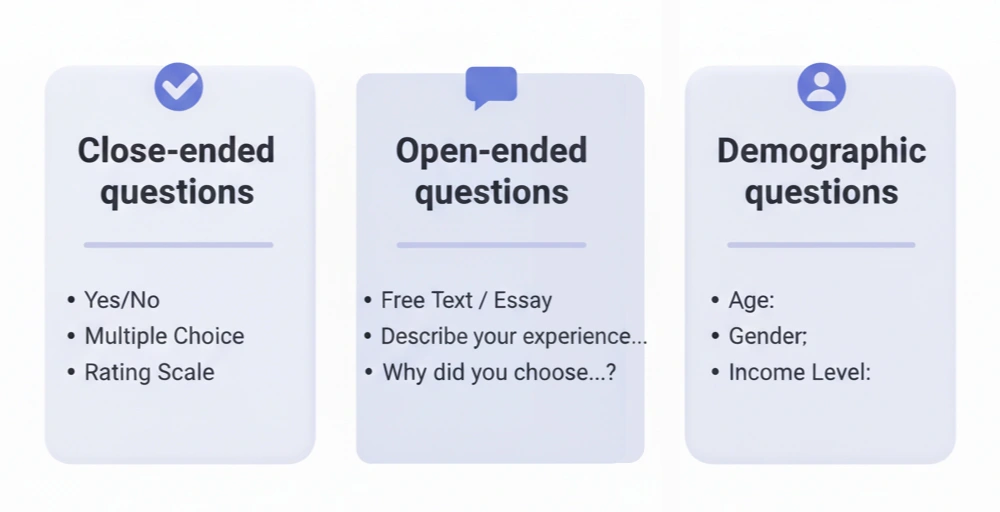
There are various types of survey questionnaires that fulfill different purposes. For simplicity, we can categorize these questions into three types. i.e., Closed-ended, Open-ended, and Demographic questions.
Let’s briefly take a look at each of them.
1. Close-ended questions
Close-ended questions are the type of questions that offer customers a set of predefined responses to choose from. For instance, asking your customers, “Is the product easy to use?” and offering “Yes” and “No” options.
These questions are helpful to generate clear and quantifiable data, which allows businesses to identify market trends, track metrics, and make data-driven decisions.
2. Open-ended questions
Open-ended questions do not have any predefined responses or answers. Instead, it involves detailed and honest answers from the customers. These types of questions encourage users to speak their mind and express their thoughts in words, resulting in more effective communication that builds trust and gives in-depth insight.
3. Demographic questions
This type of survey question involves gathering customers’ relevant data to categorize and contextualize the information. It mainly involves asking the customers about their age, gender, family status, employment status, etc.
With these insights, businesses can understand their target audience, market trends, adjust their offerings, and make ad campaigns more effective.
The importance of customer feedback surveys
Surveys are an essential aspect of businesses as they help to understand their audience better. (such as their thoughts, opinions, perspective, complaints). With this data, companies gain meaningful insights into their products, services, customer experience, and brand impression.
Listening to customers’ opinions and making notable changes based on them not only improves their experience but also builds positive rapport and boosts the satisfaction rate.
Let’s take a quick look at some of the most notable reasons why surveys are important:
- Improved customer loyalty: Hearing out the customer’s feedback and suggestions and acting on them shows that you value your customers and their opinions. And when customers feel valued, they are more likely to stay loyal to your brand.
- Drive improvement: A Survey often helps businesses identify weak points and common issues that affect their service quality. With timely actions, businesses can improve their offerings and avoid losing customers.
- Better customer experience: With survey data, companies gain insight into customer sentiments and understand their expectations. This helps them to tailor their offerings accordingly to improve their overall experience.
- Better business decisions: Insights from survey results can also help to make better customer service strategies and take data-driven decisions. They can prioritize and allocate resources to departments that help to improve customer satisfaction.
Tips for making survey questions more effective
To ensure that your customer survey questions are effective at getting responses, here are some important tips that you should consider:
- Keep the question concise and simple: Most customers prefer surveys that are short and easy. So, to respect their time and get more engagement, ensure that your questions are concise and always to the point. Avoid asking irrelevant questions.
- Avoid asking complicated questions: You should avoid complex words and technical jargon, as it can confuse the customer, causing them to abandon the survey altogether.
- Use different question types: Use a variety of different question types (rating, yes/no, open-ended) to gather diverse responses and gain better insights.
- Limit the number of questions: It’s important to limit the number of survey questions so as not to overwhelm the customer. Keeping the survey brief and impactful helps to get more engagement from the customers.
A study even suggests that users that were given a lesser number of questionnaires were more inclined to complete surveys and had better response rate compared to surveys with more questions.
- Test your survey: Before using your survey question on all customers, it’s essential to test it out on a small group of people. This will help you find errors and inconsistencies and improve them for maximum effectiveness.
- Offer incentives: It’s a good idea to offer your customers incentives (such as vouchers or discount coupons) for completing the survey or taking part in it. This helps to boost the engagement rate of your surveys.
Wrapping up!
Customer satisfaction questions are one of many effective ways to understand your customers. And with customer satisfaction survey questions, you gain insights about how your customers feel about your offering and brand.
By asking all the right questions, you not only gain insight for improving your offerings but also show your customer that their opinions matter. Ultimately, this helps to strengthen the relationship with your customer, leading to a higher retention rate and better overall business growth.
Frequently Asked Questions
How to analyze CSAT survey results?
- First off, use CSAT questions to gather responses and calculate the CSAT score. i.e., number of satisfied customers / total number of responses x 100.
- Next, analyze the responses, categorize them, and identify patterns and common trends.
- Then, use the insight to create an actionable plan for improvement.