


Last week, our team received a panicked call at 11:47 PM. A major client was threatening to cancel their annual subscription after a terrible support interaction earlier that day. The issue? No proper script for handling refund denials.
The customer, a healthcare company CEO, had demanded an immediate refund for a non-refundable annual plan. Our agent, caught off guard, responded:
“Sorry, but that’s against our policy. There’s nothing I can do about it.”
Result: The client felt dismissed and posted a scathing review that went viral in their industry.
We helped them recover with proven response frameworks for high-pressure situations. And how did we do that?
So, here we are explaining to you about some of the customer service script templates that can help you to acknowledge such issues, so you never fall into such a crisis.
✨ Key Takeaways
- Customer service scripts are structured prompts that guide your team through various customer interactions at each touchpoint.
- The key elements for customer service scripts are warm greeting, customer identification, active listening, empathy statements, solution offering, and polite closing.
- You can create customer service script templates for categories like greetings & openings, common issues & requests, troubleshooting, and call closings.
What is a customer service script?
Customer service scripts are the protocols and structured prompts that the call center agents follow during customer interactions. You can use these scripts while making interactions via phone calls, chat, email, or social media.
However, these scripts shouldn’t sound like AI-generated scripts; instead, make them more like a customer service voice to make them more interactive. These scripts will help to evaluate and improve the agent performance in terms of the regularity of responses.
Do’s and don’ts of effective customer service scripts
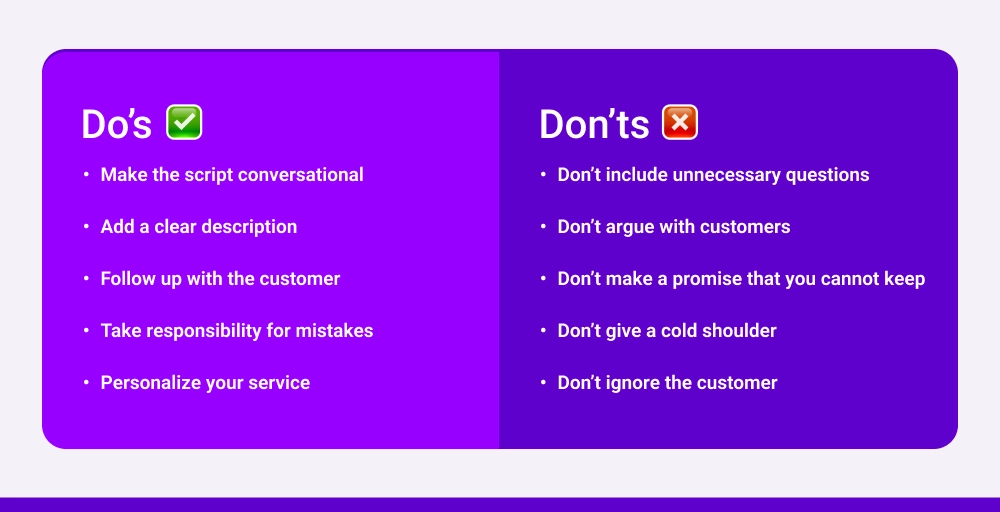
To make an effective customer service script, it is important to know the balance between structure and authenticity of the script. Here are some do’s and don’ts that you should know before writing a call center agent script:
Do’s
- Make the script conversational: Add a friendly, natural tone that makes the conversation feel real, not a scripted one like the read-aloud.
- Add a clear description: Explain the steps or processes to let customers know about what’s happening and why.
- Follow up with the customer: Keep regular follow-ups with customers, check if the issue they have mentioned is resolved, or if the customer needs anything else before ending the conversation.
- Take responsibility for mistakes: Own any errors and reassure customers that you are currently working on the solution.
- Personalize your service: Use the customer’s name and refer to their specific issues for a more tailored personalization customer experience.
Don’ts
- Don’t include unnecessary questions: Just avoid asking questions or information that’s not directly related to the issues or your business.
- Don’t argue with customers: Be calm, professional, even if the customer is upset or wrong, just don’t make unnecessary arguments with customers.
- Don’t make a promise that you cannot keep: Be honest about what you can deliver and what things you can help with; just don’t make fake promises that you cannot complete. It will break the trust.
- Don’t give a cold shoulder: Sometimes, an issue seems to be minor or small to you, but for customers, that may matter a lot. So, don’t be arrogant towards them.
- Don’t ignore the customer: Even if you are still processing or investigating their prompt or acknowledging their issue, keep talking with them, just don’t ignore them after listening to the issue.
Check out 👉: 25+ Auto Attendant Script Examples for Every Business
Key elements to include in your customer service script
Having a good customer service script is necessary to deliver good customer service, improve response rate, and enhance customer satisfaction. The key elements that must be included in call center scripts are mentioned below:
1. Warm greeting
Start with a friendly, warm, courteous opening while maintaining a professional tone. Introduce yourself by name and mention the company or business to set a welcoming atmosphere.
Example: “Good morning! Thank you for calling Dalles, Inc. My name is Nancy; how may I help you?”
2. Customer identification
Next, before proceeding, confirm the customer’s identity early on to access their information and personalize the customer experience.
Example: “Alright, Mr. Doe, could you confirm your full name and account number for me?”
3. Active listening
Invite the customers to explain their concern in full. This shows you are attentive and gives them space to express what’s going on fully.
Example: “Can you walk me through the issue you are experiencing today? I want to make sure I get the complete pictures so I can help you effectively.”
4. Empathy statements
Let the customer know you empathize with their situation. A little validation goes a long way in making someone feel heard.
Example:” That definitely sounds frustrating, I totally understand what you are going through. Let’s get this fixed together. ”
5. Solution offering
Once the issue is understood, provide a prompt, practical solution. Explain your next steps clearly and stay with the customer through the process.
Example:” It looks like this might be a caching issue. I’ll go ahead and reset your settings on our end. This should take about a few minutes, and I’ll stay with you the whole time.”
6. Polite closing
End the interaction on a positive note by adding an appreciative note to leave the customer feeling respected and valued.
Example: “Thank you so much for reaching out to Dalles, Inc., Mr Doe. Wishing you a great rest of your day?”
25 Customer service script templates + examples
The first step for customer service agents in a customer conversations is to greet and make customers feel welcomed and appreciated.
Here are some of the call center script best practice templates of customer service scripts for making interactions based on different situations and types of customers:

For greetings & openings
When interacting with customers, making a strong first impression is key. The way you open a conversation sets the tone for the entire exchange.
Here are some simple greeting and opening call center script samples for various situations:
1. General greetings and openings
Use these phrases while opening a conversation; that will make the callers feel respected, heard, and valued.
- “Good [Afternoon]! You’ve reached out to [Company Name], and I’m [Agent Name]. How can I best assist you right now?”
- “Hello! Thank you for contacting [Company Name]. My name is [Agent Name]. How can I help you today?”
- “Hi there! You’ve reached [Company Name] support. This is [Agent Name] speaking. What can I do for you today?”
2. Welcoming new customers
A new customer’s welcoming script is similar to a general greeting or opening, but is meant for the new members or first-time callers. Many of the customer service tools can show you when someone is reaching out for the first time.
- “Hello [Customer Name], and welcome to the [Company Name] family. We truly appreciate your business with us for [products/service]. What brings you to us today?”
- “Good [Morning], [Customer Name]. I am [Agent Name] calling from [Company Name]. We are thrilled to have you as a part of our community. How may I assist you today?”
- “Hi there, [Agent Name] speaking from [Company Name]. We appreciate your call. Could you please confirm your complete name and the phone number on your account?”
3. Engaging with existing customers
You want to simplify how to answer calls from existing customers, especially by using AI and their data to make conversations more personal.
- “Welcome back, [Customer Name]. It’s great to have you with us again.”
- “It’s good to hear from you again, [Customer Name]. Are you calling about the [product/service] we discussed previously, or is there something new I can help with?”
- “Nice to speak with you again, [Customer Name]. How can I help you today?”
4. Handling holds and call transfers
Putting customers on hold or transferring them can sometimes be unavoidable for effective service. Use these scripts for customer service to explain your intentions and what’s happening in real life clearly.
- “Okay, I understand. Could you hold for just a moment while I check on that for you?”
- “To get you the best help, I’m going to transfer your call to [Department/Person’s Name]. They’ll be able to assist you further.”
- “I’ll transfer you now to the right person to handle this. Please hold while I connect you.”
5. Dealing with angry or upset customers
When you’re working in a call center, dealing with angry customers is part of the job. It can be tough, but with the right approach, you can calm them down and work towards a solution.
- “My apologies for the mix-up with your order. What’s your order number so I can get this sorted?”
- “That’s completely unacceptable, and I apologize. I’m going to make sure we get you a replacement immediately.”
- “Hello [First Name], I apologize for your poor experience. I understand how this situation must be frustrating for you, and I hope we can resolve it together.”
6. Informing about call recordings
Use these call center scripts to let customers know their calls might be recorded or monitored for call center training and customer service quality assurance purposes.
- “Hello, thank you for calling [Company Name]. Please be aware that this conversation may be recorded or monitored to train our representatives and ensure service quality. How can I assist you today?
- “Before we get started, I should mention that this call may be recorded or monitored so we can continue improving our customer experience.”
- “Hello, [Customer Name]. Thank you for calling [Company Name]. Just to inform you, this call might be subject to recording or monitoring for training purposes.”
7. Initiating follow-ups
When reaching out to a customer after a recent discussion, this follow-up call script can help initiate the conversation.
- “Hello [Customer Name], I wanted to follow up regarding your recent issue with [brief issue mention]. Has it been fully resolved, or is there anything more we can do for you?”
- “Hi [Customer Name], I hope you’re doing well. I wanted to check that you were happy with the support you received from us. If there’s anything else we can do, we’re here for you.”
- “Hello, [Customer Name]. It’s [Agent Name] again from [Company Name]. I’m following up to see if the solution we provided resolved your concern. Please let me know if you need anything else.”
For common issues & requests
Regardless of your business sector, having prepared responses for frequent customer concerns prevents communication issues. Build your scripts around your product specifications and customer feedback patterns. Consider developing standardized customer service response templates for recurring situations.
Check out these customer service script examples to understand how your customer service team can address typical customer issues and requests.
8. Addressing late or missed deliveries
These customer service phrases help you assist customers experiencing shipping delays or missing packages.
- “I understand your concern about your shipment not arriving on schedule. Could you share your tracking reference so I can look into this matter?”
- “I am your order is [late/missing]. Please share your purchase reference number so I can research this for you and provide viable solutions. We are committed to getting this resolved promptly. ”
- “Thank you for reaching out regarding this delivery concern. Let me pull up the shipment details to investigate your situation.”
9. Managing damaged or missing items
Sometimes the customer receives the damaged products or items, or some of the items are missing from their order. Use these customer service script samples to find a solution.
- “I regret your item was damaged during shipping. Please email a photograph of the damaged product to [email address], and we’ll expedite a replacement immediately.”
- “I am sorry for the missing items in your shipment. May I have your purchase number? Your order shows [itemized list]. Could you verify which products are absent? After confirming your delivery address, I’ll arrange immediate shipment of the missing items.”
- “I sincerely apologize that your product was delivered in damaged condition. I‘ll generate a return shipping label immediately. Please send back the defective item, and we’ll dispatch a replacement at no charge to you.”
10. Correcting incorrect orders
You can use these script call center response templates to correct the incorrect orders of customers who received the wrong orders.
- “I am sorry for the order confusion, [Customer Name]. Would you prefer to facilitate shipping for the correct item or a complete refund?”
- “I apologize for the order mix-up. Allow me to confirm your purchase and delivery information so we can dispatch your correct order.”
- “Hello, [Customer Name]. I’m sorry the wrong order was delivered to you. I recognize it must be disappointing for you. Please describe what you received and what your original purchase was. I’ll arrange for the correct item to be sent immediately.“
11. Escalating calls to a manager
Similar to support ticket escalations, certain calls require manager intervention for situations needing specialized handling. Use these phrases to communicate escalation intentions to customers.
- “Thanks for your patience, [Customer Name]. I’ve explored my options, so I’d like to transfer you to my manager for a complete resolution. Would you mind holding?”
- “This situation needs more specialized attention than I can provide. Let me connect you with my manager, [Manager Name]. I’ll brief them on your situation before transferring so they can jump right in and help.”
- “I understand your frustration, [Customer Name], and I apologize for the inconvenience. I’ll escalate this to my manager so they can offer a solution that meets your needs.”
12. Handling billing and payment concerns
Customers often inquire about the billing topics, from the payment process to refund requests. So, use these scripts to handle both routine and complex billing discussions.
- General billing inquiry: “I’d be happy to review your recent bill statement. Could you please confirm your full name and account number so I can take a closer look at your billing details?”
- Late payment reminder: “Hi, [Customer Name], just a friendly reminder that your payment for [amount] is due on August 1, 2025. If you need help or more time, I’d be glad to assist.”
- Failed payment: “Dear [Customer Name], I see here that your transaction was declined due to [reason due to insufficient funds/expired card]. Would you like to try a different method or update your payment info now?”
For troubleshooting
Effective customer service requires agents to provide clear, empathetic, and solution-focused responses. Call center representatives must balance professionalism with personalization, understand their authority boundaries, and recognize when situations require management intervention.
The following troubleshooting call center script templates help agents handle various scenarios with confidence and consistency:
13. Basic troubleshooting steps
These scripts guide agents through initial problem identification and solution development.
- “Thank you for describing the situation with [brief problem summary]. Before we explore solutions together, I’d like to know what troubleshooting methods you’ve already tried.”
- “I appreciate you sharing those details, [Customer Name]. Based on what you’ve told me about [problem recap], let’s work through this systematically. To start, could you please [initial troubleshooting action]?”
- “Got it, [Customer Name]. It sounds like [brief restatement of the issue]. Let’s go through a few steps together. First, can you try [simple troubleshooting step] and let me know what happens?”
14. Sharing documentation or helpful resources
Use these responses to direct customers toward self-service tools and knowledge-based resources for independent problem solving.
- “We maintain an extensive help center with tutorials, video guides, and frequently asked questions about [relevant topic]. I can provide the link, and we could also arrange a follow-up conversation to ensure everything is working well.”
- “To help you further, I’m including a few resources that cover this topic in more detail: [List links or files]. Feel free to check them out at your convenience.”
- “Many of our customers find this quick-start guide helpful. I’ll share it with you here: [Insert Link]. It covers exactly what you’re working on.”
15. Assisting with account management
These call center scripts provide agents with pre-written dialogues to guide conversations with callers about account management. They cover a range of common tasks, from reviewing account details to updating a customer’s password.
- Account update: “Sure, I can help with that. May I please confirm your full name and email for verification? Once verified, I’ll go ahead and update your information.”
- Password update: “For security reasons, I’ll need to verify your identity before making changes to your account. Could you please confirm your full name and the last 4 digits of your registered phone number?”
- Help with login: “Let’s get that sorted. Are you receiving an error message, or is the login page not loading? I’ll walk you through a quick fix.”
16. Resolving technical problems
These templates help customers navigate technical difficulties and system-related issues.
- “I’m sorry to hear that, [Customer Name]. Can you describe what’s happening and when the issue started? I’ll do my best to fix this for you.”
- “It looks like this is a known issue. The good news is we have a solution. Please follow these steps: [Insert clear steps]. I’ll stay with you while you try it.”
- “We’ve tried the usual solutions, and I appreciate your patience. I’ll escalate this to our technical team now, and we’ll keep you updated with the next steps.”
17. Handling sensitive or private issues
The customer might require assistance in addressing problems related to sensitive data. The scripts below emphasize customer data protection and direct discussions involving confidential details or anonymous callers.
- “I recognize you’re contacting us about a delicate matter, [Customer Name]. Please know that our conversation remains completely private. How may I help you today?”
- “I completely understand your concern. We take your privacy very seriously. Let me explain the steps we take to protect your information, and I’ll gladly answer any questions.”
- “This is an important issue, and I want to make sure it’s handled with the attention it deserves. I’ll escalate it to our specialist team and keep you informed every step of the way.”
18. Apologizing sincerely to customers
Apologizing sincerely to customers is an effective method for cultivating customer loyalty and trust, particularly when your organization makes errors. The suggested phrases are intended to assist you in handling these delicate customer conversations with ease.
- “Thank you for alerting us to this problem, [Customer name]. We deeply regret [specific issue] and offer our genuine apologies. We are actively investigating to prevent recurrence. What can we do to resolve this for you right now?”
- “I sincerely apologize for [specific issue] and the frustration this has caused you. I completely understand your concerns, and we accept full accountability for this situation.”
- “We are genuinely sorry about this experience, [Customer Name]. This falls short of the service standards we uphold at [Company Name]. We’d like to provide [specific remedy/compensation] to address these issues. We have also implemented measures to prevent this from recurring.”
For call closings
Ending a customer service call positively and professionally is key, just like starting it. Whether the issue is resolved or not, always recap the solution or outline the next steps. This boosts customer satisfaction and your company’s reputation. Below are some recommended closings.
19. Wrapping up after successful resolutions
When you’ve successfully resolved a customer’s issue, it’s important to end the call with confidence and clarity.
- “Perfect! We’ve successfully resolved that for you. You should be all set now. Have a wonderful day!”
- “Looks like we’re all done here. Your [issue/request] has been taken care of. Is there anything else you need assistance with?”
- “Great! It looks like we’ve taken care of everything on your end. Is there anything else I can help you with today?”
20. Ending calls with unresolved issues
Sometimes, you can’t resolve a customer’s issue on the spot. In these situations, it’s crucial to provide clear next steps and wrap up the call center conversation effectively, maintaining professionalism and empathy.
- “We need a bit more time to look into this. I’ve opened a ticket for you, your reference number is [ticket number]. We’ll investigate and get back to you by August 1, 2025 with an update or solution.”
- “While I can’t resolve this for you right now, I’ve escalated your issue to [relevant department/specialist]. They’ll be in touch within [timeframe] at [customer’s preferred contact method] to help you further.”
- “[Customer Name], I’m sorry we couldn’t completely fix this today. To get this resolved quickly, we’ll [explain the next steps]. Can I schedule a quick call to update you?”
21. Managing frustrated or dissatisfied customers
When dealing with an angry or frustrated customer, your closing needs to be calm, empathetic, and solution-oriented. The goal is to acknowledge their feelings while clearly outlining the path forward.
- “My apologies for the trouble with [restate the specific problem]. We value your experience, and I’m going to fix this for you right now by [explain the solution or next steps].”
- “I’m very sorry for what happened, [Customer Name]. I’d like to make things right. I can offer you [specific solution or compensation, e.g., ‘a credit to your account,’ ‘a discount on your next service’].”
- “I’m so sorry for our error. I’ll correct that for you immediately. As a thank you for your continued loyalty, I’d also like to offer you [specific deal or promotion].”
22. Requesting customer feedback
Getting customer feedback is vital for refining services and boosting customer support quality.
- “To help us consistently provide excellent service, please share your feedback on how we handled your [issue/question] today.”
- “Thanks for your patience, [Customer Name]. Your input on today’s support experience is incredibly valuable for us to improve. Would you like to share your thoughts?”
- “I’m really glad I could assist you today, [Customer Name]. Before we end, would you mind taking a moment to provide us with your feedback?”
23. Offering upsells or cross-sells
Sometimes, customers might not be using the best product or service for their needs, or they could benefit from an additional offering.
- “Given what you’ve described, you might find [Product/Service Name] really useful. It’s designed to resolve [restate the problem] by [explain how it helps].”
- “You’re right, [Product Name] doesn’t include that specific feature. However, many customers use it successfully with [Complementary Product Name] because they work really well together to [brief explanation of synergy].”
- “To best meet your requirements, consider our [Plan/Account Name] upgrade. With it, you’ll get [short description of the benefits specifically related to the caller’s needs].”
Bonus templates
Here are some additional templates to help you effectively conclude customer service calls, focusing on personalized recommendations and empathetic responses for frustrated customers.
24. Personalized product recommendations
Sometimes, the best way to help a customer is to suggest a product or service that better fits customer needs or complements their current setup. These closings help you inform customers of their options in a helpful, non-pushy way.
- “Based on what you’ve told me about [customer’s specific need/problem], I think our [Product/Service Name] would be a great fit. It’s designed to [explain how it directly helps their need].”
- “Given that you’re looking for [desired feature/outcome], I recommend considering our [Product/Service Name]. Many customers with similar situations find it incredibly helpful because it [briefly explains a key benefit].”
- “It sounds like you’re trying to achieve [customer’s goal]. While your current [Product Name] is good, our [Upgraded Product/Service Name] offers [specific benefit], which would make that much easier for you.”
25. Empathetic responses for frustrated customers
When a customer is upset, the call’s closing is crucial for de-escalation and ensuring they feel heard and valued. These templates help diffuse difficult situations and end calls positively.
- “I sincerely apologize for the frustration this has caused, [Customer Name]. We’re committed to making this right, and I’ll personally ensure [explain the next concrete step you’ll take].”
- “I understand how upsetting [restate the specific problem they’re facing] must be. Your experience matters to us, and I want to assure you we’re working to [explain the resolution plan].”
- “I’m truly sorry you had to go through this, [Customer Name]. I’ve taken note of everything, and I want to offer [specific action: e.g., ‘a credit to your account,’ ‘expedited service’] as a gesture of our apology and commitment to your satisfaction.”
Readers also search for 👉: After-Hours Text Message Examples
From Script to service: Make every customer interaction count with KrispCall
From the first hello to the final goodbye, every customer interaction is an opportunity to build loyalty and enhance your brand. With KrispCall, you’re equipped to make every moment count. The platform ensures your team can deliver clear, professional, and impactful service, transforming routine calls into exceptional experiences.
KrispCall helps you transition seamlessly from script to stellar service, empowering your agents to confidently handle any situation, from resolving complex issues to proactively offering solutions. It’s not just about making calls; it’s about building relationships and bolstering your reputation.
Ready to see how KrispCall can revolutionize your customer service?
Get started with KrispCall now!