


The UCaaS market is booming, and every single provider out there will tell you they’re the best. AI-powered advanced features, endless integrations, hybrid work support, etc., the promises all start blurring together pretty quickly.
Finding a unified communications platform that’s genuinely built for your business, your team size, and your budget? That’s a different challenge altogether.
But we’ve done the work for you. Below is a breakdown of the top 10 UCaaS providers for 2026, including standout features, key strengths, and things to watch for.
Unified Communications as a Service (UCaaS) providers
Unified Communications as a Service (UCaaS) providers deliver cloud-based communication environments that unify essential business tools into a single, subscription-driven model. It supports core communication functions including enterprise telephony, audio and video meetings, team messaging, unified messaging, mobility, and communications-enabled workflows.
UCaaS is delivered over the internet, allowing businesses to skip the expensive hardware, lengthy IT setups, and rigid infrastructure. Most UCaaS solutions run on straightforward monthly or annual subscriptions, making them a practical choice for startups, scaling businesses, and enterprises alike.
UCaaS vs. traditional unified communications
Traditional unified communications systems live on-premises. That means physical servers, dedicated IT teams to maintain them, and significant upfront capital investment. Upgrades are slow, scaling is painful, and remote access is often an afterthought.
Hosted UCaaS flips that model entirely. Everything runs in the cloud, managed by the provider. Businesses get automatic updates, flexible scaling, and predictable subscription costs, without touching a single server.
The difference between UCaaS and VoIP
VoIP (Voice over Internet Protocol) focuses specifically on internet-based voice calling. UCaaS encompasses VoIP as one component within a broader communications ecosystem. While VoIP replaces traditional phone lines, a full UCaaS provider delivers voice, video meetings, messaging, collaboration tools, analytics, and integrations in a single, cohesive platform.
For organizations seeking a comprehensive communications strategy rather than standalone internet calling, UCaaS platforms offer a more complete, future-ready solution.
2026 UCaaS market trends we’re observing
As organizations refine their cloud communication strategies, several clear trends are shaping how decision-makers evaluate UCaaS providers in 2026.
1. AI-powered UCaaS becomes the standard
Artificial intelligence now sits at the core of leading UCaaS platforms. Real-time transcription, automated meeting summaries, intelligent call routing, predictive analytics, and sentiment detection have become built-in capabilities rather than premium add-ons.
Recent industry research shows that 88% of organizations globally deploy AI in at least one business-critical workflow, up from 78% a year ago.
2. Deep integrations drive platform selection
The modern workplace runs on interconnected systems. Businesses now use an average of 130 SaaS applications across departments, increasing demand for seamless integrations.
As a result, unified communications as a service providers are positioning their solutions as central hubs for workflows. And strong APIs and prebuilt connectors now rank among the top evaluation criteria for enterprise buyers.
3. Preferring pricing transparency
While per-user pricing has become more competitive, buyers increasingly scrutinize licensing structures. Add-ons for analytics, international calling, contact center features, and compliance tools can significantly impact the total cost of ownership.
According to research, around 87% of consumers prefer to purchase from brands that provide transparent and clear pricing. This pushes UCaaS service providers to refine packaging strategies and justify value beyond base rates.
4. Hybrid work remains the operational baseline
Hybrid work models are firmly established. Roughly 1 in 4 paid American employees‘ workdays are performed remotely, and similar patterns appear across global knowledge economies. This steady-state shift requires hosted UCaaS environments optimized for distributed performance.
High-definition video, low-latency VoIP, mobile app stability, and geo-redundant data centers are baseline expectations for any serious unified communications service provider in 2026.
5. Security and compliance are a must
As communication data volume grows, so do regulatory and cybersecurity concerns. Organizations prioritize encryption in transit and at rest, granular admin controls, and compliance with frameworks such as SOC 2, GDPR, and HIPAA.
Security posture now influences vendor shortlists as much as feature depth. For enterprise IT leaders, selecting among the best UCaaS providers requires validating infrastructure resilience, audit capabilities, and long-term compliance commitments.
6. Convergence of UCaaS and CCaaS
Another accelerating trend is the integration of unified communications with cloud contact center functionality.
UCaaS and CCaaS are increasingly being offered together, as many unified communications suppliers now bundle advanced contact center features into their broader UCaaS offerings. This allows businesses to manage internal collaboration and external customer engagement within a single, consolidated ecosystem.
Thinking of moving to a UCaaS solution? 5 Essential questions to ask
Choosing a unified communications platform is a long-term commitment. Getting clear on these five questions before you start comparing vendors will save you a lot of time and regret.
1. What is your UCaaS budget, and what’s included in the plan?
Headline pricing rarely tells the whole story. Many UCaaS providers advertise attractive base rates but layer on additional charges for international calling, extra storage, advanced analytics, or priority support.
Before committing, map out your expected usage and pressure-test the plan against it. A provider like Dialpad, for example, bundles calling, messaging, and meetings into its base plan, making cost forecasting far simpler than on platforms that charge per feature.
2. Which communication tools are in your current stack?
Audit every tool currently used for voice calls, video conferencing, internal chat, SMS, and customer support. Many organizations operate five or more disconnected apps across departments.
A modern UCaaS platform enables consolidation. Look for a unified communications solution that consolidates those fragmented stacks into one place.
3. How does UCaaS fit into your existing business tech stack?
Integration determines workflow efficiency. Evaluate how well a potential UCaaS vendor connects with your CRM, helpdesk, marketing automation, and project management systems.
Prioritize unified communications as a service providers offering native integrations with platforms such as Salesforce, HubSpot, Zendesk, Google Workspace, Microsoft 365, Slack, and Microsoft Teams. Strong API support also allows custom integrations for specialized workflows.
4. Is the UCaaS platform remote- and hybrid-work friendly?
Hybrid operations define modern workplaces. A platform that works flawlessly in a wired office environment but struggles on a home Wi-Fi connection or a mobile hotspot creates real productivity problems.
Always ensure that the UCaaS platform you choose offers fully functional mobile, desktop, and browser-based apps, and that performance holds up consistently across different devices, locations, and network conditions.
5. What are the security and compliance standards of the UCaaS platform?
Security remains a top evaluation factor. Ensure the UCaaS service provider offers encryption in transit and at rest, secure data storage, and robust authentication controls.
Compliance certifications such as SOC 2, GDPR, HIPAA, or industry-specific standards demonstrate operational maturity. Review administrative controls for user permissions, access management, audit logs, and data retention policies.
How have we selected these UCaaS providers?
Unified Communications as a Service (UCaaS) providers are selected by evaluating platforms based on core capabilities such as integrated voice, video, and messaging, as well as integrations with business tools, and criteria such as infrastructure reliability, total cost of ownership, and security.
Our selection follows a structured software review methodology that includes hands-on testing, analysis of verified user feedback, and transparent pricing verification, with no vendor influence on our findings.
To ensure the information you’re reading stays accurate as platforms evolve, we use a consistent content-update methodology that triggers reviews whenever pricing, features, or platform positioning change. All evaluations are conducted in accordance with our content integrity statement, which governs how we maintain editorial independence and factual accuracy across all published content.
Top UCaaS providers in 2026
| Providers | Key features | Pricing | Best for |
| Zoom | Intelligently process recordings, Meetings summary, Draft email response | Free (1 user) | Reliable video conferencing, professional meetings, and large-scale webinars |
| Microsoft Teams | Built-in Microsoft 365 app support, AI-powered meetings and messaging, Breakout rooms | $4/user/month | Businesses using Microsoft 365 and teams that need chat, meetings, and file collaboration in one platform |
| KrispCall | Unified callbox, 100+ CRM integrations, Power dialer | $12/user/month | Sales teams and customer support teams that need CRM-integrated calling |
| Cisco Webex | AI-driven noise removal, Integrated polling via Slido, HD audio/video conferencing | Custom quote | Enterprise-level meetings, webinars, and secure corporate collaboration |
| Mitel | ACD agent control, Business text/SMS messaging, Call park | Custom quote | Contact centers and companies that require advanced call management |
| GoTo Connect | Video/audio conferencing, Custom dial plans, Call routing | Custom quote | Small and mid-sized businesses that need unified phone and meeting systems |
| 8×8 | Video/audio conferencing, Unlimited internet fax, PSTN access | Custom quote | Global businesses that need VoIP calling and international communication |
| Dialpad | Visual voicemail, Virtual receptionist, Call routing | $15/user/month | AI-powered business phone systems and remote teams handling customer calls |
| Intermedia | Built-in video conferencing, IVR, Sentiment analysis | $27.99/user/month | Businesses that want voice, video, and messaging in one unified communication platform |
1. Zoom
Zoom started as a standalone video tool and has now transitioned into a full-scale UCaaS platform. Zoom has addressed app fatigue (common in modern enterprises) by integrating team chat, phone, and video into a single interface, Zoom Workplace.
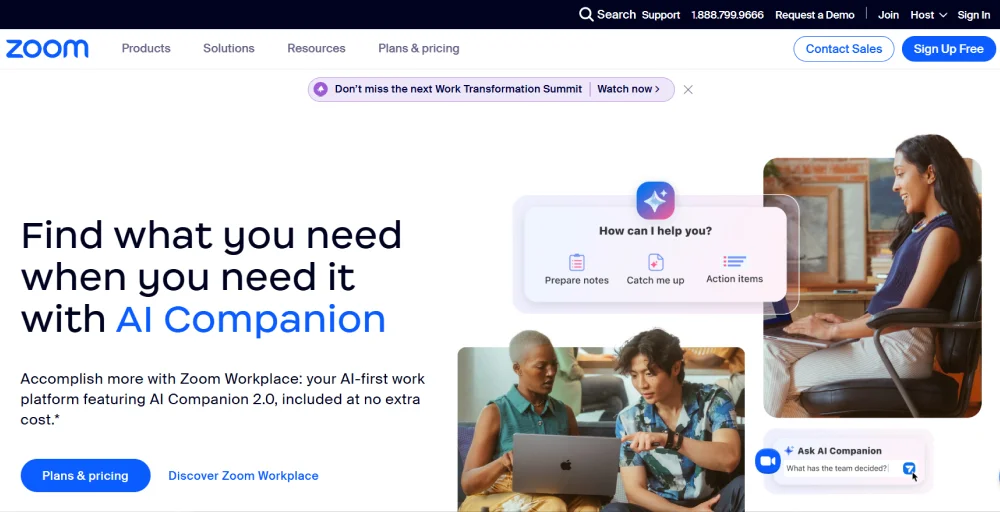
Zoom is one of the most affordable UCaaS providers in 2026, and its strength lies in its familiarity. For businesses that already live inside the Zoom ecosystem, expanding into its broader unified communications features feels like a natural next step.
But since Zoom’s entry into the telephony market is more recent, features like advanced call routing and IVR configurations remain areas of active development.
Features
- Zoom AI Companion: It is a generative AI assistant included in all eligible paid plans at no extra cost. It provides automated meeting summaries, extracts action items, and query informations from previous meetings, documents, or apps.
- Zoom Phone: A cloud-based VoIP phone system built directly into the Zoom platform. It supports calling, call routing, voicemail transcription, and number porting without leaving the Zoom interface.
- Zoom Docs: An AI-first collaborative workspace where teams can create documents and projects. It integrates directly with meetings transcripts and chat history.
- Team chat: It keeps conversations, file sharing, and collaboration organized by channels and direct messages. It connects natively with Zoom Meetings and Phone.
- Zoom Intelligent Director: It creates inclusive hybrid meeting environments, ensuring every person in a physical meeting room is framed individually on screen.
2. Microsoft Teams
Microsoft Teams holds its place among the best UCaaS providers in 2026 due to its deep, native integration with the Microsoft 365 suite. It gives organizations a communication platform that’s already embedded in their daily workflows, reducing the adoption friction that makes the most UCaaS migrations difficult.
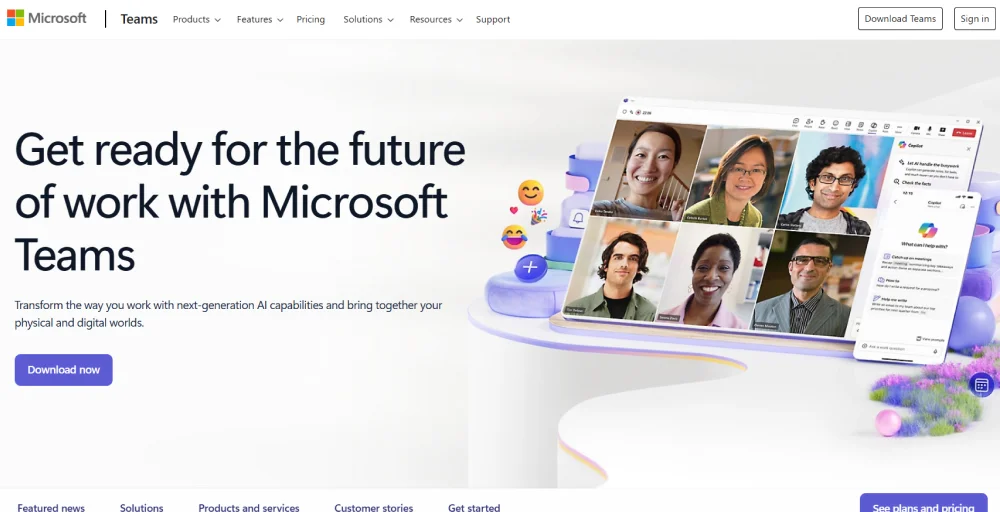
Calls, meetings, chat, and workflow automation all connect seamlessly without third-party connectors or workarounds. Its Copilot feature works across every communication surface to provide insights.
However, businesses outside of the Microsoft ecosystem rarely get the same cohesive experience. While a cheap entry point, unlocking the full potential of Teams, such as advanced AI and enterprise-grade phone features, requires multiple expensive add-ons.
Features
- Microsoft Mesh (Immersive space): Mesh allows teams to meet in 3D environments using avatars, making remote interaction more natural.
- Teams Phone with Operator Connect: Businesses can keep their existing telecom provider while managing all calls directly through the Teams interface.
- Loop components: These are flexible mini-apps like tables or task lists that stay in sync and enable real-time collaboration across Teams, Outlook, and Word.
- Microsoft 365 Copilot: An AI engine that can summarize meetings in real-time, draft follow-up tasks, and answer complex questions with ease.
- Teams meetings: Enterprise-grade video conferencing with support for up to 1,000 participants, live captions, background noise suppression, and breakout rooms.
3. RingCentral
RingCentral is one of the top-tier UCaaS providers in 2026 and offers arguably the most reliable phone system in the industry. RingCentral was built from the ground up as an enterprise-grade telecommunications platform, unlike others that started as video or chat apps and later added calling.
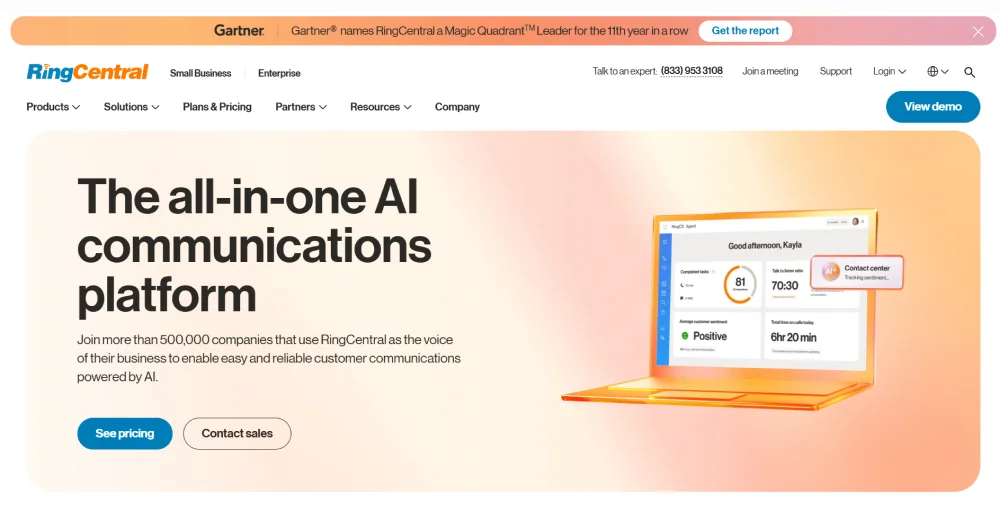
RingCentral offers 99.999% uptime guarantee with a massive library of over 500 third-party integrations. It also offers advanced sentiment analysis and conversation intelligence to better understand the context of their customer interactions.
Despite this, RingCentral’s primary limitation is its inherent complexity and cost structure. It features a steep learning curve and also tends to be one of the more expensive options on the market.
Features
- RingSense AI: This specialized AI analyzes voice and video interaction to identify key themes, track competitor mentions, and score agent performance.
- Advanced multi-level IVR: It allows businesses to create complex, multi-layered phone menus that route callers based on specific needs, time of day, or even caller ID.
- Unified mobile app & SMS: it seamlessly integrates professional business SMS, team messaging, and high-definition calling. This allows remote employees to manage their entire professional identity from a single mobile interface.
- Extensive app gallery: With 500+ pre-built integrations, trigger calls or log notes directly within their existing workflows, significantly reducing manual data entry.
- Global voice: Expand your local presence in over 110 countries, while managing all global communication from a centralized, cloud-based dashboard.
4. KrispCall
KrispCall secures its position as a top 10 UCaaS provider in 2026 with its flexible, cloud-native phone system. In the saturated UCaaS market, KrispCall takes a more focused approach, offering global reach, a clean UX, and transparent pricing that growing businesses can actually work with.
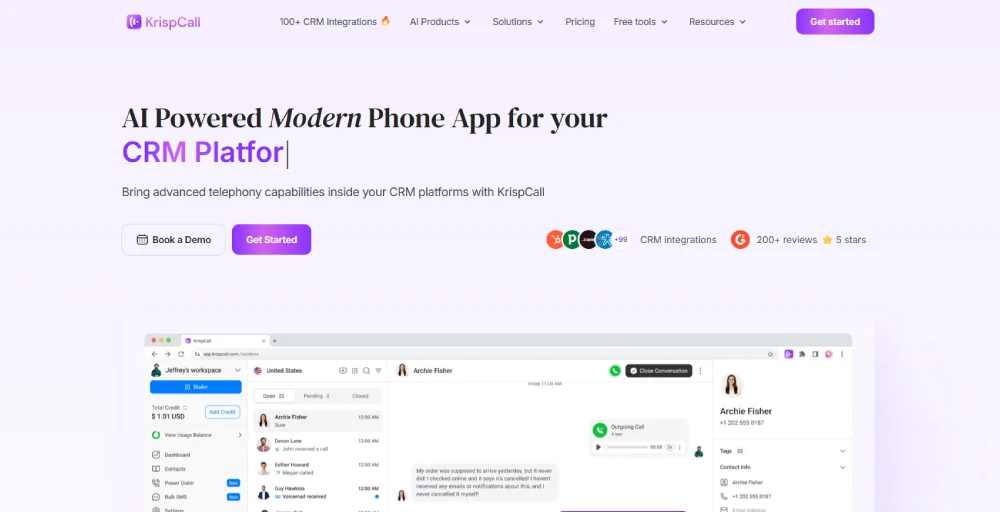
Virtual numbers across 100+ countries, intelligent call routing, IVR, shared numbers, and a unified callbox are built into the platform’s core. For remote and hybrid teams, KrispCall provides an immediate communication solution that focuses on speed and ease of use.
However, KrispCall’s limitation is its lack of native video conferencing. Businesses looking for a single platform to replace Zoom, Slack, and their phone system simultaneously will need to look elsewhere.
Features
- Unified Callbox: A centralized dashboard that brings together all communication history, including call logs, text messages, and voicemails, into a single, centralized interface.
- Shared phone numbers: Multiple team members can manage a single business number, ensuring any available agents can answer incoming call or respond to texts.
- CRM & workflow integrations: 100+ native integrations with CRMs and helpdesk tools, keeping workflow running without manual data entry or app switching.
- Global virtual phone numbers: Get local, toll-free, and international virtual phone numbers across 100+ countries, without a physical office or a SIM card.
- Multi-level IVR: Businesses can setup automated phone trees that route callers to the correct department.
5. Cisco Webex
Cisco Webex remains a dominant force in the UCaaS market, offering a full-stack experience with enterprise-grade software and high-end proprietary hardware. For organizations in government, healthcare, or finance, Webex is often the default choice due to its high stability and comprehensive compliance certifications.
What sets Webex apart is its seamless integration of AI-powered hardware with its software suite. While many competitors rely on third-party cameras and microphones, Cisco designs its own devices that work natively with Webex software.
The limitations come down to cost and complexity. Webex is priced at the enterprise end of the market, and organizations without dedicated IT resources may find the onboarding process more demanding than expected.
Features
- Webex AI Assistant: Webex’s native AI layer handles real-time meeting transcription, post-meeting summaries, action item detection, and message drafting.
- Webex Calling: A cloud-based calling solution that supports VoIP, PSTN connectivity, and routing.
- Webex Meetings: Enterprise-grade video conferencing built for scale, which includes HD video breakout rooms, live captions, and end-to-end encryption.
- Webex control hub: A central interface to easily manage your organizations, users, security policies, assign service, and device health.
- Webex intelligent director: Automatically switched camera angles and frames participants based on who is speaking or moving, ensuring a professional, high-quality view for remote attendees.
6. Mitel
Mitel is one of the long-standing names in business communication as a UCaaS provider. Like many providers, Mitel has navigated the shift from on-premise PBX systems to cloud-based unified communications.
Rather than building its own video and AI stack from scratch, Mitel has integrated Zoom Workplace and Zoom AI Companion directly into its flagship telephony platforms. This allows organizations to maintain full control over their data and hardware without sacrificing modern AI tools.
However, Mitel’s primary limitation is the potential for feature gaps stemming from its reliance on third-party partnerships for AI. This can create occasional friction in how deeply the AI can interact with Mitel’s specific legacy hardware or granular telephony settings.
Features
- Mitel CX: A specialized customer experience platform that uses AI to automate workflows and provide real-time agent assistance.
- MiVoice business: It supports voice calling, messaging, collaboration, and conferencing across cloud, on-premise, and hybrid environments.
- MiVoice analytics: A reporting and analytics layer that gives IT administrators and business leaders visibility into KPIs and communication patterns across the organization.
- CloudLink: Hybrid Cloud Connectivity is a gateway technology that allows businesses with on-site hardware to access cloud-based applications.
- Unified admin console: A centralized management tool that gives IT teams visibility across both cloud and on-premises assets.
7. GoTo Connect
GoTo Connect earns its place in the top 10 unified communications providers by remaining the most approachable all-in-one solution for growing businesses. Built on the foundations of Jive Communications, it bundles enterprise-grade phone features, video meetings, and messaging into a single, cost-effective license.
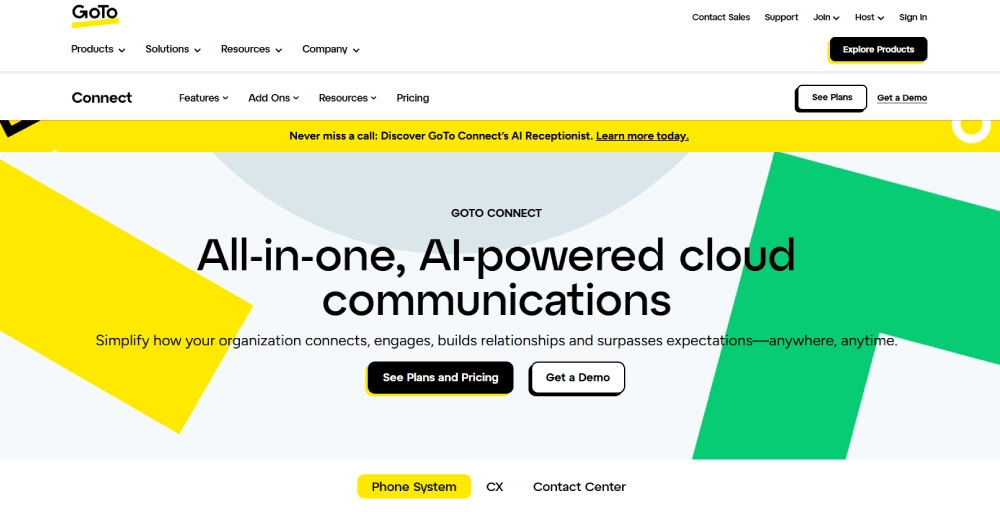
What sets GoTo Connect apart from other UCaaS platforms is its call management depth. Its dial plan editor allows administrators to map out their entire phone system using a drag-and-drop interface.
GoTo Connect shows its limitations in its scalability and AI development. The platform is well-suited to small-to-mid-sized businesses, but larger enterprises with complex multi-site requirements or high contact center volumes will likely find it underpowered.
Features
- AI receptionist: A 24/7 smart assistant that manages incoming calls by answering common questions, routing conversations, and even capturing basic customer information.
- Visual dial plan editor: Design and manage complex inbound routing logic through a visual interface that requires no coding or specialist IT knowledge.
- Shared inbox: A unified inbox that consolidates SMS, team chat, and voicemail into a single, organized communication stream.
- Unified admin portal: Manage phone system, meetings, user permissions, and device health from a centralized single dashboard.
- Smart call routing: Smart routing ensures calls follow users across their laptops, mobile devices, or desk phones based on custom schedules.
8. 8×8
8×8 pioneers the concept of XCaaS (eXperience Communication as a Service), which helps it secure a position as one of the best unified communications solutions. It unifies employee communications (UCaaS) and customer service (CCaaS) on a single global cloud platform.

8×8 supports unlimited calling to up to 32 countries. Beyond calling, the platform delivers video meetings, team messaging, SMS, and a fully integrated contact center suite with AI-powered routing, analytics, and real-time agent assistance.
However, 8×8’s primary limitation is its pace of native AI innovation. While 8×8 offers essential AI tools, many of its advanced intelligent assistant features are built through partnerships rather than developed entirely in-house.
Features
- XCaaS unified platform: A single technology stack that integrates business phone, video meetings, team chat, and a full contact center to eliminate data silos.
- 8×8 frontdesk: A specialized, high-volume call handling interface designed to help manage dozens of incoming calls simultaneously.
- Mix-and-match licensing: Mix different license tiers (e.g., X2 for general staff and X8 for contact center agents) on the same account, so you don’t overpay for what you don’t use.
- Global reach: 8×8 provides full, localized phone service in 55+ countries, including local numbers and emergency services.
- Conversation analytics: Analyze calls for sentiment, keywords, and trends, and identify at-risk customers or coaching opportunities.
9. Dialpad
Dialpad is one of the best AI-native UCaaS companies, built around its proprietary DialpadGPT. It offers a unified communication solution that uses AI to improve team communication, operations, and business workflows.
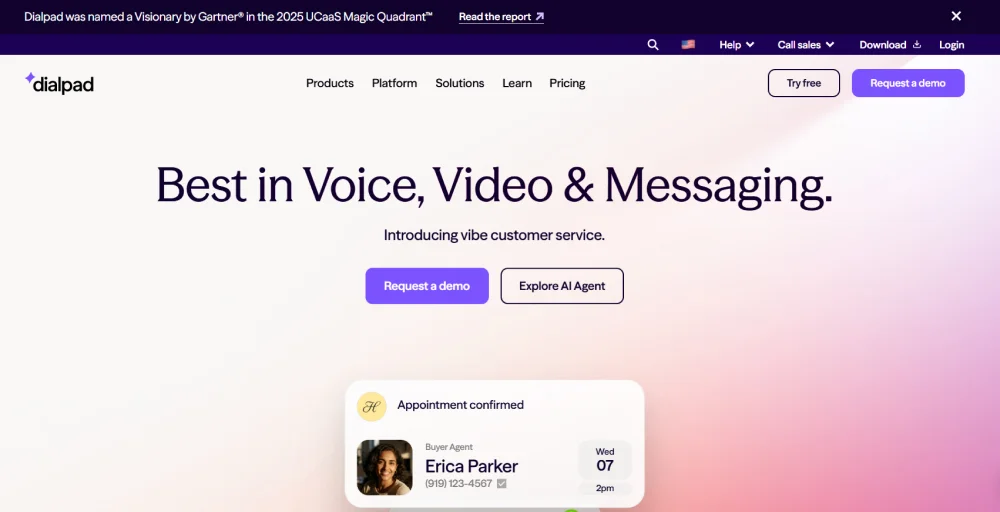
What makes Dialpad fundamentally different is its Agentic AI approach. Its focus on conversational intelligence allows Dialpad to provide enterprise-level automation to smaller teams that don’t have the resources to build their own custom AI solutions.
However, Dialpad’s primary limitation is its specialized focus, which can sometimes come at the expense of traditional breadth. While its AI is industry-leading, its internal collaboration features are less extensive than those found in ecosystem platforms like Microsoft Teams or Zoom.
Features
- DialpadGPT: Dialpad uses its own in-house LLM, enabling superior accuracy in business-specific transcriptions and call summaries.
- AI live coach card: It acts as a live coach, which automatically pops up on the agent’s screen with vital information when customers mention specific keywords.
- AI CSAT: Predicts a customer’s satisfaction score by analyzing tone and sentiment, eliminating dependence on post-call surveys across different communication channels.
- AI recap: Get a concise summary and a list of next steps after every interaction, automatically synced to CRMs like Salesforce or HubSpot.
- AI-powered proving ground: A Dialpad feature that allows businesses to test new AI workflows or agents in a sandbox environment before they go live.
10. Intermedia
Intermedia is one of the best UCaaS providers in 2026 due to its flagship product, Intermedia Unite. The platform is purpose-built for organizations that need a professional communication suite without the complexity of multiple vendors.
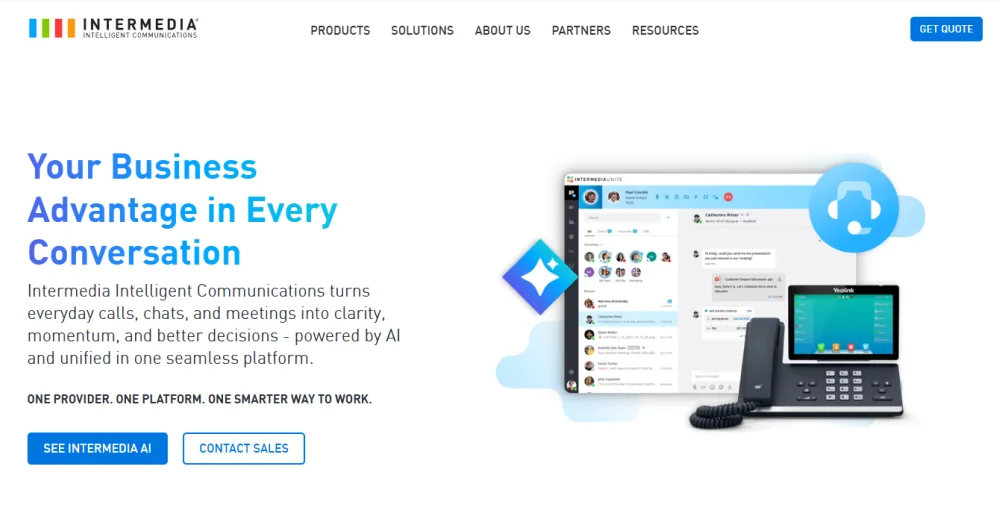
What distinguishes Intermedia from the rest of the market is its deep focus on integrated business services and partner-led support. It often includes a free enterprise-grade desk phone with its licenses, seamlessly bridging the gap between hardware and software.
The trade-off with Intermedia is depth over breadth. While the platform competently covers the core UCaaS features, it doesn’t lead the field in any single area. AI capabilities are still developing relative to cloud-native competitors, and the integration ecosystem is narrower than that of larger UCaaS platforms.
Features
- Intermedia Unite: It bundles voice calling, video meetings, team chat, SMS, and file collaboration into a single cloud-based subscription, reducing app-switching.
- AI call recaps: Automatically summarize your phone calls and video meetings, capturing key discussion points and action items.
- SecuriSync: Intermedia includes enterprise-grade file backup and synchronization, ensuring documents are securely stored, version-controlled, and accessible from any device through a single interface.
- Unite for Microsoft Teams: Intermedia offers a power-up that embeds its high-reliability phone system directly into the Microsoft Teams app.
- J.D. Power-certified support: Intermedia is renowned for its consistently reliable J.D. Power-certified 24/7 technical support.
How will UCaaS evolve in the future?
The future of Unified Communications as a Service (UCaaS) is moving rapidly beyond its simple all-in-one platforms. Here’s how UCaaS is evolving in the modern digital workplace:
From passive tools to agentic AI
Future UCaaS platforms will feature agentic AI that can independently manage follow-ups, update CRMs in real-time, draft complex responses, and even act as a digital mediator to ensure tone and compliance during sensitive interactions.
Deep ecosystem convergence (UCaaS+ CCaaS+ CPaaS)
The rigid boundaries between internal collaboration and customer service are dissolving. Future UCaaS platforms will handle both seamlessly, giving businesses a single communication layer that serves employees and customers with equal depth, without the cost and complexity of maintaining separate platforms.
Hyper personalization
The future of UCaaS prioritizes continuity over mere connectivity. Whether a conversation starts via a website chatbot, an email, or a voice call, the system maintains a single, unified thread of history.
Deeper CRM and business system integration
The future points toward real-time and bidirectional intelligence. A UCaaS platform will actively pull live CRM context into a call as it happens, update records autonomously, and trigger downstream workflows without any manual input from the user.
Stronger security architecture
With communication data becoming an increasingly valuable target, UCaaS vendors will move beyond static compliance certifications toward dynamic, AI-driven threat detection. Identifying anomalous call patterns, flagging potential fraud in real time, and enforcing zero-trust policies at the session level before they impact the network perimeter.
Pick the best UCaaS provider for your business needs
The options on this list represent some of the strongest unified communications platforms available in 2026, but the right choice varies by business.
A global enterprise with complex compliance requirements has fundamentally different priorities from a fast-scaling startup building a remote-first team from scratch. The platform that works brilliantly for one will feel like overkill or fall short for the other.
Start with what your business actually needs today. Evaluate the features that directly impact your workflows, the integrations your team relies on, and the price point your budget can sustain without compromise.
Then consider how each UCaaS provider is investing in AI, scalability, and product development. A platform that meets your needs today but shows no clear roadmap for tomorrow is a migration conversation waiting to happen.
The best UCaaS solution is the one that grows with your business, adapts to how your teams communicate, and continues delivering value as your requirements evolve. Seeing UCaaS offerings in action inside your own workflows will tell you more than any feature comparison table ever will.