

Whether you’re reconnecting with family, managing business relationships, or coordinating with colleagues overseas, knowing how to call China from the United States is an essential skill. International calling can seem complicated at first, but once you understand the format, it becomes a quick and reliable process.
China plays a major role in global business, technology, and culture, and strong communication is key to maintaining both personal and professional connections. By following the correct dialing steps and using the right tools, you can avoid unnecessary costs and ensure your calls go through smoothly.
How to call China from the USA?
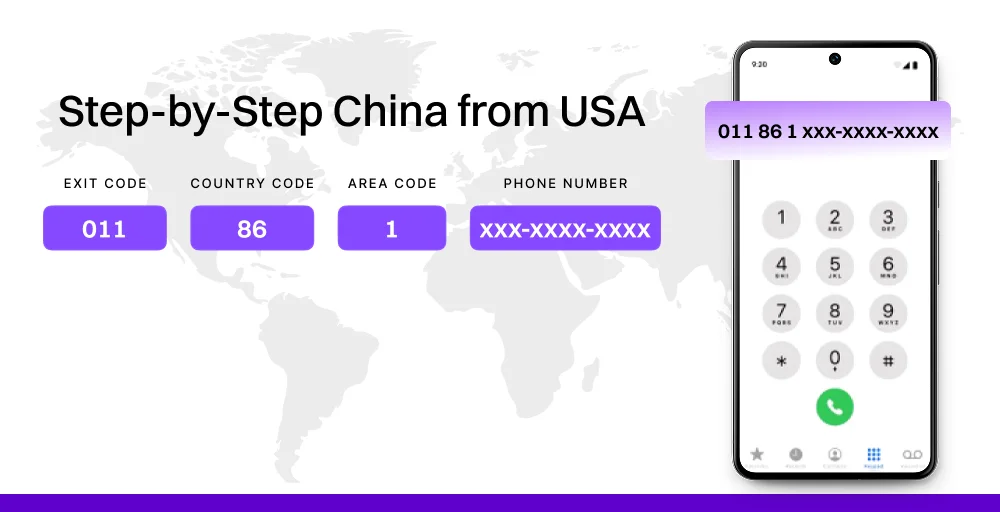
To call China from the United States, you need to follow the standard international phone number format. The full sequence is: US exit code + China country code + area code + local number.
Here’s a step-by-step breakdown:
Step 1: Dial the US exit code
To make an international call from the United States, start by dialing 011. If you are using a smartphone, you can press and hold the 0 key to insert a + symbol, which works the same way as the exit code and is often more convenient.
Step 2: Add the China country code
After the exit code, dial China’s unique country code: 86. This routes your call to China’s telephone network.
Step 3: Enter the area code
Chinese cities have area codes that are typically 2 to 4 digits long. When dialing internationally, omit the leading zero used for domestic calls. (e.g., Beijing’s 010 becomes 10).
For example:
- Beijing: 010 → 10
- Shanghai: 021 → 21
| City | Area Code | City | Area Code |
| Beijing | 10 | Shanghai | 21 |
| Guangzhou | 20 | Tianjin | 22 |
| Chongqing | 23 | Shenyang | 24 |
| Nanjing | 25 | Wuhan | 27 |
| Chengdu | 28 | Xian | 29 |
| Qingdao | 532 | Hangzhou | 571 |
| Harbin | 451 | Jinan | 531 |
| Dalian | 411 | Ningbo | 574 |
| Changchun | 431 | Wuxi | 510 |
| Anshan | 412 | Zibo | 533 |
| Huaian | 517 | Yangzhou | 514 |
| Yantai | 535 | Weifang | 536 |
Step 4: Enter the local phone number
For a landline
Use the exit code, country code, and area code, followed by the local phone number. For example, to call a landline in Shanghai with the area code 21 and the local number 87654321, you would dial 011-86-21-87654321.
For a mobile phone
Dial the full mobile number immediately after the country code. For instance, to call a Chinese mobile number like 15900159000, the correct sequence would be 011-86-15900159000.
Related 👉: How to Call the UK from the US?
How to call China from USA for free?
If both you and your contact have internet access, you can avoid traditional call charges by using online communication apps. These options are often the most convenient and cost-effective.
WeChat is the most widely used messaging and calling app in China, with over a billion users. It supports high-quality voice and video calls at no extra cost when connected to Wi-Fi or mobile data. Because it is deeply integrated into everyday life in China, it is usually the best option for both personal and business communication.
WhatsApp offers free voice and video calls globally. However, it is not always fully accessible in China, and users may need a VPN to use it reliably. Before relying on WhatsApp, confirm that your contact can access it without issues.
Zoom / Google Meet
These platforms are widely used for professional communication. They support both scheduled and instant calls, making them ideal for meetings, interviews, or team collaboration. While primarily video conferencing tools, they work just as well for voice calls.
Cheap ways to call China from USA
When free apps aren’t an option, when calling a Chinese phone number that doesn’t use messaging apps, there are several cost-effective. Here are the cheapest ways to call China from the USA:
1. Use VoIP Services (Voice Over Internet Protocol)
Voice over Internet Protocol (VoIP) services like Google Voice allow you to make international calls over the internet instead of traditional phone lines. They typically offer lower per-minute rates, better call quality, and easy integration with smartphones and computers.
2. International Calling Cards
Calling cards remain a practical option, especially for occasional use. You purchase credit in advance, dial a local access number, and then enter your international number. This method helps control costs and avoids unexpected charges.
3. Check for International Calling Plans
Major U.S. telecom providers often offer monthly add-ons for international calling. If you call China frequently, these plans can be more economical than paying standard international rates. So, check per-minute costs, phone number coverage (landlines vs. mobile), and any hidden fees or limits.
Best Practices for Calling China from the U.S.
Making a successful international call to China involves more than just dialing the correct numbers. Preparation, timing, and a stable connection are essential for ensuring a smooth and effective conversation.
- Ensure a strong connection: Before placing your call, verify that you have a reliable, high-speed internet connection. It’s best to use Wi-Fi or a wired broadband connection instead of mobile data to minimize lag and prevent call drops.
- Have a Backup Plan: Agree in advance on what to do if the call drops, whether you will reconnect immediately or wait for the other party to call back. This can help avoid confusion for both sides.
- Time Your Call Thoughtfully: China is 12 to 15 hours ahead of U.S. time zones. For example, a 9 AM call from New York will reach Beijing at 9 PM. Try to schedule business calls during standard working hours in China (9 AM to 6 PM CST).
- Respect Chinese Holidays: Major holidays, such as Chinese New Year and the Mid-Autumn Festival, can result in business closures lasting a week or more. It’s wise to schedule important calls well away from these dates.
- Test Before Important Calls: Conduct a quick test call using your chosen app or VoIP service before any significant meeting. Check the audio quality, video performance, if applicable, and connection stability.
- Use Quality Audio Equipment: Using noise-canceling headphones and a high-quality microphone can greatly enhance call clarity on both ends, reducing misunderstandings, especially when there is a language barrier.
Key considerations for calling China: language, culture, and etiquette
When calling China from the United States, technical steps are only part of the process. Understanding language preferences, cultural norms, and communication etiquette can greatly improve the quality and effectiveness of your conversation, especially in professional settings.
1. Language Differences and Common Phrases
Mandarin Chinese is the primary language of business and formal communication across China, though regional dialects are common in everyday life. While English proficiency is growing in major business centers, many professionals still prefer to communicate in Mandarin. Learning even a few basic greetings can signal respect and goodwill.
Here is a guide to common greetings in China:
- Ni chi le ma? (你吃饭了吗?): “Have you eaten?”
- Xie xie (谢谢): Thank you.
- Bu ke qi (不客气): You’re welcome.
- Zai jian (再见): Goodbye.
2. Understanding Cultural Etiquette
Chinese business culture values formality, hierarchy, and reputation. When making a professional call for the first time, use formal titles and the person’s last name, such as “Director Li” or “Manager Wang.”
Avoid using first names unless the person asks you to. In group calls, address senior members first. Be ready for indirect communication; Chinese professionals often express disagreement or discomfort through subtle hints rather than direct confrontation, so pay attention to what is not said.
3. Time Zone Awareness
All of China operates on a single time zone, China Standard Time (CST), which is UTC+8. There is no daylight saving time adjustment in China. This means the time difference between the U.S. and China remains relatively stable, with minor variations depending on the U.S. time zone.
Key time zone differences:
| U.S. Time Zone | China (CST) |
| Eastern (EDT) | 12 hours ahead |
| Central (CDT) | 13 hours ahead |
| Mountain (MDT) | 14 hours ahead |
| Pacific (PDT) | 15 hours ahead |
| Alaska (AKDT) | 16 hours ahead |
| Hawaii (HST) | 18 hours ahead |
4. The Right Time to Call
For business calls, standard working hours in China are from 9 AM to 6 PM CST, Monday through Friday. Be mindful of Chinese public holidays, particularly the Golden Week in October and the Chinese New Year (Chunjie), which typically lasts for two weeks in January or February when business activity effectively pauses. For personal calls, evenings and weekends are usually the most convenient times for your contacts.
How much does it cost to call China from US?
Calling China is affordable. Prices typically range from $0.01 to $0.05 per minute when using VoIP apps or budget carriers. Traditional service providers like AT&T or Verizon can charge over $3.00 per minute for regular calls.
In contrast, services like Google Voice call costs $0.01-$0.02 per minute, and Mint Mobile charges $0.01 per minute. For the best value, you can use data-to-data apps like WeChat or WhatsApp, which are free.
However, if you want to call a landline or mobile number directly, you usually need to pay for a service like Skype or Rebtel.
Conclusion
Calling China from the USA is a simple four-step process: dial the US exit code 011, add China’s country code 86, enter the city area code (for landlines), and finish with the local number. The full format for a Beijing landline is: 011 – 86 – 10 – XXXXXXXX.
For free or low-cost calls, internet-based apps, especially WeChat for contacts inside China, are your best option. For calls to landlines or contacts without smartphones, VoIP services and international calling cards offer rates far below standard carrier charges.
And whenever you pick up the phone, a little awareness of Chinese time zones, holidays, and cultural etiquette will go a long way toward making every call productive.