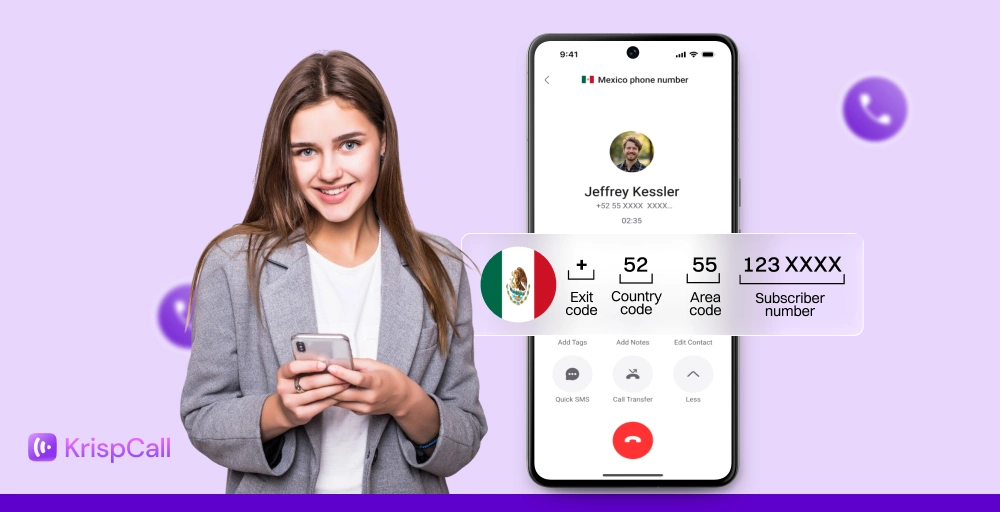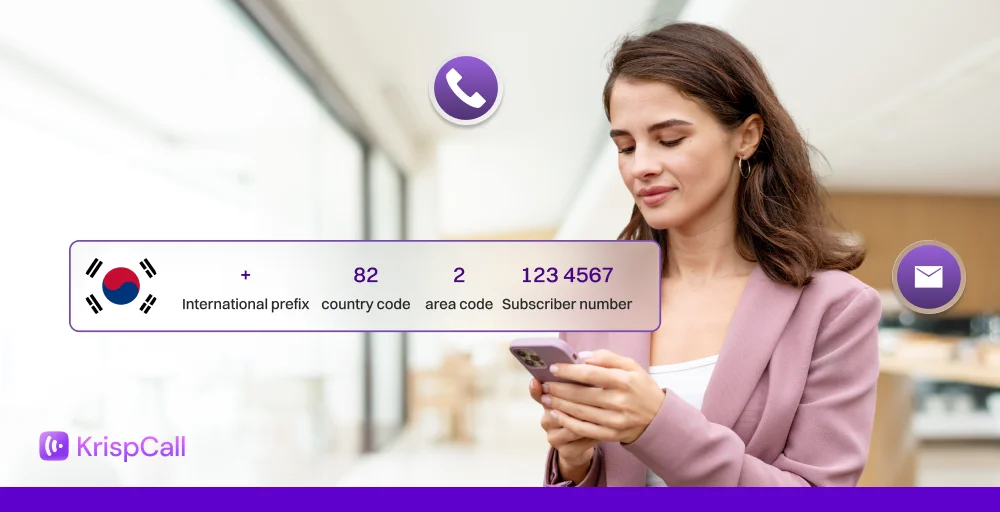



A US phone number follows a standard 10-digit format made up of three parts: a 3-digit area code, a 3-digit exchange code, and a 4-digit line number, written as (XXX) XXX-XXXX.
When dialing from outside the US, add the country code +1 at the start, making it +1 (XXX) XXX-XXXX.
For example, +1 (307) 410-6456 is a valid US number where 307 is the Wyoming area code, 410 is the exchange code, and 6456 is the subscriber number.
This guide covers the complete US phone number structure — including area codes, dialing steps from abroad, and the most common mistakes to avoid.
Understanding the US Phone Number Structure
The US phone number format is a standardized 10-digit numbering structure used across the United States under the North American Numbering Plan (NANP). It consists of a three-digit area code followed by a seven-digit local number, typically written as (AAA) XXX-XXXX.

When dialing internationally, add the country code +1 before the 10-digit number. For example, a domestic number written as (212) 555-1234 becomes +1 212 555 1234 internationally.
Components of a US phone number
| Component | Digits | Example | Purpose |
| Country code | 1 | +1 | Identifies the US in the global numbering system |
| Area code (NPA) | 3 | 212 | Geographic region or city |
| Exchange code (NXX) | 3 | 555 | Local telephone exchange |
| Line number (XXXX) | 4 | 1234 | Individual subscriber line |
A 10-digit US phone number example: +1 212-5550198
Here:
- “+1” is the country code for the US
- “212” is the area code for New York City
- “555” is the central office code
- “0198” is the line number assigned to the subscriber
Format for USA Phone Numbers
US phone numbers come in four main types — landline, mobile, toll-free, and virtual. All follow the same 10-digit (XXX) XXX-XXXX format but serve different purposes.
| Type | Example | Description |
| Landline | (212) 468-3200 | Residential or office line, tied to a physical location |
| Mobile | (512) 763-4891 | Personal or business cell number, portable across devices |
| Toll-Free | (877) 542-3300 | Customer service numbers; free for callers within the US |
| Virtual (VoIP) | (424) 319-7700 | Internet-based numbers, not tied to a physical device |
1. Landline Numbers
Landline numbers are connected through a physical network of telephone lines and are commonly used by homes, offices, and local businesses. They offer stable call quality and a strong regional presence.
For example: +1-212-468-3200
- +1 — US country code
- 212 — Area code (Manhattan, New York)
- 468 — Exchange code
- 3200 — Subscriber’s landline number
2. Mobile Numbers
Mobile numbers operate through cellular networks, allowing users to make and receive calls from anywhere. The format is identical to landlines — US mobile numbers do not use a separate prefix.
For example: +1-512-763-4891
- +1 — US country code
- 512 — Area code (Austin, Texas)
- 763 — Exchange code
- 4891 — Subscriber’s mobile number
3. Toll-Free Numbers
Toll-free numbers let customers call businesses without being charged. They begin with a special prefix instead of a geographic area code.
All active toll-free prefixes: 800, 888, 877, 866, 855, 844, 833
For example: +1-877-542-3300
- +1 — US country code
- 877 — Toll-free prefix
- 542 — Exchange code
- 3300 — Subscriber number
⚠️Important: Most US toll-free numbers cannot be dialed from outside the United States. Even if the call connects, international rates will apply and the number will not be free to the caller. Use the business’s direct local number instead when calling from abroad.
4. Virtual (VoIP) Numbers
Virtual phone numbers are not tied to a physical device or geographic location. They route calls over the internet and are widely used by remote teams, startups, and international companies wanting a US presence without a physical office.
For example: +1-424-319-7700
- +1 — US country code
- 424 — Area code (Los Angeles overlay)
- 319 — Exchange code
- 7700 — Subscriber number
Virtual numbers follow the same 10-digit format as any US number but can ring on any device — desktop, mobile app, or VoIP handset — from anywhere in the world.
How to Dial US Phone Numbers from Abroad
When calling the US from another country, you need your country’s exit code, then the US country code 1, then the area code, and local number.
Format: [Exit Code] + 1 + [Area Code] + [7-digit number]
📱 Mobile shortcut: Press and hold “0” to insert the “+” symbol, then dial +1 followed by the 10-digit US number — works from any country without needing to look up the exit code.

Here’s how to call the US from abroad (Stepwise):
- Dial your country’s international exit code (e.g., 00 for UK/France/India, 0011 for Australia, 010 for Japan). On a mobile, press and hold “0” to enter “+” instead.
- Enter the US country code: 1
- Dial the three-digit area code — e.g., 212 (New York), 312 (Chicago), 415 (San Francisco)
- Dial the seven-digit local number — e.g., 555-1234
Full example calling the US from the UK: 00-1-212-555-1234
Related 👉: How to Call the USA from the UK?
International Dialing Examples
Landline from UK: 00-1-312-464-8900
- 00 = UK exit code | 1 = US country code | 312 = Chicago area code | 464-8900 = subscriber number
Mobile from India: 00-1-512-763-4891
- 00 = India exit code | 1 = US country code | 512 = Austin area code | 763-4891 = subscriber number
Toll-Free from Australia: 0011-1-877-542-3300
- 0011 = Australia exit code | 1 = US country code | 877 = toll-free prefix | 542-3300 = subscriber number
Area codes in the United States
Area codes in the United States were introduced in 1947 as part of the North American Numbering Plan (NANP) to organize phone numbers geographically across the country. Each area code represents a specific region, city, or group of towns, helping route calls efficiently within the vast US telephone network.
Over time, the number of phone users grew, especially with the rise of mobile phones, fax lines, and VoIP services. To meet this demand, new area codes were added through overlays (assigning multiple area codes to the same region) or splits (dividing one area code into two or more).
Below is a complete list of area codes in the United States, organized by state, to help you identify the correct dialing region for any call.
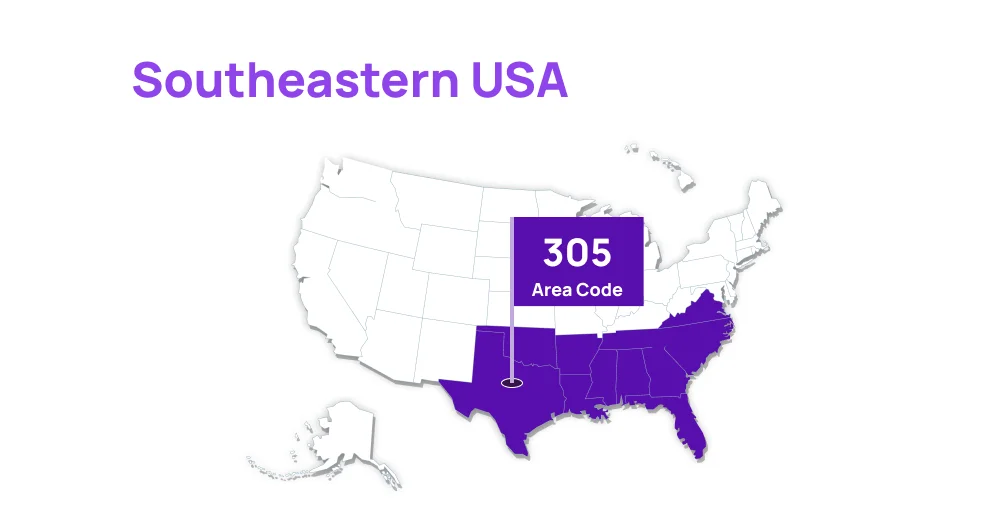
1. Southern US area codes
The Southern region has the most states and a wide mix of area codes for calling, due to its population density and business growth.
| State | Major Area code |
| Texas | 210, 214, 281, 512, 713, 817, 972 |
| Florida | 305, 321, 352, 407, 561, 727, 813, 850, 904 |
| Georgia | 229, 404, 470, 478, 678, 706, 770, 912 |
| North Carolina | 252, 336, 704, 828, 910, 919, 980 |
| South Carolina | 803, 843, 864 |
| Alabama | 205, 251, 256, 334, 938 |
| Mississippi | 228, 601, 662, 769 |
| Louisiana | 225, 318, 337, 504, 985 |
| Arkansas | 479, 501, 870 |
| Tennessee | 423, 615, 731, 865, 901, 931 |
| Kentucky | 270, 364, 502, 606, 859 |
| Virginia | 276, 434, 540, 571, 703, 757, 804 |
| West Virginia | 304, 681 |
| Oklahoma | 405, 539, 580, 918 |
| Maryland | 240, 301, 410, 443, 667 |
| Delaware | 302 |
2. Midwestern US area codes
The Midwest represents the industrial and agricultural core of the US. Area codes here were among the first established and still serve many of the country’s oldest cities and manufacturing hubs.
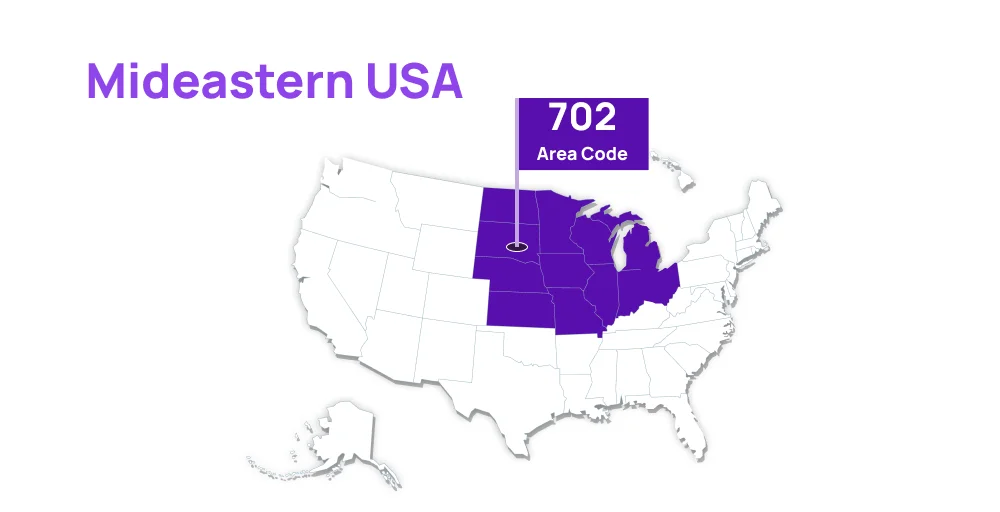
| States | Major Area codes |
| Illinois | 217, 309, 312, 618, 630, 708, 773, 815, 847 |
| Ohio | 216, 234, 330, 419, 440, 513, 567, 614, 740, 937 |
| Michigan | 231, 248, 269, 313, 517, 586, 616, 734, 810, 906 |
| Indiana | 219, 260, 317, 463, 574, 765, 812, 930 |
| Wisconsin | 262, 414, 534, 608, 715, 920 |
| Minnesota | 218, 320, 507, 612, 651, 763, 952 |
| Iowa | 319, 515, 563, 641, 712 |
| Missouri | 314, 417, 573, 636, 660, 816 |
| North Dakota | 701 |
| South Dakota | 605 |
| Nebraska | 308, 402, 531 |
| Kansas | 316, 620, 785, 913 |
| Michigan (Upper Peninsula) | 906 |
3. Western US area codes
The western region encompasses vast areas, including high-population centers and remote regions.
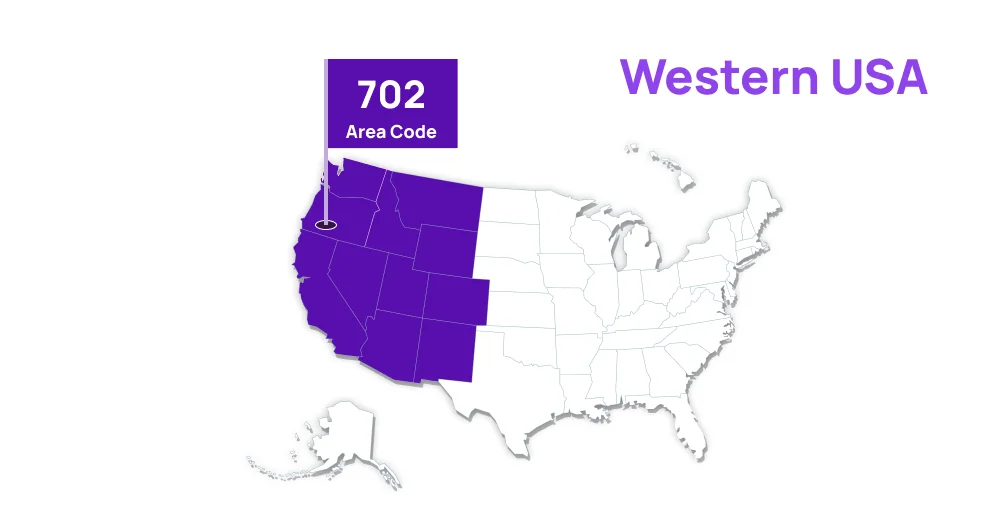
| State | Major Area Codes |
| California | 209, 213, 310, 323, 408, 415, 424, 510, 559, 619, 626, 650, 707, 714, 760, 805, 818, 831, 858, 909, 916, 925, 949, 951 |
| Washington | 206, 253, 360, 425, 509 |
| Oregon | 458, 503, 541, 971 |
| Nevada | 702, 725, 775 |
| Arizona | 480, 520, 602, 623, 928 |
| Colorado | 303, 719, 720, 970 |
| Utah | 385, 435, 801 |
| Idaho | 208, 986 |
| Montana | 406 |
| Wyoming | 307 |
| New Mexico | 505, 575 |
| Alaska | 907 |
| Hawaii | 808 |
4. Northeastern US area codes
The northeast includes some of the oldest and most densely populated areas in the country.
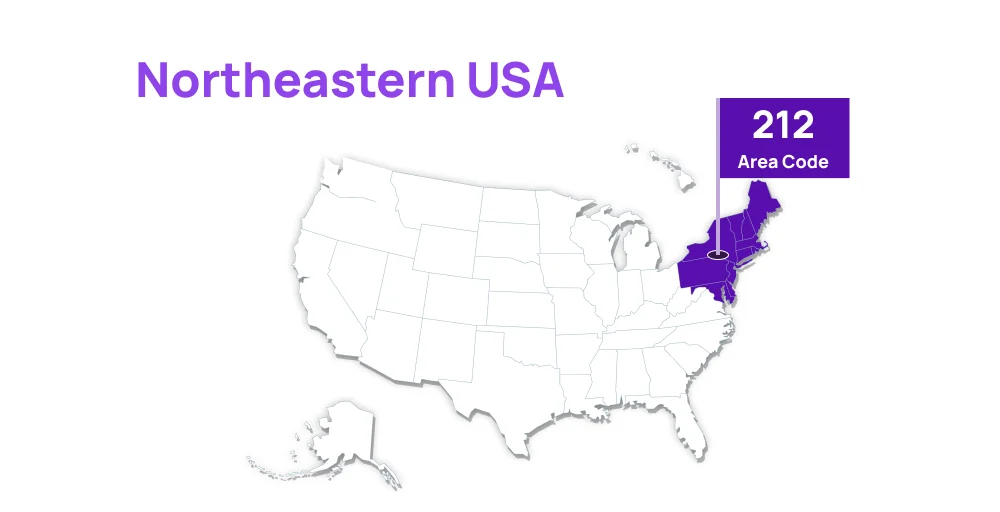
| State | Major Area Code |
| New York | 212, 315, 332, 347, 516, 518, 585, 607, 631, 646, 716, 718, 845, 914, 917, 929, 934 |
| New Jersey | 201, 551, 609, 732, 848, 856, 862, 908, 973 |
| Pennsylvania | 215, 267, 272, 412, 484, 570, 610, 717, 724, 814, 878 |
| Massachusetts | 339, 351, 413, 508, 617, 774, 781, 857, 978 |
| Connecticut | 203, 475, 860, 959 |
| Rhode Island | 401 |
| Vermont | 802 |
| New Hampshire | 603 |
| Maine | 207 |
Common mistakes to avoid when dialing a US number
| Mistake | Problem | Correct Approach |
| Missing area code | Call fails, especially in overlay regions | Always include all 3 area code digits |
| Wrong digit count | Call routes to wrong number or fails entirely | US numbers are always 10 digits (+ country code for international) |
| Using wrong UK exit code (011) | 011 is the US/Canada exit code, not UK | UK exit code is 00, not 011 |
| Extra symbols in E.164 fields | Breaks CRM/VoIP integrations | Use +1XXXXXXXXXX with no spaces, dashes, or brackets |
| Omitting country code on international platforms | International users can’t dial | Always write +1 (XXX) XXX-XXXX on global-facing pages |
| Calling toll-free from abroad | Most US toll-free numbers don’t accept international calls | Use the direct local number instead when calling from outside the US |
| Adding leading “0” before area code | US numbers never use a trunk prefix “0” | Start directly with the 3-digit area code |
How to Get a US Phone Number
Whether you need a local number tied to a specific area code or a national toll-free number for customer service, getting a US virtual phone number takes just a few minutes with the right provider.
A good US virtual number provider should offer:
- Choice of local area code or toll-free prefix
- Call forwarding, IVR, and call recording features
- E.164-compatible number storage
- Support for remote and international teams
With KrispCall, you can get a US virtual phone number and manage calls, voicemails, and messages in one unified inbox — designed for remote teams, startups, and global businesses that want a professional US presence without a physical office.
Steps to get a US phone number from KrispCall:
- Sign up at KrispCall
- Select “United States” from the country list
- Choose your number type: local, mobile, or toll-free
- Pick your preferred area code and available number
- Complete the setup and start calling immediately