

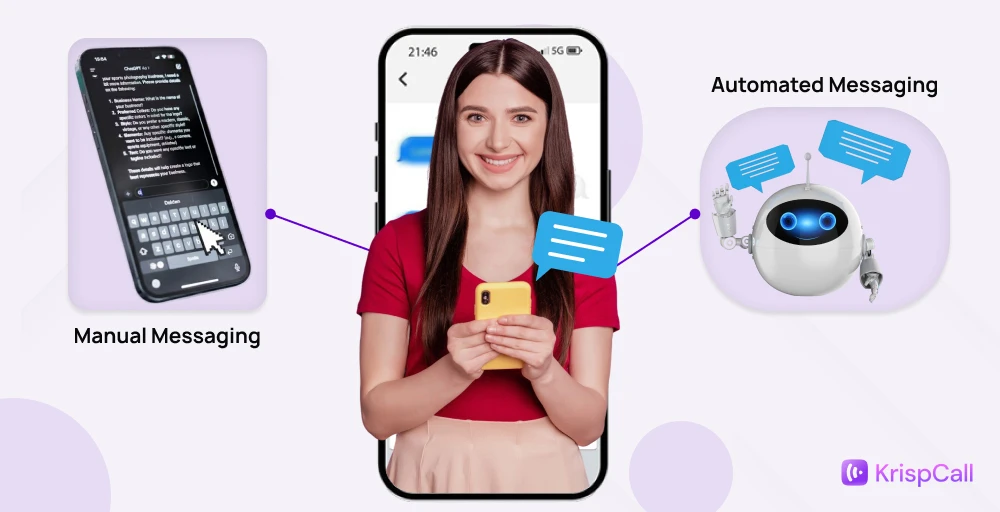
Businesses use text messaging (SMS) because it has an incredibly high open rate of nearly 98%, which far exceeds the open rates of email marketing that typically hover around 20% (99firms). However, they face a dilemma whether to use manual messaging or automated text messaging.
Manual messaging is great for low-volume, highly personal interactions, but it quickly becomes too expensive and slow as message volume increases due to labor costs and human limitations. Automated text messaging uses software to send timely, personalized messages at a massive scale without needing constant staff effort.
So, let’s make a quick comparison between automated and manual messaging to help you determine which strategy is best for managing customer communications effectively.
✨ Key Takeaways
- Automated messaging sends pre-written messages to many recipients for efficiency, while manual messaging involves a person sending each message individually for personalization and complexity.
- Individuals handle manual messaging, while automated systems require no human intervention once set up.
- Automated texts are efficient for tasks like appointment reminders, whereas manual messaging is better suited for handling customer service issues or building rapport.
Automated text messaging vs Manual messaging: Key differences
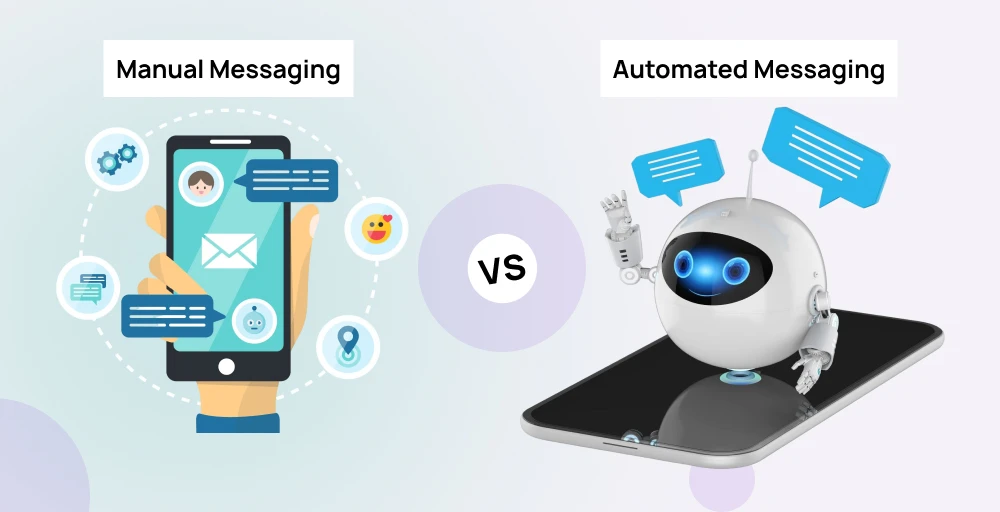
The key differences between automated text messaging and manual messaging lie in reliability, scalability, efficiency, and personalized style.
Here are some differences between them:
| Feature | Automated text messaging | Manual messaging |
| Speed/response time | Instant, real-time response. | Depends on human availability. |
| Scalability | High; can send thousands of messages simultaneously. | Limited by team size and time. |
| Cost (Software vs labor) | Lower ongoing costs, Subscription-based software. | High labor costs, time-intensive. |
| Personalization depth | Data-driven, template-based, limited empathy. | Highly personalized, empathetic. |
| Consistency/brand voice | Consistent standardized messaging. | Variable, depends on the individual. |
| Error risk | Low, automated error checking. | High; prone to human mistakes. |
| Data & analytics | Detailed tracking and insights. | Minimal tracking, manual analysis. |
| Compliance & audit trail | Built-in logging and compliance. | Harder to maintain and audit. |
| Best for | Large volumes, reminders, promotions. | Complex queries, personalized engagement. |
What is automated text messaging?
Automated text messaging is the process of sending pre-written SMS messages automatically, either on a set schedule or in response to a specific trigger. Businesses can enable these automated workflows through a text message API, which connects SMS functionality with existing software and allows messages to be sent based on specific triggers or schedules.
These SMS text messages offer quick responses, lower labor costs, and maintain a consistent brand voice.
They utilize analytics for messaging optimization and compliance. However, they are often template-driven and may lack a personal touch without advanced AI enhancements.
What is manual messaging?
Manual messaging is the process of creating and sending messages manually by a user, either via chat or email, to contacts. It excels in personalization and real-time adaptability, especially for complex or sensitive conversations.
While this method enables empathetic and context-aware communication, it is slower, costly at scale, and more prone to inconsistency and human errors.
Advantages of automated text messaging
Automated text messaging tools offer several advantages for businesses and organizations, enhancing communication and streamlining customer engagement by delivering timely, personalized messages.
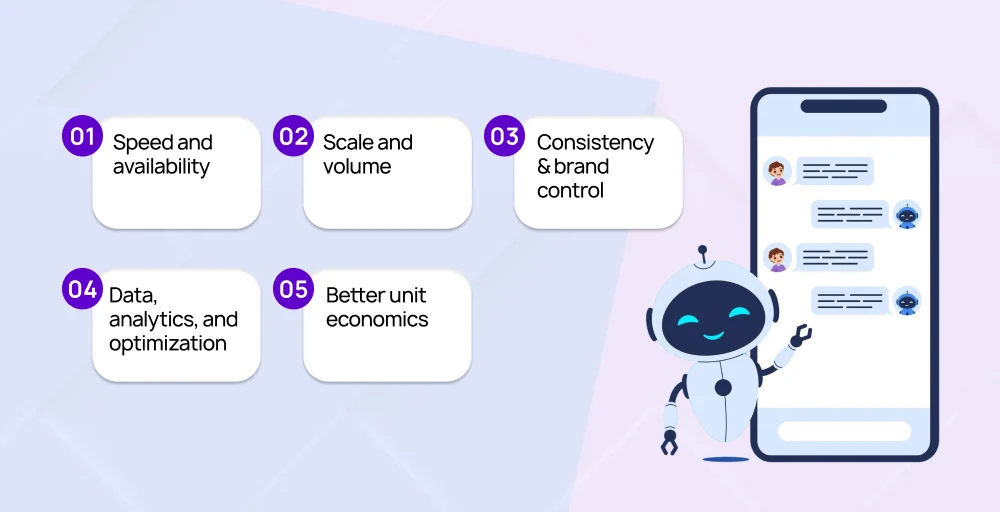
1. Speed and availability
Automated systems send messages instantly without waiting for manual input, ensuring customers receive timely updates, reminders, or notifications 24/7. This rapid response strengthens engagement and customer satisfaction by meeting expectations for real-time communication.
2. Scale and volume
Automation allows businesses to send thousands of messages simultaneously, enabling a broad reach without proportional increases in labor. This scalability allows for marketing campaigns, customer service notifications, and operational alerts to run with maximum efficiency.
3. Consistency and brand control
Automated messaging delivers standardized content with a uniform tone and style, helping maintain a consistent brand voice across all customer interactions. This reduces the risk of message variations and miscommunication that can happen with manual efforts.
4. Data, analytics, and optimization
These platforms provide rich tracking data on delivery rates, success rates, open rates, click-through rates, and customer responses. Businesses can use these insights to optimize messaging strategies, segment the audience more effectively, and improve ROI over time.
5. Better unit economics
With automated text messages, companies can more easily automate repetitive tasks, significantly reducing labor costs while increasing productivity. Automated texts eliminate manual typing and scheduling errors, allowing resources to focus on higher-value activities. This leads to improved cost efficiencies and scalability.
Disadvantages of automated text messaging
Automated text messaging has several disadvantages, including a high risk of miscommunication, limited personalization, and technical limitations.
1. Limited personalization
These automated messages can feel generic, lacking the personal touch, conversational flow, and empathy that mark human interaction. The lack of personalization makes it challenging to address complex or sensitive customer issues effectively, as the system cannot adapt its tone or word choice in real time.
2. Risk of errors in templates
Automated systems rely on predefined messages and rules; even a small mistake, like a typo, incorrect data merge, or a faulty automation trigger, can lead to confusing or misleading communication. In the case of incorrect data merging, customers might receive a message intended for someone else, raising serious privacy and confidentiality concerns.
3. Customer resistance
Many individuals view automated texts as spam, especially if they are frequent, irrelevant, or poorly timed. This perception can lower engagement rates, leading recipients to ignore future messages or opt out. Aggressive or unsolicited texts can also result in negative feedback on social media, harming a company’s brand reputation.
4. Dependence on technology
Businesses are vulnerable to system outages, software bugs, or integration failures. If the automated messaging system experiences downtime or glitches, important communication may be missed or delayed. This reliance on third-party vendors also introduces the risk of sudden price increases, service changes, or unexpected API deprecations.
5. Compliance complexity
Automated text messaging must adhere to local and international consent and privacy regulations (e.g., GDPR, TCPA). Violations, such as texting without consent or outside permitted hours, can result in legal penalties and reputational harm. Compliance varies by region and is often complex and resource-intensive.


Benefits of manual messaging
Manual messaging offers direct, instant personal communication with other channels, such as social media or email. Here are some of the key benefits of manual messaging:
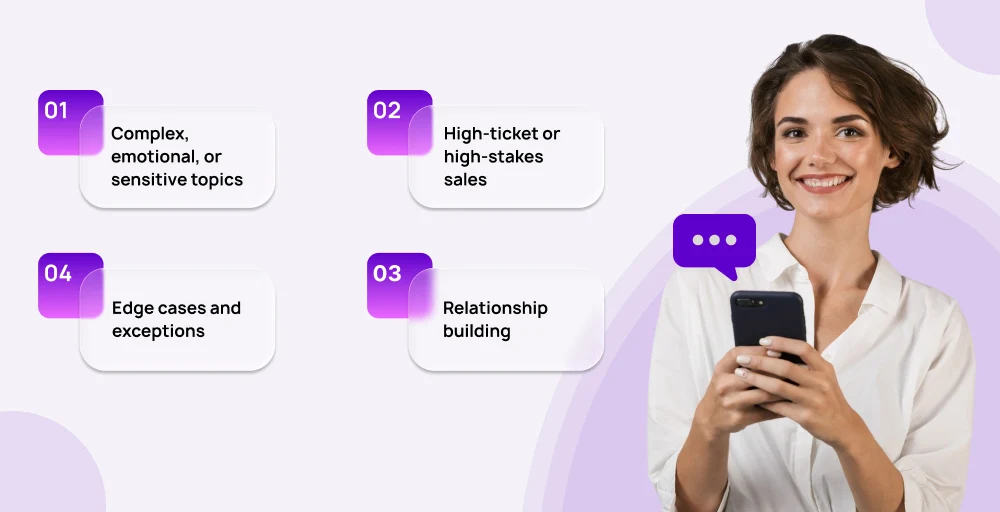
1. Complex, emotional, or sensitive topics
Manual messaging enables personalized responses that address emotional or nuanced topics with empathy and careful attention, which automated systems often cannot replicate. This is critical for customer support involving complaints, sensitive feedback, or crisis communication, where tone matters.
2. High-ticket or high-stakes sales
Manual texting fosters personalized messaging, trust, and rapport in high-ticket or complex sales situations. Customers feel more valued and understood when they receive human-crafted messages, which enhances long-term loyalty and customer lifetime value.
3. Edge cases and exceptions
Manual messaging easily adapts to unique or complex scenarios where automation might fail, such as exceptions, unclear inquiries, or require immediate judgment. The human operator can provide real-time problem-solving and bespoke solutions.
4. Relationship building
Regular manual interactions create a sense of connection and authenticity, which is valuable for brands seeking emotional resonance and differentiated customer experiences beyond transactional communication.
5. Enhanced personalization and engagement
Unlike rigid templates, manual texts can be deeply customized with specific language, references, and immediate contextual awareness, resulting in higher customer engagement rates and positive brand perception.
Cons of manual messaging
Manual messaging offers a personal touch but also has significant drawbacks, such as inefficiency, limited scalability, and human error.
1. Time-consuming
Crafting and sending each message individually limits the volume of messages that can be handled. This process diverts valuable employees’ time away from complex, high-value tasks that require critical thinking.
2. Labor-intensive
High human resources costs make scaling operations expensive. A rapid increase in message volume requires a proportional and costly expansion of staff, unlike automated systems.
3. Inconsistent brand voice
Variations in tone and style between different agents can weaken brand identity. Maintaining strict quality control across a large team to ensure uniform messaging is challenging and often impractical.
4. Slower response times
Manual processes cannot guarantee instant responses, which can frustrate customers. During peak hours or outside operational hours, customers often experience significant delays or radio silence.
5. Higher risk of human error
Without automation safeguards, there is an increased likelihood of mistakes in spelling, data entry, or message content. Simple fatigue or distraction can lead to sending sensitive or incorrect information to the wrong recipient.
Cost & ROI of automated text messaging and manual messaging
Automated text messaging is typically more cost-effective than manual messaging, particularly at higher volumes. Initial costs include software subscriptions and setup, with per-message expenses between $0.01 and $0.05; the savings from lower labor costs and high engagement are significant.
Once set up, the system can send thousands of messages instantly, resulting in a low cost per message and enabling efficient scaling of communication while maintaining high returns.
In contrast, manual messaging becomes progressively more expensive as volume increases, since each message requires human effort. The cost, calculated by hourly wages multiplied by time per message and total volume, shows that labor expenses rise with workload.
Additionally, manual messaging incurs hidden costs, including employee burnout, errors, slower response times, and potential turnover. These issues create operational strain and reduce efficiency, leading to higher long-term costs.
Use case of automated vs manual text messaging
Automated text messaging is best for efficiency, scalability, and consistent, timely delivery of routine information. In contrast, manual text messaging is suited for complex one-on-one communications that require a personalized human touch and real-time adaptability.
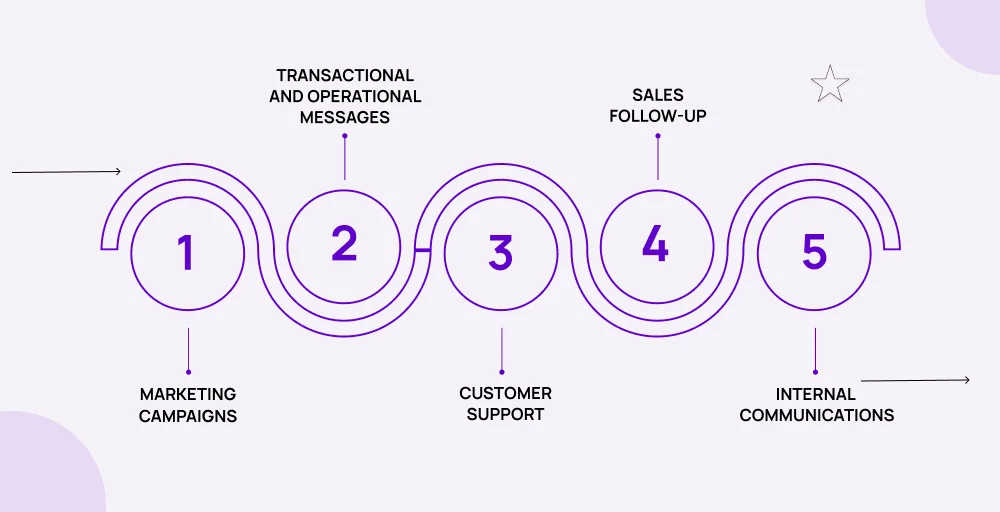
1. Marketing campaigns
Marketing often requires sending large volumes of messages quickly and consistently.
- Automated: Automation is ideal for promotions, seasonal offers, product launches, and re-engagement campaigns because these messages are repetitive and time-sensitive. Businesses can schedule them in advance and send them to thousands of contacts instantly.
- Manual: Personal thank-you messages, custom offers for top clients benefit from a human touch. These messages feel more genuine and help build stronger relationships with high-value customers.
2. Transactional and operational messages
These messages provide customers with essential updates related to their purchase accounts.
- Automated: Order confirmations, shipping updates, appointment reminders, and subscription renewals follow predictable patterns. Automation ensures they are delivered immediately, with zero delay or manual effort.
- Manual: When something goes wrong, such as a lost shipment, a failed appointment, or a payment issue, a human agent is better equipped to understand the situation and provide a thoughtful, tailored response.
3. Customer support
Support involves both routine questions and complex issues.
- Automated: Automated workflows manage initial responses, create support tickets, route customers to the appropriate team, and answer simple frequently asked questions (FAQs). This approach speeds up response times and reduces the workload.
- Manual: More complicated issues require human reasoning, empathy, and problem-solving skills. Agents can thoroughly diagnose problems, guide customers step by step, and provide personalized follow-ups after negative experiences.
4. Sales follow-up
The sales process combines outreach, nurturing, and personalized connections.
- Automated: Automated messages are perfect for sending quick follow-ups after someone fills out a form, or for delivering scheduled nurture sequences and reminders.
- Manual: When a potential customer shows interest, a human representative is needed for live qualification, demos, proposal discussions, and final negotiations. These interactions require adaptability and trust-building.
5. Internal communications
Communications within a team or organization also benefit from both automation and human input.
- Automated: Sending shift reminders, urgent announcements, and mass updates is quicker and more reliable when done automatically. This ensures that everyone receives information at the right time.
- Manual: Coaching, performance discussions, and sensitive HR conversations should always be conducted manually, as they require discretion, empathy, and personal attention.
Wrapping up!
Automated and manual text messaging play important but different roles in communication today. Automation is the best choice for quickly sending large volumes of routine or urgent messages. It helps ensure customers get timely updates without needing constant human help.
On the other hand, manual messaging is vital for conversations that need empathy, personalization, and human judgment. This includes resolving complex issues, nurturing valuable leads, or dealing with sensitive situations.
The best communication strategies usually combine both methods: use automation for efficiency and manual messaging for meaningful, human interaction. This hybrid approach allows businesses to maximize their return on investment while delivering authentic, personalized customer experiences.