


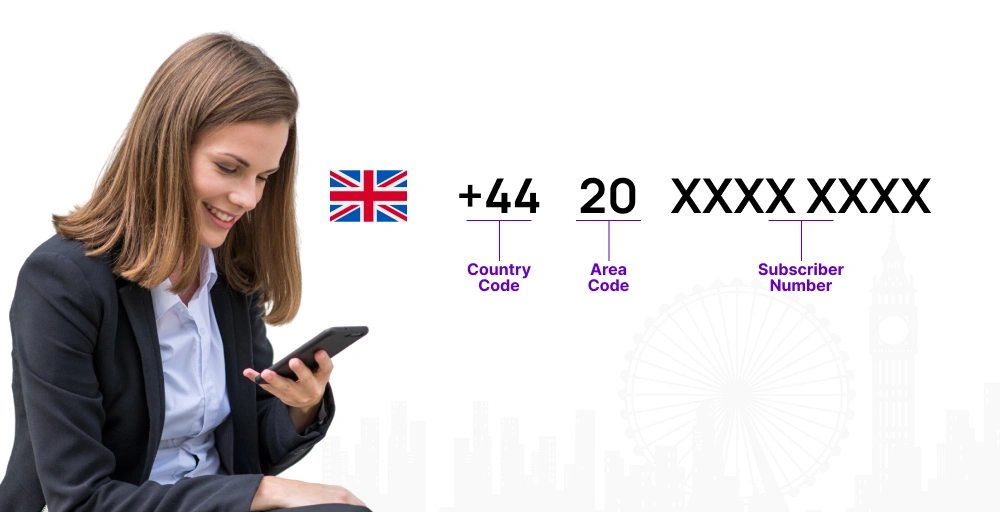
The UK phone number format refers to the standardized structure used for telephone numbers in the United Kingdom. A UK phone number is made up of the country code +44, a National Destination Code (also known as the area code), and a subscriber number.
When written in international format, UK phone numbers exclude the leading 0 trunk prefix, contain 9–10 national significant digits after +44, follow the global E.164 numbering standard, and can be up to 15 digits in total, including the country code.
This standardized structure ensures calls are routed correctly both within the UK and from abroad.
✨ UK Phone Number Format: Quick Facts
- Country code: +44
- Domestic trunk prefix: 0
- National significant number length: 9 or 10 digits
- Mobile numbers start with: 07
- Geographic landlines start with: 01 or 02
- Non-geographic business numbers start with: 03, 08, or 09
Structure of a UK Phone Number
Understanding the structure of a UK phone number is essential for making calls correctly, whether you’re dialing locally or from abroad.
A standard UK phone number consists of three core components: the country code, the National Destination Code (NDC), and the subscriber number. Together, they form the National Significant Number (NSN), which ensures every call is routed accurately.
1. Country Code (+44)
The UK country code +44 is used when calling from outside the UK. It replaces the leading zero used in domestic phone numbers.
Example:
- Domestic (UK) number: 020 7123 4567
- International format: +44 20 7123 4567
Including the country code is essential for international calls and helps businesses maintain a professional appearance when sharing contact information globally.
2. National Destination Code (NDC / Area Code)
The NDC, commonly referred to as the area code, identifies the city, town, or local exchange of the number. It plays a critical role in routing calls to the correct location.
- Large cities have shorter area codes (e.g., London: 020)
- Medium cities use 3–4 digit codes (e.g., Manchester: 0161)
- Smaller towns can have longer codes (e.g., Brampton: 016974)
When writing numbers in international format, drop the leading 0 from the area code.
Example:
- London: 020 7123 4567 → +44 20 7123 4567
- Oxford: 01865 212 961 → +44 1865 212 961
3. Subscriber Number (SN)
The subscriber number is the unique local number assigned to a landline or mobile line. Its length varies depending on the NDC and type of number.
- Landlines may have 6–8 digits after the area code
- Mobile numbers always have 10 digits after the leading 0 or +44
- Some business lines may include an optional extension for routing calls internally
Example:
- Domestic: 020 7123 4567
- International: +44 20 7123 4567
By understanding these components and their correct formatting, you can ensure calls are routed correctly, minimize dialing errors, and present a professional image for both personal and business communication.
Check out 👉: Best Call Center Software in the UK
UK Phone Number Example (Domestic & International)
Domestic (UK) format: 020 7846 2267
International format: +44 20 7846 2267
Where,
- +44 = UK country code
- 20 = London area code (without the leading 0)
- 7846 2267 = Subscriber number
When calling the UK from abroad, remove the leading 0 and replace it with +44.
This rule applies to both UK landline and mobile numbers.formatting rule applies to both landline and mobile numbers.
Types of UK phone numbers
1. Geographic Landline Numbers (01 & 02)
Format: Area code + local subscriber number
Geographic landline numbers are directly linked to a specific city, town, or region in the UK. They are widely used by households, local businesses, public offices, and institutions that want to establish a clear local presence.
- Numbers starting with 01 or 02 indicate a geographic location
- The area code identifies the region, while the remaining digits form the local number
- The length of the area code varies by location, which affects the length of the local number
Examples:
- +44 20 7846 2267 (London)
- London uses a 2-digit area code (20) followed by an 8-digit local number
- London uses a 2-digit area code (20) followed by an 8-digit local number
- Cities like Manchester use 3-digit area codes (e.g., 161), with slightly shorter local numbers
Geographic numbers are ideal for businesses that want to build trust with local customers by appearing established in a specific area.
2. UK Mobile Numbers (07)
UK mobile number format: 07 XXX XXX XXX
UK mobile numbers are used for both personal and business mobile phones and always begin with 07 when dialed within the UK.
- Commonly associated with individual users, sales teams, and mobile-first businesses
- Provide flexibility, as they are not tied to a physical location
- Often used for SMS, WhatsApp, and mobile verification services
Example:
- +44 7199 199402
When calling internationally:
- Remove the leading 0
- Dial the remaining digits after +44
Mobile numbers are especially useful for businesses that rely on mobility, remote teams, or direct customer communication.
3. Business & Non-Geographic Numbers
Non-geographic numbers are not associated with any specific location in the UK. Instead, they are designed for businesses, organizations, and service providers that want a nationwide or service-based presence.
Common non-geographic prefixes include:
- 03 – National-rate business numbers
- 08 – Freephone or service numbers
- 09 – Premium-rate service numbers
Examples:
- +44 327 882 2759 (03 number)
- +44 800 882 2759 (Freephone)
Key benefits of non-geographic numbers:
- Calls can be routed to different teams or locations
- Businesses can operate nationally without revealing a physical address
- Consistent branding across marketing channels
Among these, 03 numbers are particularly popular because they are charged at the same rate as geographic numbers (01 and 02) and are included in bundled call allowances, making them more customer-friendly.
Most commonly used UK area codes
UK area codes vary in length depending on the region or city. Larger cities have shorter area codes, while smaller towns use longer ones. This structure of multiple area codes helps organize the numbering system efficiently and allows for more local numbers in densely populated areas.
Here are some of the commonly used UK area codes:
| Area code | Location | Length of Area code | Example | Area covered |
| 020 | London | 2 digits | 020 7946 2147 | Covers all London areas |
| 0161 | Manchester | 4 digits | 0161 223 6144 | Used across Greater Manchester |
| 0121 | Birmingham | 4 digits | 0121 555 6394 | Major West Minlands area code |
| 0113 | Leeds | 4 digits | 0113 579 9852 | Leeds and its surrounding areas in West Yorkshire, England |
| 0141 | Glasgow | 4 digits | 0141 852 0369 | Covers Glasgow and nearby areas |
| 0151 | Liverpool | 4 digits | 0151 684 1578 | Serves Liverpool and Merseyside |
| 01865 | Oxford | 5 digits | 01865 212 961 | Covers Oxford and its surrounding areas |
Shorter codes (like 020) allow for longer local numbers, while longer codes (like 01865) have shorter local parts. This keeps the total length of the full phone number consistent across the UK.
How to dial UK phone numbers
Calling a UK phone number is easier than you think. Just follow these simple steps as it is to reach the desired recipient every time accurately:
1. Calling within the UK
When you are calling inside the UK, you don’t need to add any country code. Here are the steps:
- Landline calls: Dial the full number, including the area code that starts with a 0 (e.g., 020 3727 2293)
- Mobile calls: Dial the complete 07 mobile phone number (e.g., 07 199 199402)
2. Calling the UK from abroad
Steps for landline calls:
- Dial your country’s international access code or the exit code. It is different for each nation. (e.g., 011 from the US, 00 from Europe).
- Enter the UK country code (+44).
- Remove the leading ‘0’ from the area code.
- Then, dial the rest of the local phone number.
For example, to call a UK landline number (020 3727 2293) from Europe, you’ll dial “00 44 20 3727 2293”
Steps for mobile calls:
- Dial the international access code and
- The UK country code, +44.
- Omit the leading ‘0’ from the ‘07’ mobile code.
- Now, dial the remaining local subscriber number.
Example: To dial a UK mobile number (07 199 199402) from abroad, such as Europe, you’ll dial “00 44 7199 199402”
Note: For those using a VoIP system or virtual phone number, the dialing process follows the same structure, except calls are placed over the internet instead of traditional phone lines.
Common mistakes to avoid when dialing a UK phone number
Simple or small steps when dialing a UK phone number can cause call failure or create confusion. Always follow the correct format and watch out for these common mistakes:
1. Forgetting to remove the “0” when calling internationally
When dialing from outside the UK, always drop the leading zero in the area or mobile code and replace it with the country code, +44. If you keep the leading zero after adding +44, the call won’t connect because the number format becomes invalid.
2. Confusing area codes with mobile prefixes
Area codes like 020 or 0161 differ from mobile prefixes, which start with 07. Mixing up the UK mobile number digits with area codes can route your call to the wrong destinations or cause it to fail entirely.
3. Using the wrong formatting in international contexts
Always use the +44 prefix when sharing the UK phone number format international. Using or sharing the wrong formatting can cost you a lot, as it can make your business unreachable for overseas callers.
4. Listing numbers incorrectly on websites or ads
Just make sure to keep your contact information consistent and correctly formatted on your official websites or any advertisements to remove any confusion regarding your number, especially those calling from abroad, which can lead to missed calls or lost inquiries.
Start calling with a UK phone number from KrispCall
Get your own UK virtual phone numbers for business with KrispCall and connect with customers, clients, or partners across the United Kingdom effortlessly.
Whether you’re a global business expanding into the UK or a local company looking to appear more professional, KrispCall gives you reliable UK numbers that work from anywhere. You can manage calls, messages, and contacts from one unified app that does not require extra hardware or a complex setup.
Choose from local, mobile, or toll-free UK numbers and start calling with a clear and high-quality voice. Get your UK phone number today with KrispCall!