

TL;DR
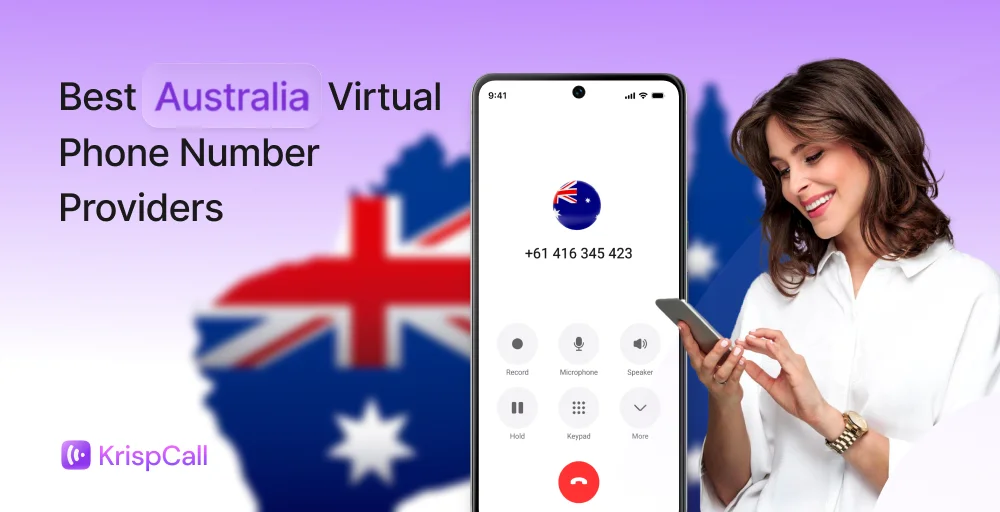
We’ve reviewed the top Australian number providers, comparing local call quality, ease of setup, ACMA compliance, and overall value for businesses of all sizes. This guide is designed to help you find a platform that provides a genuine local presence in the Australian market.
Here’s a quick overview of the 8 best Australia virtual number providers:
1. KrispCall: Best for small to mid-sized businesses wanting an affordable, all-in-one Australian virtual number solution starting at $12/user/month.
2. Ringover: Best for sales and support teams needing advanced call management tools alongside their Australian number.
3. eVoice: Best for solopreneurs and small businesses needing a simple setup of an Australian number.
4. AVOXI: Best for businesses looking for a free entry point with broad global and Australian number availability.
5. EasyRinger: Best for individuals and small teams on a tight budget who need a reliable Australian number fast.
6. CallHippo: Best for growing teams wanting a feature-rich virtual phone system built around outbound communication.
7. Alltel: Best for Australian businesses that prefer working with a locally-based telecom provider.
8. Optus: Best for established businesses prioritizing carrier-grade reliability and full Australian telecom accountability.
What is an Australian virtual number?
An Australian virtual phone number is a cloud-based phone number with a local Australian prefix that operates entirely over the internet, without requiring a physical SIM card, landline, or fixed location.
These virtual numbers function like any regular Australian number, dialable, receivable, and recognizable, but routed calls through VoIP technology to any device or location you choose. The only thing that separates a traditional number from a virtual one is its flexibility.
Benefits of using an Australian virtual phone number
- EEstablish a credible Australian identity without renting office space or hiring local staff — the smarter choice for any Australia VoIP provider looking to expand locally.
- Reduce international roaming costs by routing all calls over the internet rather than traditional phone lines.
- Manage calls from any device, anywhere, ensuring business continuity.
- Choose from local, national, or toll-free numbers depending on your audience and business needs.
- Add or remove numbers and users instantly to keep up with your business growth without any physical installations.
- Easily track call volumes, durations, and patterns to make smarter decisions about your communication setup.
Types of virtual phone numbers in Australia
Not all Australian virtual numbers serve the same purpose. The right type depends on who you’re trying to reach and the impression you want to make. Here’s a breakdown of the most common ones:
Local number
Local Australian numbers are area-code-specific numbers that tie your business to a particular Australian city or region. A Sydney-based number starts with 02, a Melbourne-based number with 03, and so on. If you’re targeting customers in a specific city, a local number makes your business feel right around the corner, even if you’re not.
For example, a business operating from overseas can use a 02-9XXX-XXXX number to appear as a legitimate Sydney-based operation.
Toll-free number
Toll-free Australian numbers (1300 & 1800) allow customers to call your business at no cost. The 1800 numbers are free for the caller, while 1300 numbers are typically charged at a local rate. They’re widely used by businesses that want a national presence rather than being associated with one specific city.
Mobile virtual numbers
Australian mobile virtual numbers use a mobile prefix, typically 04, and appear similar to a standard mobile caller ID. Their idea is for businesses or individuals who want the familiarity and accessibility of a mobile identity without being tied to a physical SIM card.
Vanity virtual numbers
Vanity virtual numbers are customized numbers that are either in a memorable pattern or spell out a word like 1800-FLOWERS or 1300-LAWYERS. They’re primarily a marketing tool, built around recognition and making it effortless for customers to remember how to reach you.
Quick comparison of Australian virtual number providers
To help you choose the right platform for your business, we spent time reviewing review sites like Trustpilot, G2, and Capterra and analyzed unfiltered user feedback. These findings were then cross-referenced to put together this list of the 8 best Australian VoIP number providers.
| Competitor | Pricing | Setup fee | Best for |
| KrispCall | $12/user/month | $0 | Small to mid-sized businesses and high-growth teams that want an affordable all-in-one solution. |
| Ringover | $21/user/month | $0 | High-volume outreach with built-in CRM integrations. |
| eVoice | $12/month | $0 | Solopreneurs and small businesses that need a professional image on a budget. |
| AVOXI | $0/month | $0 | Businesses looking for a free entry point with global number availability. |
| EasyRinger | $10/month | $0 | Individuals and small teams on a tight budget. |
| CallHippo | $19/user/month | $15 | Growing teams that need a feature-rich virtual phone system |
| Alltel | $8/month | $30 | Businesses that want a locally-based provider. |
| Optus | $35/month | $250+$45/user | Established businesses that prefer a major Australian telecom provider. |
Top 8 leading Australian virtual number providers
1. KrispCall
KrispCall is a cloud-based phone system that offers Australian virtual numbers across local, mobile, and toll-free numbers in minutes. It is one of the more versatile options for businesses that need a genuine Australian presence without the complexity of traditional hardware. You get full control over how your calls are routed, forwarded, and managed from a single dashboard.
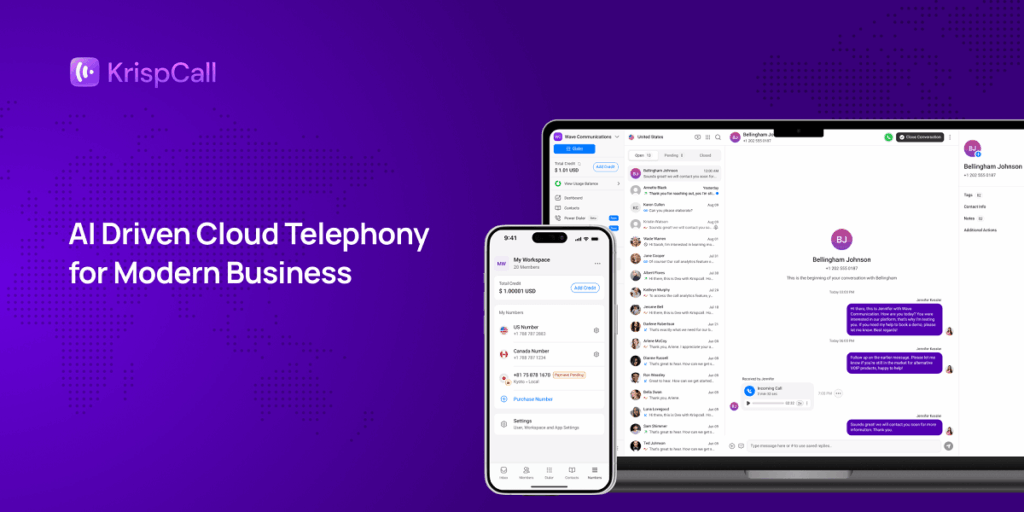
KrispCall offers communication features like team messaging, call analytics, IVR, and CRM integrations at a price point that doesn’t require an enterprise budget. It’s this combination of affordability, coverage, and functionality that puts it at the top of our list of best Australian virtual phone number providers.
Features
- Unified Callbox: Manage all calls, messages, and voicemails from one centralized inbox.
- Global number coverage: Alongside, virtual phone number Australia, scale in 100+ other markets instantly from the same dashboard.
- IVR (Interactive Voice Response): Set up a professional, multi-level phone menu that intelligently handles VoIP callers, even outside business hours.
- CRM integrations: Connect seamlessly with 100+ CRMs and business tools to keep customer data and call activity in sync.
- Shared numbers: Manage a single number by multiple team members to ensure rapid response times for customer inquiries.
| Pros | Cons |
| Affordable entry-level pricing with CRM-ready features. | Mobile apps lack features available on the web app. |
| Reliable 24/7 customer support. | Does not offer desktop apps. |
| Highly intuitive and user-friendly interface. | Not a full UCaaS suite; lacks video conferencing |
Pricing
| Plan | Annual price (per user/month) | Key features |
| Essential | $12 | 1 free local/mobile from the UK, USA, or Canada, Number porting, Voicemail |
| Standard | $32 | Call recording, Power dialer, Slack integrations |
| Enterprise | Custom | Dedicated account manager, Developer support, Custom SLA |
2. Ringover
Ringover is a cloud communication platform designed for sales and support teams. It allows businesses to obtain Australian virtual numbers while combining telephony with performance-focused tools like analytics and automation.
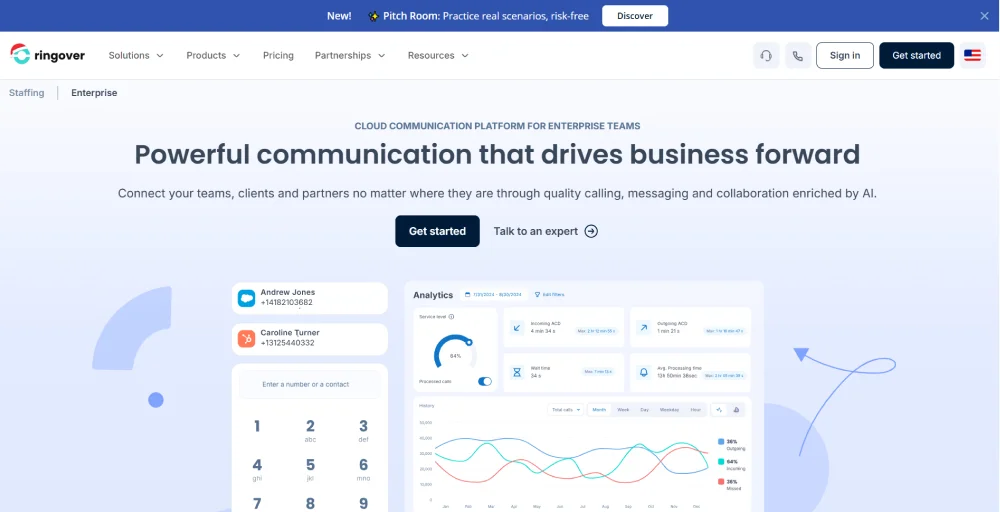
Ringover is priced higher than some alternatives, but for teams that need performance-focused tools alongside their Australian number, the value holds up.
Features
- Power dialer: Automate outbound call center campaigns by automatically dialing through a list of Australian leads.
- CRM & helpdesk integrations: Sync with 100+ tools, including Salesforce and HubSpot, to fully log every customer interaction.
- AI-powered analytics: Easily track key metrics and gain actionable insights into the team’s performance.
- Video conferencing: Transition from a voice call to a collaborative video meeting with one click.
| Pros | Cons |
| Reliable VoIP call quality and performance. | AI voice agent (AIRO) is locked behind expensive add-ons. |
| Unlimited calls to 90+ countries. | Features and accessibility limitations on mobile apps. |
| Video conferencing and instant messaging are included in the starting plan. | Users report SMS not syncing issues between desktop and mobile. |
Pricing
| Plan | Annual price (per user/month) | Key features |
| SMART | $21 | Click-to-call, AI call summary, Smart dialer |
| BUSINESS | $44 | Smart routing, Priority call queues, Call groups |
| ADVANCED | Custom quote | Auto dialer, Call scripts, Local presence dialing |
3. eVoice
eVoice is a virtual phone system focused on simplicity and professional inbound call handling. It offers Australian virtual numbers that help freelancers, solopreneurs, and small businesses present a polished image without the need for a full-featured VoIP system.
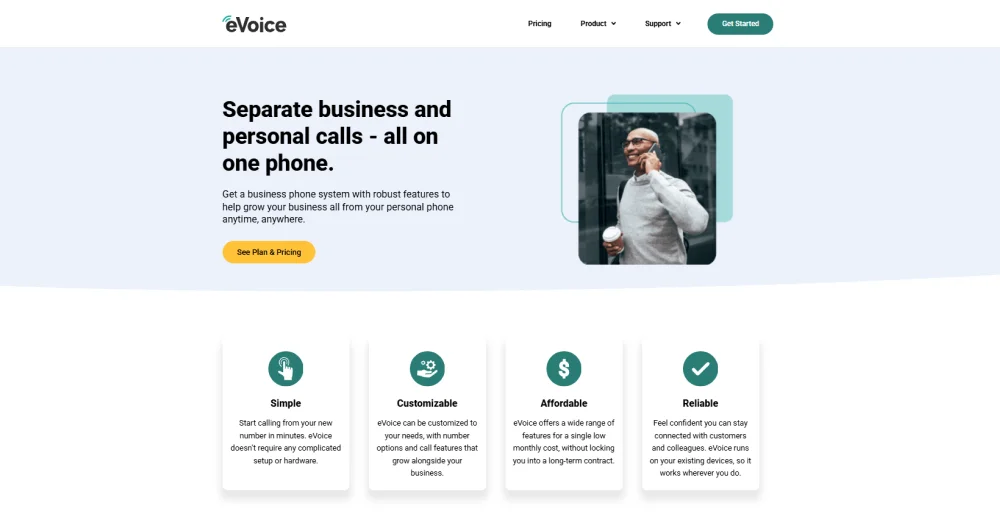
While eVoice may lack the depth of features found in larger platforms, it still delivers dependable service for solopreneurs, freelancers, and small business owners.
Features
- Auto-attendant: Greet callers with a professional automated menu that instantly directs them to the right person or department.
- Call screening: Review who’s calling before you pick up, allowing you to decide whether to take the call or send it to voicemail.
- Professional greetings: Upload your custom audio or use automated greetings to greet customers when they call.
- Mobile app: Make and receive business calls from your personal device and stay connected on the go.
| Pros | Cons |
| Offers a 30-day money-back guarantee in each plan. | Sometimes the transcription of the voicemail doesn’t match the caller’s message. |
| Unlimited calling in the U.S. and Canada. | Lacks video conferencing support. |
| Low-cost or budget-friendly entry-level option. | Voicemail transcription and professional greetings require an add-on purchase. |
Pricing
| Plan | Annual price (per month) | Key feature |
| Elite | $12 | Multiple extensions, Advanced call handling, Number porting |
| Elite Plus | $19 | Everything in the Elite plan plus Unlimited messaging (U.S. and Canada) |
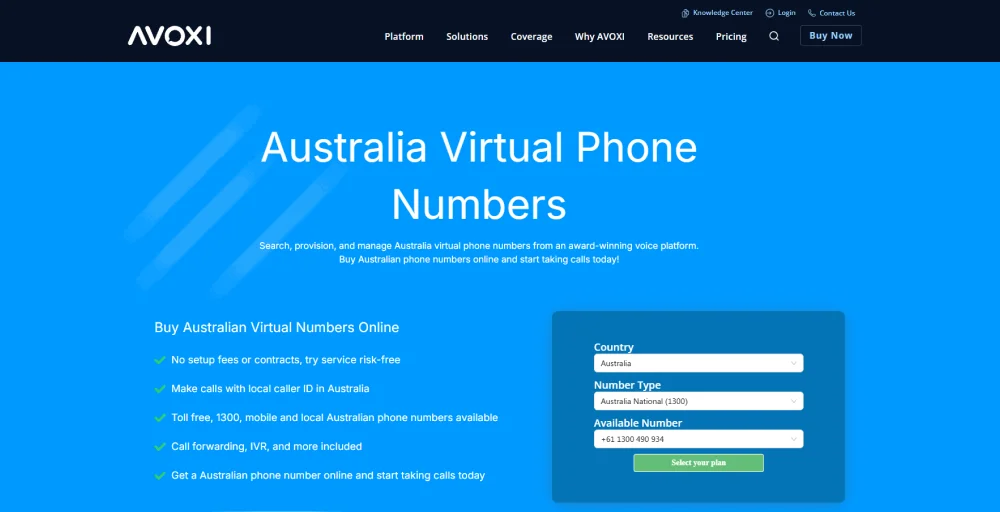
4. AVOXI
AVOXI is a global cloud communications provider designed for enterprises and international call centers. It offers Australian virtual numbers alongside extensive global coverage, making it a strong option for businesses managing high call volumes across multiple countries.
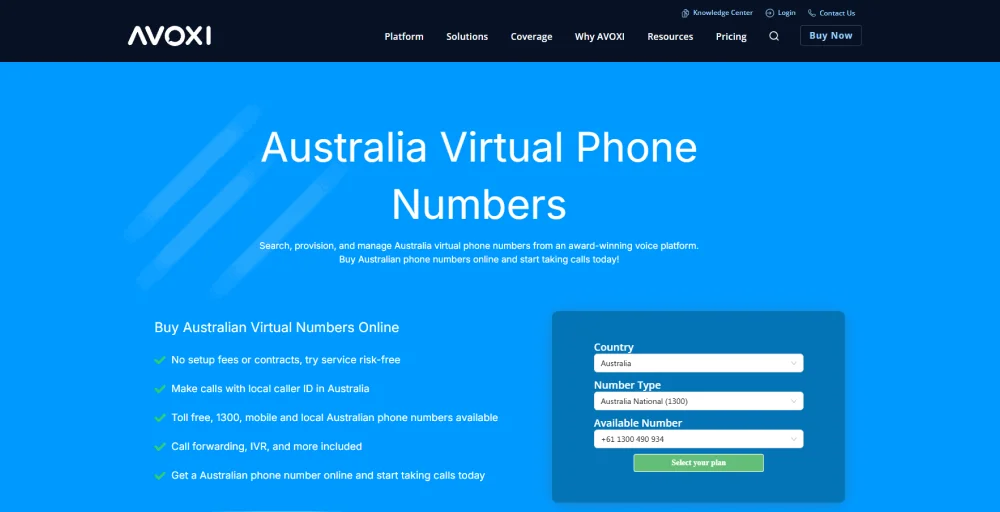
The platform emphasizes call quality, routing control, and real-time analytics with enterprise-grade infrastructure and compliance-focused design.
Features
- TrueLocal caller ID: Display a local number on outbound calls even when dialing from overseas.
- Global number coverage: Get virtual numbers from Australia and 150+ more countries from a single unified platform.
- CRM & API integrations: Connect with major CRM platforms and use AVOXI’s open API to build custom workflows.
- Call insights analytics: Monitor call quality in real-time to ensure high-definition audio.
| Pros | Cons |
| Responsive 24/7 customer support. | Lacks native video conferencing feature. |
| Simple to use & easy to set up. | Some user reports occasional lag or glitches in call quality. |
| Affordable with good value for features. | Limitations of SMS to certain international numbers. |
Pricing
| Plan | Annual price (per month) | Key features |
| Launch | $0 | Unlimited concurrent calls, Call insights, Call forwarding |
| Contact | $29.99 | Click-to-call, Mobile app, WebRTC call encryption |
| Engaged Enterprise | $49.99 | Skills-based routing, VIP calling, Outbound agent reporting |
5. EasyRinger
EasyRinger is a lightweight virtual number provider aimed at individuals and small teams with basic calling and messaging needs. It offers Australian virtual numbers with minimal setup, making it accessible even for users with limited technical experience.
While EasyRinger won’t replace a full business phone system, it will cover the core bases well, making it one of the most credible Australian virtual number providers.
Features
- Reliable SMS/MMS: Send and receive text or multimedia messages from your virtual numbers.
- Block/allow: Create a list of approved and blocked numbers to manage who can call you and reduce unwanted spam.
- Call forwarding: Redirect incoming calls to any mobile or landline globally with just a few clicks.
- Voicemail management: Access and manage voicemails easily through the platform to ensure no important message goes unheard or unanswered.
| Pros | Cons |
| Responsive and helpful customer support, praised by many users. | Some accounts get suspended unexpectedly due to usage limits of fraud checks. |
| Two months free when paid yearly. | Per-minute call rates can add up for heavy international use. |
| Simple, user-friendly setup and interface. | Call quality or reliability reports vary from user to user. |
Pricing
| Plan (Local number) | Annual price (per month) | Key features |
| Standard plan | $10 | Call forwarding to two numbers, Browser calls, SMS/MMS support |
| Pro plan | $14 | IVR, Forwarding to ten numbers, Power dialer |
6. CallHippo
CallHippo is a cloud-based phone system built for startups and growing teams that need both virtual numbers and productivity-focused calling tools. It allows businesses to easily activate Australian numbers and manage calls across distributed teams.
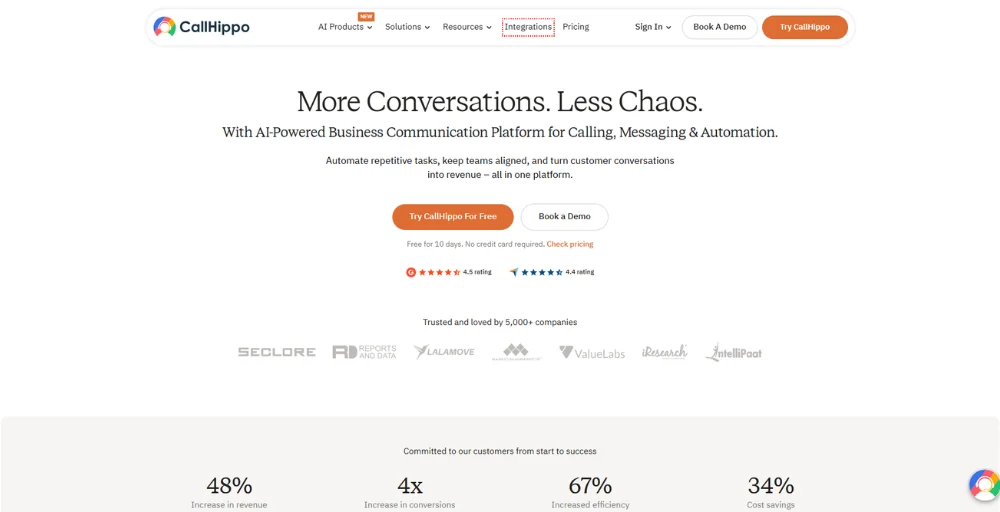
The platform positions itself as a growth enabler, offering features that support outbound sales, customer engagement, and team monitoring.
Features
- Voicemail drop: Leave pre-recorded voicemail messages automatically without ringing.
- Power dialer & auto dialer: Automate outbound call queues so agents can move through lists faster.
- Call tracking: Monitor every inbound and outbound call, maintain a complete record, and hold the team accountable.
- Smart DID routing: Intelligently route incoming calls to the most qualified agent based on previous interaction.
| Pros | Cons |
| Competitive and affordable pricing for small to medium teams. | The mobile apps glitch from time to time. |
| Offers a 10-day free trial. | Users have reported being charged unexpectedly for service they didn’t need or use. |
| Easily integrates with popular CRM and helpdesk tools. | Many users have reported poor customer service. |
Pricing
| Plans | Annual price (per user/month) | Key features |
| Starter | $19 | Basic report analytics, Free omnichannel inbox, Free WhatsApp Business API |
| Professional | $29 | Call recording, AI reports/analytics, Multilingual IVR |
| Ultimate | $45 | CRM-based VIP routing, Custom integrations, Personalized onboarding |
7. Alltel
Alltel is an Australian-based telecommunications provider that specializes in locally compliant virtual phone services. Unlike many global SaaS platforms, Alltel focuses specifically on the Australian market and adheres closely to local regulatory requirements.

This local-first approach makes Alltel appealing to businesses that value Australian-based support and accountability.
Features
- My circle calling: Allowed unlimited free calls to selected phone numbers within the customer’s chosen circle group.
- Local customer support: Access support from an Australian-based team operating in local time zones.
- Live answering service: Scale your professional image with virtual receptionists who can take messages or transfer urgent calls on your behalf.
- Custom business intro: Upload a professional greeting that plays immediately when a customer dials.
| Pros | Cons |
| Competitive pricing and flexible VoIP/SIP trunk plans. | Not a fully feature-rich system compared with larger enterprise VoIP platforms. |
| User-friendly portal for managing accounts and settings. | Many complaints regarding poor customer service and long wait times. |
| Fast setup process and easy onboarding. | Occasional interruptions or latency during VoIP calls. |
Pricing
| Plan (Local numbers) | Annual price (per month) | Key features |
| Local Starter | $8 | Call routing, Voice to email |
| Local Basic | $16 | Everything in Local Starter plans, plus 100 minutes of included calls |
| Local Plus | $24 | Everything in the Local Starter plan plus 300 minutes included calls, Call recording |
8. Optus
Optus is one of Australia’s largest telecommunications companies, offering virtual number solutions as part of its broader enterprise communications portfolio. Its services are designed for established businesses that prioritize network reliability and long-term stability.

While Optus lacks the flexibility and speed of modern SaaS-based VoIP providers, it appeals to enterprises that prefer traditional telecom backing.
Features
- Call forwarding: Automatically sends incoming business calls to a specified number or team member based on rules you set.
- Busy lamp monitoring: See the real-time status of contacts (e.g., busy, idle, in a call) across handsets.
- Hunt group & call queue: Direct incoming calls to a group of phones of team members in sequence or queue them, so callers aren’t met with a busy tone.
- Instant messaging: Communicate with colleagues via one-to-one or group chats in the loop system.
| Pros | Cons |
| Scalable for large teams without requiring a complete platform overhaul. | Requires an upfront investment of a $250 setup fee plus a $45 per user charge. |
| Carrier-grade reliability and uptime across the country. | Lacks the international flexibility, making it not ideal for remote or global teams. |
| Great value when combined with existing Optus business internet and mobile fleet plans. | Slower onboarding process with more steps, paperwork, and wait times. |
Pricing
| Plan | Annual plan (per user/ month) | Key Features |
| Basic (PAYG) | From ~$25 | 13/1300 calls, Local & national calls, Calls to mobiles |
| Premium (PAYG) | From ~$50 | Call waiting, Hot desking, Remote office |
| Ultimate | From ~70 | Group paging, Auto attendant, Hunt groups |
Note: Prices are approximate and depend on contract length and terms.
How to choose the best Australian virtual number provider?
With so many options available, narrowing down the right provider comes down to a handful of practical factors, such as:
1. Number type availability: Make sure the provider offers the different types of Australian virtual numbers you need, as not every provider covers all formats.
2. ACMA compliance & legal stability: Ensure your provider complies with the Australian Communications and Media Authority (ACMA) rules.
3. Pricing & total cost of ownership: Look beyond the monthly rate. Factor in setup fees, per-user costs, and any charges for features that other providers include as standard.
4. Local call quality & latency: Look for providers with Australian-based data centers (PoPs) to minimize lag and jitter.
5. Feature integration: Beyond simple calling, prioritize tools like unified callboxes or CRM syncs that allow management of SMS and voice data in one workflow.
6. Support quality & availability: Prioritize providers with accessible, knowledgeable support, ideally available during Australian business hours.
Wrapping up
Choosing from the best Australian phone number providers is ultimately about finding the right balance between local trust and modern functionality. Whether you’re a solopreneur needing a professional 1300 image or a global team looking to land in the Aussie market, the right virtual number removes geographical barriers.
If you’re ready to establish a professional Australian presence without the overhead, getting started with KrispCall takes a minute. Get your Australian virtual number today and see the difference a well-built system makes.