


Long wait times, repetitive inquiries, and the high cost of staffing a full-time receptionist are common pain points for businesses of all sizes. But what if you could solve these challenges with a single solution?
AI call answering services are the answer, providing a scalable, cost-effective, and always-on alternative to traditional phone support. It is an automated solution that utilizes artificial intelligence to handle and respond to incoming phone calls.
In this blog, you get to know more about the AI call answering service, its benefits, and receive a step-by-step guide on how to set it up, and review some of the AI answering tools.
✨ Key Takeaways
- AI call answering systems use artificial intelligence to manage and respond to calls automatically, providing 24/7 support and reducing operational costs.
- AI answering phones utilizes speech recognition, natural language, and text-to-speech technology to understand and respond to callers in a human-like way.
- The best AI answering services offer benefits such as cost savings, improved customer experience, seamless call routing, and valuable real-time analytics.
- The best AI answering services are KrispCall, Zendesk, Dialpad, Talkdesk, Cloudtalk, and others.
What is AI call answering?
AI call answering is a technology that uses artificial intelligence to answer and handle phone calls automatically. They function as virtual AI receptionists, routing calls, taking messages, answering questions, booking appointments, and providing 24/7 support.
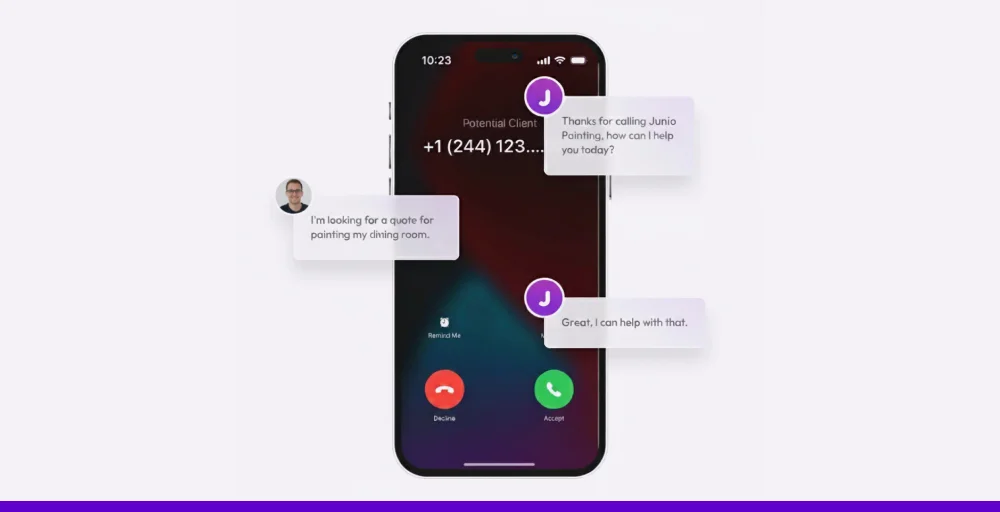
Older systems, such as Interactive Voice Response (IVR) or traditional voicemail, which rely on rigid menus and prerecorded messages, can be enhanced with AI answering. This allows AI to interpret spoken language and reply in a more natural, conversational manner. These systems use AI voice agents to save time and reduce cost.
How does AI call answering work?
AI call answering works with the help of NLP and machine learning, like they automatically pick up calls, convert the speech into text, and try to understand the caller’s need. Then, the answering machine responds to the call and routes calls to the right person or sends a follow-up message.
Here’s a more detailed breakdown of the AI phone call system process:
Step 1: Speech recognition (STT)
The process begins with the caller providing speech input, which serves as the raw data for analysis. It then uses speech recognition technology, such as automatic speech recognition (ASR) or speech-to-text (STT), which converts the caller’s spoken words into a text format.
Step 2: Natural language processing (NLP/NLU)
Once the words are completely transcribed into text format, the Natural Language Processing (NLP) and Natural Language Understanding (NLU) determine to understand the meaning and intent behind the caller’s request.
Step 3: Backend integration and decision making
If the understanding is completed, then the AI system accesses your business system, databases, or knowledge bases to find the relevant information or insights that the caller requests.
Step 4: Response generation (NLG & TTS)
Using Natural Language Generation (NLG), the AI formulates a helpful and coherent response in a human-like voice. Text-to-Speech (TTS) technology converts this into audio, delivering the answer to the caller in real-time.
AI vs. Human answering service
An AI answering service is a software-based, fully automated technology that uses NLP and machine learning to understand and respond to callers’ queries. Whereas a human answering service provides service with the help of live, professional agents who answer calls for the businesses.
These AI answering services are available 24/7, save money, and respond quickly and consistently. This makes it great for handling routine questions and high volumes of inquiries.

However, a human answering service provides a human touch, empathy, flexibility, and a personal touch, which helps build stronger customer relationships and enhances the customer experience. On the other hand, it costs more, is less available, and doesn’t scale as well.
In most cases, using a combination of both, AI for simple and repetitive tasks and using human agents for routing complex queries and emotional interactions, provides the best balance between efficiency and customer care.
Benefits of using an AI call answering service
AI call answering service are way more important than they look. They offer numerous benefits from seamless connectivity to an efficient and effective communication strategy.
Some of these benefits are:
- 24/7 customer access: AI systems can answer calls all day long, ensure that there are no missed calls, even out of business hours.
- Significant cost savings: Integration of such an AI call answering service significantly saves cost by eliminating the need for human receptionists or a call center team.
- Superior customer experience: AI can instantly route calls to the correct department or individual, provide quick answers to frequently asked questions, and personalize interactions using web scraping data, leading to higher customer satisfaction.
- Harnessing data insights: AI call answering services help to collect data and information from customer queries, including their call length. Because analysis of such data helps to understand customer behavior better and improve your business operations.
- Multilingual & omnichannel capabilities: Advanced AI systems can talk in many languages, which helps a business reach more people around the world. Also, AI call answering can be integrated across different channels, like phone calls, text messages, social media, and live chat, to ensure a consistent customer experience.
Best practices for setting up AI call answering
To set up an AI call answering service, businesses must use a virtual receptionist that is capable of managing real-time conversations and integrating with existing systems.
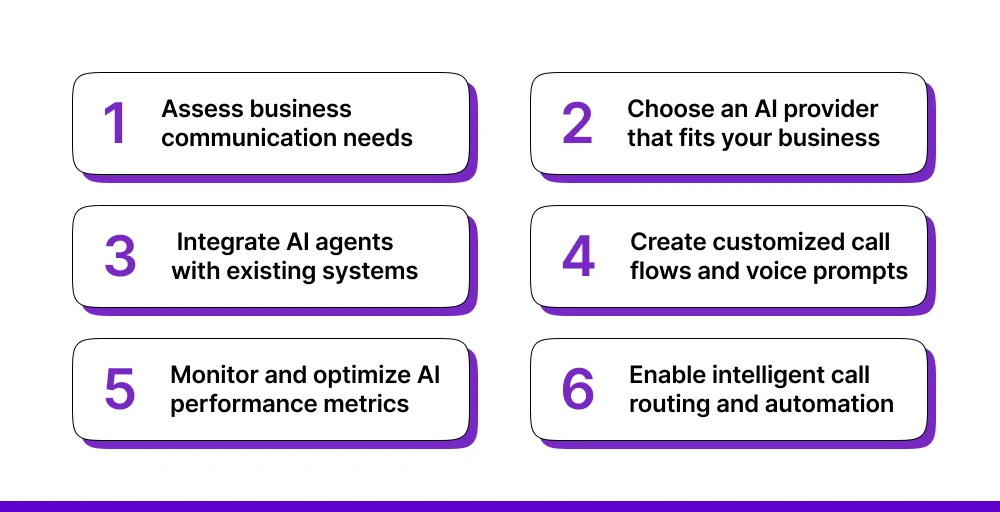
Here’s a step-by-step guide to get started:
1. Assess business communication needs
Start by analyzing your current business communication data, such as call volume, customer inquiries, and peak hours. So, you can assess why and for what purpose you need such AI call answering services.
Identify the pain points of your customers and teams, like getting repetitive questions, long wait times, and after-hours support gaps that AI can resolve.
2. Choose an AI provider that fits your business
Next, you need to select an AI provider that fits with your business needs, such as meeting your technical requirements, budget, and other capabilities. Also, evaluate its voice quality, conversational flow, and check whether it can handle customer demographics and use cases.
3. Integrate AI agents with existing systems
Connect your AI solution with CRM systems such as VoIP Salesforce integration. This enable seamless data access and ticket creation during calls. Always ensure that your selected system integrates with your existing system, allowing you to provide real-time information, and must update your customer records automatically based on your call interactions with them.
4. Create customized call flows and voice prompts
Not all providers come with the in-built functions. So, consider the one that provides customizable options, such as those for voice prompts and call flows. Then you are free to change the scripts based on your brand voice and can guide customers for common scenarios.
Also, this will help to create personalized greetings that make interaction more human-like
5. Monitor and optimize AI performance metrics
Integration and implementation of AI call answering services doesn’t mean everything is done. They need continuous monitoring and optimization as well. So, keep track of key performance indicators (KPIs), customer satisfaction scores, call resolution rates, and other call center metrics that help to identify improvement areas.
Also, consistently analyze call transcripts and customer feedback to refine responses and train the AI for new scenarios.
6. Enable intelligent call routing and automation
If everything is set, then you try to set up or enable the intelligent call routing and automation in your system. This will help you automate the follow-up capabilities and appointment scheduling, which will maximize efficiency and ensure the customer gets appropriate support.
Top AI call answering tools
There are numerous AI answering phone services available in the market, which are helpful to transform customer interaction as they are fast, innovative, reliable, and more efficient to manage calls.
Below is an overview of some of the top AI calling apps available today, their strengths, and what types of businesses they suit best.
| Tools | Key Features | Best For | Pricing |
| KrispCall | Call routing, unified callbox, CRM integration | Small to medium businesses | $12–$32/user/month, Enterprise custom |
| Zendesk | Conversation bots, ticket summaries, auto-replies | Companies using the Zendesk ecosystem | $19–$169/agent/month |
| Dialpad | AI coaching, transcription, conversational AI | Real-time coaching & analytics for teams | $15–$25/user/month, Enterprise contact |
| Talkdesk | IVR, automated workflows, call monitoring | Large enterprises need scalable solutions | Contact sales |
| CloudTalk | AI dialer, parallel dialing, voicemail drop | Sales teams with outbound automation needs | $25–$49/user/month |
1. KrispCall
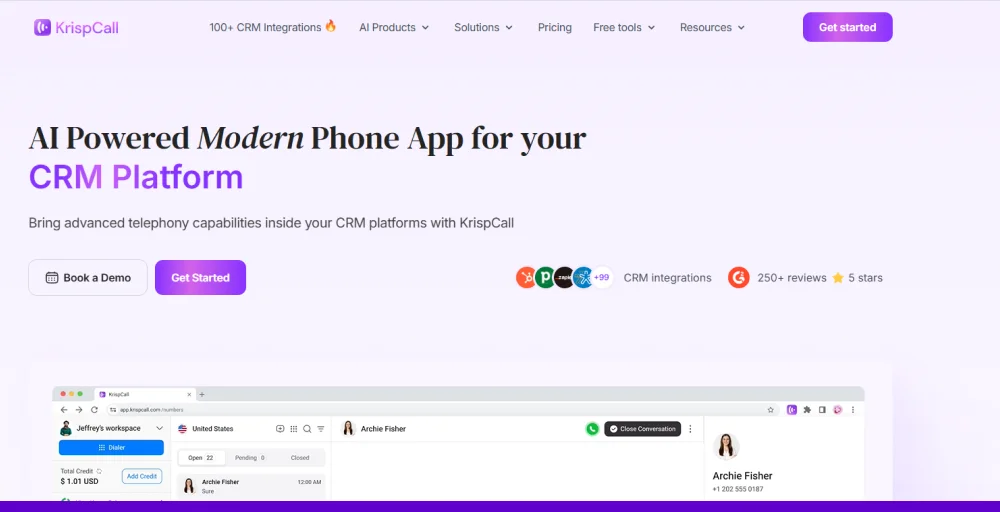
KrispCall is known as a cloud-based business phone system that integrates AI to pick up and respond to phone calls automatically. Instead of relying on traditional voicemail or missed calls, KrispCall uses smart automation and advanced features to handle inbound calls efficiently, ensuring that your business never loses potential customers.
Features
- Call routing
- Unified Callbox
- Call recording
- CRM integration
- Call analytics
Pricing
| Plan | Pricing |
| Essential | $12 per user per month |
| Standard | $32 per user per month |
| Enterprise | Custom |
Best for
Small to medium businesses seeking affordable call management with basic AI features.
2. Zendesk
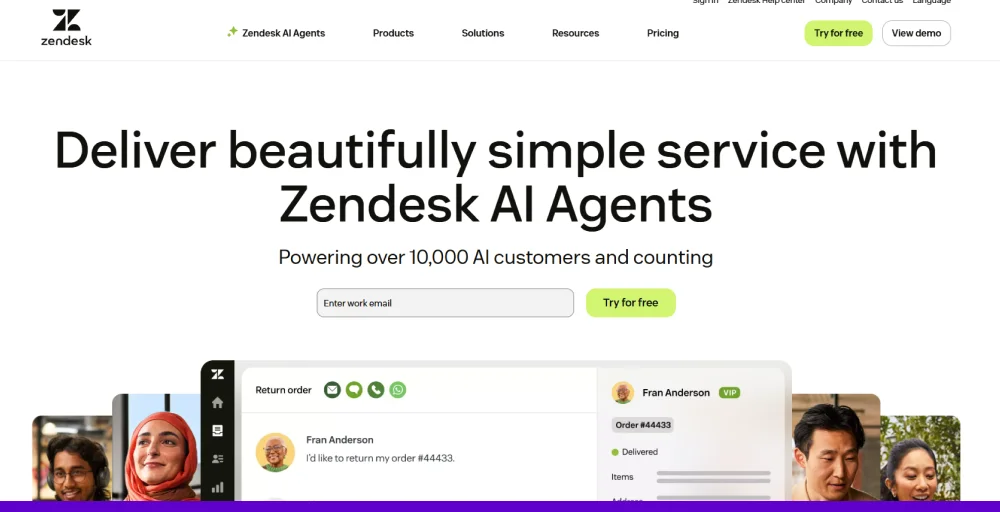
Zendesk provides AI call answering services while specializing in AI, keeping the core for the call center. With this, you get AI-powered automated workflows and knowledge management that provides support while developing a human connection with your customers.
Features
- Inbound calls
- Quality assurance
- Conversation bots
- Ticket summaries
- Auto-replies
Pricing
| Plan | Pricing |
| Support Team | $19 per agent per month |
| Suite Team | $55 per agent per month |
| Suite Professional | $115 per agent per month |
| Suite Enterprise | $169 per agent per month |
Best for
Companies already using the Zendesk ecosystem and want to integrate customer support solutions.
3. Dialpad
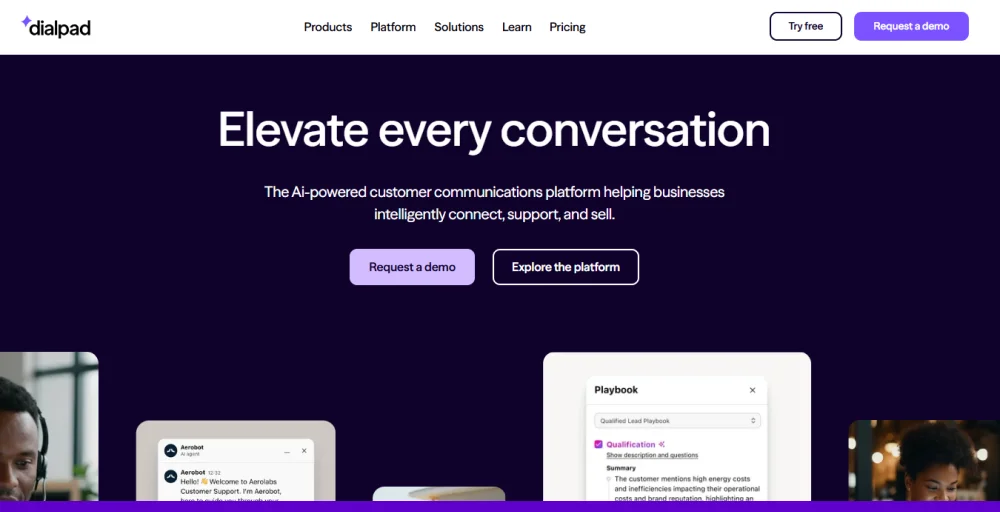
Along with an AI-powered customer engagement and collaboration platform, Dialpad is also an AI phone calling app. You are free to use its AI calling service without any coding setup on your chatbot.
Dialpad AI generates insight from customers, routes incoming calls to agents based on their skills, and offers real-time assistance to your customers.
Features
- AI live coach cards
- Automatic call distribution (ACD)
- Conversational AI
- AI Agent
- AI transcription
Pricing
| Plan | Pricing |
| Standard | $15 user/month |
| Pro | $25 user/month |
| Enterprise | Contact us |
Best for:
Businesses are prioritizing real-time AI coaching and advanced conversation analytics.
4. Talkdesk
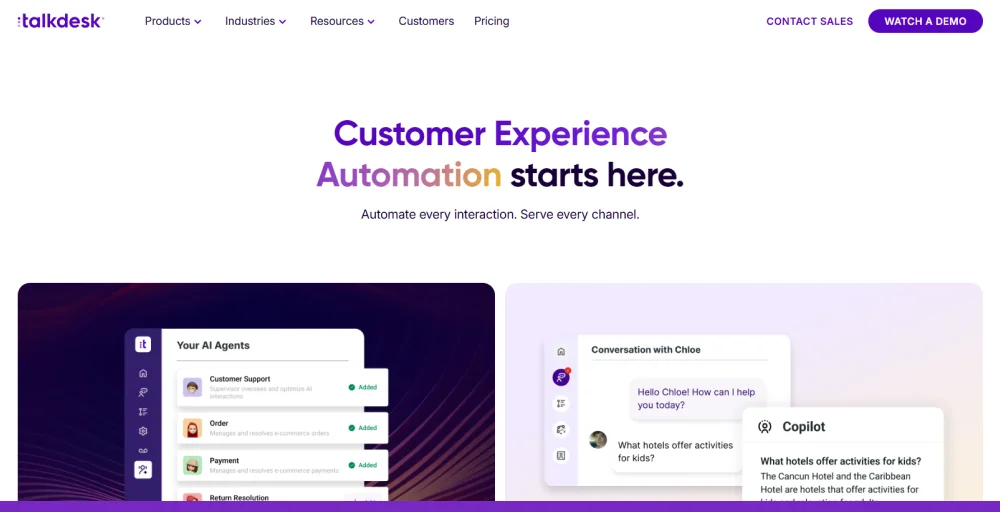
Talkdesk has an auto-pilot automated virtual agent that provides AI calling services, provides customer self-service, and 24/7 support to respond to customer queries. With its cloud-based contact center solution, it improves operational efficiencies and transforms customer experience, tailoring agent assist and self-service to high-volume call centers.
Features
- Interactive voice response (IVR) systems
- Forward-to-phone
- Automated workflow
- Call monitoring
- Call barging
Pricing
- Talk to sales
Best for
Large enterprises require sophisticated call center operations with extensive customization.
5. CloudTalk

CloudTalk is one of the best AI answering service for small businesses, with the ability to handle inbound calls automatically, 24/7, with no need to hire extra staff. With this, you can generate call notes that help in further interaction and can provide immediate feedback to customers on their queries.
Features
- AI dialer & outreach
- Parallel dialing mode
- Voicemail-to-drop
- Click-to-call
- Answering machine detection
Pricing
| Plan | Pricing |
| Starter | $25 per user per month |
| Essential | $29 per user per month |
| Expert | $49 per user per month |
Best for
Sales-focused teams that need advanced dialing capabilities and outbound call automatio
Things to consider while choosing an AI call answering platform
Here are the key considerations when choosing an AI call answering app:
- Voice quality: Check if it can access human-like voices and natural sounds, while providing clear pronunciation that can fit your brand voice.
- Reliability: Before choosing, verify its uptime and if it guarantees a robust infrastructure. Look for an AI phone answering app that provides 24/7 customer support and disaster recovery protocols.
- Handling complex queries: Handling complex questions requires a good understanding of language and the context of customer needs. It also ensures that conversations can be smoothly passed to human agents when necessary.
- CRM integration: Choose platforms that easily integrate with your existing CRM system for real-time data access and updates. Also, verify they have API support, which is essential for custom integrations.
- Data accuracy: The AI receptionist must access and relay current, accurate, and correct information from your databases, while maintaining data integrity. Make sure the system provides regular synchronization capabilities.
- Legal compliance: Verify if the platform meets relevant legal regulations (GDPR, HIPAA, PCI) for your industry and location. Essential features include call recording consent and data encryption.
Future of AI call answering services
AI call answering services are not just passing trends; they are the future of sales and support teams. They help to understand the customer behaviors, tone, feeling, intents, and queries using natural language processing and machine learning technology.
Whether you are handling inbound or outbound business calls, having AI call answering services helps you understand complex questions and connect customers with human agents.