

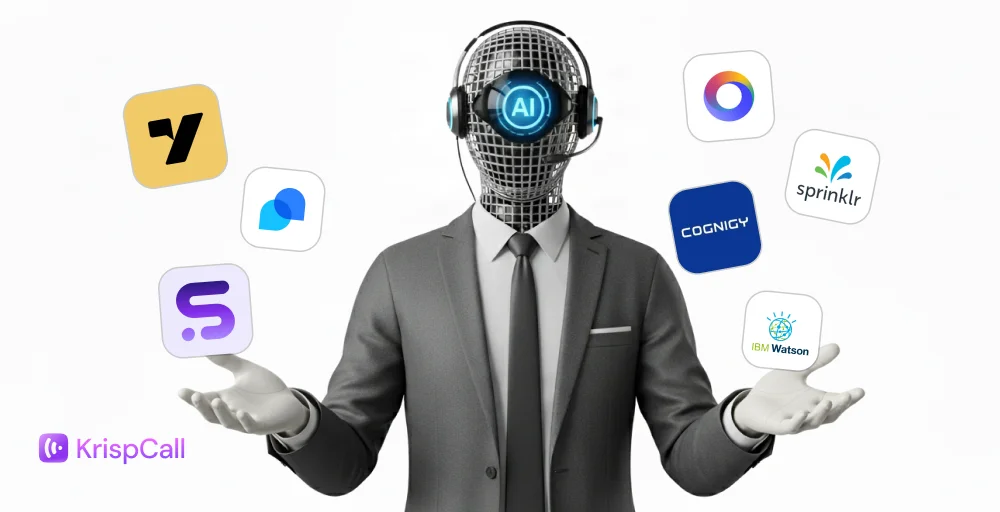
Conversational AI has become an essential part of how businesses interact with customers in 2025. From answering routine questions to providing personalized guidance, conversational platforms now play a central role in offering customer support in a natural, human-like way.
Businesses today are under constant pressure to deliver faster, more personalized customer interactions. But with so many options available, choosing the right solution can feel overwhelming.
To help, we’ve rounded up the 10 best conversational AI platforms and agents for 2025 and highlighted their strengths, use cases, and what makes each stand out.
✨ Key Takeaways
- Conversational AI platforms enhance customer experience automation with natural, context-aware interactions.
- Businesses can choose from free conversational AI tools to enterprise-grade solutions, depending on their scale and integration needs.
- The future of conversational AI lies in multi-channel support, personalization, and scalable AI solutions for customer service.
What are conversational AI platforms?
Conversational AI platforms are software frameworks that allow businesses to build, deploy, and manage AI-driven customer service applications. These platforms power chatbots and AI agents across multiple channels, such as websites, mobile apps, and social media.
A conversational application platform provides the tools to design natural, human-like interactions that improve customer experience, automate support tasks, and scale customer engagement efficiently.
How do conversational AI solutions work?
Conversational AI solutions follow a structured process to simulate human conversations:
- Input processing: The system receives input from the user, either text (chat) or voice (speech): in some modern setups, this process is enhanced with an AI Mode for more structured interaction handling.
- Understanding intent: Using NLP and NLU, the AI interprets the message, identifies the intent, and pulls out key customer details (like makes, order numbers, or dates).
- Response generation: Based on the user’s intent, the platform either fetches relevant information from a database, executes an action (like booking a ticket), or transfers the case to a human agent if needed.
- Output delivery: The AI delivers the response as text or voice. Advanced platforms use natural language generation (NLG) to make replies sound more natural and less robotic.
- Continuous learning: With every interaction, the system improves by learning from feedback, corrections, and new data.
This process allows conversational AI services to handle everything from simple FAQs to complex problem-solving, reducing workloads for human agents while giving customers quick and accurate support.
Key features to look for in a top conversational AI platform & agents
Below are the key features to look for in a top conversational AI companies that allows you to achieve measurable improvements in customer experience and support:
- Industry expertise: Platforms with experience in your sector can better handle domain-specific use cases.
- No-code AI platforms and AI agent builder: Build and deploy conversational apps without advanced coding knowledge.
- Personalized AI interactions: Tailor responses based on customer history, behavior, and preference.
- Authentic conversations: Automate routine queries, improve response accuracy, and reduce wait times.
- Ease of integration: Connect with CRMs, help desk tools, and messaging apps.
- Compliance and security: Ensure data protection with certifications like SOC 2, GDPR, HIPAA, or ISO standards.
- Scalability: Support growth with flexible pricing models and the ability to manage high query volumes.
- Multilingual and voice options: Offer global support with diverse languages, accents, and multilingual chatbot capabilities that allow businesses to serve customers across regions without language barriers.
- AI agent assists: Provide real-time suggestions and support for human agents during live interactions.
- Analytics and insights: Track performance, customer satisfaction, and areas for improvement.
- Omnichannel support: maintain a consistent customer experience across chat, voice, and digital channels, including AI call answering capabilities.
How were these platforms compared?
Each platform was assessed against the criteria outlined above, as well as G2 ratings and pricing transparency. The goal was to surface platforms that suit businesses of different scales, from small teams needing a simple no-code chatbot to enterprises running complex, multi-channel deployments.
More on how content is researched and maintained: content update process, content integrity standards, and software review methodology.
Top 10 conversational AI platforms & agents for 2025
Write connecting sentences that act as a guide for reviewing and comparing conversational AI platforms
| Conversational AI platforms & agents | G2 ratings | Starting pricing | Key feature |
| Synthflow | 4.5 | $29 per month | Unlimited assistants, API & integrations, Workflow builder |
| Tidio | 4.7 | $39 per month | Human handoff, customizable communication style, and Handle missed conversations |
| IBM Watsonx Assistant | Contact sales | Generative AI and LLMs, Visual builder, Omnichannel support | |
| Yellow.ai | 4.4 | Free | Workflow automation, Total experience (TX) focus, Pre-built flows |
| Cognigy | 4.6 | Contact sales | Multichannel connectivity, Low-code flow builder, Knowledge base integration |
| Sprinklr AI+ | 4.3 | Contact cales | Social listening & insights, Quality management, AI integration flexibility |
| Kore.ai | 4.7 | Contact sales | Experience optimization (XO) platform, Search assist, No-code platform with CX |
| LivePerson | 4.3 | Contact sales | Proactive messages, location-based message template, Conversation builder |
| Google Dialogflow CX | 4.4 | Contact sales | State-based data model, Generative AI capabilities, Speech-to-text (STT) |
| Emitrr AI | 4.8 | Contact sales | AI virtual assistant, automated responses, patient engagement |
| Coupler.io | 4.8 | $24 per month | AI Agent for conversational analysis and actionable business insights |
1. Synthflow
Synthflow stands out as one of the best conversational AI platforms for enterprises looking for a balance between flexibility and performance. It delivers both no-code usability and enterprise-grade customization.
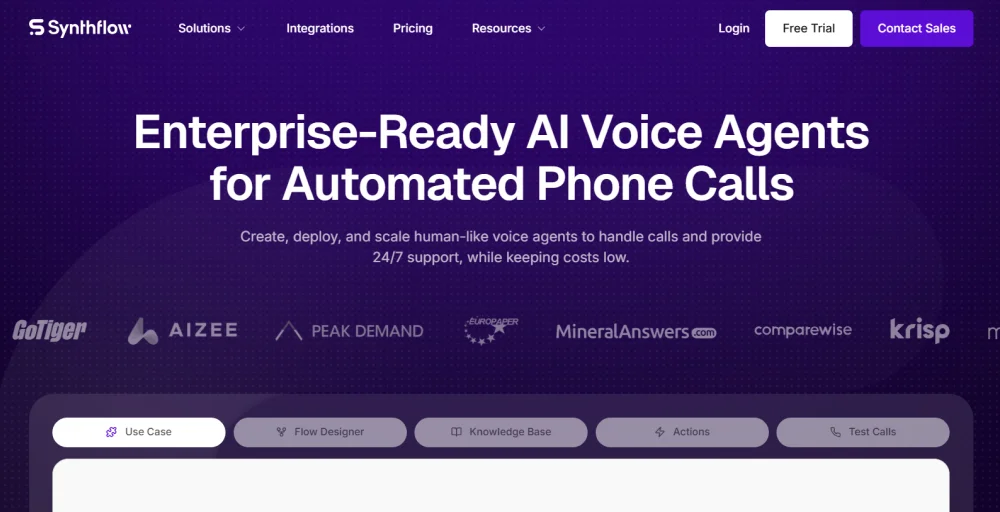
Synthflow builds and deploys its own custom models, offering higher accuracy for specific business use cases. Its strong focus on voice capabilities, including integrations with 11Labs for natural-sounding AI voices and multilingual support, enables businesses to create apps and AI Gents tailored for a global audience.
Best for:
Businesses that need customizable AI voice agents, multilingual capabilities, and enterprise performance without heavy technical dependencies.
Key features
- Omnichannel customer service support across voice and chat.
- No-code conversational app builder.
- Enterprise-ready deployment with custom AI models.
- Scalable AI solutions for both small and large enterprises.
Pros & Cons
| Pros | Cons |
| No-code platform for quick setup | Pricing may be higher for advanced features |
| Custom AI models ensure high accuracy | Some features may require technical setup for enterprise use |
| Scales easily with business growth | Free conversational AI features may feel limited |
| Supports multilingual and diverse accents | Primarily voice-focused, may need integrations for broader use cases |
2. Tidio
Tidio is one of the top conversational AI companies recognized for its accessible yet powerful AI-driven customer service tools. It’s a unique balance between affordability, ease of use, and strong conversational AI benefits for small and mid-sized businesses.
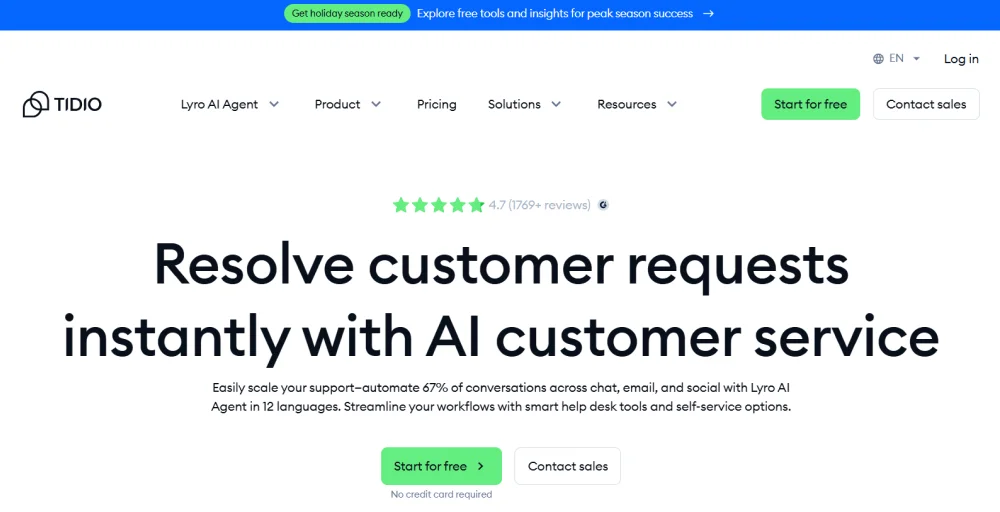
Tidio’s Lyro AI chatbot uses machine learning and NLP to create natural conversational interfaces. Combined with its visual chatbot builder, Tidio gives users the ability to design custom bots with minimal technical effort, making it a strong choice among no-code AI platforms.
Best for:
Small to medium-sized businesses seeking affordability, easy-to-use AI chatbots that improve customer service automation and sales.
Key features
- Integrates with CRM, email, and e-commerce platforms.
- Real-time monitoring of customer chats for live agent handoff.
- Customer self-service integration for support automation.
- Free conversational AI plan with scalable paid options.
Pros & Cons
| Pros | Cons |
| Real-time monitoring with live agent takeover | AI accuracy depends on the depth of the uploaded knowledge base |
| Easy no-code chatbot builder | Not as strong for large-scale enterprise |
| Free conversational AI option available | Limited customization compared to enterprise platforms |
| Supports omnichannel customer service | More focused on chat than advanced voice AI |
3. IBM Watsonx Assistant
IBM Watsonx Assistant is one of the most established conversational AI solutions in the market. It combines Natural Language Processing (NLP) with a user-friendly design, making it suitable for both technical teams and non-developers.
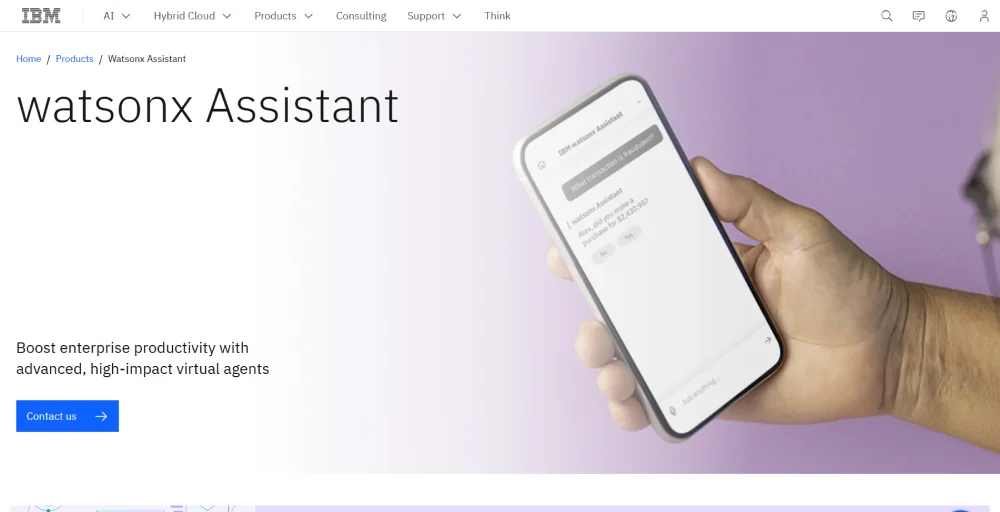
IBM’s Watsonx Assistant can support both text and voice-based conversations while integrating seamlessly with multiple channels and devices. This positions it as one of the best conversational AI platforms for enterprise use cases such as AI-driven customer service, help desk automation, and customer experience automation.
Best for:
Enterprise and mid-sized businesses that need scalable AI agents for multi-channel AI support and personalized interactions.
Key features
- Drag and drop builder with pre-built templates for quick setup. Teams comparing no-code options often also look at how an AI agent builder handles deployment, scheduling, and connections to workplace tools after setup.
- No-code chatbot design for easy deployment.
- Integration with popular channels, devices, and enterprise systems.
- Personalized AI interactions using customer data and context.
Pros & Cons
| Pros | Cons |
| Supports both text and voice interactions | The interface may feel complex for beginners |
| Flexible no-code builder wth templates | Customization for niche use cases requires expertise |
| Seamless omnichannel customer service integrations | Setup time is longer compared to simpler tools |
| Enterprise-grade compliance and security | Less suited for small businesses with limited AI needs |
4. Yellow.ai
Yellow.ai is one of the most comprehensive AI platforms designed for large enterprises. It offers enterprise-grade architecture, the ability to scale globally, and a proven track record with leading brands like Sony, Hyundai, and Domino’s.
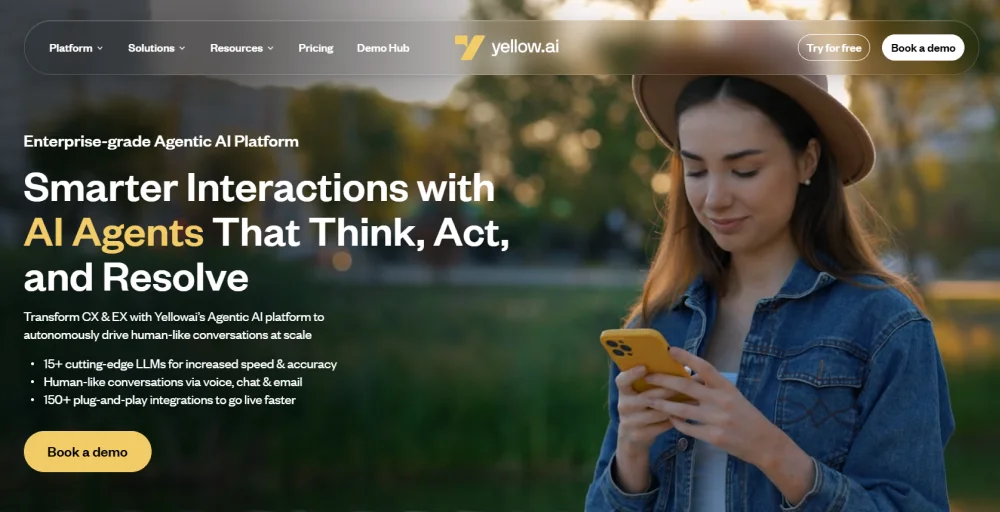
Yellow.ai’s multi-LLM (Large Language Model) architecture is trained on billions of conversations, delivering customer service that feels more natural and context-aware. It supports over 135 languages and 35+ channels, making it ideal for companies looking for omnichannel customer service at scale.
Best for:
Large enterprises need multilingual, multi-channel AI agents with advanced integrations for customer service automation.
Key features
- Multi-LLM architecture trained on billions of conversations.
- 100+ integrations for enterprise workflows.
- Customer self-portal and internal knowledge base for agents.
- Customer Data Platform (CDP) for real-time insights.
Pros & Cons
| Pros | Cons |
| Multi-LLM setup improves accuracy and adaptability | Setup and customization may require technical expertise |
| Strong CDP integration for real-time insights | The interface can feel overwhelming for first-time users |
| Scales easily for high-volume enterprise | Overpowered for companies with smaller AI needs |
| Broad omnichannel support across 35+ platforms | The free conversational AI option is limited compared to others |
5. RingCX
RingCX is an AI-first contact center platform that brings voice and more than 20 digital channels into a single agent workspace. Rather than layering AI onto an existing system, RingCX is built around it, with intelligence embedded into routing, coaching, sentiment analysis, and post-interaction insights from the ground up.
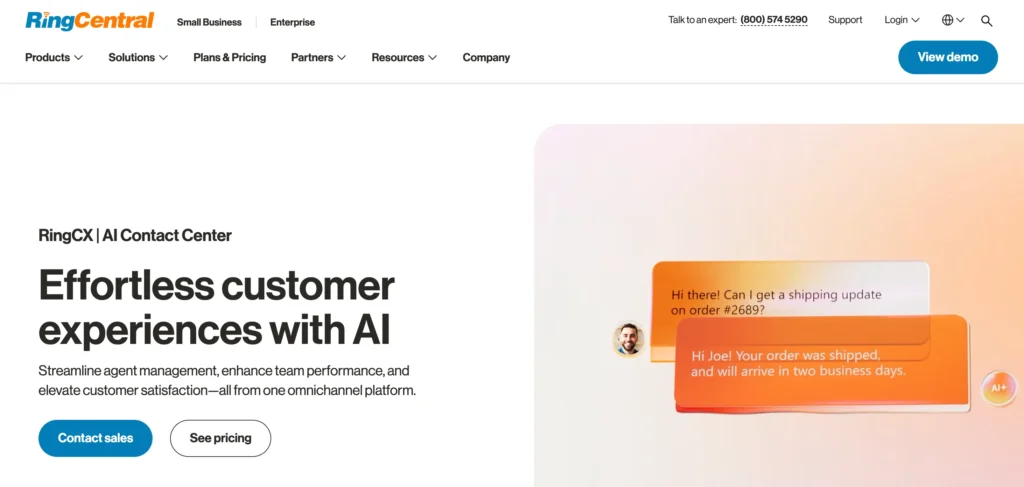
It deploys quickly in the cloud, scales with demand, and integrates natively with RingEX for organizations that want to connect their contact center with the broader business.
Best for:
Support leaders who need cross-channel visibility; growing businesses scaling customer service without adding headcount; distributed teams managing voice and digital engagement together; CX organizations prioritizing faster, more consistent resolution.
Key features
- Omnichannel routing across voice, chat, SMS, social media, review sites, and 20+ digital channels
- Unified agent and supervisor workspace with shared context across interactions
- Built-in AI for real-time coaching, sentiment tracking, and interaction insights
- Real-time dashboards and performance analytics
- Fast cloud deployment with minimal setup
- Native integrations with RingEX, Microsoft Teams, Salesforce, Asana, Google, and more
Pros & Cons
| Pros | Cons |
| AI-first by design — no bolt-on tools required | Advanced configurations may require planning for larger deployments |
| True omnichannel in one agent workspace | Feature depth may feel extensive for very small support teams |
| Real-time sentiment insights and live dashboards | Some analytics insights depend on consistent interaction volume |
| Fast cloud deployment with quick time to value | |
| Reduces tool sprawl with unified communications and AI |
6. Sprinklr AI+
Sprinklr AI+ is a unified conversational AI and generative AI platform built for large enterprises. It merges its own CX-data-driven model with leading generative models, offering strong governance, security, and broad channel coverage.
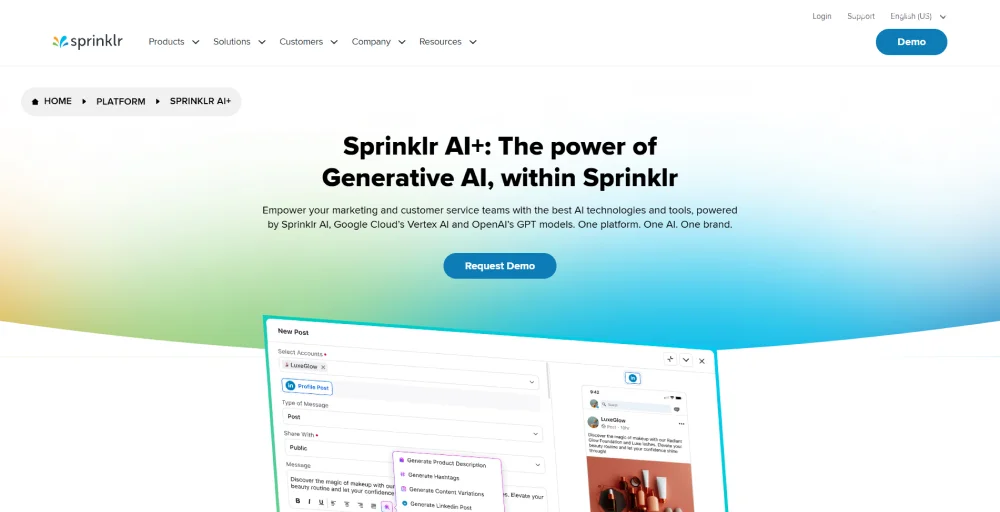
Sprinklr AI+ has the capacity to handle unstructured customer experience (CX) data from dozens of digital channels, automatic summarization and quality scoring, and high language and regional coverage.
Best for:
Enterprises that want an all-in-one conversational AI solution integrated with customer experience management, social engagement, and omnichannel support.
Key features
- Proactive live chat and AI agent assists for human teams.
- Personalized AI interactions based on customer history and preferences.
- Drag and drop or visual tools to build conversational flow.
- Strong data governance, masking, privacy controls, and compliance considerations.
Pros & Cons
| Pros | Cons |
| Strong omnichannel customer service | Longer onboarding time compared to simpler tools |
| Advanced sentiment analysis and intent detection | It can be overwhelming due to its wide feature set |
| Seamless integration with the Sprinklr ecosystem | Heavily tailored for enterprises, less flexible for small teams |
| Scalability and global language support | Some performance/lag issues have been reported by users for large volumes |
7. Kore.ai
Kore.ai earned a spot among the top conversational AI platforms because it offers strong enterprise features, especially around voice + chat automation, compliance, and flexible deployment. It delivers scalable AI solutions across industries such as healthcare, banking, and retail.
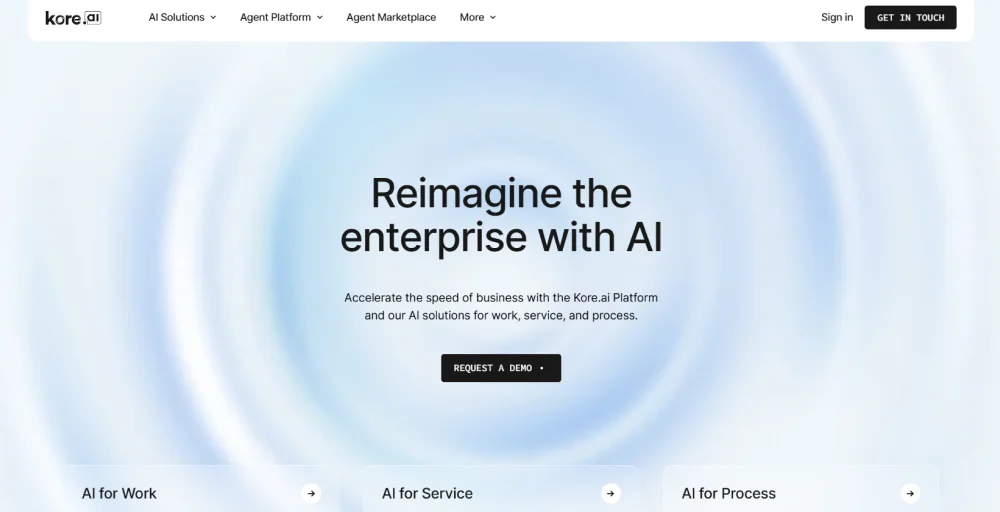
XO Platform of Kore.ai supports both customer-facing and internal agents and mixes deterministic flow with generative AI layers for more open-ended conversations. It offers deployment in cloud, hybrid, or on-premise environments, giving organizations options if they need control over sensitive data.
Best for:
Enterprises and industries need secure, compliant, and scalable conversational AI solutions.
Key features
- Analytics and reporting for customer experience automation.
- Compliance-ready with enterprise-grade security (HIPAA, GDPR, etc).
- Strong integrations with CRM, ERP, and help desk management tools.
- Pre-built template for faster chatbot deployment.
Pros & Cons
| Pros | Cons |
| Strong compliance and security certifications | Setup requires training for full utilization |
| Omnichannel customer service with deep integrations | Advanced features can feel complex for new users |
| Multilingual support and strong NLU for context-aware conversations | Requires continuous bot maintenance, training, and updates |
| Advanced features and built-in tools for building sophisticated bots | Rollbacks and potential disruptions from frequent cloud updates |
8. LivePerson
LivePerson is a trusted conversational AI platform that is used by enterprises worldwide to power AI-driven customer service and engagement. It strongly focuses on creating conversational interfaces that drive measurable improvements in customer satisfaction and sales conversions.
It blends automation and human-agent collaboration well, with strong intent detection and routing features. LivePerson’s AI has the ability to manage large-scale customer interactions across multiple channels, blending automation with human agent support.
Best for:
Enterprises that require large-scale AI customer service automation combined with proactive live chat and advanced analytics.
Key features
- Proactive live chat to engage customers before they abandon sessions.
- Scalable AI solutions for high-volume customer interactions.
- Omnichannel customer service across social, web, and mobile platforms.
- A unified knowledge base that helps bots and agents pull accurate responses quickly.
Pros & Cons
| Pros | Cons |
| Rich tools for analytics and customer insights | Learning curve can be significant |
| Smooth handoff and agent assists | Reporting /customization sometimes not flexible enough |
| Offers proactive engagement and generative AI enhancements | For smaller businesses, cost+complexity may outweigh benefits |
| Strong compliance and security | Some integrations or feature requests may need custom development |
9. Google Dialogflow CX
Google Dialogflow CX is a cloud-based conversational AI platform built to handle complex, multi-turn conversations across text and voice channels. Its advanced orchestration capabilities help businesses design natural, branching dialogue flows for customer interactions.
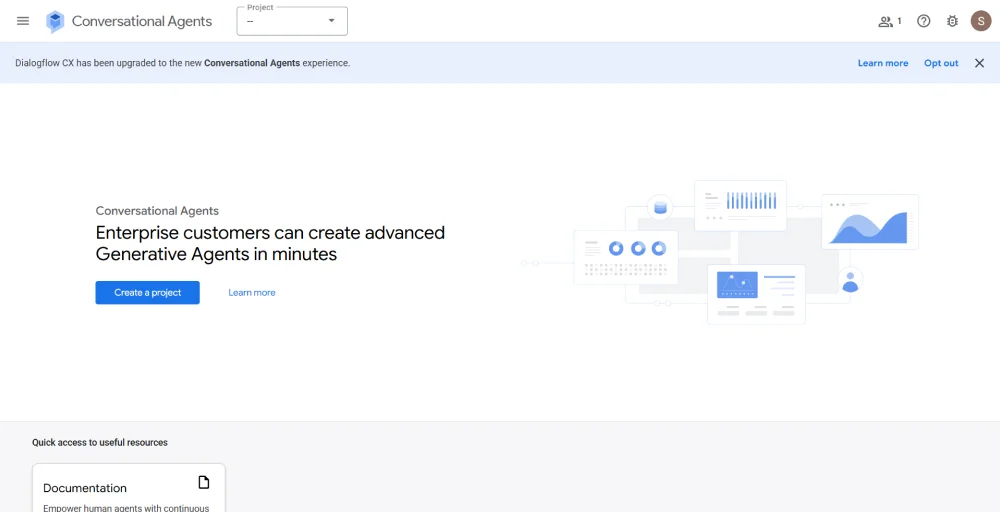
Its strong visual flow builder makes it possible to map out dialogs clearly, reducing ambiguity in conversation paths. Backed by Google’s AI and NLP expertise, it delivers accurate intent recognition and smooth handling of context in multi-step interactions.
Best for:
Enterprise and tech-driven businesses that need to design and manage complex, multi-turn conversations at scale.
Key features
- Advanced intent recognition and natural language understanding.
- Integration with Google Cloud services and APIs.
- Pre-built agents and templates for faster setup.
- Visual flow builder for managing complex conversations.
Pros & Cons
| Pros | Cons |
| Strong scalability and global infrastructure via Google Cloud | Limitations in customization that require more engineering |
| Generative AI support enhances fallback and dynamic responses | Real-time voice interactions can add cost and complexity |
| Visual flow builder helps both technical and semi-technical users design dialogs more clearly | Steeper learning curve for beginners when using Dialogflow CX |
| Suitable for enterprise-grade deployments | Customer support can be limited outside enterprise tiers |
10. Emitrr AI
Emitrr AI offers conversational tools that combine automation, messaging, scheduling, reviews, and reminders in one platform. Emitrr is focused on practical customer engagement, reducing no-shows, converting missed calls, managing reputation, and integrating with CRM that local businesses already use.
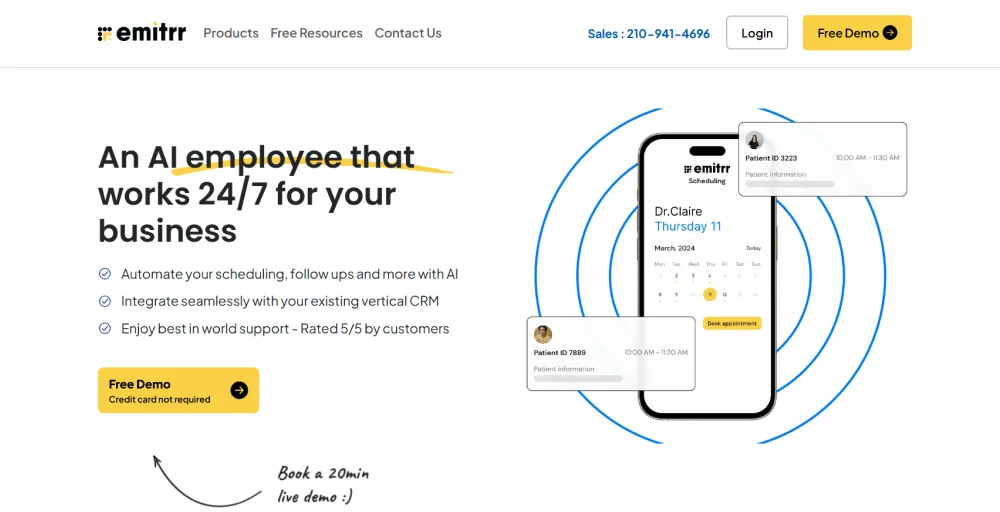
Emitrr AI positions itself as a unified business toolbox for customer communication rather than being purely about chatbots or virtual agents in isolation. It helps service-based businesses handle calls, texts, reminders, and reviews through AI-powered automation.
Best for:
Small to mid-sized service businesses that need affordable AI automation for all text and reminders.
Key features
- Single inbox to manage SMS, web chat, Facebook messages, etc.
- Automated text responses for common customer queries.
- Two-way texting with customers
- Integration with practice management and scheduling software.
Pros & Cons
| Pros | Cons |
| Specially designed for appointment-driven businesses | Fewer customization options compared to larger platforms |
| Automates calls, texts, and reminders effectively | Focused mostly on voice/SMS, less on omnichannel |
| Easy setup with minimal training requiredNot ideal for businesses needing complex workflows | Easy setup with minimal training requiredNot ideal for businesses needing complex workflows |
| Helps generate reviews and manage customer feedback | Scalability is limited for large enterprises |
11. Coupler.io
Coupler.io is an AI analytics platform designed to help businesses analyze large volumes of business data securely and accurately using AI. Unlike standalone AI chatbots that rely only on prompts and uploaded documents, Coupler.io prepares, structures, refreshes, and contextualizes data before connecting it with AI tools like Claude, ChatGPT, Gemini, Perplexity, and Cursor.
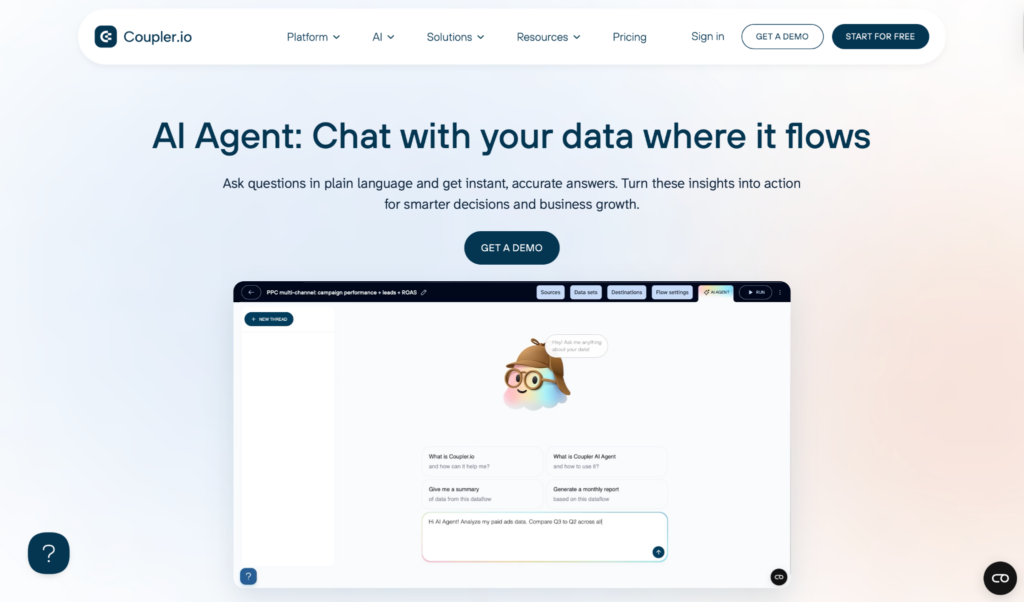
Coupler.io combines ETL-powered data preparation with conversational AI, allowing teams to chat with live business data in plain language, generate insights faster, and make more confident decisions without requiring technical expertise. Its AI Agent and MCP capabilities also support more advanced analytics workflows for teams handling complex or high-volume datasets.
Best for:
Businesses that want secure, accurate conversational analytics powered by live business data instead of isolated AI prompts or static files.
Key features
- AI integrations with Claude, ChatGPT, Gemini, Cursor, and Perplexity.
- AI Agent for conversational analysis and actionable business insights.
- MCP support for high-volume AI-powered analytics workflows.
- Automated data preparation, refresh, and contextualization for accurate AI outputs.
Pros & Cons
| Pros | Cons |
| Strong focus on data accuracy and context for AI analysis | More analytics-focused than customer support-focused |
| Connects AI directly with live business data | Advanced MCP workflows may require technical knowledge |
| Secure, read-only access to business data | Less suitable for teams looking only for simple chatbots |
| Reduces manual reporting and spreadsheet analysis | Primarily designed for analytics rather than conversational commerce |
Wrapping up! Future trends in conversational AI
Conversational AI is moving toward a new phase where natural dialogue, personalization, and automation come together to shape customer experiences. In the coming years, several trends will define the future of conversational platforms:
- Deeper personalization: AI agents will deliver tailored responses by drawing on customer history, preferences, and context in real time.
- Stronger multi-channel presence: Voice, messaging apps, email, and self-service portals will continue merging into unified conversational interfaces.
- No-code and low-code platforms: Businesses of all sizes will adopt conversational app builders without heavy technical expertise.
- AI-human collaboration: AI will handle routine queries while human agents focus on empathy-driven problem-solving.
- Ethics and compliance: As usage grows, data privacy and responsible AI practices will remain central to trust and adoption.
The future of conversational AI is going to shape customer engagement in a very meaningful way that’s gonna boost efficiency and unlock new possibilities for customer service. Organizations that invest in scalable AI platforms today will be well-positioned to lead in customer experience tomorrow.