


Customers interact with businesses through a wide range of channels, websites, mobile apps, social media, email, messaging platforms, and more. Omnichannel customer service brings all these touchpoints into one connected experience.
So, instead of serving each customer interaction separately, you can use an omnichannel strategy to remain consistent with each customer’s conversation history and service quality.
Whether switching from chat to phone or from mobile to desktop, customers expect smooth transitions and quick resolutions. Support with disconnected leads can miss opportunities, create frustration, and reduce trust.
However, this omnichannel customer support provides integrated services, which improve satisfaction and strengthen brand loyalty and operational efficiency.
✨ Key Takeaways
- Omnichannel customer service connects all communication channels, like email, live chat, social media, and phone, into a single, seamless experience.
- Omnichannel service improves customer satisfaction, increases loyalty, enhances agent efficiency, boosts revenues, and enables better use of data.
- Omnichannel contact center software, AI-powered chatbots, unified knowledge bases, reporting and analytics, and live messaging apps are some key tools used to provide omnichannel customer service.
- To have a proper omnichannel strategy, map the customer journey, implement right channeling, unify knowledge and tools, invest in intelligent self-service, and maintain centralized data visibility.
What is omnichannel customer service?
Omnichannel customer service is a customer experience strategy used to provide a seamless and connected customer experience and interaction across all channels. This includes providing customer service agents with a comprehensive view of a customer’s interaction, enabling them to answer questions more effectively and efficiently.

This is achieved by consolidating all communication channels and customer information from each into a single, central, and reliable source. And when businesses adopt an omnichannel customer experience (CX) approach, they break down isolated conversations.
As a result, teams can access the customer details they need, exactly when they need them, regardless of the channel they are using.
Benefits of a successful omnichannel customer experience
Having a good customer experience is the core quality of omnichannel customer service. A well-defined omnichannel communication strategy is not just about its convenience; it delivers measurable value across the customer journey and benefits businesses.
The benefits of omnichannel customer service are given below:
1. Increase sales and revenue growth
Omnichannel customer experiences enable buyers to access products and services when they need them without navigating traditional processes.
Removing purchase barriers and providing transparent, connected digital experiences drives both revenue growth and customer satisfaction.
2. Create a personalized experience
By collecting and integrating data across all touchpoints, businesses get a holistic view of each customer’s preferences, history, and behavior.
This enables highly personalized interactions, recommendations, and offers, making customers feel understood and valued, which significantly enhances engagement and loyalty.
3. Enhance customer retention and loyalty
Omnichannel customer experience software creates speed, convenience, transparency, and trust as representatives have access to all relevant customer information in one place.
Seamless interactions demonstrate that an organization prioritizes buyers and has modernized its sales methods for a smoother overall process.
4 Flexible buying choices
An omnichannel approach provides customers more control and creates more opportunities to meet growing customer needs by delivering self-service purchase options.
This capability frees up sales and customer engagement professionals to serve as consultative partners and provide better service for more complex, high-consideration purchases.
5. Expediting new channel integration
Businesses with established omnichannel experiences gain a competitive advantage when designing, launching, and integrating new communication channels.
Apart from this, existing omnichannel software makes it easier to introduce additional touchpoints without having to rebuild the unified customer experience infrastructure from scratch.
Omnichannel customer service strategy
An omnichannel customer service strategy is a holistic approach that unifies all of the customer interactions within a single, seamless, and consistent experience.

You can follow the given strategic approach to develop an omnichannel service strategy:
1. Focus on the complete customer journey
Instead of viewing interactions as an isolated customer journey, map out every step the customer takes while engaging with or interacting with your business. This includes their initial research, the process of making a purchase, and any post-sale support they may need.
With this approach, you can easily understand this entire customer journey. Also, you can easily pinpoint potential friction points and ensure a consistently positive and smooth experience from start to finish.
2. Integrate all channels seamlessly
Integration is the core of the omnichannel customer service. Here, you can interconnect all your websites, mobile apps, phone lines, social media, in-person interactions, and email, so that they can all work together.
A customer can start their conversation from the point where they left off, and an agent can also be aware of where they left off.
This will ensure a smooth transition and communication, without losing any information, and customers will also not have to repeat themselves, making the customer journey effortless.
3. Leverages data and automation
To support this integrated approach, customers are willing to share personal information in exchange for better experiences. This data becomes valuable for improving omni-channel customer service and creating personalized omnichannel experiences.
Businesses should adopt technologies that use customer data to customize services while enhancing support through automation and chatbots.
Omnichannel customer service use cases and examples
Omnichannel means providing a seamless and consistent experience for customers wherever they interact with your brand, whether online, in-store, or in any other setting. It’s about making their journey feel unified, no matter how they choose to connect with you.
Here are some use cases and examples of omnichannel customer care to improve customer experiences:
1. Disney: Simplifying the park experience
Disney vacation planning used to require juggling multiple websites and phone calls for hotels, dining, and ride reservations, creating a fragmented and frustrating experience for guests.
After launching the My Disney Experience portal, Disney unified all its services into a single self-service platform. Users can now plan their entire trip through integrated tabs, book hotels, make dining reservations with real-time availability, and automatically store ride photos for sharing.
When they need live support, agents instantly access complete customer profiles, including all reservations and interactions, providing seamless service that builds on guests’ self-service activity. This approach reduces wait times and improves satisfaction scores.
2. Peloton: Connecting fitness across platforms
Peloton transformed home fitness by combining high-quality equipment with an interactive digital experience, but coordinating across physical products, apps, showrooms, and communication channels initially created disconnected touchpoints for customers.
The company unified the entire fitness journey into an omnichannel experience. Users can purchase equipment online or book showroom appointments to try products with a 30-day home trial, removing purchase barriers.
The mobile app seamlessly connects users, presenting them with live and recorded classes while tracking their workout progress. Weekly emails help keep members informed about their upcoming schedules and on-demand content, while post-workout texts congratulate users and suggest more complementary stress-relieving sessions.
This integrated approach ensures users can maintain their fitness across all devices and touchpoints without interruption, keeping them motivated and engaged throughout their fitness journey.
Omnichannel vs. multichannel customer service
Multichannel and omnichannel are types of customer service strategies that are designed to enhance customer engagement across multiple communication channels.
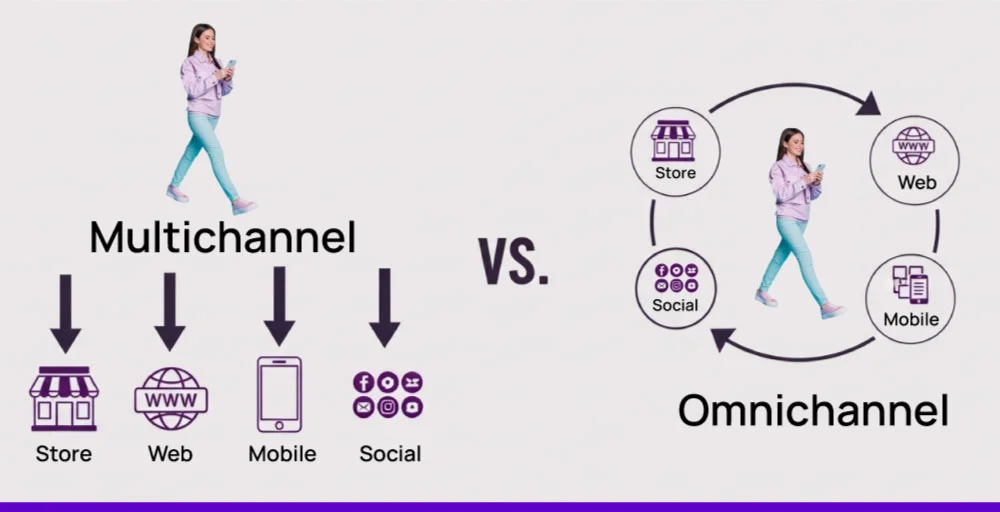
However, two key comparisons of multichannel vs omnichannel set them apart: integration and cross-platform experience.
1. Channel Synchronization
A multichannel approach encompasses tools such as a website, social media account, email, or a mobile app. While these channels offer multiple ways for customers to connect, they often operate independently, with little to no connection between them. This means that customer interactions on one platform may not be carried over to another.
An omnichannel approach utilizes a variety of channels, all of which are synchronized. Whether a customer reaches out via email, continues the conversation on live chat, or switches to mobile, the experience is connected and seamless. All data, context, and history move with the customer.
2. Cross-platform experience
Multichannel systems tend to be channel-specific, meaning interactions are confined to the platform or device where they start. For instance, a customer shopping on a desktop might not see the same cart or product recommendations when they switch to a mobile app.
In contrast, omnichannel systems are integrated across all omnichannel platforms and devices. This enables businesses to provide a continuous, unified experience, no matter where or how the customer engages.
Omnichannel customer support tools
Omnichannel customer support relies on various powerful tools to create a seamless and efficient customer experience across all touchpoints. These tools work in concert to unify customer interactions and provide a comprehensive view of the omnichannel customer journey.
Some of the essential customer support tools are:
1. AI and automation
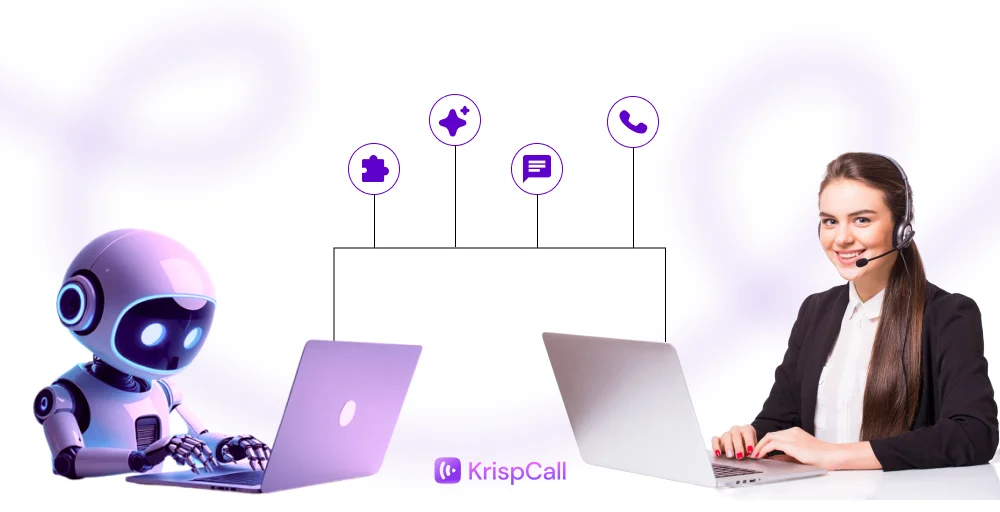
AI and automation enable intelligent routing, chatbots, and self-service options, ensuring customers receive prompt answers to common queries and are directed to the right agent when human assistance is required.
This significantly reduces response times, freeing up agents to handle more complex issues.
2. Omnichannel contact center software
Omnichannel contact center software is the central nervous system of the omnichannel support, consolidating all communication channels, such as phone, email, chat, and social media, into a single, unified platform.
It provides agents with a complete view of past interactions, regardless of the channel, enabling them to offer informed and consistent support.
3. Reporting and analytics
Reporting and analytics tools are another essential component of omnichannel customer support. They track key performance indicators (KPI’s) across all channels.
They provide valuable insights into customer behavior, popular contact methods, agent performance, and areas of improvement, helping businesses continually refine their communication strategy.
4. Live chat and messaging
Live chat and messaging app offers customers instant, convenient ways to get support directly from a website or mobile device.
These channels are often preferred for their speed and ability to handle multiple interactions simultaneously, enhancing customer satisfaction.
Omnichannel customer service challenges
Adopting an omnichannel approach to customer service presents its own set of challenges. Businesses often face these key omnichannel services challenges:

1. Data silos and poor system integration
One of the biggest obstacles is data silos, where customer information is fragmented across different systems and departments. This makes it incredibly difficult to get a complete view of a customer’s history, leading to inefficiencies and repeated information requests.
Poor integration between various customer service platforms only increases the issues, preventing a seamless flow of data.
2. Inconsistent customer experience
With a unified strategy, customers can receive wildly inconsistent experiences across different channels.
A customer might have a significant interaction on a live chat, but then find themselves repeating information and getting conflicting advice when they switch to a phone call. This disjointed experience frustrates customers and destroys trust.
3. Channel overload and resource constraints
While having more channels is good, it can also lead to channel overload if they are not appropriately managed. Teams can become stretched thin while trying to monitor and respond across multiple channels, which leads to slower responses and agent burnout.
This is often compounded by resource constraints, where businesses lack the staff or technology to manage the volume across all channels effectively.
4. Lack of training and cross-channel visibility
To create a successful omnichannel strategy, agents require comprehensive training on all channels and tools used to manage them. A lack of proper training can leave agents unprepared to handle diverse queries or to navigate complex integrated systems.
Furthermore, without cross-channel visibility, agents can’t see the whole customer journey, making it difficult to provide personalized and informed support, regardless of how the customers choose to interact.
Omnichannel customer service best practices
Customers are never loyal to a single channel, nor will they be. They keep switching between websites, mobile apps, live chats, social media, and phone calls throughout their journey.
Whether they are searching for a product, making a purchase, or seeking the sale, they expect a seamless customer experience across every touchpoint.
Based on some successful omnichannel customer service contact centers, these are some recommended best practices you can try:
1. Visualize and understand customer journey
To design a successful customer-centric experience, start by identifying key customer segments and building detailed personas. Understand how each persona navigates their journey, from discovery and consideration to purchase and support.
Mapping these journeys across all channels reveals preferred touchpoints, pain points, and moments that matter. This kind of journey mapping doesn’t just guide technology choices; it informs staffing, content, and support workflows that align with real customer behavior.
2. Implement intelligent channel routing
Every interaction doesn’t need the same level of support. With automation and AI-powered intelligent routing, intelligent virtual assistants, or “right-channeling”, businesses can match customers to the most effective and cost-efficient channel at the right stage of the customer journey.
For instance, a customer-facing high-value or complex purchase might be routed to video chat or co-browsing support. If it is just about a routine password reset, then automated self-service can help.
And if it is about a customer raising an issue on Twitter, it can be handled by routing them to a private 1-on-1 chat for faster resolution.
3. Centralize with an omnichannel customer engagement hub (CEH)
One of the biggest obstacles to great omnichannel customer support is the lack of integration. Fragmented systems force customers to repeat themselves and lead agents to get inconsistent answers.
For this, the customer engagement hub is the best solution. It is a unified platform that brings together customer interaction history, knowledge, workflows, automations, and analytics.
By centralizing everything in one place, CEH empowers your team to retain full context across channels, deliver consistent answers and experiences, respond quickly, and minimize duplication, thereby reducing operational costs.
4. Unify knowledge across channels
Customers receive inconsistent answers, and agents waste time searching for information, or worse, provide outdated guidance. The fix is a centralized, AI-enhanced knowledge base that serves both agents and customers.
This should support various discovery methods, including smart FAQs, natural language search, guided workflow, conversational AI agents, and interactive self-help tools. As a result, it will help to improve customer support, reduce maintenance overhead, and boost customer satisfaction and agent efficiency.
5. Elevate self-service with intelligence and community
As most of the customers are digital users, they expect smart, conversational, and intuitive tools that can actually solve their problems. By incorporating AI-driven guidance, such as case-based reasoning (CBR), your self-service platform can stimulate human-like interactions.
This will help to make informed decisions and guide them through the complex process with confidence. Further, it will enhance the virtual assistant to provide conversational help, community forums where users can learn from peers, and seamless handoffs from bot to agent when needed.
Why choose KrispCall for customer support?
To truly ace customer support, you need a unified platform. KrispCall delivers precisely that. KrispCall centralizes all of your call and text interactions. With this, your agents get a complete history of every interaction with customers from a single dashboard. It ensures personalized support without requiring customers to repeat themselves.
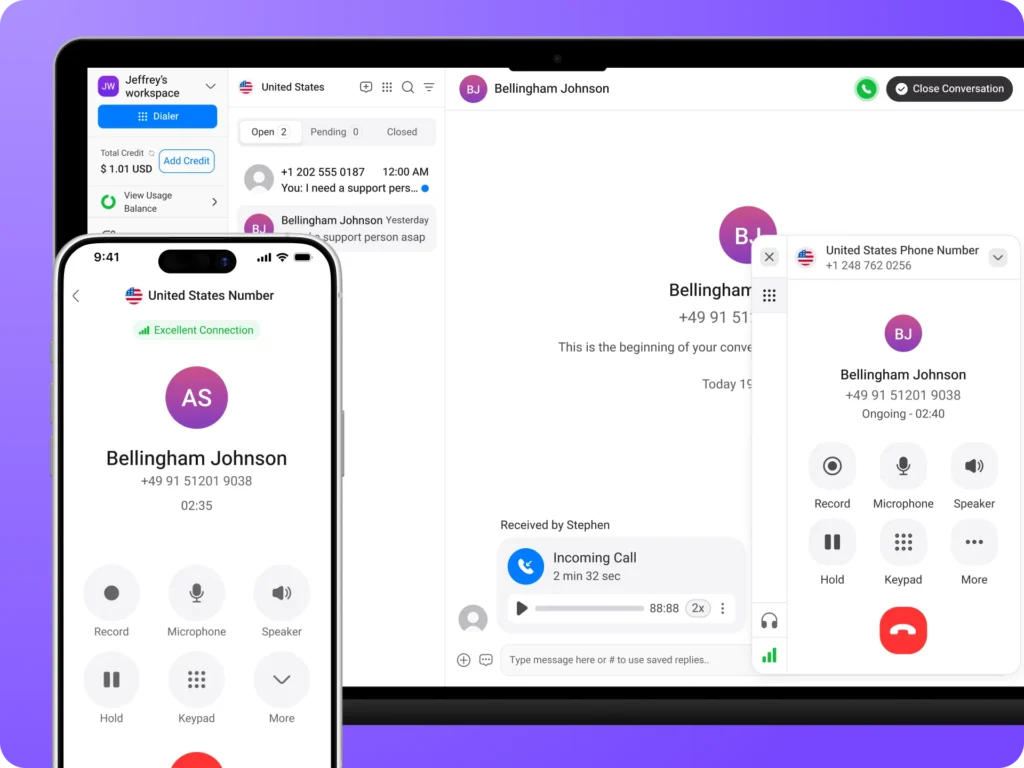
Apart from calls and texts, KrispCall also offers advanced features, such as call routing, to ensure quick problem resolution. This is vital for 24/7 customer support, enabling the handling of queries even after hours.
While KrispCall excels in voice and text, its robust CRM integrations ensure seamless connections with your existing social media management platform and other business tools.
By centralizing customer data, KrispCall helps you build a truly seamless customer experience. Get started now!