

Do you want to talk to your customers anywhere, anytime, without building infrastructure from scratch?
That’s what CPaaS lets you do.
Whether you want to connect with customers, send alerts, or run virtual meetings, CPaaS enables you to create real-time customer interactions across multiple communication channels.
In this blog, we’ll discuss CPaaS, its key features, how it works, its benefits, and its use cases. We also learn how it differs from UCaaS and CCaaS.
✨ Key Takeaways
- CPaaS is a cloud-based solution that adds communication features to your existing websites or mobile apps via APIs.
- CPaaS can integrate voice, video, SMS, IVR, and social media messaging, offering flexibility and security while reducing costs.
- CPaaS is used across industries such as finance, healthcare, retail, travel and hospitality, and education.
What is CPaaS?
CPaaS (Communications Platform as a Service) is a cloud-based solution that enables developers to integrate voice, video, messaging, and authentication features into applications through APIs and SDKs.
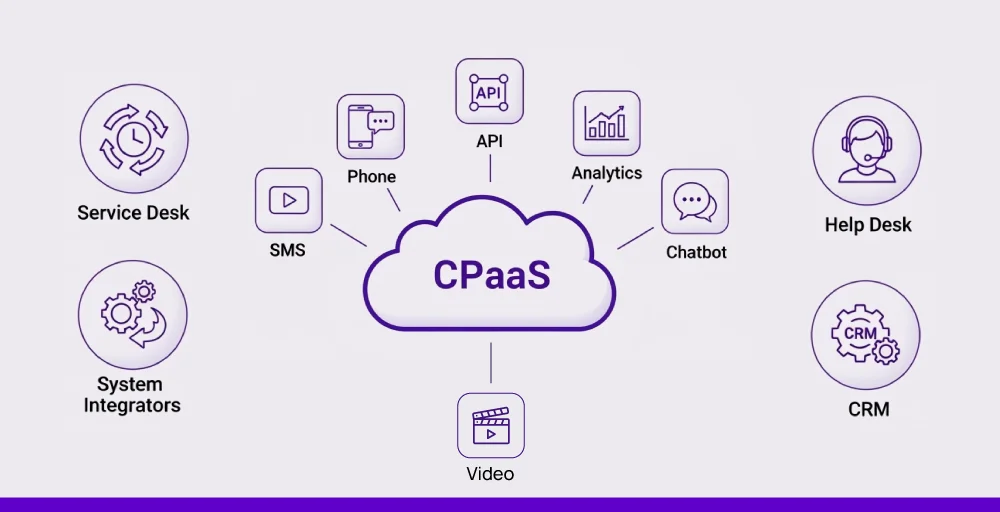
Instead of relying on traditional telecom hardware or standalone communication systems, companies can integrate these capabilities into their existing software, websites, or mobile apps with minimal infrastructure.
At its core, CPaaS provides developers with programmable building blocks. These building blocks include APIs and SDKs that allow them to embed messaging, calling, authentication (like OTP verification), and video conferencing features into digital platforms. Because the infrastructure is hosted and managed by the CPaaS provider, businesses do not need to build or maintain complex backend telecom systems.
How does CPaaS work?
CPaaS works by providing APIs that connect your existing platforms to various communication tools, allowing you to exchange messages, make calls, and more.
Many CPaaS service providers also offer additional guidelines, technical support, and even software development kits (SDKs) to build applications for desktop, web, or mobile devices.
These APIs typically utilize Voice over IP (VoIP) technology to transmit data, such as voice or text, between devices. To optimize this process and enhance system interoperability, integrating robust data transformation tools is often essential for converting communication metadata into standardized formats
For example, in a ride-sharing app, CPaaS enables riders to call you directly through the app, or you can view the driver’s location updates.
Benefits of CPaaS
CPaaS provides businesses with a flexible and scalable way to integrate voice, messaging, video, and authentication into their applications without building telecom infrastructure. It enables companies to modernize communication while keeping costs predictable and aligned with usage.
- Speed and Agility: Pre-built APIs allow rapid integration of communication features into web and mobile apps, helping businesses launch new capabilities faster.
- Cost Efficiency: With a pay-as-you-go pricing model, companies avoid upfront hardware investments and only pay for what they use.
- Scalability: CPaaS platforms scale instantly to handle traffic spikes or growth, ensuring performance without overprovisioning resources.
- Innovation: By simplifying communication integration, CPaaS enables businesses to build personalized, omnichannel customer experiences and continuously innovate.
CPaaS vs UCaaS vs CCaaS: What’s the difference?
CPaaS is a cloud-based platform that enables businesses to integrate real-time communication features into their existing operations.
In contrast, UCaaS is a cloud-based communication solution that provides tools for communication and collaboration within a single platform.
On the other hand, CCaaS is a solution that provides tools for customer service teams to manage multichannel interactions.
These three models offer a range of services and capabilities and have different roles in communication.
Here is a clear comparison table of the key differences among CPaaS, UCaaS, and CCaaS:
| Aspect | CPaaS | UCaaS | CCaaS |
| Purpose | Enable developers to embed real-time communication features into apps | Improve internal business communication and team collaboration | Manage and optimize customer service interactions |
| Primary users | Developers and product teams | Internal teams, remote workers | Customer service, sales, and support teams |
| Key functions | APIs for voice, video, messaging, and authentication | Voice, video, team messaging, conferencing. | Omnichannel customer support (voice, chat, social media, websites, email). |
| Integration | Custom app environments, CRMs, and websites | Typically integrates with productivity tools (e.g., Microsoft 365, Slack) | CRM, helpdesk, and ticketing tools. |
| Customization | Highly customizable via APIs | Limited customization; mostly pre-built features | Moderate; configurable to fit call center needs |
| Deployment | Cloud API platform | Cloud-based or hybrid communication API | Cloud-based contact center |
| Scalability | Scales with developer use cases and workloads | Scalable for growing teams | Scalable for small to enterprise contact centers |
| Popular CPaaS vendors | Twilio, Vonage API, Plivo | RingCentral, Zoom Phone, Microsoft Teams | Five9, Genesys, NICE CXone |
| Use Case Examples | Embedding SMS alerts, voice/video calls in apps | Team collaboration, remote communication | Managing inbound/outbound customer support |
Key CPaaS Functions
CPaaS platforms provide a collection of programmable APIs that allow businesses to embed voice, messaging, video, and authentication directly into their applications. Instead of relying on fixed communication systems, companies can build flexible, scalable solutions tailored to their operational needs.
Below are the essential building blocks of a modern CPaaS setup.
1. Outbound Voice Calling
Voice APIs allow businesses to integrate outgoing calls into their applications or software platforms. This enables teams to initiate calls directly from a CRM, helpdesk, or mobile app without external dialing systems.
Outbound voice functionality is especially useful for sales outreach, appointment confirmations, customer notifications, and support follow-ups. Capacity can scale instantly based on demand, making it easy to handle seasonal spikes or campaign-driven traffic.
2. Intelligent Inbound Call Routing
Inbound call routing enables businesses to manage incoming calls dynamically using programmable rules. When a call is received, predefined instructions determine how it should be handled — whether routing to a specific agent, department, IVR menu, or voicemail.
This flexibility allows companies to design customized call flows, prioritize VIP customers, distribute calls evenly among agents, and optimize response times during high-volume periods.
3. WebRTC-Based Voice and Video
WebRTC technology enables real-time voice and video communication directly within web browsers and mobile applications. With CPaaS, businesses can embed secure calling and video conferencing features without requiring users to download additional software.
This function is ideal for telehealth consultations, virtual onboarding sessions, online education, and in-app collaboration. Advanced capabilities such as recording, encryption, and conferencing can also be integrated. Since these encrypted sessions rely on valid TLS certificates, sound certificate management keeps calls secure and prevents expired credentials from interrupting service.
4. SMS and Two-Way Messaging
Messaging APIs allow businesses to send SMS notifications, alerts, reminders, and promotional updates directly from their systems. Two-way messaging functionality enables customers to reply, creating interactive communication channels.
Businesses can automate workflows, schedule campaigns, track delivery status, and manage customer engagement at scale. Messaging APIs are widely used for order confirmations, appointment reminders, and authentication codes.
5. SIP Trunking Connectivity
SIP trunking connects internet-based phone systems to the public telephone network. With on-demand SIP trunking, businesses can adjust call capacity as needed without installing physical lines.
This is particularly valuable for organizations transitioning from traditional telephony to cloud-based infrastructure while maintaining flexibility in call management.
6. Multimedia Messaging (MMS)
Beyond text messaging, CPaaS platforms often support multimedia messaging. This allows businesses to send images, videos, documents, and other file formats alongside standard SMS communication.
Multimedia messaging enhances engagement, especially in marketing campaigns, customer support interactions, and product updates where visual content adds value.
7. Social and Omnichannel Messaging
Modern CPaaS solutions extend communication to social platforms such as WhatsApp and other messaging channels. Businesses can centralize conversations across multiple platforms while maintaining consistent workflows.
This enables unified customer engagement, automated responses, multimedia sharing, and scalable support operations across various digital touchpoints.
8. Number Masking and Privacy Protection
Number masking allows two parties to communicate without revealing their personal phone numbers. The CPaaS platform acts as an intermediary, protecting both participants’ identities.
This function is widely used in ride-sharing, delivery services, online marketplaces, and customer support environments where privacy and security are critical.
Top 5 use cases of CPaaS
Here are the top 5 use cases of CPaaS:
1. Financial services
Financial services providers, such as banks, use CPaaS to integrate SMS and calls into their apps and websites. With this, banks offer instant support by sending messages and alerts about suspicious activities. CPaaS enhances security with two-factor authentication to prevent fraud during login and transactions.
For example, a bank can send a verification code to confirm a user’s identity when they access their account or make a transfer.
2. Healthcare
CPaaS is widely used in hospitals and clinics to send appointment reminders, test results, and follow-up messages through SMS, messaging apps, or emails. It helps reduce no-shows, automates follow-ups, and keeps both healthcare providers and patients up to date.
For example, a hospital sends a patient’s blood report via email.
3. Retail and e-commerce
Retailers and e-commerce businesses utilize CPaaS to send order confirmations and shipping alerts directly to customers’ phones via various business communication channels. Most CPaaS providers also support chatbots to handle customer queries.
For example, a beauty brand launches a new product and sends personalized messages to loyal customers with a special discount and a link.
4. Travel and hospitality
The travel and hospitality industry, including airlines and hotels, uses CPaaS to quickly access booking confirmations, gate changes, and service updates. They update their customer through SMS and voice directly from their website.
For example, a hotel sends a message confirming the room booking, including details such as location, time, and other rules.
5. Education and E-Learning
CPaaS enables both students and institutions to stay connected. They use CPaaS to send automated class reminders, share exam results, notify about fees, and even run virtual classes using video calling platforms.
For example, schools send a message with a Zoom link for a virtual class.
Conclusion
CPaaS is transforming the way businesses communicate with their customers. It allows for rapid integration of communication features without setup. Its flexibility, security, and cost-saving empower companies to deliver better, faster, and more personalized communication experiences.
Additionally, CPaaS is a vital tool for customer-centric businesses, enabling them to stay connected and responsive across multiple channels. With smooth and secure interactions, it strengthens customer relationships and drives growth in a digital marketplace.
Not all CPaaS providers offer the same features; evaluate them carefully before choosing the right CPaaS provider.